Pearson Edexcel · A-Level · Economics B
Course version: 9EB0 · Version from Sept 2015
The economic problem: b) Choices and potential trade-offs
Full specification wording
The economic problem: b) Choices and potential trade-offs
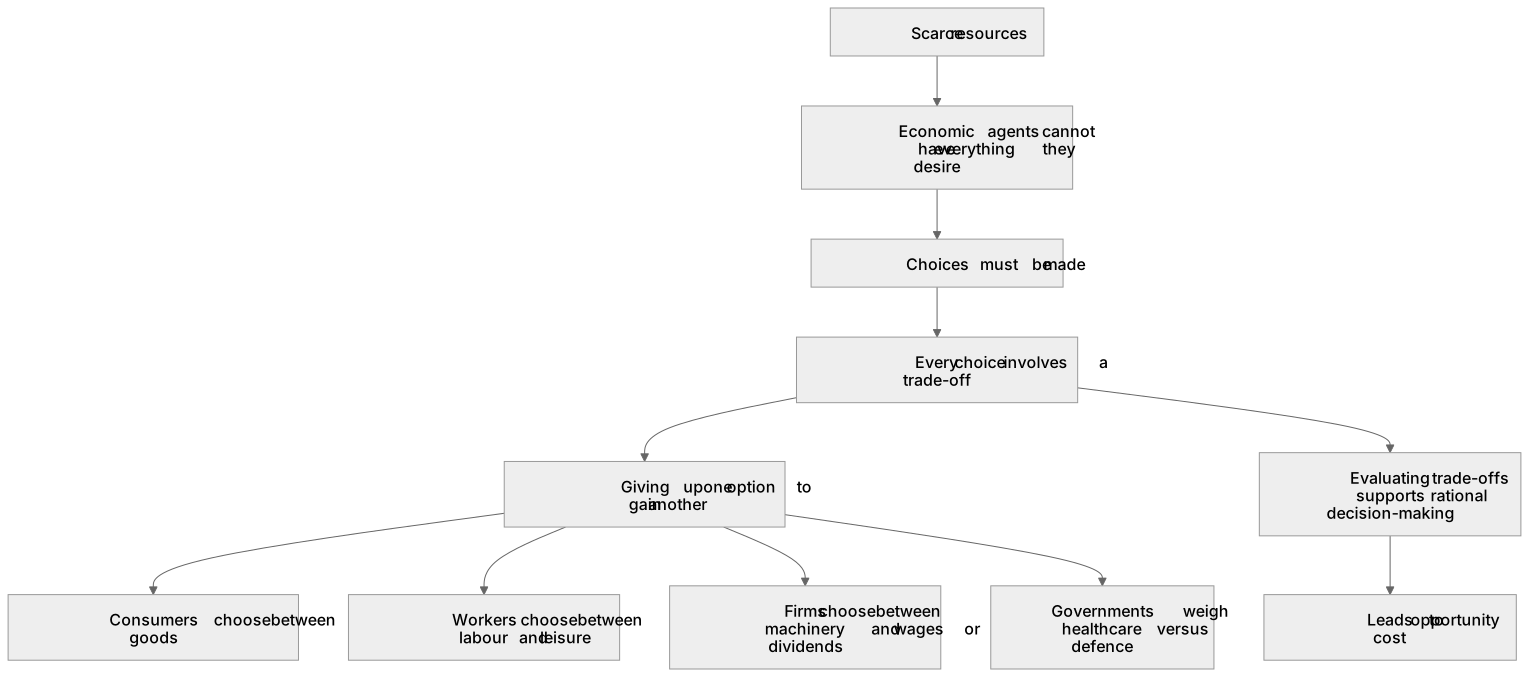
Because resources are scarce, economic agents cannot have everything they desire and must make choices.
Checked against the Pearson Edexcel 9EB0 specification (opens in a new tab) on .
- Point 2 of 3
- 3 key terms
Study notes
From the checked teaching notes for this specification point.
The idea
Because resources are scarce, economic agents cannot have everything they desire and must make choices. Every choice involves a trade-off, which is the process of giving up one option in order to gain another. For instance, if a business chooses to invest its retained profit in upgrading machinery, the trade-off is that it cannot use those same funds to increase employee wages or pay higher dividends. Trade-offs occur at all levels of the economy: consumers decide between purchasing different goods, workers choose between labour and leisure, and governments weigh up spending on healthcare versus defence. Evaluating these potential trade-offs is essential for rational decision-making and leads directly to the concept of opportunity cost.
What earns the marks
- Explain that choices are necessary because finite resources cannot satisfy unlimited wants.
- Define a trade-off as a situation where choosing one alternative requires sacrificing another.
- Provide examples of trade-offs faced by consumers, firms, or governments.
- Link the concept of making choices and trade-offs to the need for rational decision-making in resource allocation.
Common mistakes and how to put them right
Using 'trade-off' and 'opportunity cost' as exact synonyms.
Put it right: A trade-off refers to all the alternatives given up, whereas opportunity cost is specifically the value of the next best alternative forgone.
Assuming that trade-offs only apply to financial decisions.
Put it right: Trade-offs apply to the allocation of any scarce resource, including time, labour, and physical space.
Failing to identify the specific trade-off in an applied scenario.
Put it right: Explicitly state what is being gained and what is being sacrificed when analysing a choice.
Exam tips
- When evaluating a business decision, explicitly state the potential trade-offs to demonstrate analytical depth.
- Look for multiple-choice options that highlight the sacrifice of one good or service for another when identifying trade-offs.
- Use production possibility frontiers to visually illustrate trade-offs between two different goods in an economy.
Try the lesson
The start of the The economic problem: b) Choices and potential trade-offs lesson, made from checked teaching notes for this specification point.
Have a go first
In economics, what is meant by a 'trade-off' when making a choice?
Listen
Because resources are scarce, economic agents cannot have everything they desire and must make choices. Every choice involves a trade-off, which is the process of giving up one option in order to gain another. For instance, if a business chooses to invest its retained profit in upgrading machinery, the trade-off is that it cannot use those same funds to increase employee wages or pay higher dividends. Trade-offs occur at all levels of the economy: consumers decide between purchasing different goods, workers choose between labour and leisure, and governments weigh up spending on healthcare versus defence. Evaluating these potential trade-offs is essential for rational decision-making and leads directly to the concept of opportunity cost. A strong answer earns marks for these points. Explain that choices are necessary because finite resources cannot satisfy unlimited wants. Define a trade-off as a situation where choosing one alternative requires sacrificing another. Provide examples of trade-offs faced by consumers, firms, or governments. Link the concept of making choices and trade-offs to the need for rational decision-making in resource allocation. Exam tip: When evaluating a business decision, explicitly state the potential trade-offs to demonstrate analytical depth.
See it
Key words
Say what each word means before you turn the card.
Economic agents
Try answering aloud or in your head before turning the card.
Trade-off
Try answering aloud or in your head before turning the card.
Rational decision-making
Try answering aloud or in your head before turning the card.
See every definition
- Economic agents
- Those who cannot have everything they desire because resources are scarce and so must make choices.
- Trade-off
- The process of giving up one option in order to gain another.
- Rational decision-making
- Deciding by evaluating potential trade-offs, which leads directly to the concept of opportunity cost.
Label the diagram
Some boxes have lost their names. Pick the right name for each number.
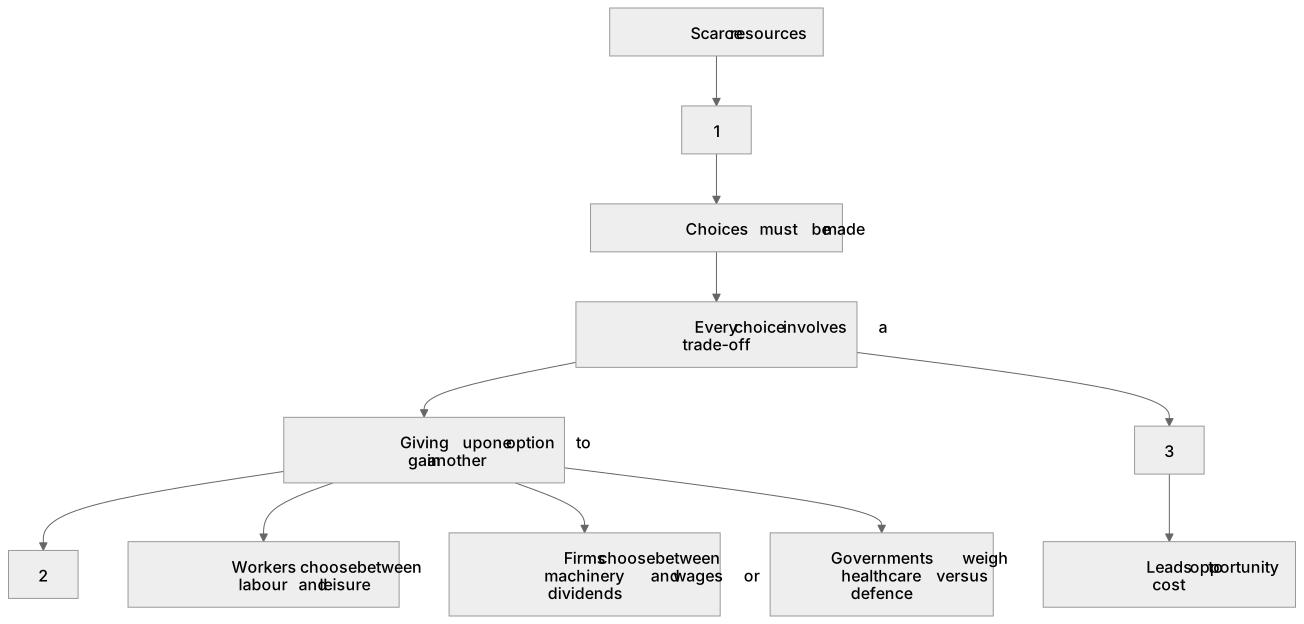
1Box 1
2Box 2
3Box 3
There is more to this lesson
The full lesson goes on to check your understanding and help you earn the marks. Create a free account to carry on, with your progress saved.
A week of Premium from your first lesson · Then the free plan continues · No card, no charge
Test your understanding of The economic problem: b) Choices and potential trade-offs
Active recall beats re-reading. Take an instant quiz now to test what you’ve learned and lock it into long-term memory.
A week of Premium from your first lesson · Then the free plan continues · No card, no charge