Pearson Edexcel · A-Level · Economics B
Course version: 9EB0 · Version from Sept 2015
C) The importance of opportunity costs to consumers, producers and…
Full specification wording
The economic problem: c) The importance of opportunity costs to consumers, producers and government
Opportunity cost is the value of the next best alternative forgone when making a choice.
Checked against the Pearson Edexcel 9EB0 specification (opens in a new tab) on .
- Point 3 of 3
- 3 key terms
Study notes
From the checked teaching notes for this specification point.
The idea
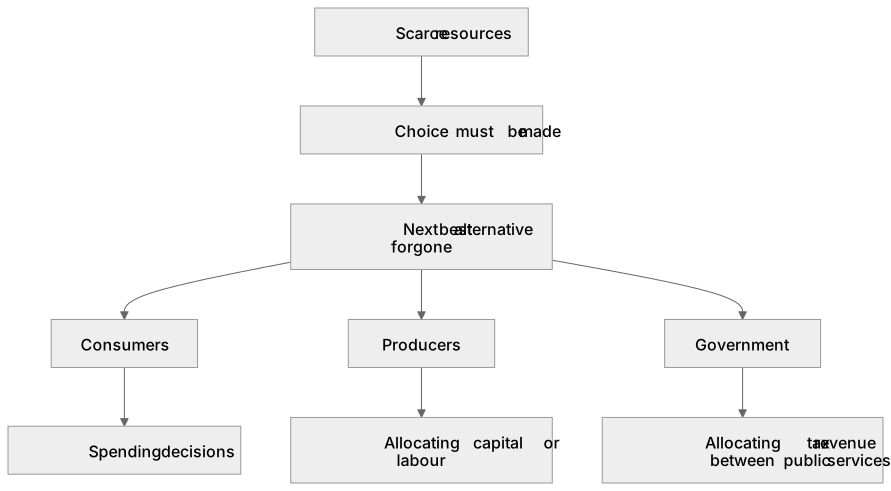
Opportunity cost is the value of the next best alternative forgone when making a choice. Since resources are scarce, all economic agents face trade-offs. For consumers, opportunity cost dictates spending; choosing to buy a smartphone might mean giving up a holiday. Producers use opportunity cost to allocate resources efficiently, such as deciding whether to invest in machinery or marketing. If they choose machinery, the lost potential revenue from marketing is the opportunity cost. Governments must also weigh opportunity costs when allocating tax revenues. For example, spending £10 billion on healthcare means that money cannot be spent on education. Understanding these trade-offs is crucial for rational decision-making across all sectors.
What earns the marks
- Definition of opportunity cost as the next best alternative forgone.
- Application to consumers, such as choosing between goods given a limited budget.
- Application to producers, such as allocating capital or labour to different projects.
- Application to government, such as allocating tax revenue between competing public services.
Common mistakes and how to put them right
Defining opportunity cost as all alternatives forgone.
Put it right: It is only the next best alternative forgone.
Confusing opportunity cost with financial cost.
Put it right: Opportunity cost includes non-financial sacrifices, such as time or utility.
Assuming governments do not face opportunity costs.
Put it right: Governments have finite tax revenues and must make trade-offs between competing public services.
Exam tips
- Always include the phrase 'next best alternative forgone' when defining opportunity cost.
- Be prepared to apply the concept of opportunity cost to a specific scenario provided in the stimulus material.
- Remember that opportunity cost applies to time as well as money, such as a consumer choosing between working and leisure.
Try the lesson
The start of the The economic problem: c) The importance of opportunity costs to consumers, producers and government lesson, made from checked teaching notes for this specification point.
Have a go first
Which of the following best describes the opportunity cost for a consumer choosing to spend their entire weekly income on a new smartphone?
Listen
Opportunity cost is the value of the next best alternative forgone when making a choice. Since resources are scarce, all economic agents face trade-offs. For consumers, opportunity cost dictates spending; choosing to buy a smartphone might mean giving up a holiday. Producers use opportunity cost to allocate resources efficiently, such as deciding whether to invest in machinery or marketing. If they choose machinery, the lost potential revenue from marketing is the opportunity cost. Governments must also weigh opportunity costs when allocating tax revenues. For example, spending £10 billion on healthcare means that money cannot be spent on education. Understanding these trade-offs is crucial for rational decision-making across all sectors. A strong answer earns marks for these points. Definition of opportunity cost as the next best alternative forgone. Application to consumers, such as choosing between goods given a limited budget. Application to producers, such as allocating capital or labour to different projects. Application to government, such as allocating tax revenue between competing public services. A common slip: Defining opportunity cost as all alternatives forgone. Instead, It is only the next best alternative forgone. Exam tip: Always include the phrase 'next best alternative forgone' when defining opportunity cost.
See it
Key words
Say what each word means before you turn the card.
Scarcity
Try answering aloud or in your head before turning the card.
Trade-offs
Try answering aloud or in your head before turning the card.
Rational decision-making
Try answering aloud or in your head before turning the card.
See every definition
- Scarcity
- The condition of limited resources which means all economic agents face trade-offs when making choices.
- Trade-offs
- The choices economic agents face because resources are scarce, weighing the value of alternatives given up.
- Rational decision-making
- Making choices across all sectors with an understanding of the trade-offs involved.
Label the diagram
Some boxes have lost their names. Pick the right name for each number.
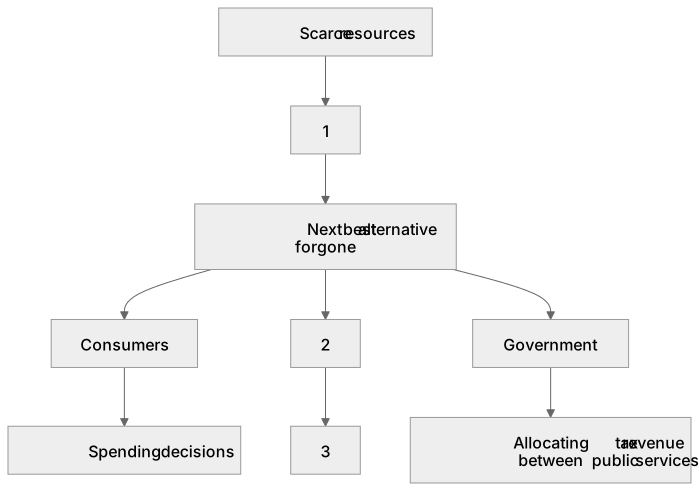
1Box 1
2Box 2
3Box 3
There is more to this lesson
The full lesson goes on to check your understanding and help you earn the marks. Create a free account to carry on, with your progress saved.
A week of Premium from your first lesson · Then the free plan continues · No card, no charge
Test your understanding of The economic problem: c) The importance of opportunity costs to consumers, producers and government
Active recall beats re-reading. Take an instant quiz now to test what you’ve learned and lock it into long-term memory.
A week of Premium from your first lesson · Then the free plan continues · No card, no charge