Pearson Edexcel · A-Level · Economics B
Course version: 9EB0 · Version from Sept 2015
A) Contributing factors: o sub-prime mortgages o moral hazard (too big to…
Full specification wording
The Global Financial Crisis: a) Contributing factors: o sub-prime mortgages o moral hazard (too big to fail) o collapse of lending to businesses o speculation and market bubbles o the role of organisational culture
The 2007-2008 Global Financial Crisis was driven by multiple interconnected factors.
Checked against the Pearson Edexcel 9EB0 specification (opens in a new tab) on .
- Point 1 of 2
- 4 key terms
Study notes
From the checked teaching notes for this specification point.
The idea
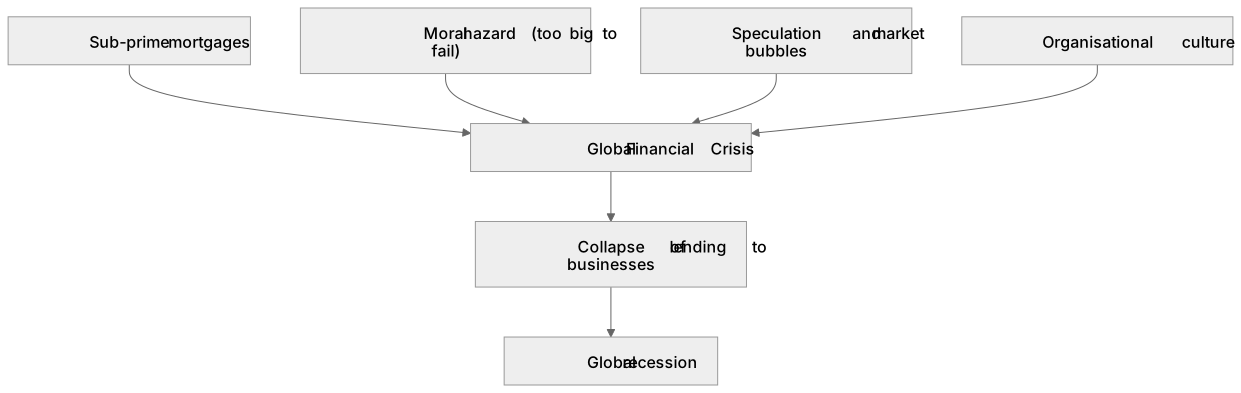
The 2007-2008 Global Financial Crisis was driven by multiple interconnected factors. Sub-prime mortgages were issued to borrowers with poor credit histories, leading to massive defaults when interest rates rose. The belief that major banks were 'too big to fail' created moral hazard, encouraging excessive risk-taking as institutions expected government bailouts. Speculation and market bubbles, particularly in housing, artificially inflated asset prices. A toxic organisational culture within banks prioritised short-term bonuses over long-term stability. Ultimately, this led to a severe credit crunch, causing a collapse of lending to businesses, which triggered a deep global recession as firms could not finance their daily operations.
What earns the marks
- Identify sub-prime mortgages as high-risk loans that triggered the crisis when borrowers defaulted.
- Explain how the 'too big to fail' perception led to moral hazard and reckless lending by financial institutions.
- Describe how speculation drove unsustainable market bubbles in housing and complex financial derivatives.
- Analyse how a flawed organisational culture incentivised short-term profit and ignored long-term systemic risks.
- Link the financial sector's distress to the real economy through the collapse of lending to businesses (the credit crunch).
Common mistakes and how to put them right
Confusing sub-prime mortgages with standard mortgages.
Put it right: Sub-prime mortgages are specifically loans given to individuals with poor credit ratings at higher interest rates.
Misunderstanding moral hazard as just 'taking risks'.
Put it right: Moral hazard specifically refers to taking excessive risks because the negative consequences will be borne by someone else (e.g., the taxpayer).
Assuming the crisis only affected banks.
Put it right: The collapse of interbank lending caused a credit crunch that severely restricted lending to non-financial businesses, causing a wider economic recession.
Exam tips
- Ensure you can define each contributing factor clearly and explain how they interacted to cause the Global Financial Crisis.
- Use the concept of moral hazard to evaluate the effectiveness of government bailouts and subsequent financial regulations.
- When discussing the impact of the crisis, explicitly connect the failure in financial markets to the collapse of business lending and the resulting fall in aggregate demand.
Try the lesson
The start of the The Global Financial Crisis: a) Contributing factors: o sub-prime mortgages o moral hazard (too big to fail) o collapse of lending to businesses o speculation and market bubbles o the role of organisational culture lesson, made from checked teaching notes for this specification point.
Have a go first
Which of the following best describes the concept of 'moral hazard' in the context of large financial institutions prior to the Global Financial Crisis?
Listen
The 2007-2008 Global Financial Crisis was driven by multiple interconnected factors. Sub-prime mortgages were issued to borrowers with poor credit histories, leading to massive defaults when interest rates rose. The belief that major banks were 'too big to fail' created moral hazard, encouraging excessive risk-taking as institutions expected government bailouts. Speculation and market bubbles, particularly in housing, artificially inflated asset prices. A toxic organisational culture within banks prioritised short-term bonuses over long-term stability. Ultimately, this led to a severe credit crunch, causing a collapse of lending to businesses, which triggered a deep global recession as firms could not finance their daily operations. A strong answer earns marks for these points. Identify sub-prime mortgages as high-risk loans that triggered the crisis when borrowers defaulted. Explain how the 'too big to fail' perception led to moral hazard and reckless lending by financial institutions. Describe how speculation drove unsustainable market bubbles in housing and complex financial derivatives. Analyse how a flawed organisational culture incentivised short-term profit and ignored long-term systemic risks. A common slip: Confusing sub-prime mortgages with standard mortgages. Instead, sub-prime mortgages are specifically loans given to individuals with poor credit ratings at higher interest rates. Exam tip: Ensure you can define each contributing factor clearly and explain how they interacted to cause the Global Financial Crisis.
See it
Key words
Say what each word means before you turn the card.
Sub-prime mortgages
Try answering aloud or in your head before turning the card.
Moral hazard
Try answering aloud or in your head before turning the card.
Speculation and market bubbles
Try answering aloud or in your head before turning the card.
Collapse of lending to businesses
Try answering aloud or in your head before turning the card.
See every definition
- Sub-prime mortgages
- Loans issued to borrowers with poor credit histories, which led to massive defaults when interest rates rose.
- Moral hazard
- Taking excessive risks because the negative consequences will be borne by someone else, encouraged by the belief that major banks were 'too big to fail' and expected government bailouts.
- Speculation and market bubbles
- Speculation artificially inflated asset prices, particularly in housing, creating unsustainable market bubbles.
- Collapse of lending to businesses
- A severe credit crunch in which firms could not finance their daily operations, triggering a deep global recession.
Label the diagram
Some boxes have lost their names. Pick the right name for each number.
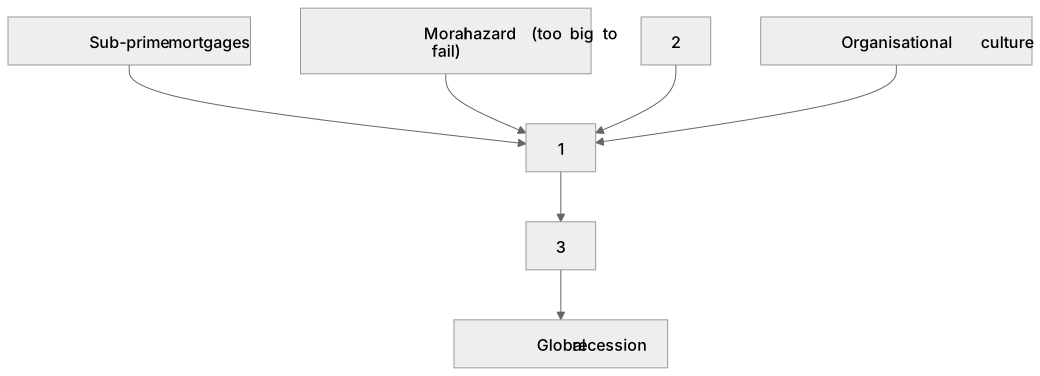
1Box 1
2Box 2
3Box 3
There is more to this lesson
The full lesson goes on to check your understanding and help you earn the marks. Create a free account to carry on, with your progress saved.
A week of Premium from your first lesson · Then the free plan continues · No card, no charge
Test your understanding of The Global Financial Crisis: a) Contributing factors: o sub-prime mortgages o moral hazard (too big to fail) o collapse of lending to businesses o speculation and market bubbles o the role of organisational culture
Active recall beats re-reading. Take an instant quiz now to test what you’ve learned and lock it into long-term memory.
A week of Premium from your first lesson · Then the free plan continues · No card, no charge