Pearson Edexcel · A-Level · Economics B
Course version: 9EB0 · Version from Sept 2015
The Global Financial Crisis: b) The role of banking regulation
Full specification wording
The Global Financial Crisis: b) The role of banking regulation
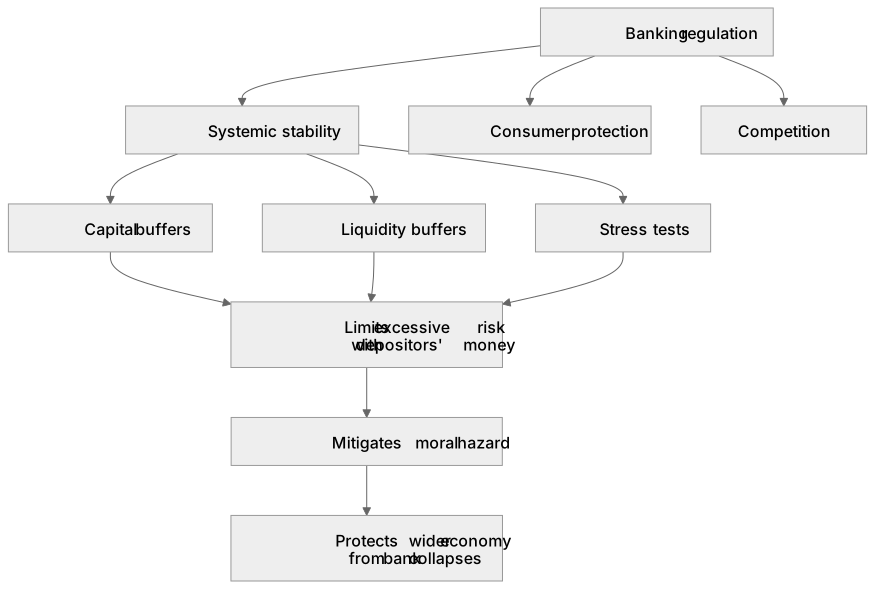
Banking regulation is essential to maintain financial system stability and prevent systemic failures, as seen during the Global Financial Crisis.
Checked against the Pearson Edexcel 9EB0 specification (opens in a new tab) on .
- Point 2 of 2
- 4 key terms
Study notes
From the checked teaching notes for this specification point.
The idea
Banking regulation is essential to maintain financial system stability and prevent systemic failures, as seen during the Global Financial Crisis. Regulators, like the UK's Prudential Regulation Authority (PRA) and Financial Conduct Authority (FCA), enforce rules ensuring banks hold sufficient capital and liquidity buffers. This prevents banks from taking excessive risks with depositors' money. For example, stress tests are conducted to check if a bank can withstand severe economic shocks. Regulation also aims to protect consumers from unfair practices and ensure competition. By limiting risky lending and enforcing transparency, regulation mitigates moral hazard and protects the wider economy from the devastating impacts of bank collapses.
What earns the marks
- Identify the main objectives of banking regulation, such as systemic stability and consumer protection.
- Recognise the role of capital and liquidity ratios in preventing bank failures.
- Understand how regulators use stress testing to assess a bank's resilience to economic shocks.
- Explain the concept of moral hazard in the context of banking and how regulation seeks to reduce it.
Common mistakes and how to put them right
Confusing the roles of different regulators.
Put it right: The PRA focuses on prudential regulation (stability) while the FCA focuses on conduct and consumer protection.
Assuming regulation completely eliminates the risk of bank failure.
Put it right: Regulation reduces the probability and impact of failure but cannot eliminate risk entirely without stifling economic growth.
Misunderstanding moral hazard; correction: moral hazard occurs when banks take excessive risks because they believe the government will bail them out, not just general risk-taking.
Exam tips
- When answering multiple-choice questions on regulation, look for the distinction between microprudential (individual bank) and macroprudential (whole system) regulation.
- Be prepared to identify the specific UK regulatory bodies (FCA, PRA, FPC) and their primary functions.
- Use the Global Financial Crisis as context for why stricter capital and liquidity requirements were introduced.
Try the lesson
The start of the The Global Financial Crisis: b) The role of banking regulation lesson, made from checked teaching notes for this specification point.
Have a go first
What is a primary objective of banking regulation in the context of preventing a recurrence of a global financial crisis?
Listen
Banking regulation is essential to maintain financial system stability and prevent systemic failures, as seen during the Global Financial Crisis. Regulators, like the UK's Prudential Regulation Authority (PRA) and Financial Conduct Authority (FCA), enforce rules ensuring banks hold sufficient capital and liquidity buffers. This prevents banks from taking excessive risks with depositors' money. For example, stress tests are conducted to check if a bank can withstand severe economic shocks. Regulation also aims to protect consumers from unfair practices and ensure competition. By limiting risky lending and enforcing transparency, regulation mitigates moral hazard and protects the wider economy from the devastating impacts of bank collapses. A strong answer earns marks for these points. Identify the main objectives of banking regulation, such as systemic stability and consumer protection. Recognise the role of capital and liquidity ratios in preventing bank failures. Understand how regulators use stress testing to assess a bank's resilience to economic shocks. Explain the concept of moral hazard in the context of banking and how regulation seeks to reduce it. A common slip: Confusing the roles of different regulators. Instead, the PRA focuses on prudential regulation (stability) while the FCA focuses on conduct and consumer protection. Exam tip: When answering multiple-choice questions on regulation, look for the distinction between microprudential (individual bank) and macroprudential (whole system) regulation.
See it
Key words
Say what each word means before you turn the card.
Financial stability
Try answering aloud or in your head before turning the card.
Consumer protection
Try answering aloud or in your head before turning the card.
Stress tests
Try answering aloud or in your head before turning the card.
Moral hazard
Try answering aloud or in your head before turning the card.
See every definition
- Financial stability
- A condition of the financial system that banking regulation is essential to maintain, preventing systemic failures such as those seen during the Global Financial Crisis.
- Consumer protection
- An aim of regulation that seeks to protect consumers from unfair practices and ensure competition.
- Stress tests
- Checks conducted to see whether a bank can withstand severe economic shocks.
- Moral hazard
- A situation in which banks take excessive risks because they believe the government will bail them out, which regulation seeks to mitigate.
Label the diagram
Some boxes have lost their names. Pick the right name for each number.
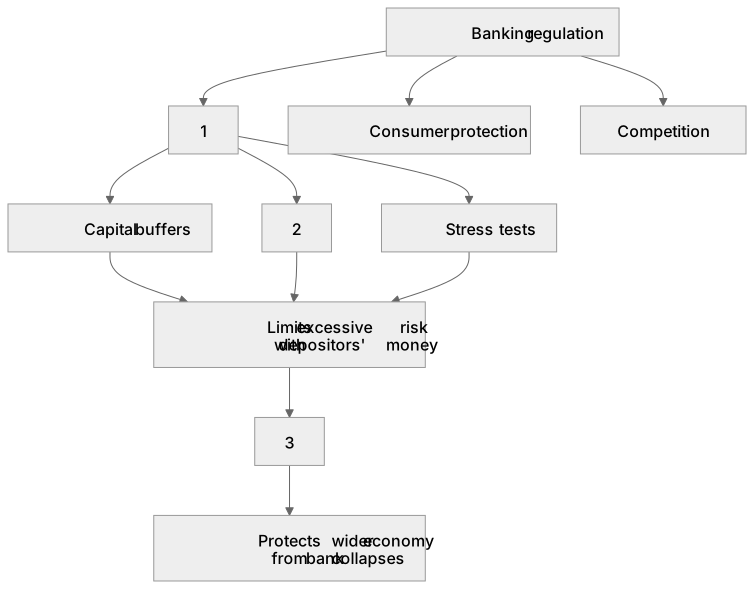
1Box 1
2Box 2
3Box 3
There is more to this lesson
The full lesson goes on to check your understanding and help you earn the marks. Create a free account to carry on, with your progress saved.
A week of Premium from your first lesson · Then the free plan continues · No card, no charge
Test your understanding of The Global Financial Crisis: b) The role of banking regulation
Active recall beats re-reading. Take an instant quiz now to test what you’ve learned and lock it into long-term memory.
A week of Premium from your first lesson · Then the free plan continues · No card, no charge