Pearson Edexcel · A-Level · Economics B
Course version: 9EB0 · Version from Sept 2015
B) Break-even point: total fixed costs + total variable costs = total…
Full specification wording
The relationship between revenue and costs: b) Break-even point: total fixed costs + total variable costs = total sales revenue
The break-even point is the exact level of output where a business neither makes a profit nor a loss.
Checked against the Pearson Edexcel 9EB0 specification (opens in a new tab) on .
- Point 2 of 5
- 3 key terms
Study notes
From the checked teaching notes for this specification point.
The idea
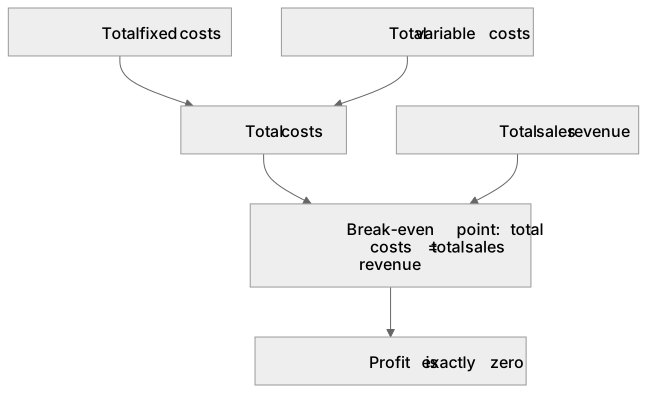
The break-even point is the exact level of output where a business neither makes a profit nor a loss. At this specific point, total sales revenue is exactly equal to total costs, which are the sum of total fixed costs and total variable costs. For example, if a business has total fixed costs of £10,000 and total variable costs of £5,000 at an output of 1,000 units, its total costs are £15,000. If the total sales revenue from selling those 1,000 units is also £15,000, the business has broken even. Understanding this equation (total fixed costs + total variable costs = total sales revenue) is crucial for businesses to set sales targets and assess the viability of new products or services.
What earns the marks
- Identify the break-even point as the level of output where total revenue equals total costs.
- Calculate total costs by adding total fixed costs and total variable costs.
- Equate total costs to total sales revenue to find the break-even point.
- Recognise that at the break-even point, profit is exactly zero.
Common mistakes and how to put them right
Confusing total variable costs with variable cost per unit.
Put it right: Multiply the variable cost per unit by the number of units to find total variable costs.
Assuming the break-even point is a financial value rather than a quantity of output.
Put it right: The break-even point is expressed as the number of units produced and sold, not a currency amount.
Forgetting to include fixed costs when calculating total costs.
Put it right: Total costs must always include both total fixed costs and total variable costs.
Exam tips
- Always state the formula 'total fixed costs + total variable costs = total sales revenue' before attempting any calculations.
- Check your final answer by substituting the break-even quantity back into the total revenue and total cost equations to ensure they are equal.
- Pay close attention to the units required in the answer, ensuring you state the number of items rather than a monetary value.
Try the lesson
The start of the The relationship between revenue and costs: b) Break-even point: total fixed costs + total variable costs = total sales revenue lesson, made from checked teaching notes for this specification point.
Have a go first
Which of the following equations correctly defines the break-even point for a business?
Listen
The break-even point is the exact level of output where a business neither makes a profit nor a loss. At this specific point, total sales revenue is exactly equal to total costs, which are the sum of total fixed costs and total variable costs. For example, if a business has total fixed costs of £10,000 and total variable costs of £5,000 at an output of 1,000 units, its total costs are £15,000. If the total sales revenue from selling those 1,000 units is also £15,000, the business has broken even. Understanding this equation (total fixed costs + total variable costs = total sales revenue) is crucial for businesses to set sales targets and assess the viability of new products or services. A strong answer earns marks for these points. Identify the break-even point as the level of output where total revenue equals total costs. Calculate total costs by adding total fixed costs and total variable costs. Equate total costs to total sales revenue to find the break-even point. Recognise that at the break-even point, profit is exactly zero. A common slip: Confusing total variable costs with variable cost per unit. Instead, multiply the variable cost per unit by the number of units to find total variable costs. Exam tip: Always state the formula 'total fixed costs + total variable costs = total sales revenue' before attempting any calculations.
See it
Key words
Say what each word means before you turn the card.
Break-even point
Try answering aloud or in your head before turning the card.
Total costs
Try answering aloud or in your head before turning the card.
Business viability
Try answering aloud or in your head before turning the card.
See every definition
- Break-even point
- The exact level of output where a business neither makes a profit nor a loss, because total sales revenue is exactly equal to total costs.
- Total costs
- The sum of total fixed costs and total variable costs.
- Business viability
- Whether a new product or service is worth pursuing, assessed by businesses using the break-even equation to set sales targets.
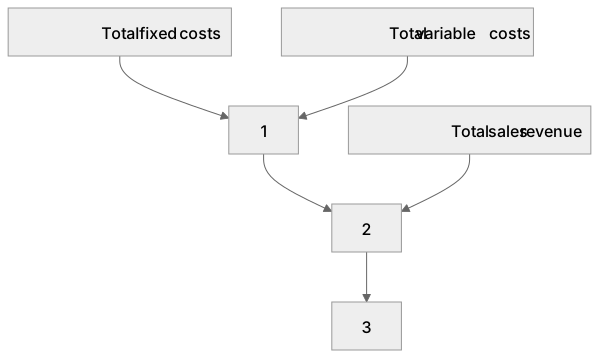
Label the diagram
Some boxes have lost their names. Pick the right name for each number.
1Box 1
2Box 2
3Box 3
There is more to this lesson
The full lesson goes on to check your understanding and help you earn the marks. Create a free account to carry on, with your progress saved.
A week of Premium from your first lesson · Then the free plan continues · No card, no charge
Test your understanding of The relationship between revenue and costs: b) Break-even point: total fixed costs + total variable costs = total sales revenue
Active recall beats re-reading. Take an instant quiz now to test what you’ve learned and lock it into long-term memory.
A week of Premium from your first lesson · Then the free plan continues · No card, no charge