Pearson Edexcel · A-Level · Economics B
Course version: 9EB0 · Version from Sept 2015
C) Using contribution to calculate the break-even point
Full specification wording
The relationship between revenue and costs: c) Using contribution to calculate the break-even point
Contribution per unit is the difference between the selling price of a product and its variable cost per unit.
Checked against the Pearson Edexcel 9EB0 specification (opens in a new tab) on .
- Point 3 of 5
- 4 key terms
Study notes
From the checked teaching notes for this specification point.
The idea
Contribution per unit is the difference between the selling price of a product and its variable cost per unit. It represents the amount each unit sold contributes towards paying off the total fixed costs of the business. Once total fixed costs are covered, any further contribution goes towards profit. To calculate the break-even point using this method, divide the total fixed costs by the contribution per unit. For example, if a product sells for £20, has a variable cost of £12 per unit, the contribution per unit is £8. If total fixed costs are £4,000, the break-even point is £4,000 divided by £8, which equals 500 units. This method provides a quick and effective way to determine required sales volumes.
What earns the marks
- Define contribution per unit as selling price minus variable cost per unit.
- State the formula for calculating the break-even point: total fixed costs divided by contribution per unit.
- Calculate the contribution per unit from given financial data.
- Apply the contribution formula to determine the exact break-even level of output.
Common mistakes and how to put them right
Calculating contribution as selling price minus total costs.
Put it right: Contribution per unit is selling price minus variable cost per unit only; fixed costs are not subtracted at this stage.
Confusing contribution per unit with total contribution.
Put it right: Total contribution is contribution per unit multiplied by the number of units sold, whereas the break-even formula uses contribution per unit.
Expressing the break-even point calculated via contribution as a monetary value.
Put it right: The result of dividing total fixed costs by contribution per unit is a quantity of units, not a currency figure.
Exam tips
- Clearly show your working for the contribution per unit calculation before applying the break-even formula.
- Remember that if the selling price or variable cost changes, the contribution per unit will change, altering the break-even point.
- Use the contribution method as a quick way to verify break-even calculations performed using the total revenue and total costs method.
Try the lesson
The start of the The relationship between revenue and costs: c) Using contribution to calculate the break-even point lesson, made from checked teaching notes for this specification point.
Have a go first
A manufacturer produces desk lamps with a selling price of £30 per unit and variable costs of £18 per unit. The business has total fixed costs of £180,000 per year. What is the break-even point in units?
Listen
Contribution per unit is the difference between the selling price of a product and its variable cost per unit. It represents the amount each unit sold contributes towards paying off the total fixed costs of the business. Once total fixed costs are covered, any further contribution goes towards profit. To calculate the break-even point using this method, divide the total fixed costs by the contribution per unit. For example, if a product sells for £20, has a variable cost of £12 per unit, the contribution per unit is £8. If total fixed costs are £4,000, the break-even point is £4,000 divided by £8, which equals 500 units. This method provides a quick and effective way to determine required sales volumes. A strong answer earns marks for these points. Define contribution per unit as selling price minus variable cost per unit. State the formula for calculating the break-even point: total fixed costs divided by contribution per unit. Calculate the contribution per unit from given financial data. Apply the contribution formula to determine the exact break-even level of output. A common slip: Calculating contribution as selling price minus total costs. Instead, Contribution per unit is selling price minus variable cost per unit only; fixed costs are not subtracted at this stage. Exam tip: Clearly show your working for the contribution per unit calculation before applying the break-even formula.
See it

Key words
Say what each word means before you turn the card.
Contribution per unit
Try answering aloud or in your head before turning the card.
Break-even point
Try answering aloud or in your head before turning the card.
Total contribution
Try answering aloud or in your head before turning the card.
Fixed costs
Try answering aloud or in your head before turning the card.
See every definition
- Contribution per unit
- The difference between the selling price of a product and its variable cost per unit.
- Break-even point
- The level of output found by dividing total fixed costs by contribution per unit.
- Total contribution
- Contribution per unit multiplied by the number of units sold.
- Fixed costs
- Costs that are covered by contribution before any further contribution goes towards profit.
Label the diagram
Some boxes have lost their names. Pick the right name for each number.
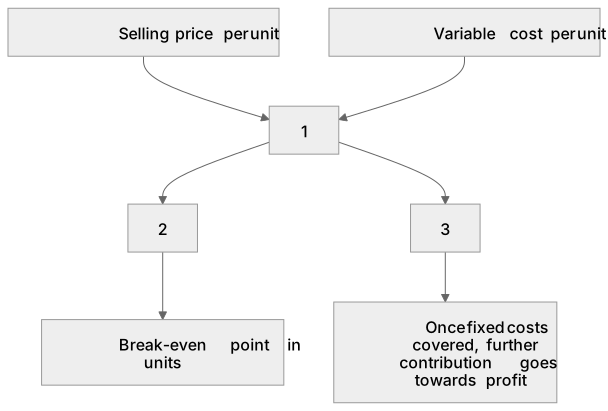
1Box 1
2Box 2
3Box 3
There is more to this lesson
The full lesson goes on to check your understanding and help you earn the marks. Create a free account to carry on, with your progress saved.
A week of Premium from your first lesson · Then the free plan continues · No card, no charge
Test your understanding of The relationship between revenue and costs: c) Using contribution to calculate the break-even point
Active recall beats re-reading. Take an instant quiz now to test what you’ve learned and lock it into long-term memory.
A week of Premium from your first lesson · Then the free plan continues · No card, no charge