Pearson Edexcel · A-Level · Economics B
Course version: 9EB0 · Version from Sept 2015
E) Limitations of break-even analysis
Full specification wording
The relationship between revenue and costs: e) Limitations of break-even analysis
Break-even analysis relies on simplifying assumptions that limit its real-world accuracy.
Checked against the Pearson Edexcel 9EB0 specification (opens in a new tab) on .
- Point 5 of 5
- 4 key terms
Study notes
From the checked teaching notes for this specification point.
The idea
Break-even analysis relies on simplifying assumptions that limit its real-world accuracy. It assumes all output is sold, ignoring unsold stock. It presumes fixed costs remain constant, which is untrue if capacity expands, leading to stepped fixed costs. Furthermore, it assumes variable costs increase linearly, ignoring economies of scale that lower average variable costs at higher outputs. The model typically assumes a constant selling price, whereas businesses often lower prices to sell higher volumes. Finally, it is a static model that struggles to account for dynamic market conditions, multi-product businesses, or changes in the external economic environment, making it less reliable for long-term strategic planning.
What earns the marks
- Identify that break-even analysis assumes all units produced are sold, which is rarely the case in reality.
- Explain that the model assumes fixed costs are constant, ignoring stepped fixed costs when capacity increases.
- Discuss how the assumption of constant variable costs ignores economies of scale and bulk purchasing discounts.
- Evaluate the limitation that break-even analysis assumes a constant selling price, ignoring the need for price reductions to stimulate demand.
- Recognise that break-even analysis is difficult to apply accurately to businesses selling multiple products with different profit margins.
Common mistakes and how to put them right
Stating that break-even analysis is useless because of its limitations.
Put it right: Acknowledge that while limited by its assumptions, it remains a useful initial planning and forecasting tool.
Confusing fixed and variable cost assumptions.
Put it right: The model assumes fixed costs are perfectly horizontal and total variable costs are perfectly linear.
Forgetting to mention the multi-product limitation.
Put it right: Explicitly state that the standard break-even model struggles when a firm sells a diverse portfolio of products.
Exam tips
- Use the limitations of break-even analysis as evaluative points when assessing the usefulness of financial forecasting tools.
- Provide concrete examples, such as a firm needing to rent a new factory to increase capacity, to illustrate why the assumptions may fail.
- Contrast the static nature of break-even charts with the dynamic reality of changing market prices and costs.
Try the lesson
The start of the The relationship between revenue and costs: e) Limitations of break-even analysis lesson, made from checked teaching notes for this specification point.
Have a go first
Which of the following is a fundamental limitation of basic break-even analysis?
Listen
Break-even analysis relies on simplifying assumptions that limit its real-world accuracy. It assumes all output is sold, ignoring unsold stock. It presumes fixed costs remain constant, which is untrue if capacity expands, leading to stepped fixed costs. Furthermore, it assumes variable costs increase linearly, ignoring economies of scale that lower average variable costs at higher outputs. The model typically assumes a constant selling price, whereas businesses often lower prices to sell higher volumes. Finally, it is a static model that struggles to account for dynamic market conditions, multi-product businesses, or changes in the external economic environment, making it less reliable for long-term strategic planning. A strong answer earns marks for these points. Identify that break-even analysis assumes all units produced are sold, which is rarely the case in reality. Explain that the model assumes fixed costs are constant, ignoring stepped fixed costs when capacity increases. Discuss how the assumption of constant variable costs ignores economies of scale and bulk purchasing discounts. Evaluate the limitation that break-even analysis assumes a constant selling price, ignoring the need for price reductions to stimulate demand. A common slip: Stating that break-even analysis is useless because of its limitations. Instead, Acknowledge that while limited by its assumptions, it remains a useful initial planning and forecasting tool. Exam tip: Use the limitations of break-even analysis as evaluative points when assessing the usefulness of financial forecasting tools.
See it

Key words
Say what each word means before you turn the card.
Break-even analysis
Try answering aloud or in your head before turning the card.
Stepped fixed costs
Try answering aloud or in your head before turning the card.
Economies of scale
Try answering aloud or in your head before turning the card.
Static model
Try answering aloud or in your head before turning the card.
See every definition
- Break-even analysis
- A model that relies on simplifying assumptions which limit its real-world accuracy, including that all output is sold and costs behave in set ways.
- Stepped fixed costs
- Costs that rise when capacity expands, meaning the assumption that fixed costs remain constant is untrue.
- Economies of scale
- A reason why variable costs do not increase linearly, as they lower average variable costs at higher outputs.
- Static model
- A model that struggles to account for dynamic market conditions, multi-product businesses or changes in the external economic environment, making it less reliable for long-term strategic planning.
Label the diagram
Some boxes have lost their names. Pick the right name for each number.
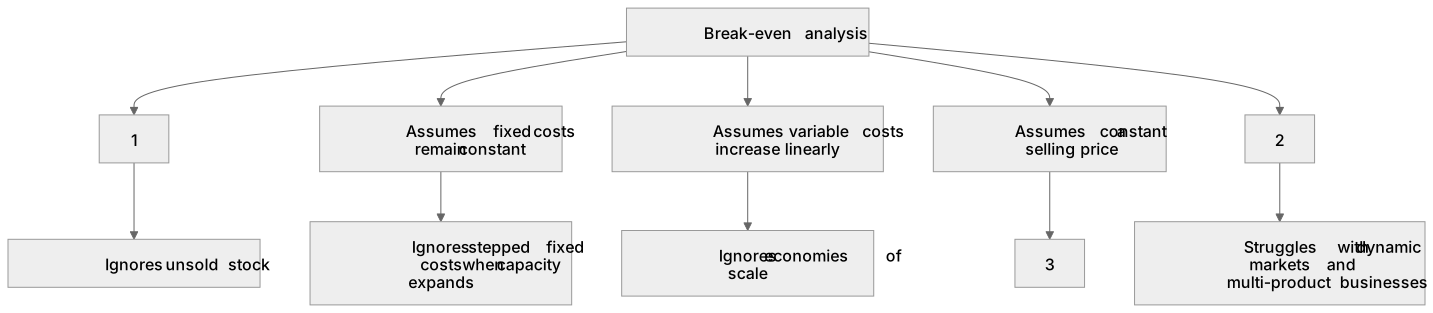
1Box 1
2Box 2
3Box 3
There is more to this lesson
The full lesson goes on to check your understanding and help you earn the marks. Create a free account to carry on, with your progress saved.
A week of Premium from your first lesson · Then the free plan continues · No card, no charge
Test your understanding of The relationship between revenue and costs: e) Limitations of break-even analysis
Active recall beats re-reading. Take an instant quiz now to test what you’ve learned and lock it into long-term memory.
A week of Premium from your first lesson · Then the free plan continues · No card, no charge