Pearson Edexcel · A-Level · Economics B
Course version: 9EB0 · Version from Sept 2015
The role of the central bank: d) Banker to the banks – lender of last resort
Full specification wording
The role of the central bank: d) Banker to the banks – lender of last resort
The central bank acts as a banker to commercial banks, holding their reserve accounts to settle interbank payments and manage daily clearing.
Checked against the Pearson Edexcel 9EB0 specification (opens in a new tab) on .
- Point 4 of 4
- 4 key terms
Study notes
From the checked teaching notes for this specification point.
The idea
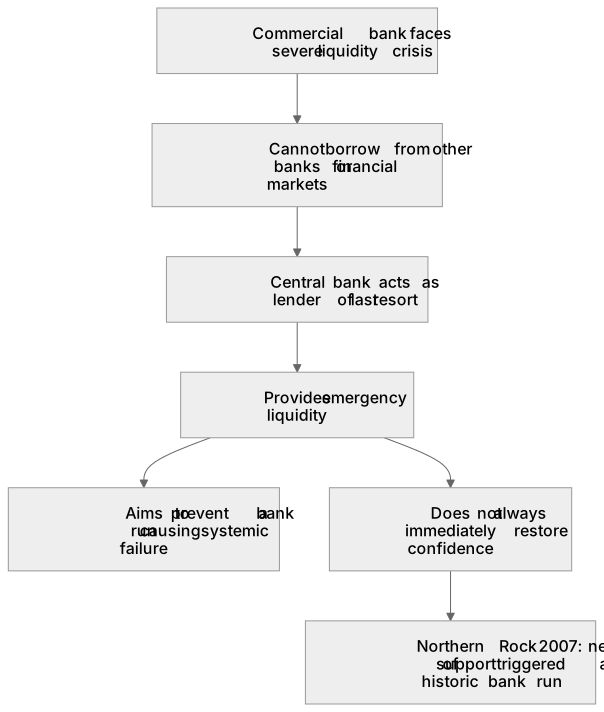
The central bank acts as a banker to commercial banks, holding their reserve accounts to settle interbank payments and manage daily clearing. Crucially, it also acts as the 'lender of last resort'. If a commercial bank faces a severe liquidity crisis and cannot borrow from other banks or financial markets, the central bank can provide emergency liquidity. This function aims to prevent a bank run from causing systemic failure across the financial sector. However, it does not always immediately restore confidence. For example, in 2007, the Bank of England provided emergency funding to Northern Rock as lender of last resort. Rather than reassuring the public, news of this support triggered a historic bank run.
What earns the marks
- Identify the central bank's role in holding reserve balances for commercial banks to facilitate interbank clearing.
- Define 'lender of last resort' as the provision of emergency liquidity to solvent but illiquid banks.
- Explain that this function aims to prevent systemic risk and bank runs by maintaining public confidence, though it can sometimes signal distress.
- Recognise that lending of last resort is typically provided at a penalty interest rate and requires collateral to mitigate moral hazard.
Common mistakes and how to put them right
Confusing 'lender of last resort' with bailing out insolvent banks.
Put it right: The central bank provides liquidity to illiquid but solvent banks, whereas insolvency is usually handled by the government.
Assuming the central bank lends to consumers.
Put it right: The central bank acts as a banker to commercial banks and the government, not to the general public.
Believing that lender of last resort funding is cheap.
Put it right: It is usually offered at a penalty rate to discourage banks from taking excessive risks (moral hazard).
Exam tips
- When evaluating the lender of last resort function, always link it to the concept of systemic risk and the prevention of financial contagion.
- Use the example of Northern Rock to illustrate that while the lender of last resort function aims to maintain confidence, its announcement can sometimes trigger a bank run.
- Be prepared to discuss the trade-off between providing emergency liquidity and creating moral hazard among commercial banks.
Try the lesson
The start of the The role of the central bank: d) Banker to the banks – lender of last resort lesson, made from checked teaching notes for this specification point.
Have a go first
In its role as 'lender of last resort', what specific function does the Bank of England perform for the banking system?
Listen
The central bank acts as a banker to commercial banks, holding their reserve accounts to settle interbank payments and manage daily clearing. Crucially, it also acts as the 'lender of last resort'. If a commercial bank faces a severe liquidity crisis and cannot borrow from other banks or financial markets, the central bank can provide emergency liquidity. This function aims to prevent a bank run from causing systemic failure across the financial sector. However, it does not always immediately restore confidence. For example, in 2007, the Bank of England provided emergency funding to Northern Rock as lender of last resort. Rather than reassuring the public, news of this support triggered a historic bank run. A strong answer earns marks for these points. Identify the central bank's role in holding reserve balances for commercial banks to facilitate interbank clearing. Define 'lender of last resort' as the provision of emergency liquidity to solvent but illiquid banks. Explain that this function aims to prevent systemic risk and bank runs by maintaining public confidence, though it can sometimes signal distress. Recognise that lending of last resort is typically provided at a penalty interest rate and requires collateral to mitigate moral hazard. Exam tip: When evaluating the lender of last resort function, always link it to the concept of systemic risk and the prevention of financial contagion.
See it
Key words
Say what each word means before you turn the card.
Central banking
Try answering aloud or in your head before turning the card.
Liquidity and solvency
Try answering aloud or in your head before turning the card.
Systemic risk
Try answering aloud or in your head before turning the card.
Moral hazard
Try answering aloud or in your head before turning the card.
See every definition
- Central banking
- Acting as a banker to commercial banks by holding their reserve accounts to settle interbank payments and manage daily clearing.
- Liquidity and solvency
- Emergency liquidity is provided to banks that are illiquid but solvent, whereas insolvency is usually handled by the government.
- Systemic risk
- The risk of failure spreading across the financial sector, which the lender of last resort function aims to prevent by stopping a bank run from causing systemic failure.
- Moral hazard
- Excessive risk-taking by banks that lending of last resort can encourage, mitigated by providing funding at a penalty interest rate and requiring collateral.
Label the diagram
Some boxes have lost their names. Pick the right name for each number.
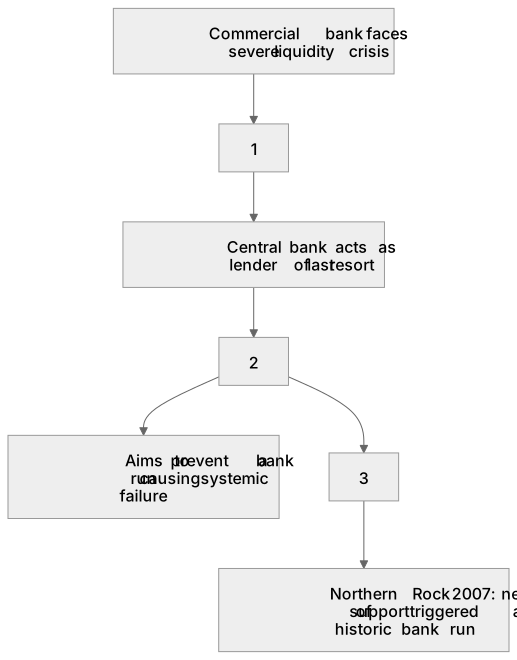
1Box 1
2Box 2
3Box 3
There is more to this lesson
The full lesson goes on to check your understanding and help you earn the marks. Create a free account to carry on, with your progress saved.
A week of Premium from your first lesson · Then the free plan continues · No card, no charge
Test your understanding of The role of the central bank: d) Banker to the banks – lender of last resort
Active recall beats re-reading. Take an instant quiz now to test what you’ve learned and lock it into long-term memory.
A week of Premium from your first lesson · Then the free plan continues · No card, no charge