Pearson Edexcel · A-Level · Economics B
Course version: 9EB0 · Version from Sept 2015
A) To mobilise savings for lending to firms and individuals
Full specification wording
The role of the financial sector: a) To mobilise savings for lending to firms and individuals
The financial sector acts as a vital intermediary between savers and borrowers.
Checked against the Pearson Edexcel 9EB0 specification (opens in a new tab) on .
- Point 1 of 7
- 4 key terms
Study notes
From the checked teaching notes for this specification point.
The idea
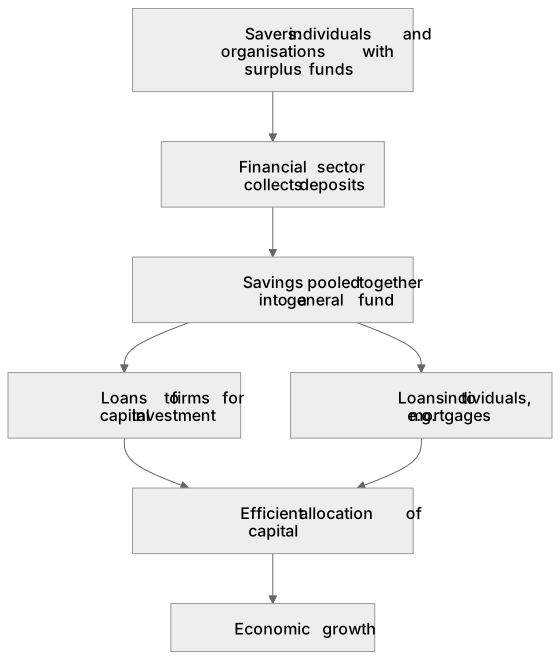
The financial sector acts as a vital intermediary between savers and borrowers. It mobilises savings by collecting deposits from individuals and organisations with surplus funds. These pooled resources are then transformed into loans for firms and individuals needing capital for investment or consumption. For example, a commercial bank aggregates the small savings of thousands of retail customers to provide a mortgage to an individual or an expansion loan to a manufacturing firm. This process of financial intermediation ensures that idle funds are allocated efficiently to productive uses, driving economic growth and enabling both personal and corporate financial goals to be met without savers and borrowers needing to find each other directly.
What earns the marks
- Identifies the financial sector's role as an intermediary between savers and borrowers.
- Explains that mobilising savings involves pooling small deposits from many individuals and organisations.
- Describes how pooled savings are converted into loans for firms (e.g., for capital investment) and individuals (e.g., for mortgages).
- Recognises that this process allocates capital efficiently, supporting broader economic growth.
Common mistakes and how to put them right
Believing banks lend out the exact same money a specific saver deposits.
Put it right: Banks pool all deposits together to create a general fund from which loans are made, rather than matching individual savers to specific borrowers.
Assuming only individuals save and only firms borrow.
Put it right: Both individuals and firms can be savers (depositing surplus cash) and borrowers (taking out loans or mortgages).
Confusing mobilising savings with creating money.
Put it right: Mobilising savings refers to the intermediation process of transferring existing funds from surplus units to deficit units, whereas money creation involves the fractional reserve banking system.
Exam tips
- When defining financial intermediation, explicitly mention both the collection of savings and the provision of loans.
- Use concrete examples, such as retail banks providing mortgages, to illustrate lending to individuals.
- Link the mobilisation of savings to broader macroeconomic objectives, such as increased investment and economic growth.
Try the lesson
The start of the The role of the financial sector: a) To mobilise savings for lending to firms and individuals lesson, made from checked teaching notes for this specification point.
Have a go first
What is meant by the financial sector's role in 'mobilising savings'?
Listen
The financial sector acts as a vital intermediary between savers and borrowers. It mobilises savings by collecting deposits from individuals and organisations with surplus funds. These pooled resources are then transformed into loans for firms and individuals needing capital for investment or consumption. For example, a commercial bank aggregates the small savings of thousands of retail customers to provide a mortgage to an individual or an expansion loan to a manufacturing firm. This process of financial intermediation ensures that idle funds are allocated efficiently to productive uses, driving economic growth and enabling both personal and corporate financial goals to be met without savers and borrowers needing to find each other directly. A strong answer earns marks for these points. Identifies the financial sector's role as an intermediary between savers and borrowers. Explains that mobilising savings involves pooling small deposits from many individuals and organisations. Describes how pooled savings are converted into loans for firms (e.g., for capital investment) and individuals (e.g., for mortgages). Recognises that this process allocates capital efficiently, supporting broader economic growth. A common slip: Believing banks lend out the exact same money a specific saver deposits. Instead, Banks pool all deposits together to create a general fund from which loans are made, rather than matching individual savers to specific borrowers. Exam tip: When defining financial intermediation, explicitly mention both the collection of savings and the provision of loans.
See it
Key words
Say what each word means before you turn the card.
Financial intermediation
Try answering aloud or in your head before turning the card.
Capital allocation
Try answering aloud or in your head before turning the card.
Economic growth
Try answering aloud or in your head before turning the card.
Saving and borrowing
Try answering aloud or in your head before turning the card.
See every definition
- Financial intermediation
- The process by which the financial sector collects savings and provides loans, ensuring idle funds are allocated efficiently to productive uses.
- Capital allocation
- Directing pooled resources to productive uses, such as loans for investment or consumption, so that idle funds are used efficiently.
- Economic growth
- The broader outcome driven by the efficient allocation of idle funds to productive uses through financial intermediation.
- Saving and borrowing
- The relationship between individuals and organisations with surplus funds and firms and individuals needing capital, linked by the financial sector as intermediary.
Label the diagram
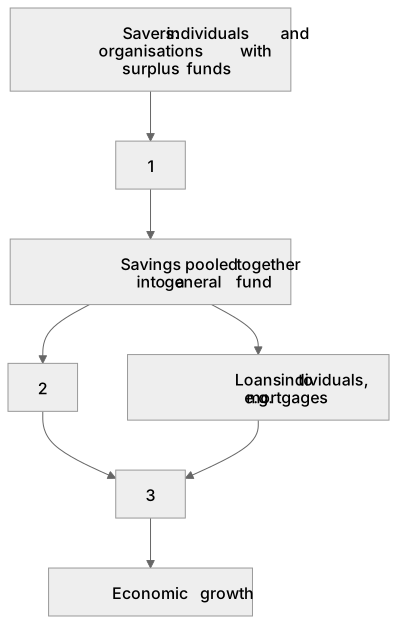
Some boxes have lost their names. Pick the right name for each number.
1Box 1
2Box 2
3Box 3
There is more to this lesson
The full lesson goes on to check your understanding and help you earn the marks. Create a free account to carry on, with your progress saved.
A week of Premium from your first lesson · Then the free plan continues · No card, no charge
Test your understanding of The role of the financial sector: a) To mobilise savings for lending to firms and individuals
Active recall beats re-reading. Take an instant quiz now to test what you’ve learned and lock it into long-term memory.
A week of Premium from your first lesson · Then the free plan continues · No card, no charge