Pearson Edexcel · A-Level · Economics B
Course version: 9EB0 · Version from Sept 2015
B) To lend to business for investment in working capital
Full specification wording
The role of the financial sector: b) To lend to business for investment in working capital
A key function of the financial sector is providing short-term finance to businesses to fund working capital requirements.
Checked against the Pearson Edexcel 9EB0 specification (opens in a new tab) on .
- Point 2 of 7
- 2 key terms
Study notes
From the checked teaching notes for this specification point.
The idea
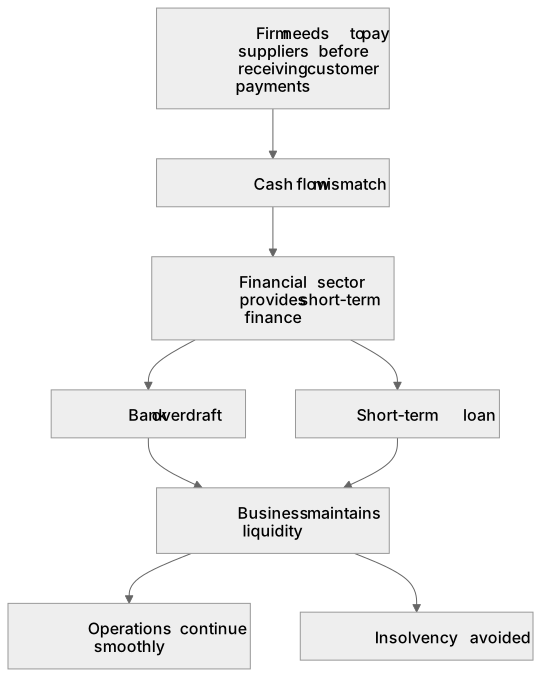
A key function of the financial sector is providing short-term finance to businesses to fund working capital requirements. Working capital, calculated as current assets minus current liabilities, covers day-to-day operational expenses. Firms often face cash flow mismatches, needing to pay suppliers before receiving customer payments. Financial institutions bridge this gap by offering facilities like overdrafts or short-term loans. For instance, a retailer might use a bank overdraft to purchase seasonal inventory, repaying the funds once the goods are sold. This lending ensures businesses maintain liquidity, continue operations smoothly, and avoid insolvency due to temporary cash shortages, thereby supporting overall economic stability.
What earns the marks
- Defines working capital as the funds required for day-to-day business operations, calculated as current assets minus current liabilities.
- Identifies the role of the financial sector in providing short-term liquidity to cover cash flow mismatches.
- Gives examples of working capital financing, such as bank overdrafts or short-term loans.
- Explains that lending for working capital prevents business insolvency and ensures smooth operational continuity.
Common mistakes and how to put them right
Confusing working capital with fixed capital investment.
Put it right: Working capital is for day-to-day expenses (like inventory or wages), whereas fixed capital is for long-term assets (like machinery or buildings).
Assuming working capital loans are always long-term.
Put it right: Working capital financing is typically short-term, designed to bridge temporary cash flow gaps until revenue is received.
Believing profitable firms do not need working capital loans.
Put it right: Even highly profitable firms can face liquidity crises if their cash inflows and outflows are poorly synchronised, necessitating short-term borrowing.
Exam tips
- Clearly distinguish between lending for working capital (short-term) and lending for fixed capital expansion (long-term).
- Use the formula 'current assets minus current liabilities' to demonstrate a precise understanding of working capital.
- In multiple-choice questions, look for scenarios involving inventory purchases or wage payments as indicators of working capital needs.
Try the lesson
The start of the The role of the financial sector: b) To lend to business for investment in working capital lesson, made from checked teaching notes for this specification point.
Have a go first
Which of the following best describes a financial institution lending to a business for investment in working capital?
Listen
A key function of the financial sector is providing short-term finance to businesses to fund working capital requirements. Working capital, calculated as current assets minus current liabilities, covers day-to-day operational expenses. Firms often face cash flow mismatches, needing to pay suppliers before receiving customer payments. Financial institutions bridge this gap by offering facilities like overdrafts or short-term loans. For instance, a retailer might use a bank overdraft to purchase seasonal inventory, repaying the funds once the goods are sold. This lending ensures businesses maintain liquidity, continue operations smoothly, and avoid insolvency due to temporary cash shortages, thereby supporting overall economic stability. A strong answer earns marks for these points. Defines working capital as the funds required for day-to-day business operations, calculated as current assets minus current liabilities. Identifies the role of the financial sector in providing short-term liquidity to cover cash flow mismatches. Gives examples of working capital financing, such as bank overdrafts or short-term loans. Explains that lending for working capital prevents business insolvency and ensures smooth operational continuity. A common slip: Confusing working capital with fixed capital investment. Instead, Working capital is for day-to-day expenses (like inventory or wages), whereas fixed capital is for long-term assets (like machinery or buildings). Exam tip: Clearly distinguish between lending for working capital (short-term) and lending for fixed capital expansion (long-term).
See it
Key words
Say what each word means before you turn the card.
Working capital
Try answering aloud or in your head before turning the card.
Short-term financing
Try answering aloud or in your head before turning the card.
See every definition
- Working capital
- The funds required for day-to-day business operations, calculated as current assets minus current liabilities.
- Short-term financing
- Finance provided to businesses to fund working capital requirements, such as overdrafts or short-term loans.
Label the diagram
Some boxes have lost their names. Pick the right name for each number.
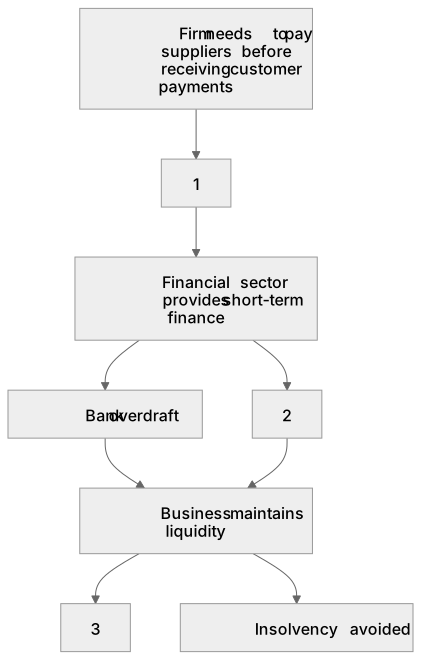
1Box 1
2Box 2
3Box 3
There is more to this lesson
The full lesson goes on to check your understanding and help you earn the marks. Create a free account to carry on, with your progress saved.
A week of Premium from your first lesson · Then the free plan continues · No card, no charge
Test your understanding of The role of the financial sector: b) To lend to business for investment in working capital
Active recall beats re-reading. Take an instant quiz now to test what you’ve learned and lock it into long-term memory.
A week of Premium from your first lesson · Then the free plan continues · No card, no charge