Pearson Edexcel · A-Level · Economics B
Course version: 9EB0 · Version from Sept 2015
D) To facilitate the exchange of goods and services
Full specification wording
The role of the financial sector: d) To facilitate the exchange of goods and services
A fundamental role of the financial sector is to facilitate the exchange of goods and services by providing efficient payment systems.
Checked against the Pearson Edexcel 9EB0 specification (opens in a new tab) on .
- Point 4 of 7
- 4 key terms
Study notes
From the checked teaching notes for this specification point.
The idea
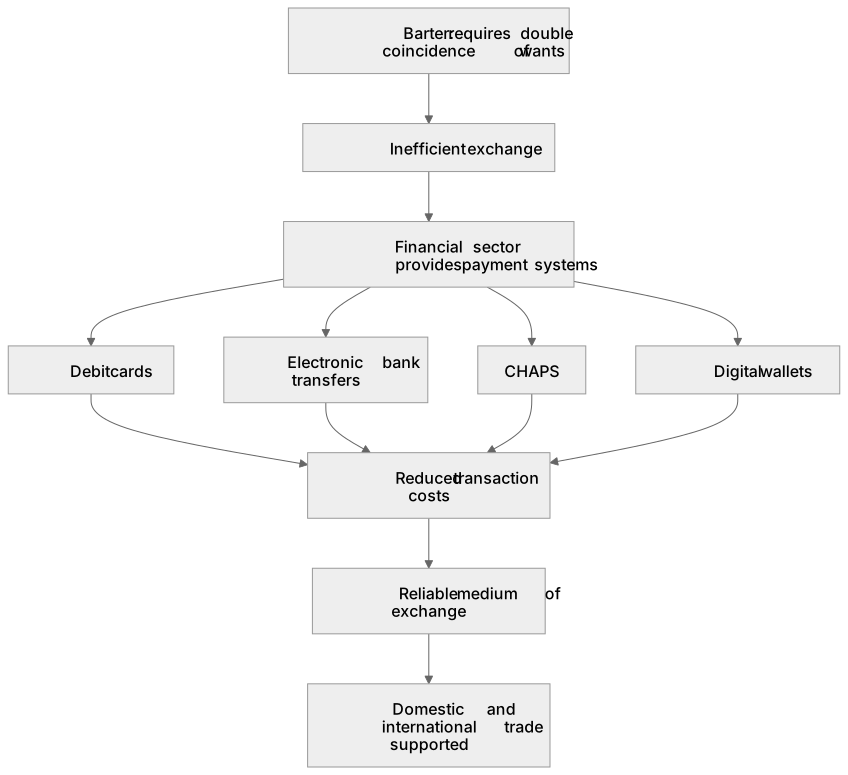
A fundamental role of the financial sector is to facilitate the exchange of goods and services by providing efficient payment systems. Without these systems, economies would rely on barter, which requires a double coincidence of wants and is highly inefficient. Financial institutions offer mechanisms such as debit cards, electronic bank transfers, clearing house automated payment systems (CHAPS), and digital wallets, which allow transactions to occur swiftly and securely. By reducing transaction costs and providing a reliable medium of exchange, the financial sector underpins domestic and international trade, ensuring that markets function smoothly and economic activity can expand.
What earns the marks
- Identify the financial sector's role in providing a medium of exchange to overcome the inefficiencies of a barter system.
- Recognise various payment mechanisms facilitated by the financial sector, such as electronic transfers, debit cards, and digital wallets.
- Explain how efficient payment systems reduce transaction costs for consumers and businesses.
- Understand the importance of secure and rapid transaction clearing in supporting domestic and international trade.
Common mistakes and how to put them right
Assuming the financial sector only facilitates exchange through physical cash.
Put it right: Recognise that the vast majority of modern transactions are facilitated through electronic payment systems and digital transfers.
Confusing the facilitation of exchange with the provision of credit.
Put it right: Facilitating exchange refers to the mechanics of payment, such as clearing a cheque or processing a card payment, whereas credit involves lending money.
Overlooking the role of the financial sector in international trade.
Put it right: Financial institutions facilitate cross-border exchanges through foreign exchange services and letters of credit.
Exam tips
- Use examples like contactless payments or BACS transfers to illustrate how the financial sector reduces the time and cost of transactions.
- Link the efficiency of payment systems to the overall productivity and growth of an economy.
- Consider how technological advancements, such as blockchain or mobile banking, are evolving the way financial institutions facilitate exchange.
Try the lesson
The start of the The role of the financial sector: d) To facilitate the exchange of goods and services lesson, made from checked teaching notes for this specification point.
Have a go first
Which of the following best describes how the financial sector fulfils its primary role of facilitating the exchange of goods and services in the economy?
Listen
A fundamental role of the financial sector is to facilitate the exchange of goods and services by providing efficient payment systems. Without these systems, economies would rely on barter, which requires a double coincidence of wants and is highly inefficient. Financial institutions offer mechanisms such as debit cards, electronic bank transfers, clearing house automated payment systems (CHAPS), and digital wallets, which allow transactions to occur swiftly and securely. By reducing transaction costs and providing a reliable medium of exchange, the financial sector underpins domestic and international trade, ensuring that markets function smoothly and economic activity can expand. A strong answer earns marks for these points. Identify the financial sector's role in providing a medium of exchange to overcome the inefficiencies of a barter system. Recognise various payment mechanisms facilitated by the financial sector, such as electronic transfers, debit cards, and digital wallets. Explain how efficient payment systems reduce transaction costs for consumers and businesses. Understand the importance of secure and rapid transaction clearing in supporting domestic and international trade. A common slip: Assuming the financial sector only facilitates exchange through physical cash. Instead, Recognise that the vast majority of modern transactions are facilitated through electronic payment systems and digital transfers. Exam tip: Use examples like contactless payments or BACS transfers to illustrate how the financial sector reduces the time and cost of transactions.
See it
Key words
Say what each word means before you turn the card.
Medium of exchange
Try answering aloud or in your head before turning the card.
Payment systems
Try answering aloud or in your head before turning the card.
Transaction costs
Try answering aloud or in your head before turning the card.
Trade facilitation
Try answering aloud or in your head before turning the card.
See every definition
- Medium of exchange
- Something the financial sector provides to overcome the inefficiencies of a barter system, which requires a double coincidence of wants.
- Payment systems
- Efficient mechanisms such as debit cards, electronic bank transfers, clearing house automated payment systems (CHAPS) and digital wallets that allow transactions to occur swiftly and securely.
- Transaction costs
- Costs that efficient payment systems reduce for consumers and businesses.
- Trade facilitation
- Supporting domestic and international trade by reducing transaction costs and providing a reliable medium of exchange, ensuring markets function smoothly.
Label the diagram
Some boxes have lost their names. Pick the right name for each number.
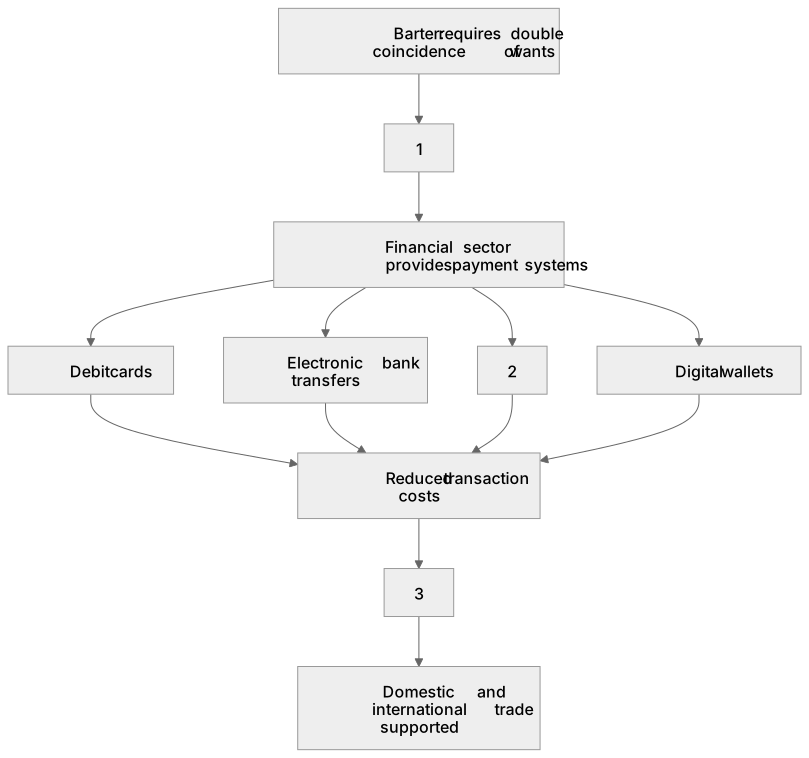
1Box 1
2Box 2
3Box 3
There is more to this lesson
The full lesson goes on to check your understanding and help you earn the marks. Create a free account to carry on, with your progress saved.
A week of Premium from your first lesson · Then the free plan continues · No card, no charge
Test your understanding of The role of the financial sector: d) To facilitate the exchange of goods and services
Active recall beats re-reading. Take an instant quiz now to test what you’ve learned and lock it into long-term memory.
A week of Premium from your first lesson · Then the free plan continues · No card, no charge