Pearson Edexcel · A-Level · Economics B
Course version: 9EB0 · Version from Sept 2015
The role of the financial sector: e) To assess creditor risk
Full specification wording
The role of the financial sector: e) To assess creditor risk
The financial sector plays a crucial role in assessing creditor risk, universally known as credit risk or default risk.
Checked against the Pearson Edexcel 9EB0 specification (opens in a new tab) on .
- Point 5 of 7
- 4 key terms
Study notes
From the checked teaching notes for this specification point.
The idea
The financial sector plays a crucial role in assessing creditor risk, universally known as credit risk or default risk. This is the likelihood that a borrower will fail to meet debt obligations. Financial institutions, such as commercial banks and credit rating agencies, evaluate the creditworthiness of individuals, businesses, and governments. They analyse financial history and existing debt levels to determine the probability of default. For example, a bank assesses a business's cash flow and collateral before approving a loan, adjusting the interest rate to reflect the risk. By accurately assessing this risk, the financial sector ensures capital is allocated efficiently, protecting depositors and maintaining systemic stability.
What earns the marks
- Define credit risk (creditor risk) as the probability that a borrower will fail to repay their debt obligations.
- Explain the role of credit rating agencies in evaluating the default risk of corporate and government bonds.
- Describe how banks use credit scoring models and financial analysis to assess the risk of individual and corporate borrowers.
- Analyse the relationship between assessed credit risk and the interest rate charged, often referred to as the risk premium.
- Evaluate the importance of assessing credit risk in preventing systemic financial crises and protecting depositors' funds.
Common mistakes and how to put them right
Confusing credit risk with market risk.
Put it right: Credit risk specifically relates to the default of a borrower, whereas market risk relates to losses from changes in market prices.
Assuming only banks assess credit risk.
Put it right: Credit rating agencies, investment firms, and individual bondholders also actively assess the risk of default.
Believing higher credit risk always prevents lending.
Put it right: Higher risk often results in lending at a higher interest rate to compensate for the increased probability of default, rather than an outright refusal.
Exam tips
- When discussing interest rates, explicitly link the rate charged to the level of credit risk assessed by the financial institution.
- Use the 2008 financial crisis as an example of the systemic consequences when the financial sector fails to accurately assess credit risk in mortgage lending.
- Remember that credit rating agencies assign grades to help investors assess the default risk of bonds, which directly impacts the cost of borrowing for firms and governments.
Try the lesson
The start of the The role of the financial sector: e) To assess creditor risk lesson, made from checked teaching notes for this specification point.
Have a go first
Within the role of the financial sector, what is the primary purpose of assessing creditor risk?
Listen
The financial sector plays a crucial role in assessing creditor risk, universally known as credit risk or default risk. This is the likelihood that a borrower will fail to meet debt obligations. Financial institutions, such as commercial banks and credit rating agencies, evaluate the creditworthiness of individuals, businesses, and governments. They analyse financial history and existing debt levels to determine the probability of default. For example, a bank assesses a business's cash flow and collateral before approving a loan, adjusting the interest rate to reflect the risk. By accurately assessing this risk, the financial sector ensures capital is allocated efficiently, protecting depositors and maintaining systemic stability. A strong answer earns marks for these points. Define credit risk (creditor risk) as the probability that a borrower will fail to repay their debt obligations. Explain the role of credit rating agencies in evaluating the default risk of corporate and government bonds. Describe how banks use credit scoring models and financial analysis to assess the risk of individual and corporate borrowers. Analyse the relationship between assessed credit risk and the interest rate charged, often referred to as the risk premium. A common slip: Confusing credit risk with market risk. Instead, credit risk specifically relates to the default of a borrower, whereas market risk relates to losses from changes in market prices. Exam tip: When discussing interest rates, explicitly link the rate charged to the level of credit risk assessed by the financial institution.
See it
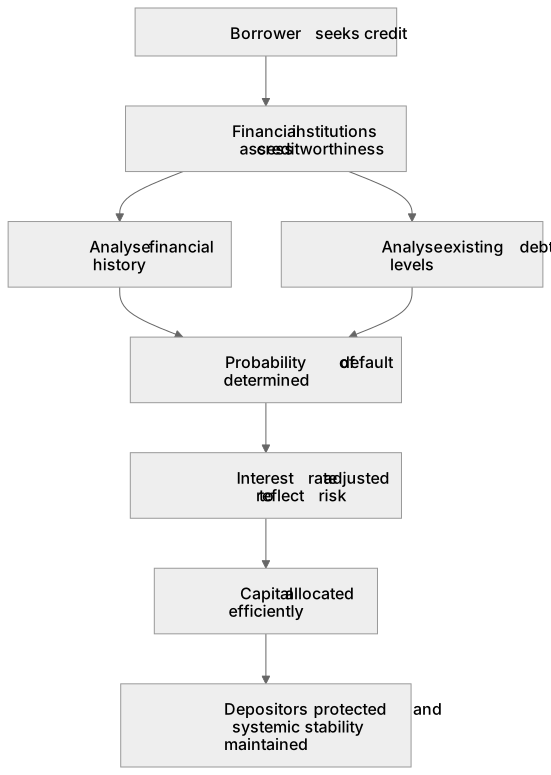
Key words
Say what each word means before you turn the card.
Credit risk
Try answering aloud or in your head before turning the card.
Credit rating agencies
Try answering aloud or in your head before turning the card.
Risk premium
Try answering aloud or in your head before turning the card.
Systemic stability
Try answering aloud or in your head before turning the card.
See every definition
- Credit risk
- The likelihood that a borrower will fail to meet debt obligations, also known as default risk.
- Credit rating agencies
- Institutions that evaluate the default risk of corporate and government bonds and assign grades to help investors assess that risk.
- Risk premium
- The higher interest rate charged to reflect the increased probability of default when assessed credit risk is higher.
- Systemic stability
- The maintenance of stability across the financial system, supported by accurately assessing credit risk so that capital is allocated efficiently and depositors are protected.
Label the diagram
Some boxes have lost their names. Pick the right name for each number.
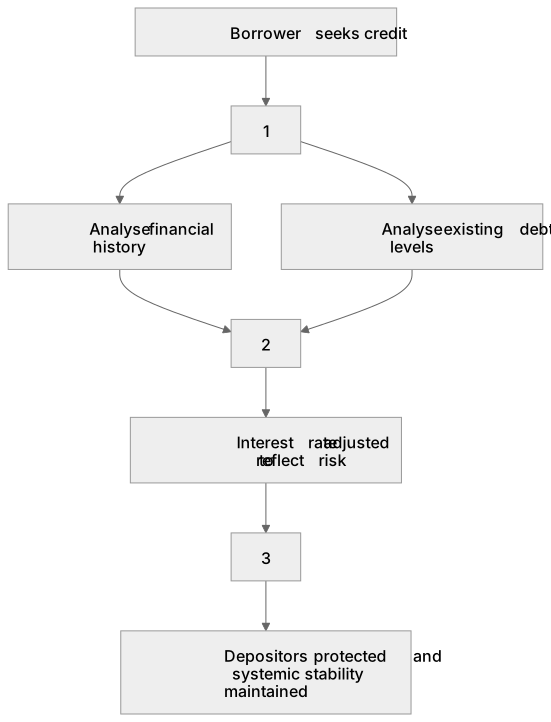
1Box 1
2Box 2
3Box 3
There is more to this lesson
The full lesson goes on to check your understanding and help you earn the marks. Create a free account to carry on, with your progress saved.
A week of Premium from your first lesson · Then the free plan continues · No card, no charge
Test your understanding of The role of the financial sector: e) To assess creditor risk
Active recall beats re-reading. Take an instant quiz now to test what you’ve learned and lock it into long-term memory.
A week of Premium from your first lesson · Then the free plan continues · No card, no charge