Pearson Edexcel · A-Level · Economics B
Course version: 9EB0 · Version from Sept 2015
The role of the financial sector: g) To provide a market for equities
Full specification wording
The role of the financial sector: g) To provide a market for equities
The financial sector plays a crucial role in providing a market for equities, which are shares representing ownership in a company.
Checked against the Pearson Edexcel 9EB0 specification (opens in a new tab) on .
- Point 7 of 7
- 3 key terms
Study notes
From the checked teaching notes for this specification point.
The idea
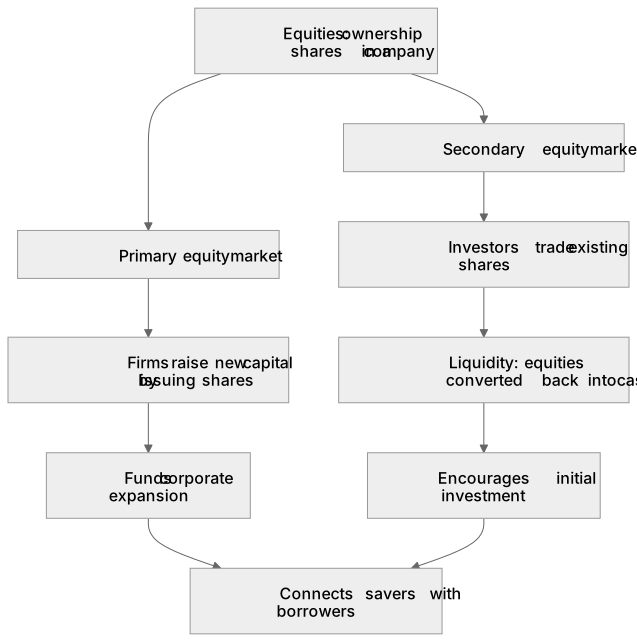
The financial sector plays a crucial role in providing a market for equities, which are shares representing ownership in a company. This market, typically a stock exchange like the London Stock Exchange, facilitates the buying and selling of these shares. By providing this marketplace, the financial sector allows businesses to raise long-term capital to fund expansion. For example, a growing tech firm might issue new equities to finance a new factory. Simultaneously, it provides investors with an opportunity to purchase a stake in businesses, potentially earning returns through dividends and capital gains. The secondary market ensures liquidity, meaning investors can easily convert their equities back into cash by selling them to other investors, which encourages initial investment.
What earns the marks
- Identifies that equities represent ownership shares in a public or private limited company.
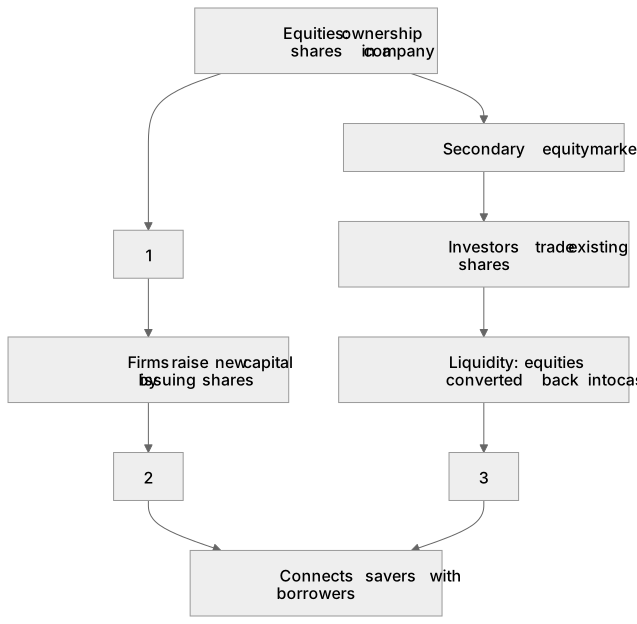
- Explains that the primary equity market allows firms to raise new capital by issuing shares.
- Explains that the secondary equity market provides liquidity by allowing investors to trade existing shares.
- Recognises that equity markets facilitate corporate growth and investment by connecting savers with borrowers.
Common mistakes and how to put them right
Confusing equities with bonds.
Put it right: Equities represent ownership and pay variable dividends, whereas bonds represent debt and pay fixed interest.
Assuming the company receives money every time its shares are traded.
Put it right: Companies only raise capital during the initial issuance in the primary market, not during secondary market trading.
Believing that equity markets guarantee a return for investors.
Put it right: Equity investments carry risk, and returns depend on company performance and market conditions.
Exam tips
- When evaluating the role of financial markets, distinguish clearly between the primary market for raising capital and the secondary market for providing liquidity.
- Use real-world examples of stock exchanges, such as the London Stock Exchange, to illustrate where equity trading occurs.
- Remember to link the provision of an equity market to broader macroeconomic objectives, such as economic growth driven by corporate investment.
Try the lesson
The start of the The role of the financial sector: g) To provide a market for equities lesson, made from checked teaching notes for this specification point.
Have a go first
What is the primary purpose of a company issuing shares on an equity market?
Listen
The financial sector plays a crucial role in providing a market for equities, which are shares representing ownership in a company. This market, typically a stock exchange like the London Stock Exchange, facilitates the buying and selling of these shares. By providing this marketplace, the financial sector allows businesses to raise long-term capital to fund expansion. For example, a growing tech firm might issue new equities to finance a new factory. Simultaneously, it provides investors with an opportunity to purchase a stake in businesses, potentially earning returns through dividends and capital gains. The secondary market ensures liquidity, meaning investors can easily convert their equities back into cash by selling them to other investors, which encourages initial investment. A strong answer earns marks for these points. Identifies that equities represent ownership shares in a public or private limited company. Explains that the primary equity market allows firms to raise new capital by issuing shares. Explains that the secondary equity market provides liquidity by allowing investors to trade existing shares. Recognises that equity markets facilitate corporate growth and investment by connecting savers with borrowers. Exam tip: When evaluating the role of financial markets, distinguish clearly between the primary market for raising capital and the secondary market for providing liquidity.
See it
Key words
Say what each word means before you turn the card.
Capital raising
Try answering aloud or in your head before turning the card.
Liquidity
Try answering aloud or in your head before turning the card.
Investment and growth
Try answering aloud or in your head before turning the card.
See every definition
- Capital raising
- Allowing businesses to raise long-term capital to fund expansion by issuing new equities in the primary market.
- Liquidity
- The ability of investors to easily convert their equities back into cash by selling them to other investors in the secondary market.
- Investment and growth
- Equity markets facilitate corporate growth and investment by connecting savers with borrowers.
Label the diagram
Some boxes have lost their names. Pick the right name for each number.
1Box 1
2Box 2
3Box 3
There is more to this lesson
The full lesson goes on to check your understanding and help you earn the marks. Create a free account to carry on, with your progress saved.
A week of Premium from your first lesson · Then the free plan continues · No card, no charge
Test your understanding of The role of the financial sector: g) To provide a market for equities
Active recall beats re-reading. Take an instant quiz now to test what you’ve learned and lock it into long-term memory.
A week of Premium from your first lesson · Then the free plan continues · No card, no charge