Pearson Edexcel · A-Level · Economics B
Course version: 9EB0 · Version from Sept 2015
F) To provide forward markets in currencies and commodities
Full specification wording
The role of the financial sector: f) To provide forward markets in currencies and commodities
The financial sector provides forward markets to help businesses manage the risks associated with price volatility in currencies and commodities.
Checked against the Pearson Edexcel 9EB0 specification (opens in a new tab) on .
- Point 6 of 7
- 4 key terms
Study notes
From the checked teaching notes for this specification point.
The idea
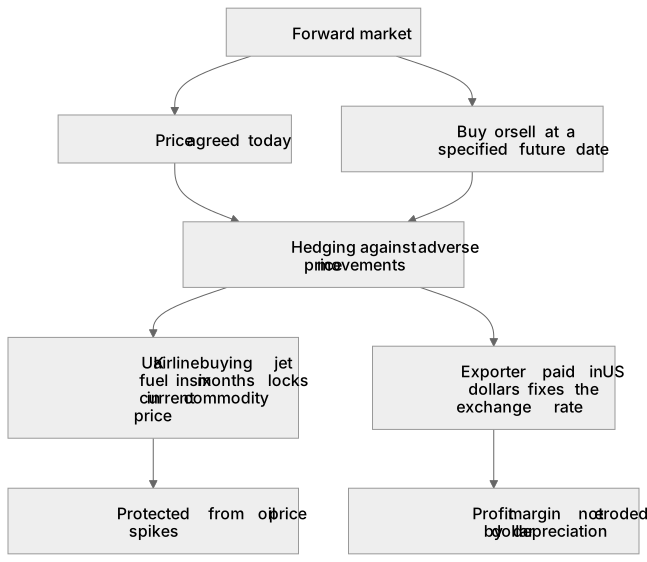
The financial sector provides forward markets to help businesses manage the risks associated with price volatility in currencies and commodities. A forward market allows participants to buy or sell an asset at a specified future date for a price agreed upon today. This mechanism is vital for hedging against adverse price movements. For example, a UK airline expecting to buy jet fuel in six months can use a forward contract to lock in the current commodity price, protecting itself from sudden oil price spikes. Similarly, an exporter expecting payment in US dollars can use a forward currency market to fix the exchange rate, ensuring their profit margin is not eroded by a depreciation of the dollar before the payment is received.
What earns the marks
- Definition of a forward market as a financial market where contracts are made to buy or sell assets at a future date at a pre-agreed price.
- The role of forward markets in allowing firms to hedge against exchange rate volatility in international trade.
- The use of commodity forward markets by producers and consumers to guarantee future prices for raw materials like oil or wheat.
- The distinction between hedging to reduce risk and speculation to take on risk for profit in forward markets.
- How financial institutions act as intermediaries or counterparties to facilitate these forward contracts and provide liquidity.
Common mistakes and how to put them right
Confusing forward markets with spot markets.
Put it right: Spot markets involve immediate delivery and payment, whereas forward markets involve agreeing on a price now for delivery and payment at a future date.
Assuming forward contracts eliminate all business risks.
Put it right: Forward contracts only eliminate price risk for the specific currency or commodity; they do not protect against other risks like default by the counterparty.
Believing forward markets are only used by speculators.
Put it right: While speculators provide liquidity, forward markets are primarily essential tools for businesses seeking to hedge against price volatility in their normal operations.
Exam tips
- Use a clear numerical example when explaining how a forward currency contract protects an importer or exporter from exchange rate fluctuations.
- Distinguish clearly between the underlying asset, such as the physical commodity or currency, and the financial derivative, which is the forward contract itself.
- Highlight that providing forward markets is a key function of the financial sector that facilitates international trade and investment by reducing uncertainty.
Try the lesson
The start of the The role of the financial sector: f) To provide forward markets in currencies and commodities lesson, made from checked teaching notes for this specification point.
Have a go first
Which of the following best describes the primary function of a forward market in commodities?
Listen
The financial sector provides forward markets to help businesses manage the risks associated with price volatility in currencies and commodities. A forward market allows participants to buy or sell an asset at a specified future date for a price agreed upon today. This mechanism is vital for hedging against adverse price movements. For example, a UK airline expecting to buy jet fuel in six months can use a forward contract to lock in the current commodity price, protecting itself from sudden oil price spikes. Similarly, an exporter expecting payment in US dollars can use a forward currency market to fix the exchange rate, ensuring their profit margin is not eroded by a depreciation of the dollar before the payment is received. A strong answer earns marks for these points. Definition of a forward market as a financial market where contracts are made to buy or sell assets at a future date at a pre-agreed price. The role of forward markets in allowing firms to hedge against exchange rate volatility in international trade. The use of commodity forward markets by producers and consumers to guarantee future prices for raw materials like oil or wheat. The distinction between hedging to reduce risk and speculation to take on risk for profit in forward markets. Exam tip: Use a clear numerical example when explaining how a forward currency contract protects an importer or exporter from exchange rate fluctuations.
See it
Key words
Say what each word means before you turn the card.
Forward market
Try answering aloud or in your head before turning the card.
Price volatility
Try answering aloud or in your head before turning the card.
International trade
Try answering aloud or in your head before turning the card.
Financial derivatives
Try answering aloud or in your head before turning the card.
See every definition
- Forward market
- A financial market where contracts are made to buy or sell assets at a future date at a pre-agreed price.
- Price volatility
- Adverse price movements in currencies and commodities that businesses manage the risks of through forward markets.
- International trade
- Activity in which firms face exchange rate volatility and can hedge against it through forward markets.
- Financial derivatives
- The forward contract itself, as distinct from the underlying asset such as the physical commodity or currency.
Label the diagram
Some boxes have lost their names. Pick the right name for each number.
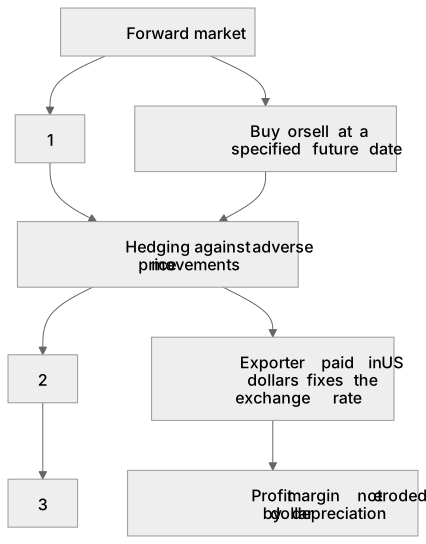
1Box 1
2Box 2
3Box 3
There is more to this lesson
The full lesson goes on to check your understanding and help you earn the marks. Create a free account to carry on, with your progress saved.
A week of Premium from your first lesson · Then the free plan continues · No card, no charge
Test your understanding of The role of the financial sector: f) To provide forward markets in currencies and commodities
Active recall beats re-reading. Take an instant quiz now to test what you’ve learned and lock it into long-term memory.
A week of Premium from your first lesson · Then the free plan continues · No card, no charge