Pearson Edexcel · A-Level · Economics B
Course version: 9EB0 · Version from Sept 2015
B) Expansion of trading blocs: o EU and the single market o ASEAN o NAFTA
Full specification wording
Trading blocs: b) Expansion of trading blocs: o EU and the single market o ASEAN o NAFTA
Trading blocs are agreements between countries to reduce protectionist barriers like tariffs.
Checked against the Pearson Edexcel 9EB0 specification (opens in a new tab) on .
- Point 2 of 3
- 4 key terms
Study notes
From the checked teaching notes for this specification point.
The idea
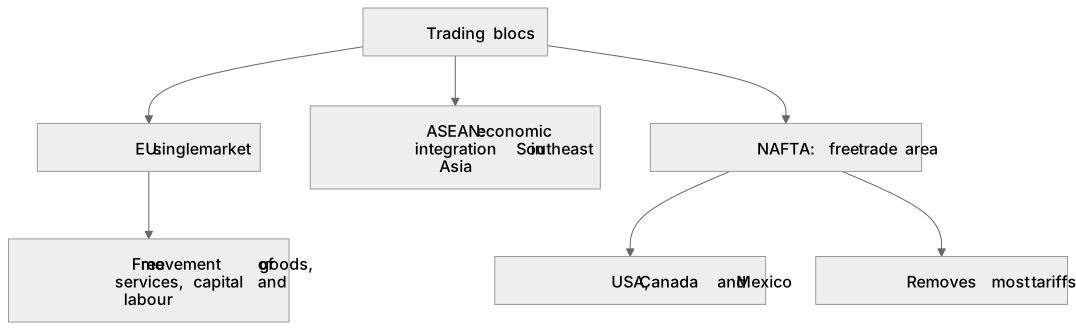
Trading blocs are agreements between countries to reduce protectionist barriers like tariffs. Their expansion has reshaped global trade. The European Union (EU) operates as a single market, allowing the free movement of goods, services, capital, and labour, deeply integrating its members' economies. The Association of Southeast Asian Nations (ASEAN) facilitates economic integration and free trade among its Southeast Asian member states. The North American Free Trade Agreement (NAFTA) established a massive free trade zone between the US, Canada, and Mexico by removing most tariffs. Studying the expansion of the EU, ASEAN, and NAFTA reveals how regional agreements influence global supply chains, market access, and foreign direct investment.
What earns the marks
- Identify the EU as a single market with free movement of goods, services, capital, and labour.
- Recognise ASEAN as a trading bloc promoting economic integration in Southeast Asia.
- Define NAFTA as a free trade area between the USA, Canada, and Mexico.
- Distinguish between a free trade area (like NAFTA) and a single market (like the EU).
Common mistakes and how to put them right
Confusing a free trade area with a single market.
Put it right: A single market allows free movement of factors of production (labour and capital), whereas a free trade area only removes tariffs on goods.
Assuming NAFTA includes South American countries.
Put it right: NAFTA (and its successor USMCA) only includes North American countries: the USA, Canada, and Mexico.
Believing all trading blocs share a common currency.
Put it right: Only specific economic unions like the Eurozone share a currency; NAFTA and ASEAN members retain their own currencies.
Exam tips
- When answering multiple-choice questions on trading blocs, carefully check whether the question asks about a customs union, free trade area, or single market.
- Use the specific features of the EU, such as the free movement of labour, to distinguish it from ASEAN and NAFTA in comparative questions.
- Be prepared to identify the member countries of NAFTA and the general geographic region of ASEAN.
Try the lesson
The start of the Trading blocs: b) Expansion of trading blocs: o EU and the single market o ASEAN o NAFTA lesson, made from checked teaching notes for this specification point.
Have a go first
When a trading bloc such as the European Union expands by admitting new member states, which of the following is the most likely immediate economic effect on the existing single market?
Listen
Trading blocs are agreements between countries to reduce protectionist barriers like tariffs. Their expansion has reshaped global trade. The European Union (EU) operates as a single market, allowing the free movement of goods, services, capital, and labour, deeply integrating its members' economies. The Association of Southeast Asian Nations (ASEAN) facilitates economic integration and free trade among its Southeast Asian member states. The North American Free Trade Agreement (NAFTA) established a massive free trade zone between the US, Canada, and Mexico by removing most tariffs. Studying the expansion of the EU, ASEAN, and NAFTA reveals how regional agreements influence global supply chains, market access, and foreign direct investment. A strong answer earns marks for these points. Identify the EU as a single market with free movement of goods, services, capital, and labour. Recognise ASEAN as a trading bloc promoting economic integration in Southeast Asia. Define NAFTA as a free trade area between the USA, Canada, and Mexico. Distinguish between a free trade area (like NAFTA) and a single market (like the EU). A common slip: Confusing a free trade area with a single market. Instead, a single market allows free movement of factors of production (labour and capital), whereas a free trade area only removes tariffs on goods. Exam tip: When answering multiple-choice questions on trading blocs, carefully check whether the question asks about a customs union, free trade area, or single market.
See it
Key words
Say what each word means before you turn the card.
Trading blocs
Try answering aloud or in your head before turning the card.
Single market
Try answering aloud or in your head before turning the card.
Economic integration
Try answering aloud or in your head before turning the card.
Free trade area
Try answering aloud or in your head before turning the card.
See every definition
- Trading blocs
- Agreements between countries to reduce protectionist barriers like tariffs, whose expansion has reshaped global trade.
- Single market
- Arrangement, such as the European Union, allowing the free movement of goods, services, capital, and labour, deeply integrating members' economies.
- Economic integration
- Process facilitated by ASEAN among its Southeast Asian member states through free trade.
- Free trade area
- Arrangement such as NAFTA, which removes tariffs on goods but, unlike a single market, does not allow free movement of factors of production.
Label the diagram
Some boxes have lost their names. Pick the right name for each number.
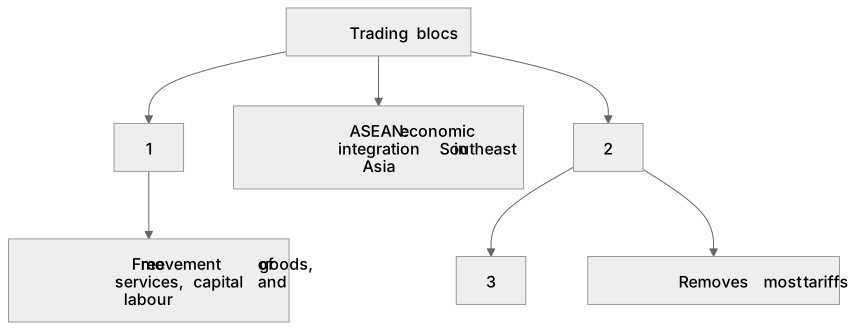
1Box 1
2Box 2
3Box 3
There is more to this lesson
The full lesson goes on to check your understanding and help you earn the marks. Create a free account to carry on, with your progress saved.
A week of Premium from your first lesson · Then the free plan continues · No card, no charge
Test your understanding of Trading blocs: b) Expansion of trading blocs: o EU and the single market o ASEAN o NAFTA
Active recall beats re-reading. Take an instant quiz now to test what you’ve learned and lock it into long-term memory.
A week of Premium from your first lesson · Then the free plan continues · No card, no charge