Pearson Edexcel · A-Level · Economics B
Course version: 9EB0 · Version from Sept 2015
Trading blocs: d) Growing interdependence
Trading blocs, such as the European Union or USMCA, foster growing economic interdependence among member nations.
Checked against the Pearson Edexcel 9EB0 specification (opens in a new tab) on .
- Point 3 of 3
- 3 key terms
Study notes
From the checked teaching notes for this specification point.
The idea
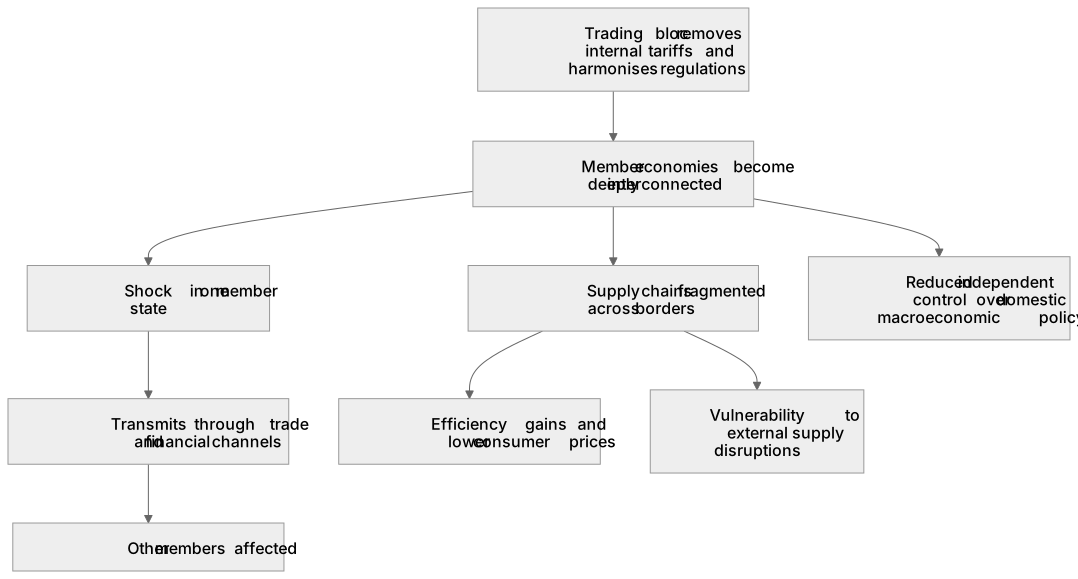
Trading blocs, such as the European Union or USMCA, foster growing economic interdependence among member nations. As countries remove internal tariffs and harmonise regulations, their economies become deeply interconnected. This means a macroeconomic shock in one member state rapidly transmits to others through trade and financial channels. For example, if Germany experiences a recession, its demand for imported components from Poland falls, negatively impacting Polish economic growth. Interdependence also extends to supply chains, where manufacturing processes are fragmented across borders to exploit comparative advantages. While this increases efficiency and lowers consumer prices, it leaves nations vulnerable to external supply disruptions and reduces their independent control over domestic macroeconomic policy.
What earns the marks
- Define economic interdependence as the mutual reliance between economies for goods, services, and capital.
- Explain how trading blocs accelerate interdependence by eliminating internal trade barriers.
- Analyse the transmission of economic shocks between interdependent nations.
- Evaluate the trade-off between increased efficiency from integrated supply chains and the loss of independent macroeconomic policy control.
Common mistakes and how to put them right
Assuming interdependence only brings positive economic growth.
Put it right: Recognise that interdependence also transmits negative economic shocks and increases vulnerability to external crises.
Confusing interdependence with globalisation.
Put it right: While related, interdependence specifically refers to the mutual reliance between specific economies, often intensified within regional trading blocs.
Believing interdependence increases a government's control over its economy.
Put it right: Interdependence typically reduces independent policy control, as nations must coordinate with bloc members.
Exam tips
- Use specific examples of trading blocs, like the EU or ASEAN, to illustrate how integrated supply chains create interdependence.
- When evaluating trading blocs, always weigh the efficiency gains of interdependence against the risks of contagion during economic downturns.
- Link growing interdependence to the concept of comparative advantage and the fragmentation of production processes.
Try the lesson
The start of the Trading blocs: d) Growing interdependence lesson, made from checked teaching notes for this specification point.
Have a go first
Which of the following scenarios provides the clearest evidence of growing economic interdependence between nations?
Listen
Trading blocs, such as the European Union or USMCA, foster growing economic interdependence among member nations. As countries remove internal tariffs and harmonise regulations, their economies become deeply interconnected. This means a macroeconomic shock in one member state rapidly transmits to others through trade and financial channels. For example, if Germany experiences a recession, its demand for imported components from Poland falls, negatively impacting Polish economic growth. Interdependence also extends to supply chains, where manufacturing processes are fragmented across borders to exploit comparative advantages. While this increases efficiency and lowers consumer prices, it leaves nations vulnerable to external supply disruptions and reduces their independent control over domestic macroeconomic policy. A strong answer earns marks for these points. Define economic interdependence as the mutual reliance between economies for goods, services, and capital. Explain how trading blocs accelerate interdependence by eliminating internal trade barriers. Analyse the transmission of economic shocks between interdependent nations. Evaluate the trade-off between increased efficiency from integrated supply chains and the loss of independent macroeconomic policy control. A common slip: Assuming interdependence only brings positive economic growth. Instead, Recognise that interdependence also transmits negative economic shocks and increases vulnerability to external crises. Exam tip: Use specific examples of trading blocs, like the EU or ASEAN, to illustrate how integrated supply chains create interdependence.
See it
Key words
Say what each word means before you turn the card.
Economic interdependence
Try answering aloud or in your head before turning the card.
Macroeconomic shocks
Try answering aloud or in your head before turning the card.
Supply chain integration
Try answering aloud or in your head before turning the card.
See every definition
- Economic interdependence
- The mutual reliance between economies for goods, services, and capital, often intensified within regional trading blocs.
- Macroeconomic shocks
- Events that transmit rapidly from one member state to others through trade and financial channels in deeply interconnected economies.
- Supply chain integration
- The fragmentation of manufacturing processes across borders to exploit comparative advantages, which increases efficiency and lowers consumer prices.
Label the diagram
Some boxes have lost their names. Pick the right name for each number.
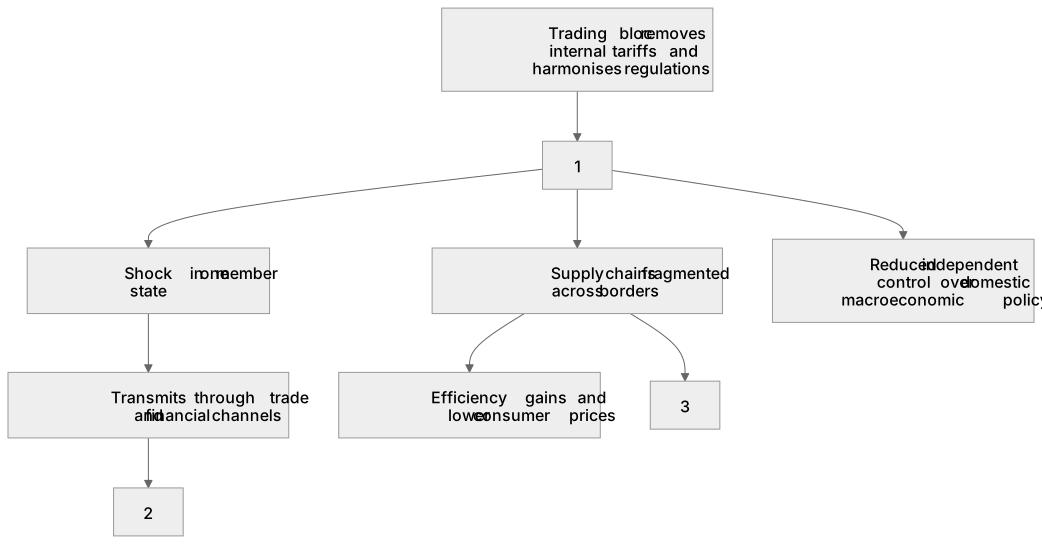
1Box 1
2Box 2
3Box 3
There is more to this lesson
The full lesson goes on to check your understanding and help you earn the marks. Create a free account to carry on, with your progress saved.
A week of Premium from your first lesson · Then the free plan continues · No card, no charge
Test your understanding of Trading blocs: d) Growing interdependence
Active recall beats re-reading. Take an instant quiz now to test what you’ve learned and lock it into long-term memory.
A week of Premium from your first lesson · Then the free plan continues · No card, no charge