Pearson Edexcel · A-Level · Economics B
Course version: 9EB0 · Version from Sept 2015
D) Other sources of finance: o owner’s capital: personal savings o…
Full specification wording
Types and sources of credit and the impact of credit within the economy: d) Other sources of finance: o owner’s capital: personal savings o retained profit o sale of assets o individual investors o online collaborative funding
Businesses can access various internal and external sources of finance.
Checked against the Pearson Edexcel 9EB0 specification (opens in a new tab) on .
- Point 4 of 5
Study notes
From the checked teaching notes for this specification point.
The idea
Businesses can access various internal and external sources of finance. Internal sources include owner's capital, where entrepreneurs invest their personal savings, and retained profit, which is profit kept within the business after dividends are paid to fund future growth. A business might also raise funds through the sale of assets it no longer needs. External sources include individual investors who provide capital for a share of the business, and online collaborative funding, where small amounts of money are raised from a large number of people via the internet.
For example: A sole trader might use personal savings to start, then use retained profit to expand.
What earns the marks
- Categorise owner's capital, retained profit, and sale of assets as internal sources of finance.
- Identify individual investors and online collaborative funding as external sources of finance.
- Explain that retained profit is a cheap source of finance as it incurs no interest, but it has an opportunity cost.
- Describe online collaborative funding as raising small amounts of capital from a large pool of individuals, typically via online platforms.
Common mistakes and how to put them right
Stating that retained profit is entirely free.
Put it right: While it lacks interest payments, it carries an opportunity cost for shareholders who forgo higher dividends.
Confusing individual investors with venture capital firms.
Put it right: Individual investors invest their own money, whereas venture capitalists invest pooled funds from institutions.
Assuming the sale of assets is always a viable long-term strategy.
Put it right: Selling assets can provide a quick cash injection but may reduce the productive capacity of the business.
Exam tips
- Always link the source of finance to the legal structure of the business; sole traders rely heavily on personal savings, while limited companies can attract individual investors.
- When discussing online collaborative funding, mention its dual benefit of raising capital and acting as market research or marketing.
- Contrast the speed and cost of internal finance, such as retained profit, with the complexities of securing external finance.
Try the lesson
The start of the Types and sources of credit and the impact of credit within the economy: d) Other sources of finance: o owner’s capital: personal savings o retained profit o sale of assets o individual investors o online collaborative funding lesson, made from checked teaching notes for this specification point.
Have a go first
Which of the following is an internal source of finance for an established business?
Listen
Businesses can access various internal and external sources of finance. Internal sources include owner's capital, where entrepreneurs invest their personal savings, and retained profit, which is profit kept within the business after dividends are paid to fund future growth. A business might also raise funds through the sale of assets it no longer needs. External sources include individual investors who provide capital for a share of the business, and online collaborative funding, where small amounts of money are raised from a large number of people via the internet. For example, a sole trader might use personal savings to start, then use retained profit to expand. A strong answer earns marks for these points. Categorise owner's capital, retained profit, and sale of assets as internal sources of finance. Identify individual investors and online collaborative funding as external sources of finance. Explain that retained profit is a cheap source of finance as it incurs no interest, but it has an opportunity cost. Describe online collaborative funding as raising small amounts of capital from a large pool of individuals, typically via online platforms. Exam tip: Always link the source of finance to the legal structure of the business; sole traders rely heavily on personal savings, while limited companies can attract individual investors.
See it
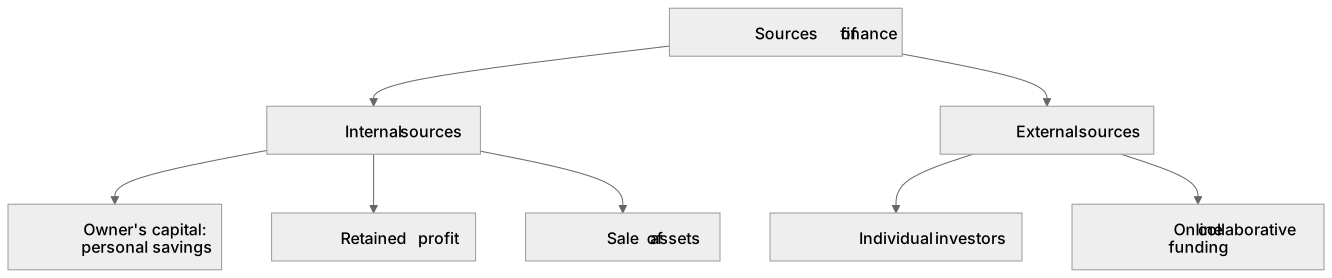
Label the diagram
Some boxes have lost their names. Pick the right name for each number.
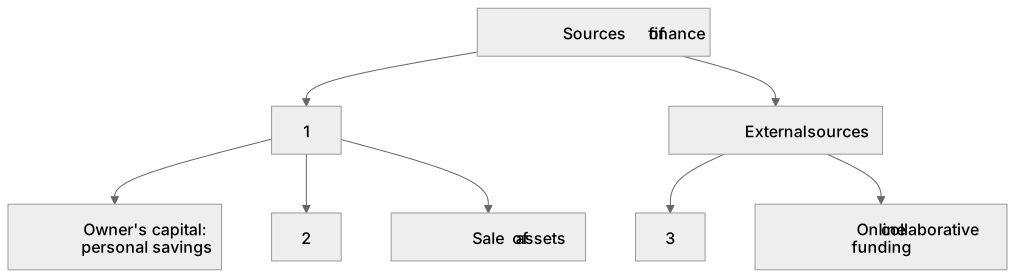
1Box 1
2Box 2
3Box 3
There is more to this lesson
The full lesson goes on to check your understanding and help you earn the marks. Create a free account to carry on, with your progress saved.
A week of Premium from your first lesson · Then the free plan continues · No card, no charge
Test your understanding of Types and sources of credit and the impact of credit within the economy: d) Other sources of finance: o owner’s capital: personal savings o retained profit o sale of assets o individual investors o online collaborative funding
Active recall beats re-reading. Take an instant quiz now to test what you’ve learned and lock it into long-term memory.
A week of Premium from your first lesson · Then the free plan continues · No card, no charge