Pearson Edexcel · A-Level · Economics B
Course version: 9EB0 · Version from Sept 2015
Understanding the consumer: c) Categorising consumers: market segmentation
Full specification wording
Understanding the consumer: c) Categorising consumers: market segmentation
Market segmentation involves dividing a broad target market into subsets of consumers who have common needs, interests, or priorities.
Checked against the Pearson Edexcel 9EB0 specification (opens in a new tab) on .
- Point 3 of 3
- 4 key terms
Study notes
From the checked teaching notes for this specification point.
The idea
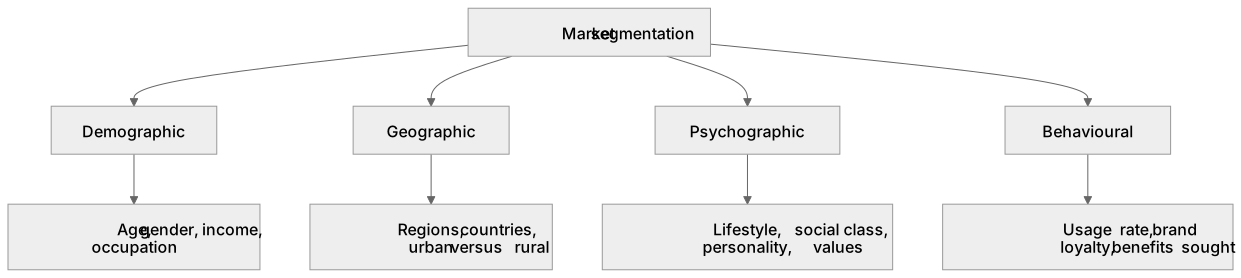
Market segmentation involves dividing a broad target market into subsets of consumers who have common needs, interests, or priorities. By categorising consumers, businesses can design and implement strategies tailored to specific groups, improving marketing efficiency. Common methods of segmentation include demographic (age, gender, income), geographic (location), psychographic (lifestyle, values), and behavioural (brand loyalty). For example, a car manufacturer might segment its market demographically, offering affordable hatchbacks to young buyers and luxury SUVs to higher-income families. Effective segmentation allows firms to identify niche markets and allocate resources effectively.
What earns the marks
- Market segmentation is the process of dividing a heterogeneous market into distinct, homogeneous groups of consumers with shared needs or characteristics.
- Demographic segmentation categorises consumers by quantifiable traits such as age, gender, income, and occupation.
- Geographic segmentation divides the market based on physical locations, such as regions, countries, or urban versus rural areas.
- Psychographic segmentation groups consumers according to their lifestyle, social class, personality, and personal values.
- Behavioural segmentation focuses on consumer interactions with the product, including usage rate, brand loyalty, and benefits sought.
Common mistakes and how to put them right
Confusing market segmentation with market research.
Put it right: Market research is the process of gathering data, whereas segmentation is the application of that data to divide the market into distinct consumer groups.
Assuming demographic segmentation is the only method.
Put it right: Recognise that markets can also be segmented geographically, psychographically, and behaviourally depending on the product.
Believing that segmentation guarantees higher profits.
Put it right: While segmentation can improve targeting, it also incurs costs for tailored marketing and requires effective execution to be profitable.
Exam tips
- Always link the chosen method of segmentation to the specific product or service in the given scenario.
- Use concrete examples to illustrate how a business might adapt its marketing mix for different consumer segments.
- Consider the costs associated with developing separate marketing campaigns for multiple segments when evaluating its effectiveness.
Try the lesson
The start of the Understanding the consumer: c) Categorising consumers: market segmentation lesson, made from checked teaching notes for this specification point.
Have a go first
Which of the following best describes the process of market segmentation?
Listen
Market segmentation involves dividing a broad target market into subsets of consumers who have common needs, interests, or priorities. By categorising consumers, businesses can design and implement strategies tailored to specific groups, improving marketing efficiency. Common methods of segmentation include demographic (age, gender, income), geographic (location), psychographic (lifestyle, values), and behavioural (brand loyalty). For example, a car manufacturer might segment its market demographically, offering affordable hatchbacks to young buyers and luxury SUVs to higher-income families. Effective segmentation allows firms to identify niche markets and allocate resources effectively. A strong answer earns marks for these points. Market segmentation is the process of dividing a heterogeneous market into distinct, homogeneous groups of consumers with shared needs or characteristics. Demographic segmentation categorises consumers by quantifiable traits such as age, gender, income, and occupation. Geographic segmentation divides the market based on physical locations, such as regions, countries, or urban versus rural areas. Psychographic segmentation groups consumers according to their lifestyle, social class, personality, and personal values. A common slip: Confusing market segmentation with market research. Instead, market research is the process of gathering data, whereas segmentation is the application of that data to divide the market into distinct consumer groups. Exam tip: Always link the chosen method of segmentation to the specific product or service in the given scenario.
See it
Key words
Say what each word means before you turn the card.
Market segmentation
Try answering aloud or in your head before turning the card.
Demographic segmentation
Try answering aloud or in your head before turning the card.
Geographic segmentation
Try answering aloud or in your head before turning the card.
Psychographic segmentation
Try answering aloud or in your head before turning the card.
See every definition
- Market segmentation
- The process of dividing a heterogeneous market into distinct, homogeneous groups of consumers with shared needs or characteristics.
- Demographic segmentation
- Categorising consumers by quantifiable traits such as age, gender, income, and occupation.
- Geographic segmentation
- Dividing the market based on physical locations, such as regions, countries, or urban versus rural areas.
- Psychographic segmentation
- Grouping consumers according to their lifestyle, social class, personality, and personal values.
Label the diagram
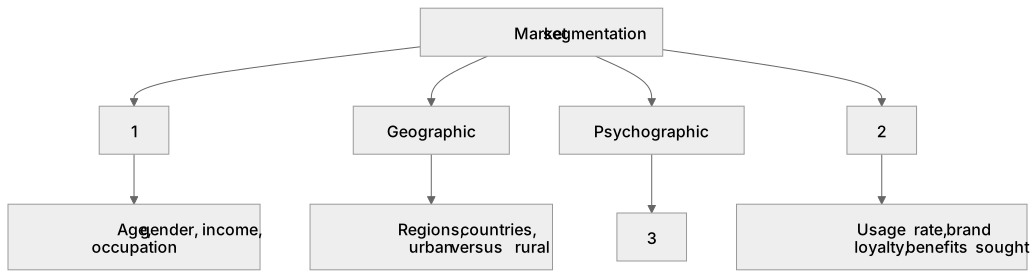
Some boxes have lost their names. Pick the right name for each number.
1Box 1
2Box 2
3Box 3
There is more to this lesson
The full lesson goes on to check your understanding and help you earn the marks. Create a free account to carry on, with your progress saved.
A week of Premium from your first lesson · Then the free plan continues · No card, no charge
Test your understanding of Understanding the consumer: c) Categorising consumers: market segmentation
Active recall beats re-reading. Take an instant quiz now to test what you’ve learned and lock it into long-term memory.
A week of Premium from your first lesson · Then the free plan continues · No card, no charge