Pearson Edexcel · A-Level · Economics B
Course version: 9EB0 · Version from Sept 2015
B) Limitations of market research, sample size and bias
Full specification wording
Understanding the consumer: b) Limitations of market research, sample size and bias
While market research provides valuable insights, it has significant limitations that can affect business decision-making.
Checked against the Pearson Edexcel 9EB0 specification (opens in a new tab) on .
- Point 2 of 3
- 3 key terms
Study notes
From the checked teaching notes for this specification point.
The idea
While market research provides valuable insights, it has significant limitations that can affect business decision-making. A major limitation is sample size; if a sample is too small, it may not accurately represent the target market, leading to unreliable conclusions about consumer demand. Bias is another critical issue, which can occur if survey questions are leading (questionnaire bias) or if the sample is unrepresentative (selection bias). Furthermore, market research can be costly and time-consuming. Consumer behaviour may also change between the research phase and the product launch, rendering the data obsolete and increasing the risk of product failure.
What earns the marks
- A small sample size reduces the statistical reliability of quantitative market research findings, increasing the margin of error.
- Bias can distort results, either through poorly phrased leading questions (questionnaire bias) or unrepresentative sampling (selection bias).
- Market research data can quickly become outdated in dynamic markets where consumer preferences change rapidly.
- The financial cost and time required to conduct comprehensive primary research may outweigh the benefits, particularly for small businesses.
Common mistakes and how to put them right
Assuming a large sample size guarantees accuracy.
Put it right: A large sample can still be highly biased if it does not reflect the target demographic accurately.
Confusing bias with random error.
Put it right: Bias is a systematic error in how data is collected or interpreted, whereas random error relates to natural variations.
Believing market research guarantees success.
Put it right: Research only reduces risk; it cannot eliminate it entirely due to unforeseen market changes and external shocks.
Exam tips
- When evaluating a business decision, question the reliability of the market research data provided in the extract.
- Explicitly mention how a small sample size or potential bias might lead a business to make incorrect assumptions about demand.
- Consider the trade-off between the cost of conducting extensive market research and the financial risk of launching a product without it.
Try the lesson
The start of the Understanding the consumer: b) Limitations of market research, sample size and bias lesson, made from checked teaching notes for this specification point.
Have a go first
What is meant by 'sampling bias' in the context of market research?
Listen
While market research provides valuable insights, it has significant limitations that can affect business decision-making. A major limitation is sample size; if a sample is too small, it may not accurately represent the target market, leading to unreliable conclusions about consumer demand. Bias is another critical issue, which can occur if survey questions are leading (questionnaire bias) or if the sample is unrepresentative (selection bias). Furthermore, market research can be costly and time-consuming. Consumer behaviour may also change between the research phase and the product launch, rendering the data obsolete and increasing the risk of product failure. A strong answer earns marks for these points. A small sample size reduces the statistical reliability of quantitative market research findings, increasing the margin of error. Bias can distort results, either through poorly phrased leading questions (questionnaire bias) or unrepresentative sampling (selection bias). Market research data can quickly become outdated in dynamic markets where consumer preferences change rapidly. The financial cost and time required to conduct comprehensive primary research may outweigh the benefits, particularly for small businesses. A common slip: Assuming a large sample size guarantees accuracy. Instead, A large sample can still be highly biased if it does not reflect the target demographic accurately. Exam tip: When evaluating a business decision, question the reliability of the market research data provided in the extract.
See it
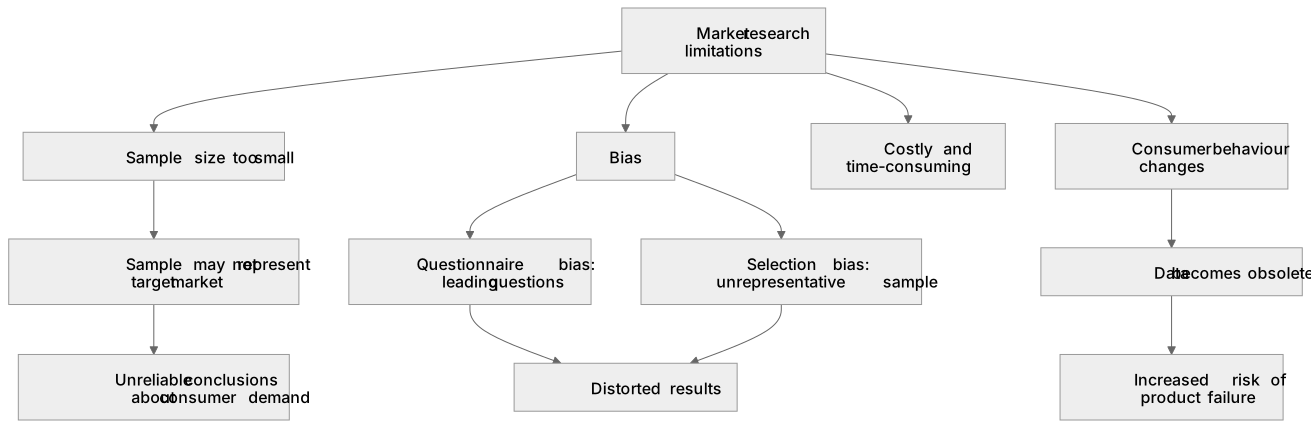
Key words
Say what each word means before you turn the card.
Bias
Try answering aloud or in your head before turning the card.
Questionnaire bias
Try answering aloud or in your head before turning the card.
Selection bias
Try answering aloud or in your head before turning the card.
See every definition
- Bias
- A critical issue that can occur if survey questions are leading or if the sample is unrepresentative.
- Questionnaire bias
- A form of bias that can occur if survey questions are leading.
- Selection bias
- A form of bias that can occur if the sample is unrepresentative.
Label the diagram
Some boxes have lost their names. Pick the right name for each number.
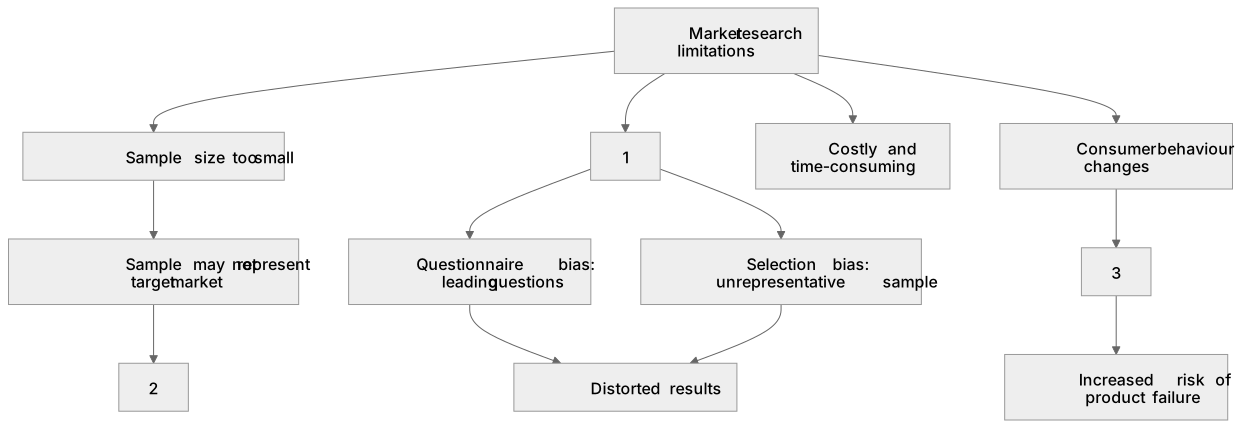
1Box 1
2Box 2
3Box 3
There is more to this lesson
The full lesson goes on to check your understanding and help you earn the marks. Create a free account to carry on, with your progress saved.
A week of Premium from your first lesson · Then the free plan continues · No card, no charge
Test your understanding of Understanding the consumer: b) Limitations of market research, sample size and bias
Active recall beats re-reading. Take an instant quiz now to test what you’ve learned and lock it into long-term memory.
A week of Premium from your first lesson · Then the free plan continues · No card, no charge