Balance of Payments Revision Notes

    Subject: Economics | Level: GCSE | Exam Board: OCR

    This guide provides a comprehensive, exam-focused breakdown of the Balance of Payments for OCR GCSE Economics (J205). It dissects the Current Account, explains how to analyze data, and provides proven techniques to help candidates secure top marks.

    Revision Notes & Key Concepts

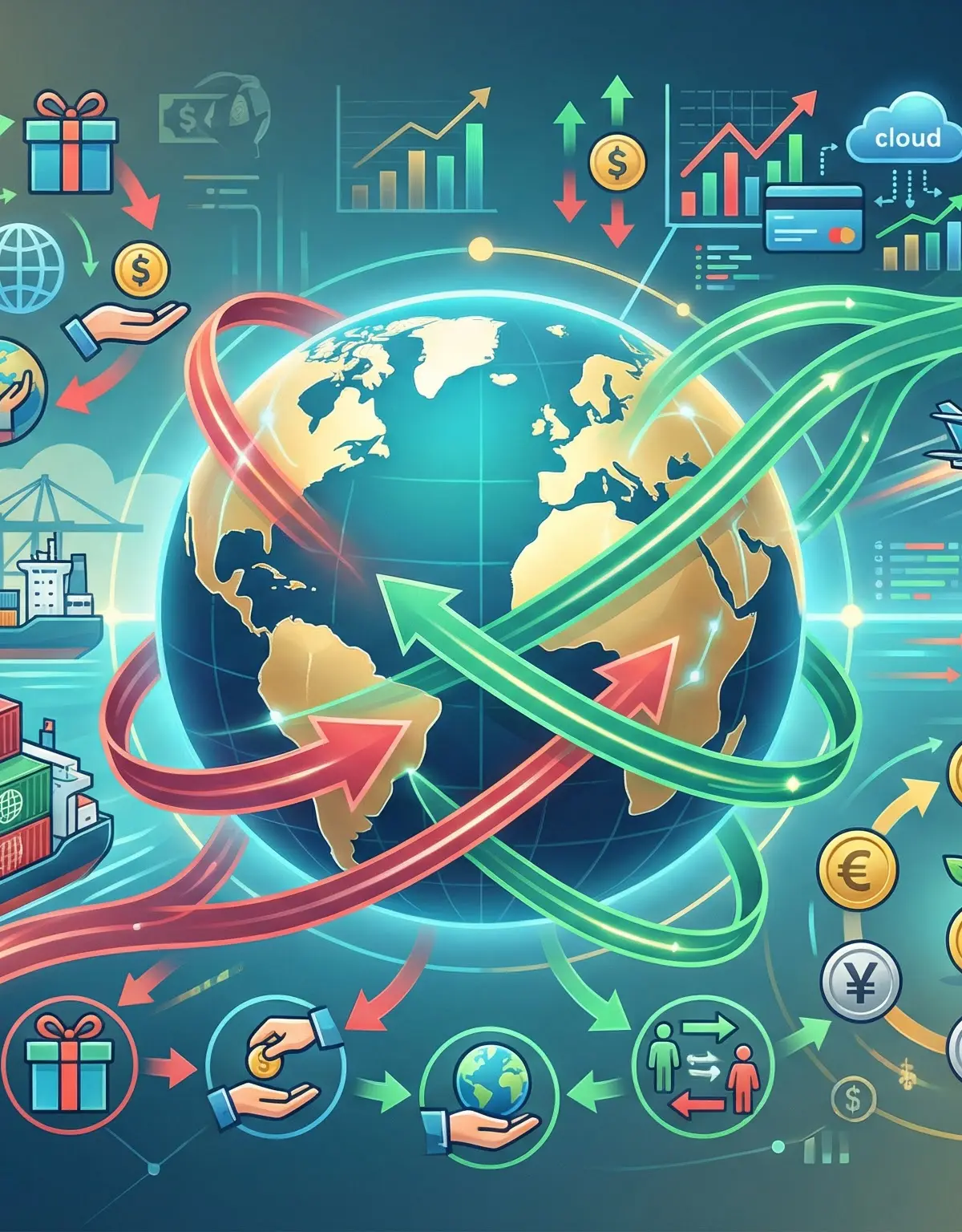
    ![A visual overview of the components and flows within the Balance of Payments.](https://xnnrgnazirrqvdgfhvou.supabase.co/storage/v1/object/public/study-guide-assets/guide_0d6e0b35-936b-4c41-9472-3c5bef8b9338/header_image.png) ## Overview The Balance of Payments is a crucial topic in macroeconomics, and for the OCR J205 specification, your focus is squarely on the **Current Account**. This guide will equip you with the precise knowledge and skills needed to excel. Examiners expect candidates to not only define the four key components but also to interpret data, calculate balances, and analyze the real-world consequences of current account deficits and surpluses on the UK economy. This involves understanding the impact on major macroeconomic objectives like employment, economic growth, and inflation. Mastery of this topic is essential for demonstrating AO2 (Application) and AO3 (Analysis) skills, which together constitute 65% of your final grade. This guide will walk you through the theory, provide worked examples, and highlight common pitfalls to ensure you are fully prepared. ![Listen to our 10-minute podcast guide on the Balance of Payments.](https://xnnrgnazirrqvdgfhvou.supabase.co/storage/v1/object/public/study-guide-assets/guide_0d6e0b35-936b-4c41-9472-3c5bef8b9338/balance_of_payments_podcast.wav) ## The Four Components of the Current Account To secure full marks, you must be able to define and distinguish between the four components of the Current Account. These are the channels through which money flows into (credits) and out of (debits) the country. ![The four components of the Current Account.](https://xnnrgnazirrqvdgfhvou.supabase.co/storage/v1/object/public/study-guide-assets/guide_0d6e0b35-936b-4c41-9472-3c5bef8b9338/current_account_components.png) ### 1. Trade in Goods **What it is**: This is the most straightforward component, representing the buying and selling of physical, tangible items. * **Exports (Credits)**: Goods produced in the UK and sold to other countries, leading to an inflow of money. For example, the sale of a UK-manufactured car to a customer in France. * **Imports (Debits)**: Goods produced abroad and bought by UK residents, leading to an outflow of money. For example, the purchase of a smartphone made in South Korea. **Key Term**: The difference between the value of goods exported and imported is known as the **Balance of Trade in Goods**. ### 2. Trade in Services **What it is**: This component tracks the buying and selling of intangible services. * **Exports (Credits)**: Services provided by UK firms to foreigners. Examples include a US tourist paying for a hotel in London, a German company using a UK-based law firm, or an overseas student paying tuition fees to a UK university. * **Imports (Debits)**: Services provided by foreign firms to UK residents. For example, a UK citizen flying with an Irish airline or using a US-based streaming service. **Key Fact**: The UK typically runs a significant **surplus** on its trade in services, thanks to its strong financial, legal, and educational sectors. ### 3. Primary Income **What it is**: This is income earned from investments and employment abroad. It's a return on factors of production. Examiners look for precision here. * **Credits**: Income flowing into the UK. This includes dividends from shares owned in foreign companies, interest on loans made to foreign entities, and profits repatriated by UK firms from their overseas operations (Foreign Direct Investment - FDI). * **Debits**: Income flowing out of the UK. This includes profits sent abroad by foreign-owned companies operating in the UK or interest paid to overseas lenders. ### 4. Secondary Income **What it is**: These are one-way transfers where no good or service is exchanged. They are often referred to as 'current transfers'. * **Credits**: Money transferred to the UK. Examples include remittances sent home by UK citizens working abroad or pension payments received from a foreign government. * **Debits**: Money transferred from the UK. This includes UK government contributions to international organizations (like the UN) or foreign aid payments to developing countries. ## Current Account Deficits and Surpluses A country's Current Account balance is calculated by summing the balances of all four components. * **Current Account Deficit**: Total debits exceed total credits. More money is flowing out of the economy than is flowing in. This has been the UK's typical position for many years. * **Current Account Surplus**: Total credits exceed total debits. More money is flowing into the economy than is flowing out. ![Comparing a Current Account Surplus and Deficit.](https://xnnrgnazirrqvdgfhvou.supabase.co/storage/v1/object/public/study-guide-assets/guide_0d6e0b35-936b-4c41-9472-3c5bef8b9338/surplus_vs_deficit.png) ### Consequences of a Current Account Deficit * **Currency Depreciation**: A deficit means there is a higher supply of pounds (as UK residents sell them to buy imports) than demand for pounds (from foreigners buying UK exports). This can cause the value of the pound to fall. * **Financing the Deficit**: A persistent deficit must be financed by borrowing from abroad or selling domestic assets to foreigners, which can lead to an increase in national debt and future income outflows (debits on the primary income account). * **Indication of Uncompetitiveness**: A large deficit may signal that a country's industries are struggling to compete internationally, potentially leading to job losses in those sectors. * **Potential for Growth**: However, a deficit can also be a sign of a strong economy where confident consumers are spending heavily, including on imported goods. ### Consequences of a Current Account Surplus * **Currency Appreciation**: A surplus increases the demand for a country's currency, causing its value to rise. This can make exports more expensive and imports cheaper, potentially harming export-focused industries over time. * **Sign of Competitiveness**: It indicates that a country is selling a high volume of goods and services that are in demand globally. * **Potential for Weak Domestic Demand**: A surplus could also suggest that domestic consumption is too low, with consumers saving instead of spending, which could restrain economic growth.

    Revision Podcast Transcript

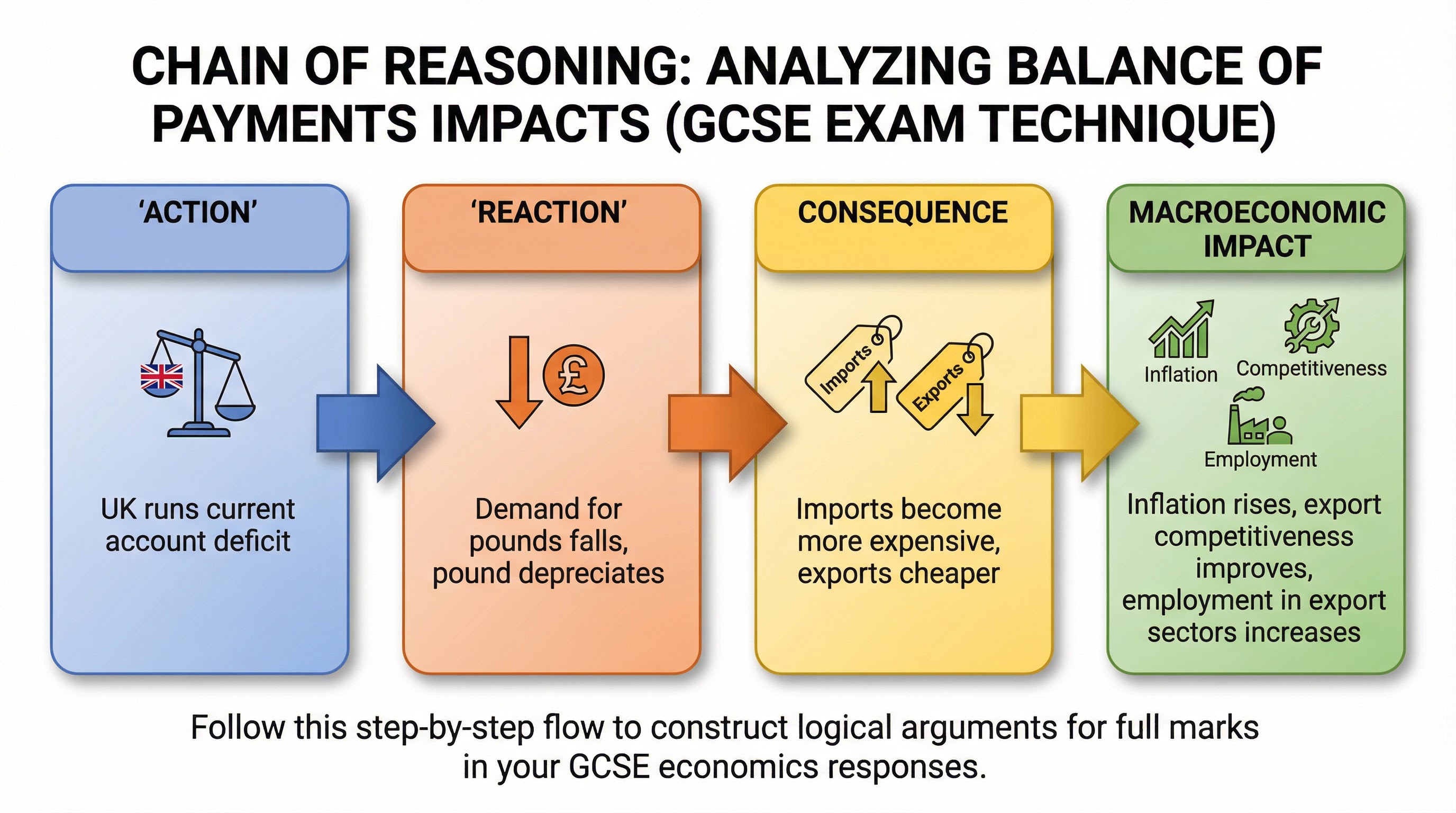
    BALANCE OF PAYMENTS PODCAST SCRIPT - 10 MINUTES Female Voice: Warm, Confident, Enthusiastic Educator Tone [INTRO - 1 MINUTE] Hello and welcome to GCSE Economics Essentials! I'm your tutor for today, and we're diving into one of the most exam-focused topics in the OCR J205 specification: the Balance of Payments, specifically the Current Account. Now, I know what you're thinking - "Balance of Payments sounds complicated!" But trust me, by the end of this ten-minute episode, you'll have the confidence to tackle any exam question on this topic. We'll break down the four components, learn how to calculate balances from data tables, and explore the macroeconomic impacts of surpluses and deficits. This topic is worth significant marks on Paper 2, and examiners love testing your ability to apply data and analyse consequences. So grab a pen, get comfortable, and let's earn those marks together! [CORE CONCEPTS - 5 MINUTES] Right, let's start with the fundamentals. The Balance of Payments is a record of all financial transactions between the UK and the rest of the world over a specific time period, usually one year. For OCR GCSE, you only need to focus on the Current Account - don't get distracted by the Capital Account or Financial Account, they're not on your specification. The Current Account has four components, and you absolutely must memorise these for definition questions. Let's use the mnemonic "Good Students Practice Seriously" to remember them: Goods, Services, Primary income, and Secondary income. First up: Trade in Goods. This is the export and export of physical, tangible products - think cars manufactured in the UK and sold to Germany, or smartphones imported from China. When we export goods, money flows INTO the UK, which is a credit. When we import goods, money flows OUT of the UK, which is a debit. The difference between the value of goods exported and goods imported gives us the Balance of Trade in Goods. Second: Trade in Services. This covers intangible services like tourism, financial services, and business consulting. For example, when a foreign tourist stays in a London hotel, that's a service export for the UK - money comes in. When a UK family holidays in Spain, that's a service import - money goes out. The UK actually has a strong surplus in services, especially in financial services and education. Third: Primary Income. This is where students often lose marks by being too vague. Primary income includes investment income - dividends from shares, interest on loans, and profits from foreign direct investment. For instance, if a UK company owns a factory in India and sends profits back home, that's a credit in primary income. If a foreign investor receives dividends from UK shares, that's a debit. Fourth: Secondary Income. These are transfers with no exchange of goods or services - think foreign aid sent by the UK government, remittances sent home by workers abroad, or pension payments to UK citizens living overseas. If the UK sends foreign aid to a developing country, that's a debit. If a UK resident receives a pension from abroad, that's a credit. Now, here's the calculation you must master. The Current Account Balance equals the sum of all four components: Trade in Goods plus Trade in Services plus Primary Income plus Secondary Income. If the total is positive, we have a Current Account Surplus - more money flowing in than out. If it's negative, we have a Current Account Deficit - more money flowing out than in. Let's talk about the macroeconomic impacts, because this is where the analysis marks are. A Current Account Deficit means the UK is spending more on imports than it earns from exports. This can lead to several consequences. First, it may cause the pound to depreciate because demand for pounds falls - fewer people want to buy UK exports, so they need fewer pounds. Second, a deficit can indicate weak international competitiveness - UK goods and services aren't attractive enough on global markets. Third, if the deficit is large and persistent, it may need to be financed by borrowing from abroad, increasing national debt. However - and this is crucial for evaluation marks - not all deficits are bad. A deficit might result from strong consumer confidence and high import spending, which actually indicates a growing economy. It depends on whether the deficit is short-term or structural. Conversely, a Current Account Surplus means more money is flowing in than out. This can boost employment in export industries, strengthen the currency, and indicate strong competitiveness. But again, context matters - a surplus might also mean weak domestic demand, with consumers not spending enough on imports. [EXAM TIPS & COMMON MISTAKES - 2 MINUTES] Let's talk exam technique, because this is where candidates lose easy marks. First, the biggest mistake: confusing the Government Budget Deficit with the Balance of Payments Deficit. They are completely different. The government budget deficit is about government spending versus tax revenue - that's fiscal policy. The Balance of Payments deficit is about international trade and money flows. Keep them separate in your mind. Second mistake: getting the direction of money flows wrong. Remember, exports bring money IN, imports send money OUT. I've seen students write that imports bring money into the economy - that costs marks. Third mistake: confusing volume and value of trade. If the pound depreciates, the volume of exports might stay the same, but the value in foreign currency changes. Be precise with your language. Fourth mistake: forgetting Primary and Secondary Income when defining the Current Account. Many students only mention exports and imports of goods and services. That's incomplete - you need all four components for full marks. Now, exam technique. When you're given a data table - and you will be - quote the figures explicitly in your answer. For example, "The UK's trade in goods deficit was £137 billion in 2024, as shown in the data." That's AO2 application, and examiners reward it. Use the Chain of Reasoning technique for analysis questions. Start with the Action: "The UK runs a current account deficit." Then the Reaction: "Demand for pounds falls, causing the pound to depreciate." Then the Consequence: "Imports become more expensive, exports become cheaper." Finally, the Macroeconomic Impact: "This may lead to inflation as import prices rise, but export competitiveness improves, potentially increasing employment in export sectors." That logical flow earns you top-level marks. For twelve-mark evaluation questions, your judgement must be supported by the weight of your arguments, not just a summary. Don't write "In conclusion, there are advantages and disadvantages." Instead, write something like "Overall, a current account deficit is more concerning if it is large, persistent, and structural, as this indicates fundamental competitiveness issues. However, a small, short-term deficit during a period of strong economic growth is less worrying." [QUICK-FIRE RECALL QUIZ - 1 MINUTE] Right, let's test your recall. I'll ask a question, pause for three seconds, then give the answer. Cover your notes and see how you do. Question one: What are the four components of the Current Account? Three, two, one... Trade in Goods, Trade in Services, Primary Income, and Secondary Income. Question two: If the UK exports goods worth £300 billion and imports goods worth £450 billion, what is the balance of trade in goods? Three, two, one... A deficit of £150 billion. Question three: What is Primary Income? Three, two, one... Investment income including dividends, interest, and profits from foreign direct investment. Question four: What might cause a current account deficit? Three, two, one... Low international competitiveness, strong consumer demand for imports, or an overvalued currency. Question five: Why might a current account surplus not always be beneficial? Three, two, one... It might indicate weak domestic demand or under-consumption in the economy. How did you do? If you got four or five correct, you're on track. If not, go back and review the core concepts section. [SUMMARY & SIGN-OFF - 1 MINUTE] Brilliant work today! Let's recap the essentials. The Current Account has four components: Goods, Services, Primary income, and Secondary income - remember "Good Students Practice Seriously." A deficit means more money out than in, which can lead to currency depreciation, competitiveness concerns, and potential debt. A surplus means more money in than out, which can boost employment and strengthen the currency, but might also indicate weak domestic demand. For exam success, always quote data when provided, use the Chain of Reasoning for analysis, and ensure your evaluation includes a supported judgement, not just a summary. Avoid confusing the government budget deficit with the balance of payments deficit, and always include all four components when defining the Current Account. This topic appears frequently on Paper 2, often worth eight to twelve marks, so mastering it is essential. Practice calculating balances from data tables, and always link your analysis to macroeconomic impacts like employment, growth, and inflation. Keep practicing, stay focused, and remember - examiners reward specific knowledge, clear analysis, and supported judgements. You've got this! Good luck with your revision, and I'll see you in the next episode of GCSE Economics Essentials. Bye for now!

    Key Terms & Definitions

    Current Account
    A component of the Balance of Payments that records all financial transactions relating to trade in goods and services, plus primary and secondary income.
    Balance of Trade
    The difference between the value of a country's visible exports (goods) and visible imports (goods).
    Primary Income
    Income earned from the loan of factors of production abroad. This includes interest, profits, and dividends (investment income) and wages (employment income).
    Secondary Income
    One-way payments where no good or service is exchanged. Also known as current transfers.
    Exchange Rate
    The price of one currency expressed in terms of another currency.
    Depreciation
    A fall in the value of a currency in a floating exchange rate system.

    Worked Examples

    Practice Questions

    Balance of Payments

    OCR
    GCSE
    Economics

    This guide provides a comprehensive, exam-focused breakdown of the Balance of Payments for OCR GCSE Economics (J205). It dissects the Current Account, explains how to analyze data, and provides proven techniques to help candidates secure top marks.

    6
    Min Read
    3
    Examples
    5
    Questions
    6
    Key Terms
    🎙 Podcast Episode
    Balance of Payments
    0:00-0:00

    Study Notes

    A visual overview of the components and flows within the Balance of Payments.

    Overview

    The Balance of Payments is a crucial topic in macroeconomics, and for the OCR J205 specification, your focus is squarely on the Current Account. This guide will equip you with the precise knowledge and skills needed to excel. Examiners expect candidates to not only define the four key components but also to interpret data, calculate balances, and analyze the real-world consequences of current account deficits and surpluses on the UK economy. This involves understanding the impact on major macroeconomic objectives like employment, economic growth, and inflation. Mastery of this topic is essential for demonstrating AO2 (Application) and AO3 (Analysis) skills, which together constitute 65% of your final grade. This guide will walk you through the theory, provide worked examples, and highlight common pitfalls to ensure you are fully prepared.

    Listen to our 10-minute podcast guide on the Balance of Payments.

    The Four Components of the Current Account

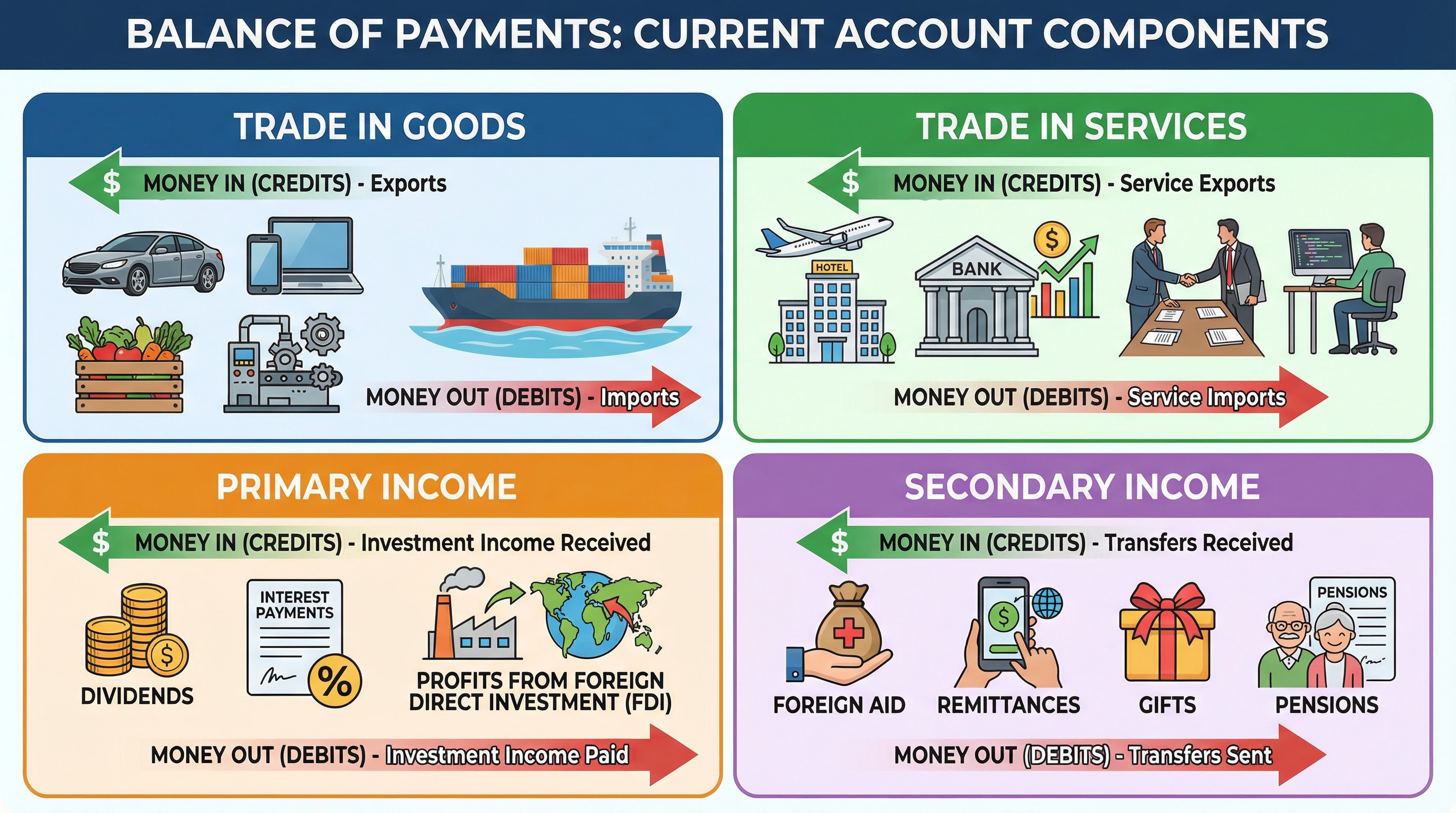
    To secure full marks, you must be able to define and distinguish between the four components of the Current Account. These are the channels through which money flows into (credits) and out of (debits) the country.
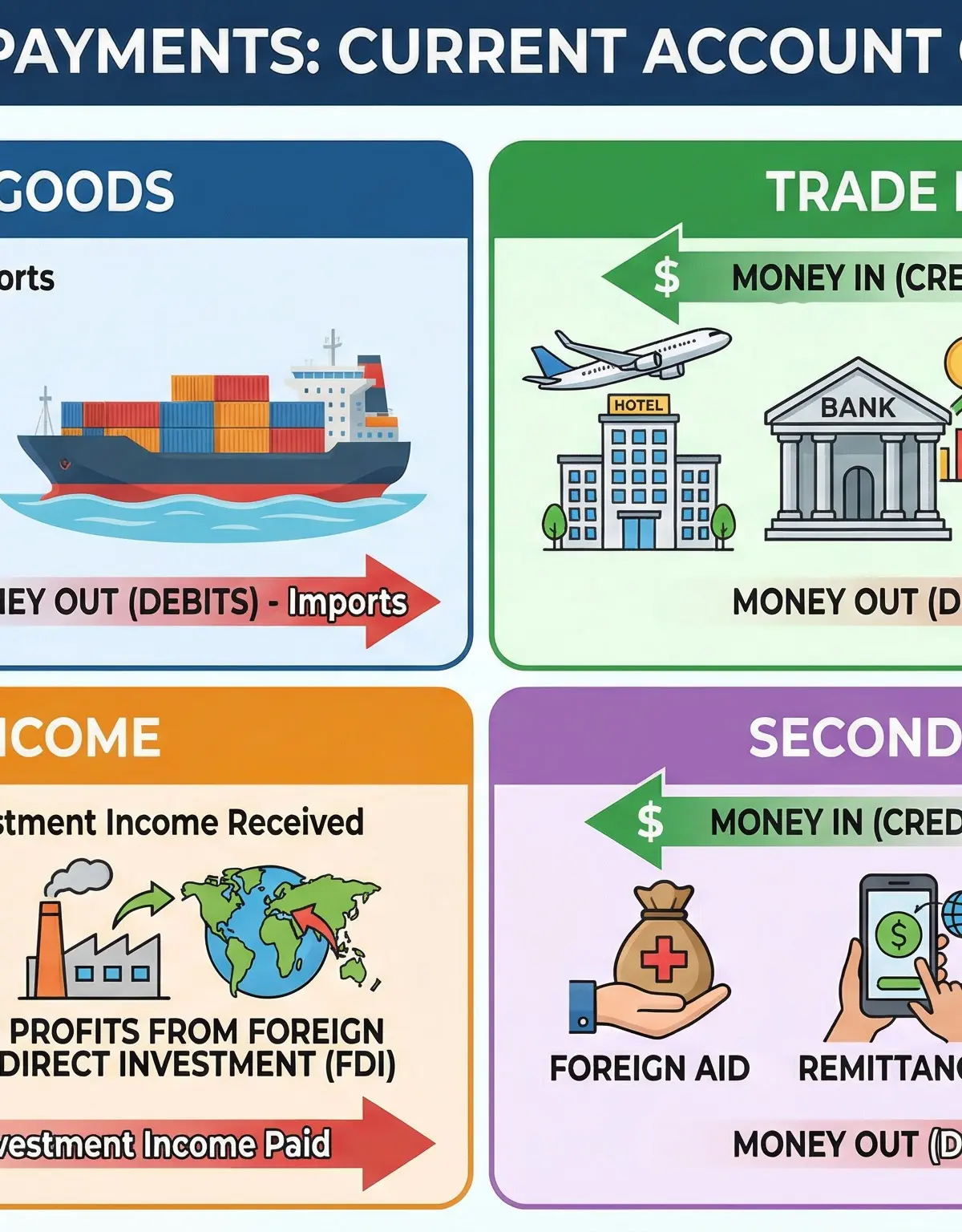
    The four components of the Current Account.

    1. Trade in Goods

    What it is: This is the most straightforward component, representing the buying and selling of physical, tangible items.

    • Exports (Credits): Goods produced in the UK and sold to other countries, leading to an inflow of money. For example, the sale of a UK-manufactured car to a customer in France.
    • Imports (Debits): Goods produced abroad and bought by UK residents, leading to an outflow of money. For example, the purchase of a smartphone made in South Korea.
      Key Term: The difference between the value of goods exported and imported is known as the Balance of Trade in Goods.

    2. Trade in Services

    What it is: This component tracks the buying and selling of intangible services.

    • Exports (Credits): Services provided by UK firms to foreigners. Examples include a US tourist paying for a hotel in London, a German company using a UK-based law firm, or an overseas student paying tuition fees to a UK university.
    • Imports (Debits): Services provided by foreign firms to UK residents. For example, a UK citizen flying with an Irish airline or using a US-based streaming service.
      Key Fact: The UK typically runs a significant surplus on its trade in services, thanks to its strong financial, legal, and educational sectors.

    3. Primary Income

    What it is: This is income earned from investments and employment abroad. It's a return on factors of production. Examiners look for precision here.

    • Credits: Income flowing into the UK. This includes dividends from shares owned in foreign companies, interest on loans made to foreign entities, and profits repatriated by UK firms from their overseas operations (Foreign Direct Investment - FDI).
    • Debits: Income flowing out of the UK. This includes profits sent abroad by foreign-owned companies operating in the UK or interest paid to overseas lenders.

    4. Secondary Income

    What it is: These are one-way transfers where no good or service is exchanged. They are often referred to as 'current transfers'.

    • Credits: Money transferred to the UK. Examples include remittances sent home by UK citizens working abroad or pension payments received from a foreign government.
    • Debits: Money transferred from the UK. This includes UK government contributions to international organizations (like the UN) or foreign aid payments to developing countries.

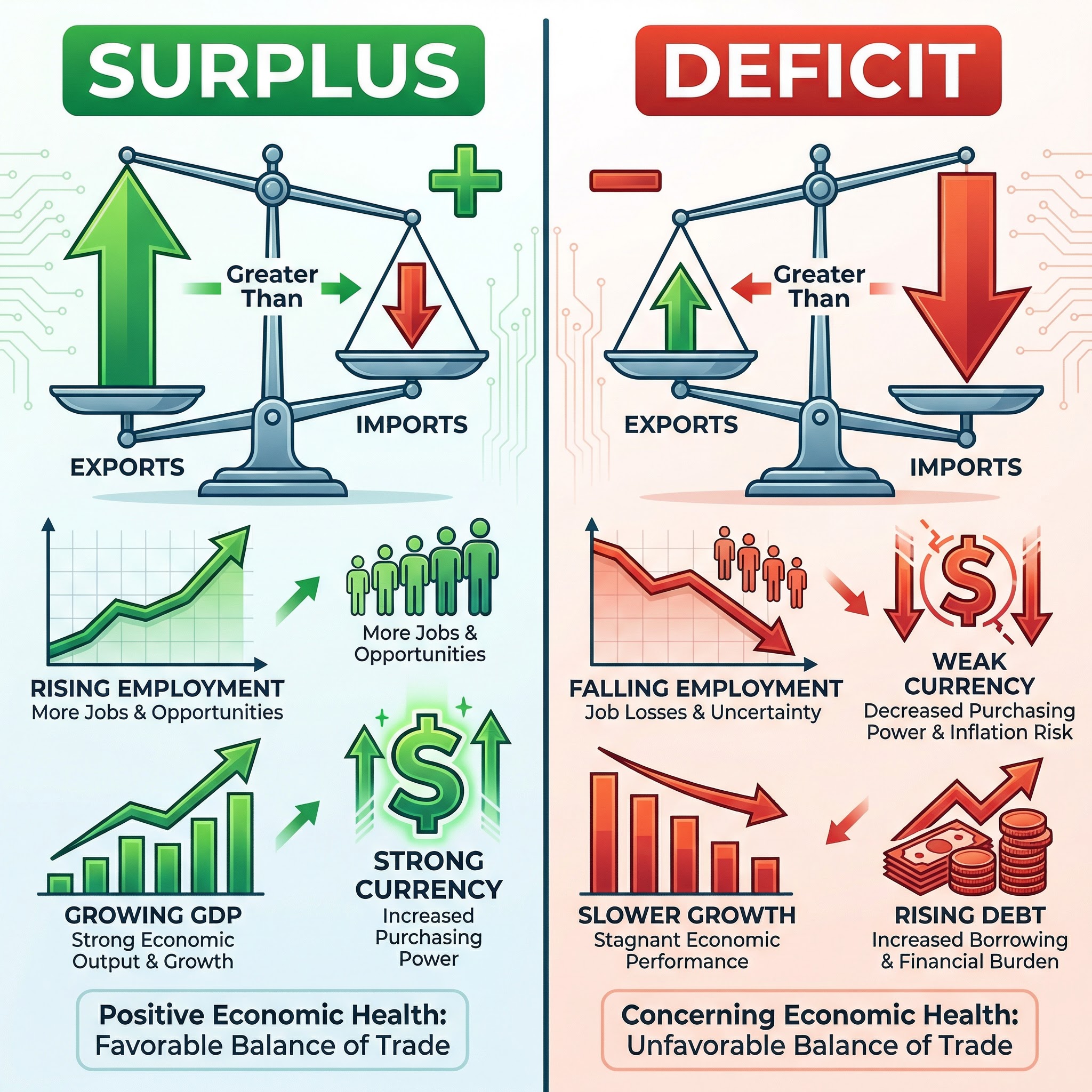
    Current Account Deficits and Surpluses

    A country's Current Account balance is calculated by summing the balances of all four components.

    • Current Account Deficit: Total debits exceed total credits. More money is flowing out of the economy than is flowing in. This has been the UK's typical position for many years.
    • Current Account Surplus: Total credits exceed total debits. More money is flowing into the economy than is flowing out.
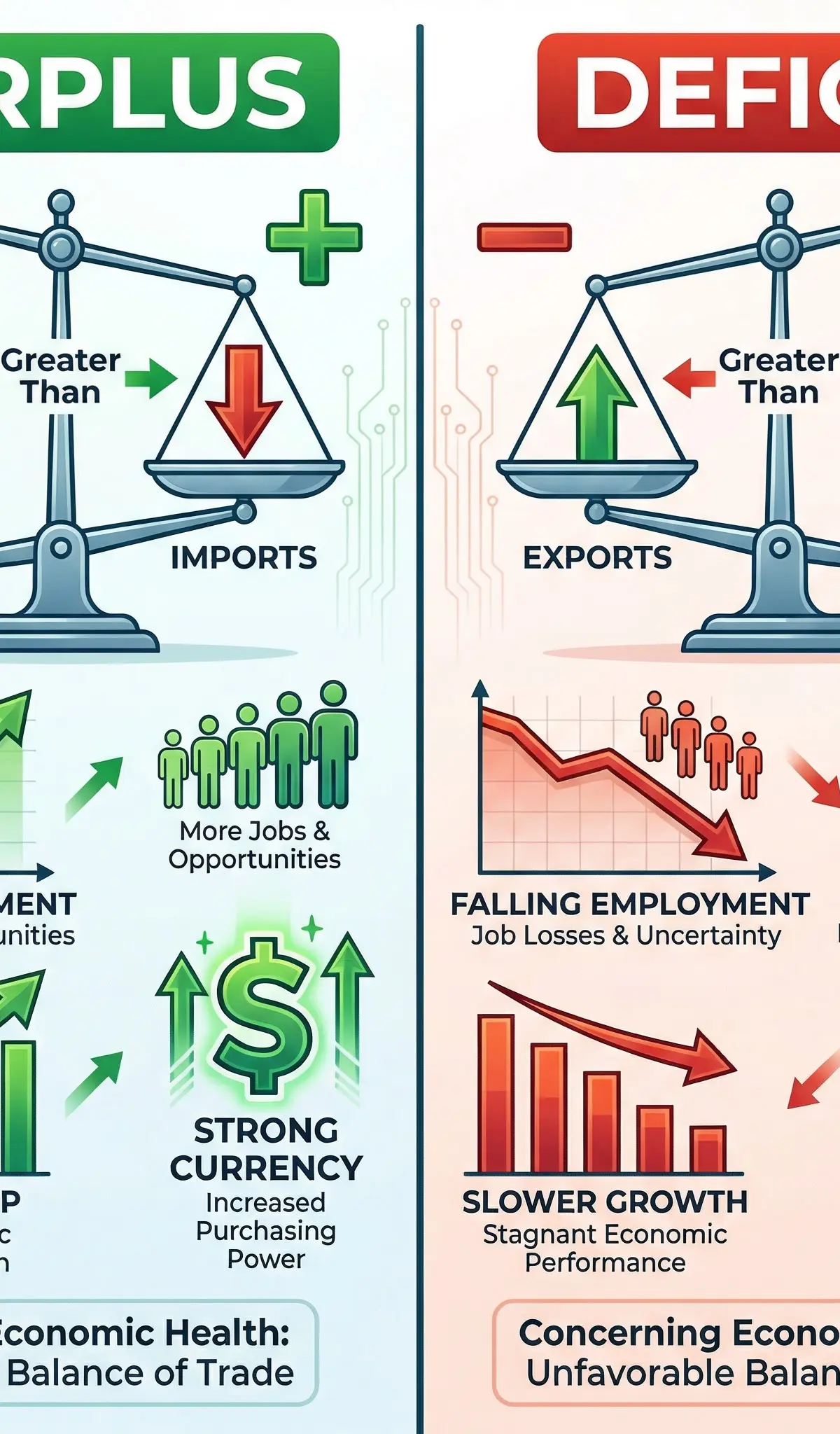
    Comparing a Current Account Surplus and Deficit.

    Consequences of a Current Account Deficit

    • Currency Depreciation: A deficit means there is a higher supply of pounds (as UK residents sell them to buy imports) than demand for pounds (from foreigners buying UK exports). This can cause the value of the pound to fall.
    • Financing the Deficit: A persistent deficit must be financed by borrowing from abroad or selling domestic assets to foreigners, which can lead to an increase in national debt and future income outflows (debits on the primary income account).
    • Indication of Uncompetitiveness: A large deficit may signal that a country's industries are struggling to compete internationally, potentially leading to job losses in those sectors.
    • Potential for Growth: However, a deficit can also be a sign of a strong economy where confident consumers are spending heavily, including on imported goods.

    Consequences of a Current Account Surplus

    • Currency Appreciation: A surplus increases the demand for a country's currency, causing its value to rise. This can make exports more expensive and imports cheaper, potentially harming export-focused industries over time.
    • Sign of Competitiveness: It indicates that a country is selling a high volume of goods and services that are in demand globally.
    • Potential for Weak Domestic Demand: A surplus could also suggest that domestic consumption is too low, with consumers saving instead of spending, which could restrain economic growth.
    Visual Resources

    3 diagrams and illustrations

    The four components of the Current Account.
    The four components of the Current Account.
    Comparing a Current Account Surplus and Deficit.
    Comparing a Current Account Surplus and Deficit.
    Use the Chain of Reasoning to build powerful analytical arguments.
    Use the Chain of Reasoning to build powerful analytical arguments.

    Worked Examples

    3 detailed examples with solutions and examiner commentary

    Practice Questions

    Test your understanding — click to reveal model answers

    Q1

    Explain how a rise in the UK's exchange rate could affect its current account balance. (6 marks)

    6 marks
    standard

    Hint: Think about the effect on the price of exports and imports. Use the mnemonic SPICED.

    Q2

    Distinguish between primary and secondary income on the current account. (4 marks)

    4 marks
    standard

    Hint: One is a return for a factor of production, the other is a one-way transfer.

    Q3

    Analyse why a large, persistent current account deficit might be a concern for the UK government. (8 marks)

    8 marks
    hard

    Hint: Consider the long-term consequences for debt, employment, and the value of the pound.

    Q4

    Calculate the balance of trade in services. (1 mark)

    1 marks
    easy

    Hint: Use the data from the worked example table.

    Q5

    Define 'Balance of Payments'. (2 marks)

    2 marks
    easy

    Hint: Think about what it records and between whom.

    Explore this topic further

    View Topic PageAll Economics Topics

    Key Terms

    Essential vocabulary to know