OCR · GCSE · English Language
Course version: J351 · Version from Sept 2017
Communicating information and ideas (01)
This topic tests your ability to read closely, analyse language and structure, and produce highly effective original writing. You will be assessed on how well you understand writers' methods and how successfully you can apply those methods in your own creative and transactional writing.
- 5 min read
- 3 worked examples
- 5 practice questions
- 8 key terms
Study Notes
Overview
 Open full-size image (opens in a new tab)
This unit focuses on the core skills of reading and writing. In the reading section, you are required to respond to unseen literary prose texts, demonstrating your ability to draw inferences, analyse language and structure, and compare writers' viewpoints. In the writing section, you must produce original creative and transactional writing that applies narrative techniques and linguistic conventions to create deliberate effects on the reader.
Listen to our comprehensive revision podcast to kickstart your study session:
Reading Skills
Identifying Information & Ideas
When approaching an unseen text, your first task is to locate both explicit and implicit information. Explicit information is clearly stated on the page, whereas implicit information requires you to read between the lines. Examiners reward candidates who can draw perceptive inferences and justify their points of view using close, judiciously selected textual evidence.
Analysing Language
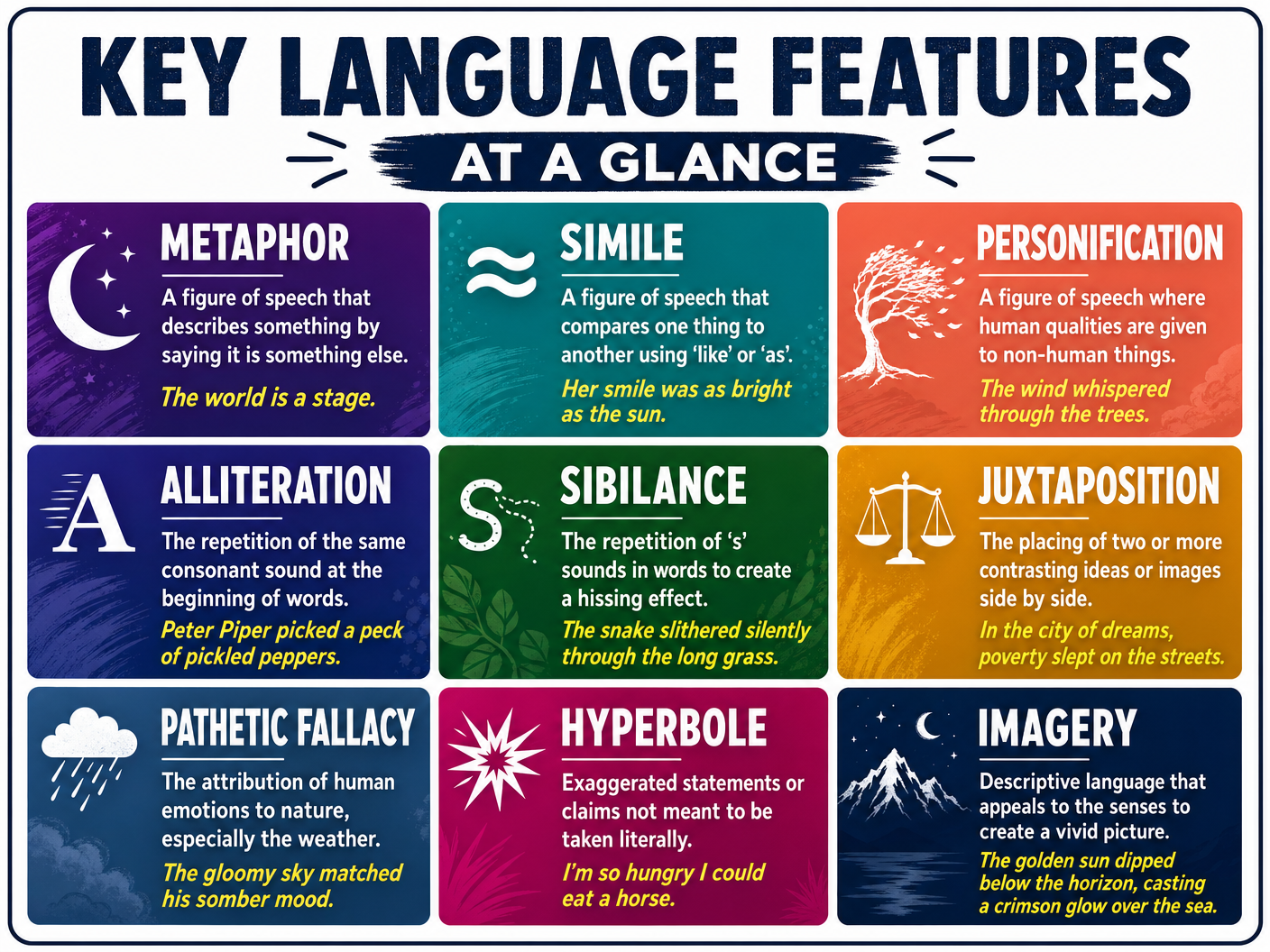
Key Language Features to Identify
| Feature | Definition | Effect on Reader | Example |
|---|---|---|---|
| Metaphor | Describing something by saying it is something else | Creates vivid imagery, forces the reader to see the subject in a new, often startling way | 'The classroom was a zoo.' |
| Simile | Comparing two things using 'like' or 'as' | Helps the reader visualise an unfamiliar concept by comparing it to a familiar one | 'Her smile was as bright as the sun.' |
| Personification | Giving human qualities to non-human things | Brings the inanimate to life, often reflecting the mood of a scene or character | 'The wind whispered through the trees.' |
| Pathetic Fallacy | Giving human emotions to nature/weather | Establishes atmosphere and often foreshadows narrative events | 'The gloomy sky matched his somber mood.' |
| Alliteration | Repetition of consonant sounds at the start of words | Draws attention to a phrase, affecting pace and tone (e.g., harsh 'c' sounds create aggression) | 'The cruel, cold wind cut through him.' |
| Sibilance | Repetition of 's' sounds | Creates a hissing, whispering, or soothing auditory effect | 'The snake slithered silently.' |
| Juxtaposition | Placing contrasting ideas side by side | Highlights differences, creating tension or emphasizing a specific trait | 'In the city of dreams, poverty slept on the streets.' |
 Open full-size image (opens in a new tab)
Analysing Structure
Structural analysis is often the differentiator between mid-tier and top-tier candidates. When analysing structure, consider the journey the writer takes the reader on. Look for:
- Openings: Are we dropped in medias res (into the middle of the action)?
- Shifts in focus: Does the writer move from a panoramic view of a setting to a tight close-up on a character?
- Narrative perspective: Who is telling the story, and how reliable are they?
- Sentence length variation: Are short sentences used to build tension, followed by complex sentences for descriptive flow?
- Paragraph structure: Does a single-sentence paragraph create a sudden, jarring impact?
- Cyclical structure: Does the ending return to an image from the beginning, creating a sense of inevitability or entrapment?
Evaluating Critically
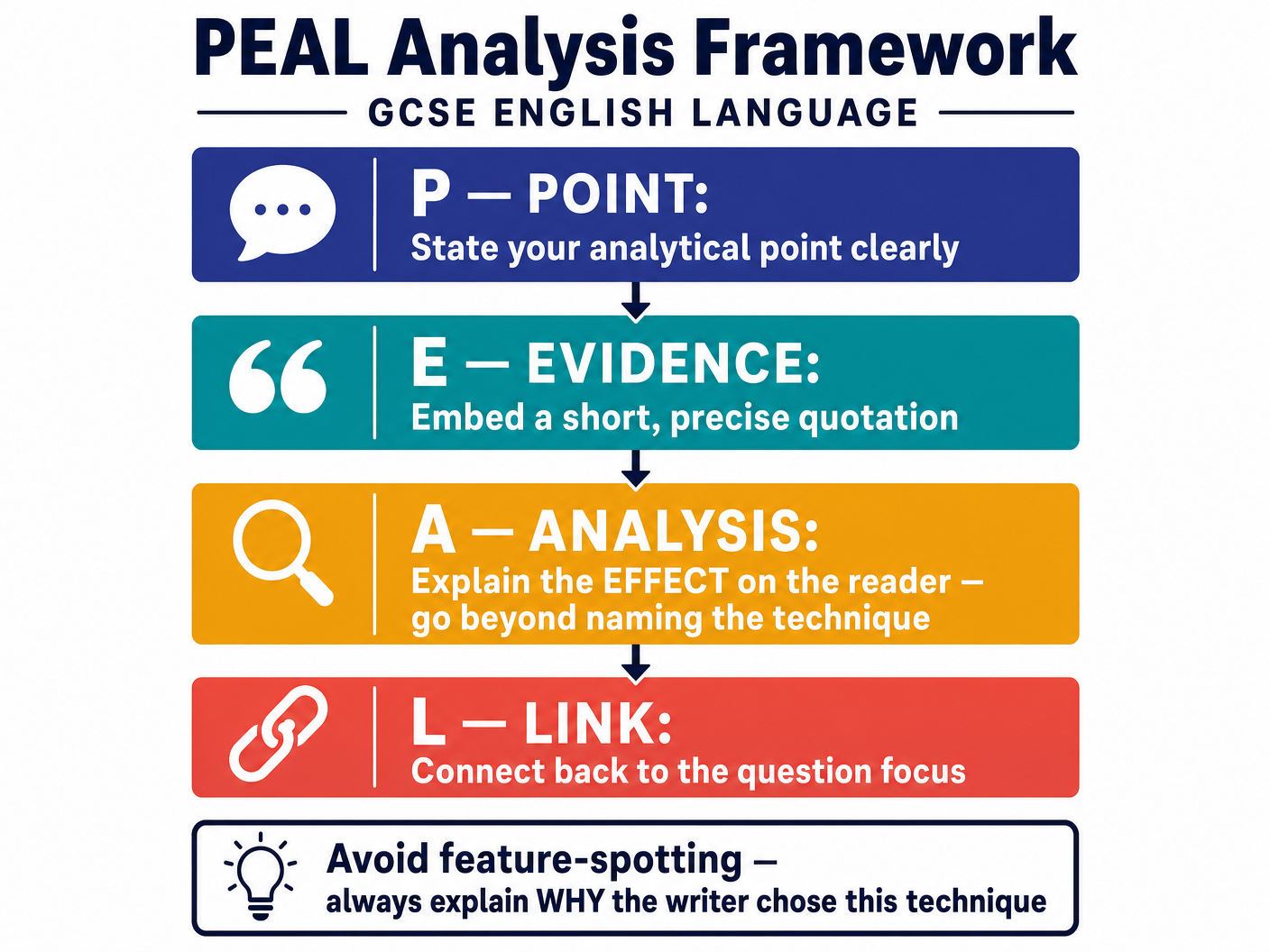
Evaluation requires you to form a judgement about how successfully a writer has achieved their aims. You must express your opinions with supporting evidence. Use the statement-evidence-analysis-link framework to ensure your evaluation is grounded in the text rather than vague personal opinion.
 Open full-size image (opens in a new tab)
Comparing Writers' Viewpoints
When comparing texts, you must identify the differing viewpoints, compare the methods the writers use to convey those viewpoints, and evaluate their effectiveness. Use comparison connectives such as 'similarly', 'in contrast', and 'whereas' to explicitly link the texts throughout your response.
 Open full-size image (opens in a new tab)
Writing Skills
Creative Writing
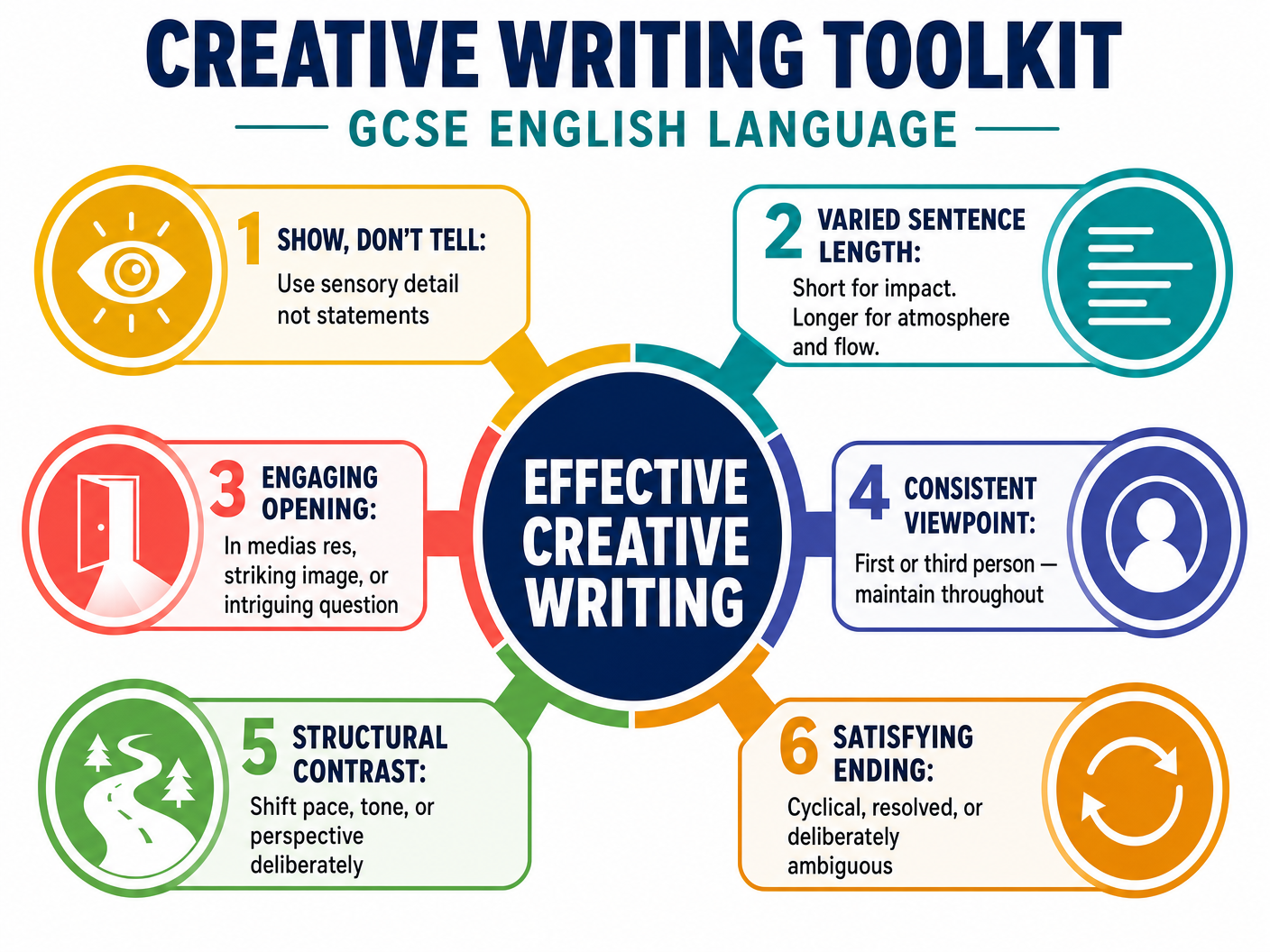
Original creative writing must maintain a consistent viewpoint and be structured to create deliberate effects rather than just telling a chronological story. Apply the 'show, don't tell' principle: use sensory description to evoke mood rather than stating emotions explicitly. Employ varied sentence structures and ensure your opening is engaging and your ending is satisfying.
 Open full-size image (opens in a new tab)
Transactional/Non-Fiction Writing
For letters, articles, speeches, and leaflets, you must adapt your tone and register to suit the specified purpose and audience. Use the AFOREST framework to embed persuasive techniques effectively, but remember that a coherent, logical structure is just as important as individual rhetorical devices.
Technical Accuracy (SPaG)
Spelling, punctuation, and grammar (SPaG) constitute a significant portion of your writing marks. Use ambitious punctuation (semicolons, colons, dashes, parenthetical commas) to demonstrate control. Ensure paragraph cohesion by using appropriate discourse markers to guide the reader through your argument or narrative.
Check what you remember
Read the wording for your board, then hide it and explain Inference in your own words. Rough notes are fine. This is a self-check, with no mark or grade.
Reference: OCR
A conclusion reached on the basis of evidence and reasoning; reading between the lines.
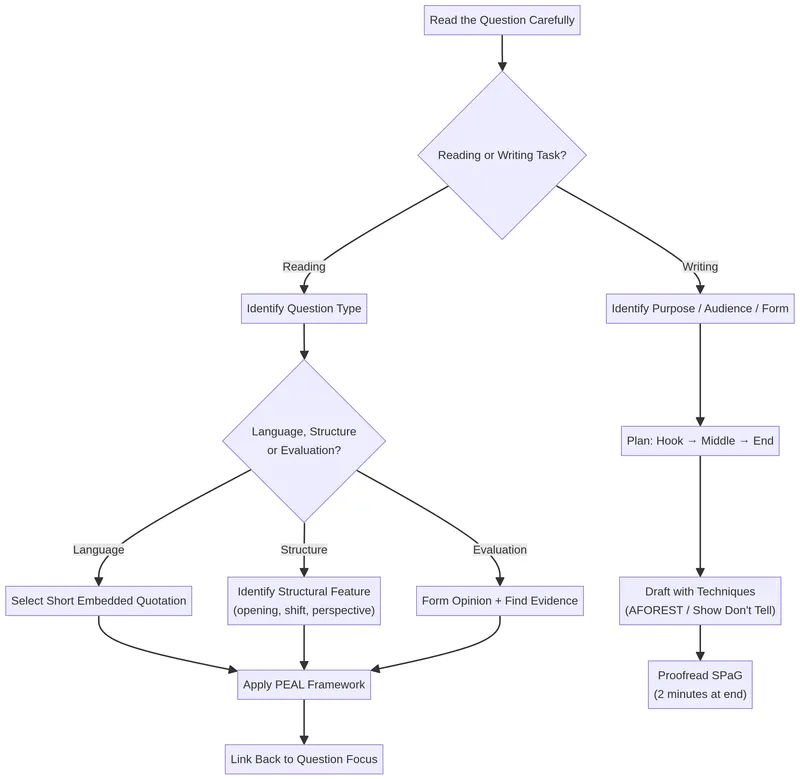
Interactive Diagrams
2 interactive diagrams to visualise key concepts
Conceptual Flow Outline
English Language exam approach flowchart
Conceptual Flow Outline
Framework for comparing writers' viewpoints
Worked Examples
3 worked examples — open one to explore the question and available guidance.
Practice Questions
Try the question, then reveal an answer plan or example response
Read lines 1-5. List four things we learn about the setting.
Hint: Only look at the specified lines. Keep your answers brief. You do not need to write in full sentences.
How does the writer use language to describe the character's fear?
Hint: Identify a technique, quote it, and explain its effect. Focus on connotations of specific words.
Evaluate the statement: 'The ending of the story is highly effective in creating a sense of mystery.'
Hint: Take a clear stance. Use evidence to support your view. Analyse how the writer's structural and linguistic choices create that mystery.
Write a story with the title 'The Discovery'.
Hint: Plan your structure. Use 'show, don't tell'. Vary your sentence lengths for impact. Ensure your SPaG is accurate.
Compare how the writers of Text A and Text B convey their perspectives on city life.
Hint: Identify the viewpoint in each text. Compare them explicitly using connectives. Analyse the methods each writer uses.
Ready to test yourself interactively?
Active recall beats reading alone. Answer questions on Communicating information and ideas (01) with instant AI scoring and mark scheme guidance.
A week of Premium from your first lesson · Then the free plan continues · No card, no charge
Exam technique
How to turn what you know into marks
How to approach the question
Always read the question before reading the text. Highlight the key focus words. For reading questions, track through the text chronologically. For writing, plan your structure before you write a single sentence.
How to structure your answer
Reading: Use PEAL. Writing: Plan → Hook opening → Developed middle → Satisfying ending → Proofread.
Timing
Allocate roughly 1.5 minutes per mark for reading questions (e.g., 8-mark question = 12 mins). For the 40-mark writing section, spend 5-10 minutes planning, 30 minutes writing, and 5 minutes proofreading.
Common pitfalls
- Feature-spotting without analysing the effect on the reader
- Using block quotations instead of short, embedded quotes
- Writing a narrative without planning the ending first
- Forgetting to proofread for basic spelling and punctuation errors
- Summarising the plot instead of analysing the writer's methods
What the command words want
- Compare
- Use a point-by-point or block structure. Always use comparative connectives and link back to the specific focus of the question.
- Evaluate
- Give your opinion clearly, support it with textual evidence, and analyse how the writer's methods justify your view.
- Identify/List
- Find and write down specific information — brief answers are sufficient. Do not waste time analysing.
- Write a [text type]
- Match the conventions of the form, sustain the appropriate register, and consciously use ambitious vocabulary and punctuation.
- How does the writer use language
- Name the technique, quote it precisely, and explain the specific EFFECT on the reader.
- How does the writer use structure
- Focus on shifts, patterns, narrative perspective changes, and paragraphing — always link to meaning.
Watch or listen (optional)
Test your understanding of Communicating information and ideas (01)
Active recall beats re-reading. Take an instant quiz now to test what you’ve learned and lock it into long-term memory.
A week of Premium from your first lesson · Then the free plan continues · No card, no charge