OCR · GCSE · English Language
Course version: J351 · Version from Sept 2017
Exploring effects and impact (02)
This study guide masters Component 02: Exploring Effects and Impact. It develops the core skills of analysing how writers use language and structure to create meaning in reading tasks, and how to make deliberate, effective choices in your own creative writing.
- 6 min read
- 3 worked examples
- 5 practice questions
- 8 key terms
Study Notes
Overview
Component 02 focuses on two critical skill areas: reading literary prose texts and producing original creative writing. In the reading section, candidates are assessed on their ability to respond to unseen 20th and/or 21st-century literary prose texts, analysing how writers make choices to create specific effects. In the writing section, candidates must produce original creative writing, applying narrative techniques and linguistic conventions to create deliberate effects on the reader.
This component is essentially about the relationship between writer and reader. The reader analyses the choices made; the writer makes deliberate choices to influence the reader.
Listen to the Podcast
Enhance your revision by listening to our 10-minute deep dive into this topic. Our expert tutor breaks down the core concepts, common pitfalls, and provides a quick-fire recall quiz.
Reading Skills
Identifying Information & Ideas
The foundation of reading comprehension is the ability to locate and retrieve information. Examiners look for your ability to identify both explicit and implicit ideas.
- Explicit information is stated directly in the text (e.g., "The door was red").
- Implicit information requires inference; you must read between the lines (e.g., "She slammed the door" implies anger, though the word 'anger' is not used).
When drawing inferences, you must always justify your points of view using close textual evidence.
Analysing Language
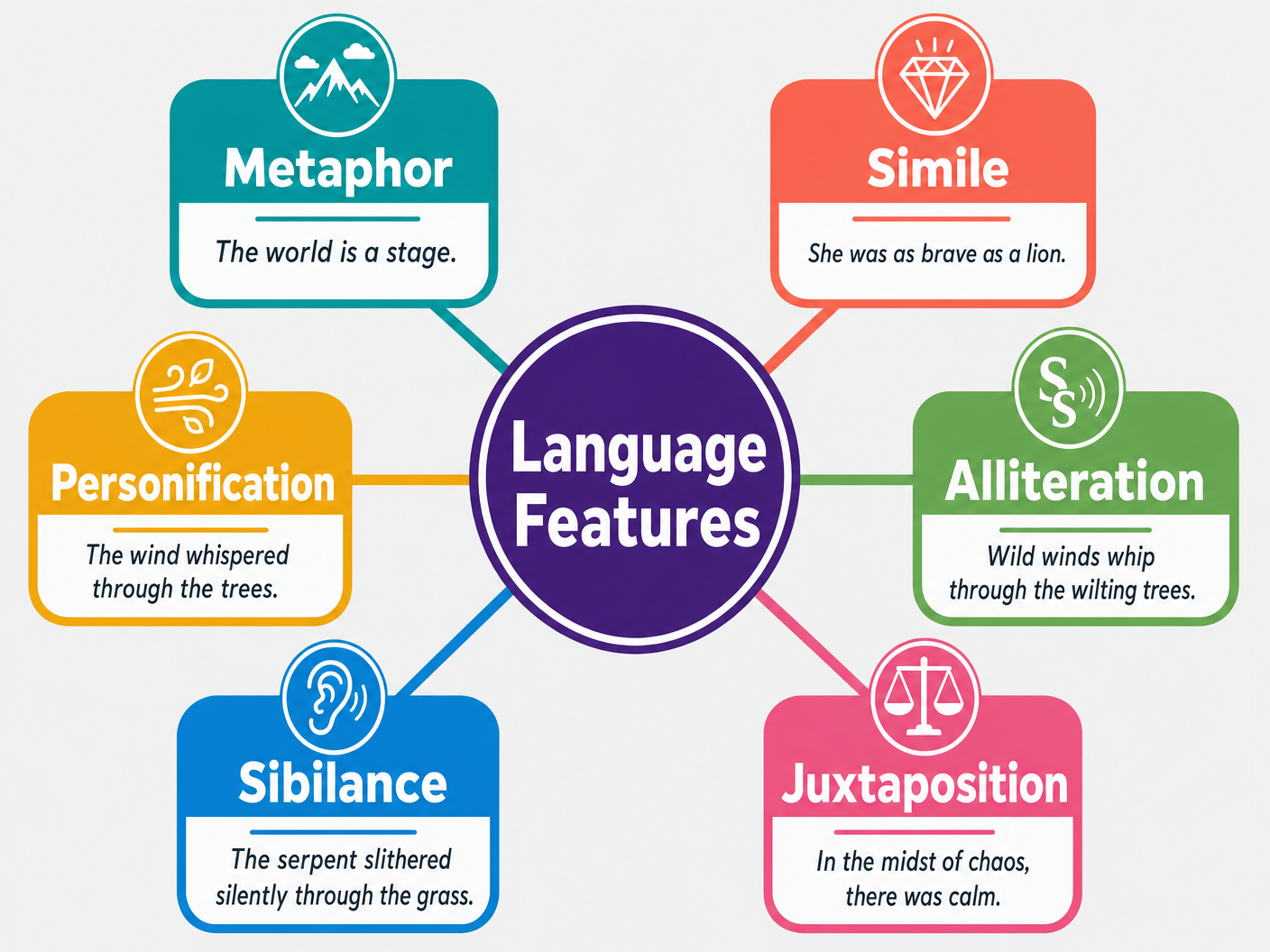
This is where candidates secure the most marks. You must comment on writers' choices of vocabulary, form, and grammatical features, explaining how these create meaning. Avoid feature-spotting (merely naming a technique without explaining its effect).
 Open full-size image (opens in a new tab)
Key Language Features to Identify
| Feature | Definition | Effect on Reader | Example |
|---|---|---|---|
| Metaphor | A direct comparison stating one thing is another. | Creates a vivid, visceral image; can make abstract concepts tangible. | "The house was a rotting carcass." |
| Simile | A comparison using 'like' or 'as'. | Helps the reader visualise something unfamiliar by comparing it to something familiar. | "His hands were like gnarled roots." |
| Personification | Giving human qualities to non-human objects. | Brings the inanimate to life, often reflecting mood or creating atmosphere. | "The wind whispered secrets." |
| Pathetic Fallacy | Using weather or environment to reflect human emotion. | Sets the tone instantly; foreshadows events. | "Thunder cracked as the argument began." |
| Alliteration | Repeated consonant sounds at the start of words. | Draws attention to specific phrases; can create a harsh or soft rhythm. | "Cruel, cold calculations." |
| Sibilance | Repeated soft 's' or 'sh' sounds. | Can create a sinister, hissing tone, or a soothing, hushed atmosphere. | "The serpent slithered silently." |
| Juxtaposition | Placing contrasting ideas side by side. | Highlights differences; creates tension or surprise. | "A diamond sparkling in the mud." |
| Semantic Field | Words linked by a common theme or subject. | Builds a cumulative, overwhelming impression or atmosphere. | "Blood, weapons, attack, wounds" (War). |
 Open full-size image (opens in a new tab)
Analysing Structure
Structure refers to how a text is organised. You must evaluate how form and structure contribute to effectiveness and impact. Consider the whole text, not just sentence-level features.
- Openings & Endings: How does the text hook the reader? Does it use a cyclical structure (ending where it began) to create a sense of entrapment or completion?
- Shifts in Focus: Does the narrative move from setting to character, or from present to past (flashback)? Why?
- Sentence Length: Short sentences build pace, tension, and panic. Long, complex sentences can slow the pace, creating a reflective or overwhelming mood.
- Narrative Perspective: First-person ("I") creates intimacy and bias. Third-person omniscient provides a god-like overview.
Evaluating Critically
Evaluation requires you to form a judgment about a text's effectiveness. You must state your opinion, provide evidence, and analyse why the writer's methods work.
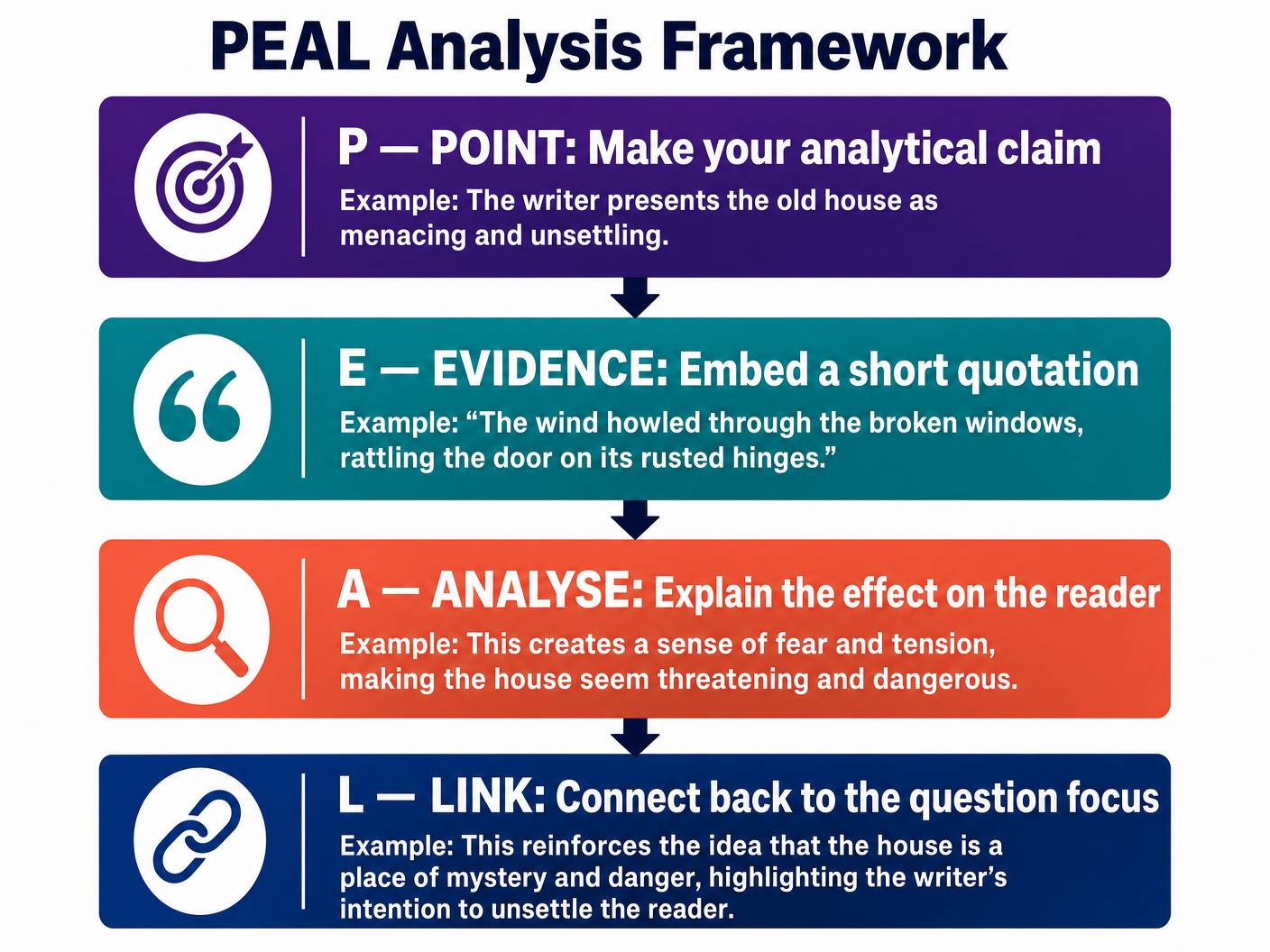
Formula: Statement → Evidence → Analysis → Link back to statement.
Example: "To a great extent, the writer successfully builds tension through the use of short, fragmented sentences..."
Comparing Writers' Viewpoints
When comparing texts, use a structured framework.
- Identify the viewpoint in Text A.
- Identify the viewpoint in Text B.
- Compare the methods used to convey these viewpoints.
- Evaluate which is more effective and why.
Writing Skills
Creative Writing
In creative writing, you must organise and structure ideas to create deliberate effects. You are not just telling a story; you are crafting an experience.
- Show, Don't Tell: Instead of writing "He was nervous," write "His hands trembled as he reached for the handle."
- Consistent Viewpoint: Maintain your chosen narrative perspective and tone throughout the piece.
- The One-Scene Rule: Avoid sprawling, multi-year epics. Focus on a single scene, moment, or hour, and describe it with intense, sensory detail.
- Deliberate Structure: Plan your opening (hook), development (rising action/shift in focus), and ending (resolution or cliffhanger).
Transactional/Non-Fiction Writing
If required to write a speech, article, or letter, you must adapt your tone to suit the Purpose, Audience, and Form (PAF). Use persuasive techniques systematically.
Technical Accuracy (SPaG)
Spelling, Punctuation, and Grammar (SPaG) marks are crucial.
- Use a range of sentence structures (simple, compound, complex) for clarity, purpose, and effect.
- Employ ambitious punctuation correctly: semicolons to link related independent clauses; colons to introduce lists or dramatic statements; dashes for emphasis.
- Ensure paragraph cohesion using appropriate discourse markers (e.g., 'Furthermore', 'Conversely', 'Consequently').
Check what you remember
Read the wording for your board, then hide it and explain Inference in your own words. Rough notes are fine. This is a self-check, with no mark or grade.
Reference: OCR
A conclusion reached on the basis of evidence and reasoning; reading between the lines.
Interactive Diagrams
2 interactive diagrams to visualise key concepts
Conceptual Flow Outline
Exam Approach Flowchart
Conceptual Flow Outline
Comparison Question Framework
Worked Examples
3 worked examples — open one to explore the question and available guidance.
Practice Questions
Try the question, then reveal an answer plan or example response
Read lines 1-5. List four things you learn about the setting.
Hint: Only look at the specified lines. Keep your answers brief. You do not need to write in full sentences.
How does the writer use language in lines 10-15 to describe the storm?
Hint: Focus on specific words, phrases, and techniques. Explain how they make the storm seem dangerous.
Write a description suggested by this image (a crowded city street in the rain).
Hint: Do not write a story with dialogue and plot. Focus purely on describing the atmosphere using sensory details.
You now need to think about the whole of the text. How has the writer structured the text to interest you as a reader?
Hint: Look at the opening, the middle (shifts in focus), and the ending. Don't analyse words; analyse the order of information.
A student said, 'The writer makes the ending of the story feel completely hopeless.' To what extent do you agree?
Hint: State your opinion clearly. Use evidence from the ending to support your view. Evaluate how the writer's choices make you feel that way.
Ready to test yourself interactively?
Active recall beats reading alone. Answer questions on Exploring effects and impact (02) with instant AI scoring and mark scheme guidance.
A week of Premium from your first lesson · Then the free plan continues · No card, no charge
Exam technique
How to turn what you know into marks
How to approach the question
Always read the question before reading the text. Highlight the specific focus (e.g., 'how does the writer create tension'). For writing, always plan your structure before putting pen to paper.
How to structure your answer
Reading: Use PEAL. Writing: Plan -> Hook opening -> Developed middle -> Satisfying ending -> Proofread.
Timing
As a general rule, allocate roughly 1.5 minutes per mark. A 4-mark question should take 5-6 minutes; an 8-mark question should take 12 minutes. For the 24-mark writing section, spend 5 minutes planning, 35 minutes writing, and 5 minutes proofreading.
Common pitfalls
- Feature-spotting without analysing the effect on the reader.
- Using long, block quotations instead of short, embedded ones.
- Writing a narrative that covers years of time instead of focusing on a single, detailed scene.
- Forgetting to leave time to check spelling, punctuation, and grammar.
- Summarising or retelling the story rather than analysing the writer's methods.
What the command words want
- Compare
- Use a comparative framework (e.g., 'Similarly', 'In contrast'). Always compare the *methods* the writers use, not just the content.
- Evaluate
- Give a clear opinion on the statement provided. Use evidence to justify your view. Discuss *how* the writer's methods make you feel that way.
- Identify/List
- Find explicit facts in the text. Bullet points or short sentences are fine. Do not waste time analysing.
- Write a [text type]
- Adopt the correct format (e.g., letter, story). Maintain a consistent register and viewpoint. Focus on deliberate vocabulary and varied punctuation.
- How does the writer use language
- Identify specific words or techniques, quote them, and explain their precise effect on the reader's thoughts or feelings.
- How does the writer use structure
- Look at the beginning, middle, and end. Discuss shifts in focus, paragraphing, and sentence length. Link these to the overall atmosphere or meaning.
Watch or listen (optional)
Test your understanding of Exploring effects and impact (02)
Active recall beats re-reading. Take an instant quiz now to test what you’ve learned and lock it into long-term memory.
A week of Premium from your first lesson · Then the free plan continues · No card, no charge