OCR · GCSE · English Language
Course version: J351 · Version from Sept 2017
Writing for audience, impact and purpose
This topic focuses on developing the essential skills required to adapt your writing style, tone, and register for specific audiences and purposes. Examiners heavily reward candidates who demonstrate conscious control over their language choices and structural techniques to create a deliberate impact on the reader.
- 6 min read
- 3 worked examples
- 5 practice questions
- 8 key terms
Study Notes
Overview
 Open full-size image (opens in a new tab)
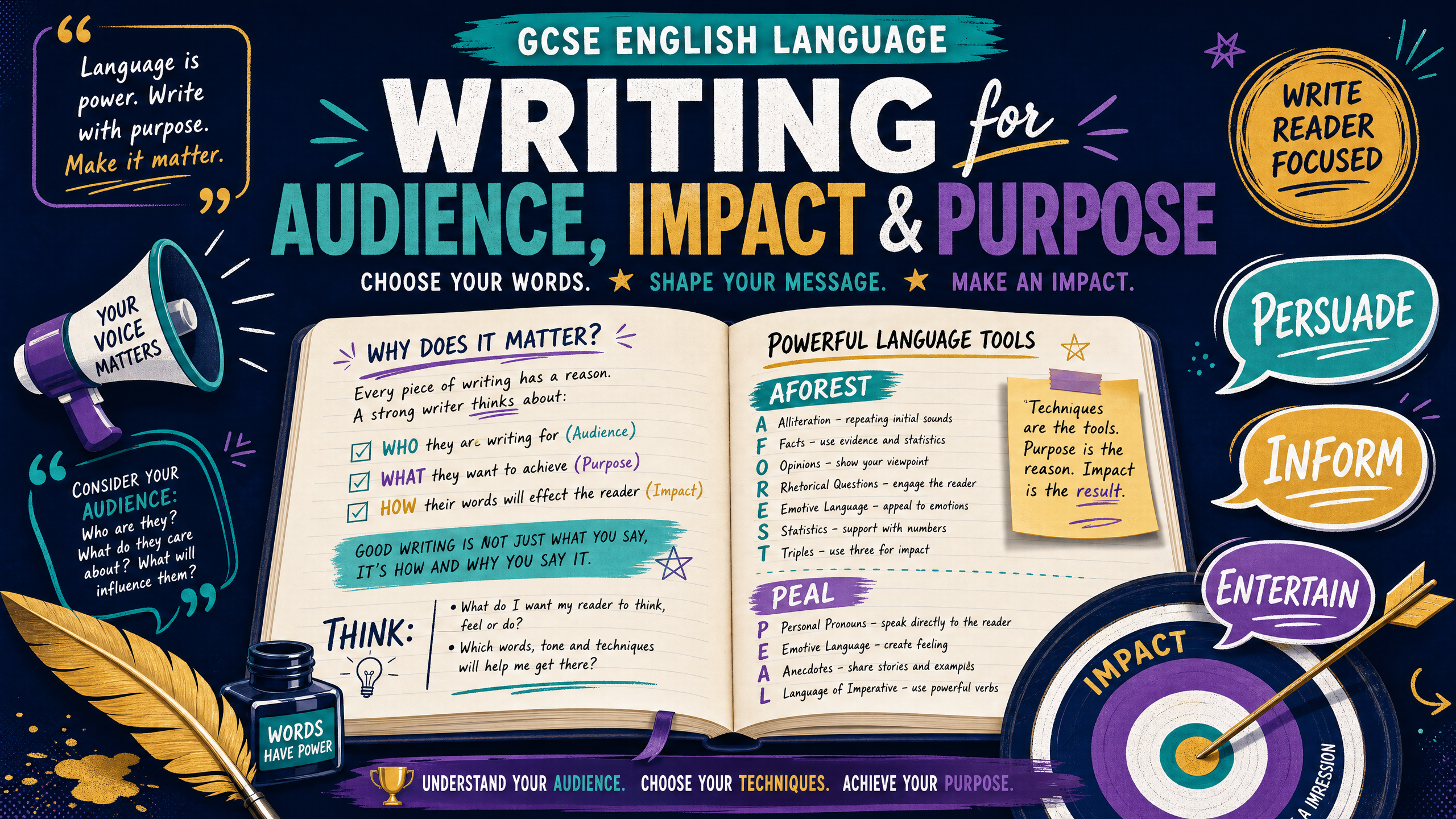
Writing for audience, impact, and purpose is the cornerstone of the GCSE English Language writing assessment. Examiners are looking for candidates who do not just write, but who craft their writing with a specific reader and goal in mind. Whether you are arguing a point in a broadsheet article, persuading a headteacher in a formal letter, or crafting a compelling narrative opening, every word choice must be deliberate.
Listen to our 10-minute revision podcast to consolidate your understanding:
Reading Skills
Identifying Information & Ideas
The foundation of reading comprehension is the ability to locate both explicit and implicit information in unseen texts. Explicit information is clearly stated on the page, while implicit information requires you to read between the lines and infer meaning. Examiners expect candidates to synthesise information from across the text rather than simply copying out large chunks.
Analysing Language
When analysing language, candidates must move beyond simple feature-spotting. The examiner awards marks for exploring the effect of the language on the reader.
Key Language Features to Identify
| Feature | Definition | Effect on Reader | Example |
|---|---|---|---|
| Metaphor | Describing something as if it is something else. | Creates vivid imagery and strong emotional associations. | "The classroom was a zoo." |
| Simile | Comparing two things using 'like' or 'as'. | Helps the reader visualise an unfamiliar concept by linking it to a familiar one. | "The wind howled like a wounded animal." |
| Personification | Giving human qualities to non-human things. | Brings inanimate objects to life, often reflecting the mood of the scene. | "The shadows danced on the wall." |
| Pathetic Fallacy | When the weather or environment reflects human emotions. | Establishes atmosphere and foreshadows events. | "A heavy, oppressive rain began to fall as she received the news." |
| Alliteration | Repetition of the same consonant sound at the start of words. | Creates rhythm, draws attention to key phrases, and can sound harsh or soothing depending on the letter. | "Cruel, cold, and calculating." |
| Sibilance | Repetition of 's' or 'sh' sounds. | Can create a sinister, hissing effect or a soft, soothing tone. | "The snake slithered silently." |
| Juxtaposition | Placing two contrasting ideas close together. | Highlights differences and creates tension or surprise. | "The bright, innocent child stood in the dark, decaying room." |
Analysing Structure
Structure is how the writer builds the text. Examiners want to see that you understand how the text is put together to guide the reader's experience.
Focus on these structural features:
- Openings: How does the writer hook the reader? (e.g., in medias res, establishing setting, introducing character).
- Shifts in Focus: Does the text move from the general to the specific, from inside to outside, or from one character to another?
- Narrative Perspective: Is it first-person (intimate, biased) or third-person (omniscient, detached)?
- Sentence Length Variation: Short sentences build tension or create impact; long sentences build description or flow.
- Cyclical Structure: Does the ending return to the beginning, suggesting a lack of escape or a sense of completion?
Evaluating Critically
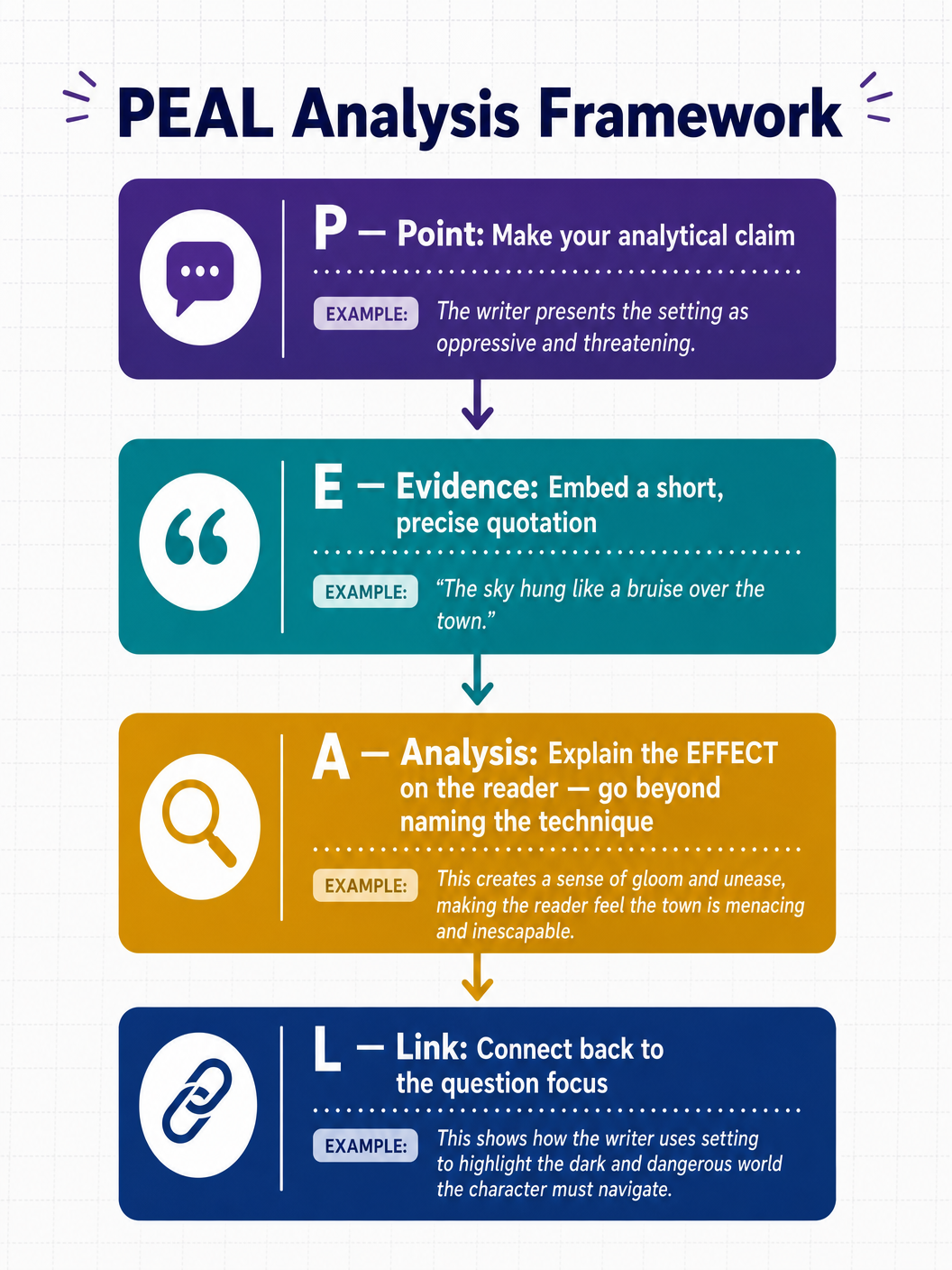
Evaluation requires you to form a judgement about how successful a writer has been. You must provide an opinion supported by evidence. Use the statement-evidence-analysis-link framework to structure your response.
 Open full-size image (opens in a new tab)
Comparing Writers' Viewpoints
When comparing texts, you must identify the differing viewpoints and then compare the methods the writers use to convey them. Always use comparative discourse markers (e.g., "Similarly", "In contrast", "On the other hand").
Writing Skills
 Open full-size image (opens in a new tab)
Creative Writing
Creative writing tasks demand a focus on description and narrative. Examiners reward candidates who use the "show, don't tell" technique. Instead of stating a character is angry, describe their clenched fists and gritted teeth.
Key techniques include:
- Sensory Description: Engage sight, sound, smell, touch, and taste.
- Varied Sentence Structures: Use simple sentences for dramatic impact and complex sentences for detailed description.
- Engaging Openings: Start in medias res (in the middle of the action) to hook the reader immediately.
- The One-Scene Rule: In exam conditions, it is often safer and more effective to describe one scene in detail rather than attempting a sprawling, multi-location narrative.
Transactional/Non-Fiction Writing
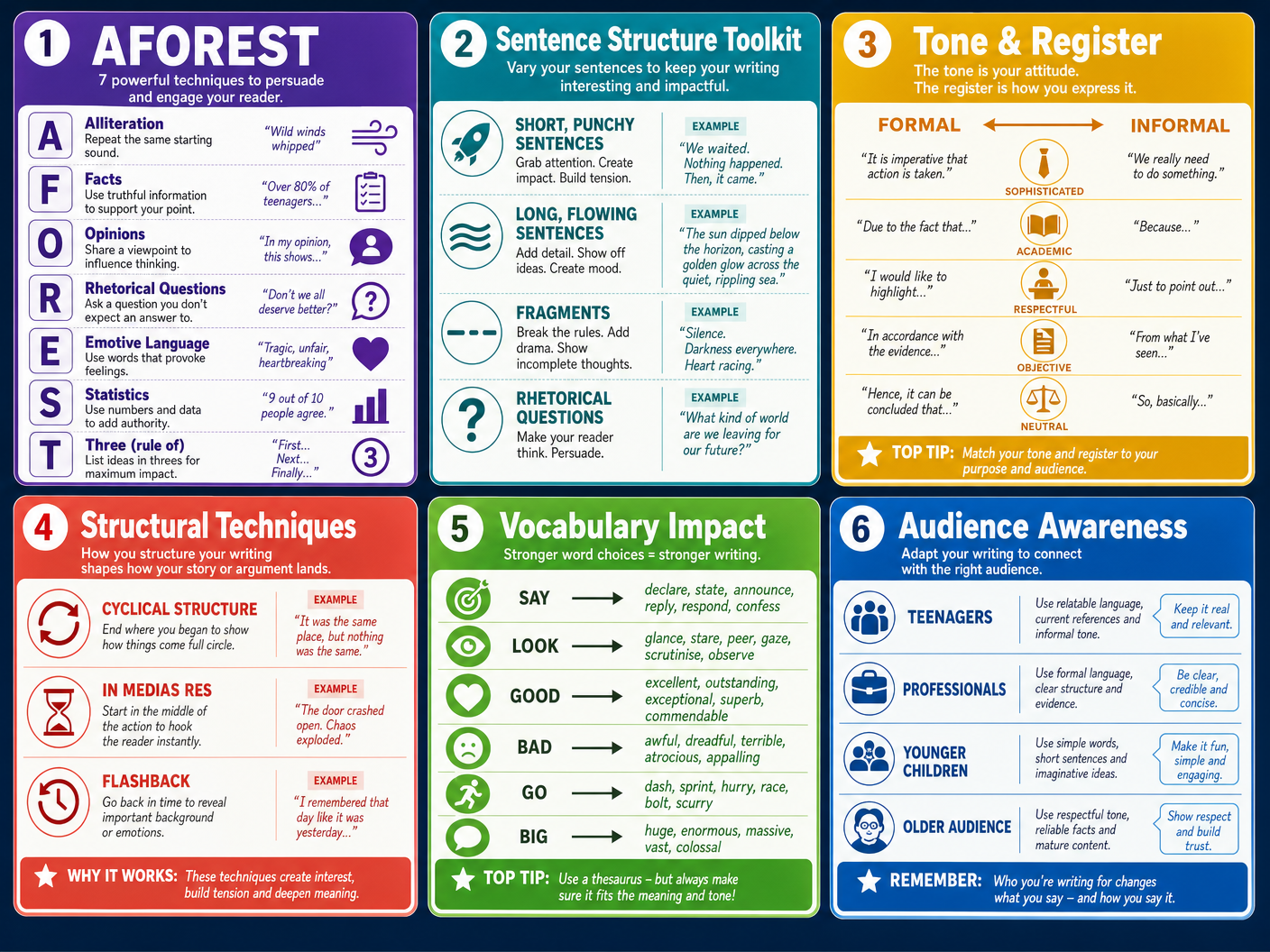
Transactional writing requires you to adopt a specific form (e.g., letter, article, speech, leaflet) for a specific purpose (e.g., argue, persuade, advise).
 Open full-size image (opens in a new tab)
For persuasive writing, employ the AFOREST techniques to influence your reader. Always ensure your register matches the intended audience—a speech to your peers will sound very different from a formal letter to a local MP.
Technical Accuracy (SPaG)
Spelling, punctuation, and grammar (SPaG) constitute a significant portion of the marks in the writing section. Examiners look for ambitious vocabulary and a range of punctuation used accurately.
To access the highest bands, demonstrate control over:
- Semicolons (;): To link two closely related independent clauses.
- Colons (:): To introduce a list or an explanation.
- Dashes (—): To create a dramatic pause or add emphasis.
- Parenthetical Commas: To embed extra information within a sentence.
Ensure paragraph cohesion by using appropriate discourse markers to guide the reader through your argument or narrative.
Check what you remember
Read the wording for your board, then hide it and explain Register in your own words. Rough notes are fine. This is a self-check, with no mark or grade.
Reference: OCR
The level of formality and the style of language used, adapted to suit a specific audience and context.
Interactive Diagrams
2 interactive diagrams to visualise key concepts
Conceptual Flow Outline
English Language exam approach flowchart
Conceptual Flow Outline
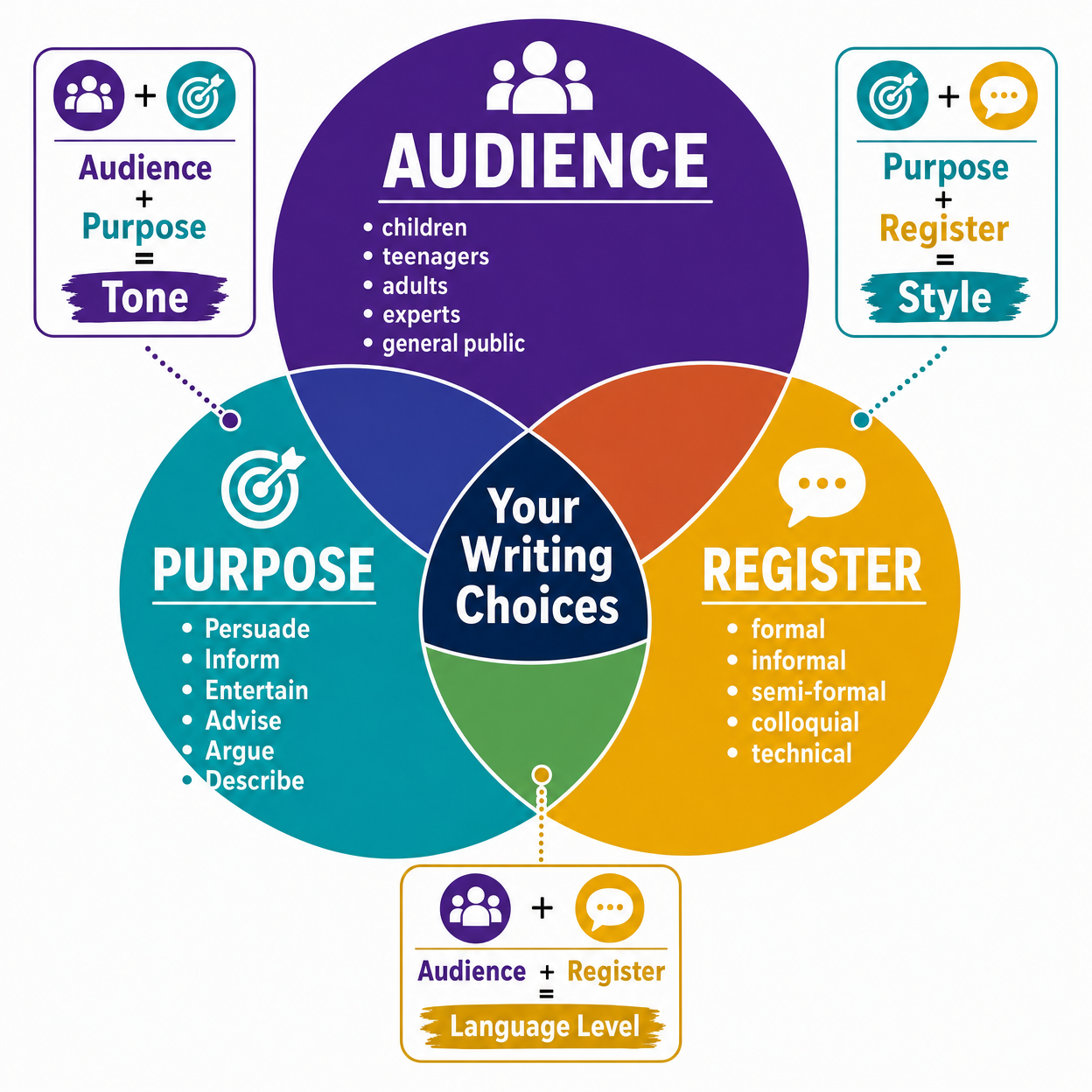
Writing Purpose and Audience Framework
Worked Examples
3 worked examples — open one to explore the question and available guidance.
Practice Questions
Try the question, then reveal an answer plan or example response
List four things you learn about the character's house from the first paragraph.
Hint: Look only at the first paragraph. Find explicit facts. You do not need to write in full sentences or analyse the language.
Read lines 10-15. Analyse how the writer uses language to create a sense of panic.
Hint: Focus on specific word choices (verbs, adjectives) and any figurative language (similes, metaphors). Explain *why* these choices make the reader feel panicked.
Write a letter to your local council arguing that funding for youth centres should be increased.
Hint: Plan your response. Form: Formal letter. Audience: Local council officials. Purpose: Argue/Persuade. Use AFOREST techniques and maintain a formal, respectful but firm register.
Evaluate the statement: 'The writer effectively makes the reader sympathise with the main character.' To what extent do you agree?
Hint: You need to form an opinion. It's usually best to agree 'to a large extent'. Find evidence where the writer creates sympathy, analyse the methods used, and explain how it impacts your feelings as a reader.
Write the opening of a story suggested by the image of a deserted train station at night.
Hint: Focus on 'Show, Don't Tell'. Use sensory description to build atmosphere. Do not try to write a whole story; focus on a detailed, atmospheric opening scene.
Ready to test yourself interactively?
Active recall beats reading alone. Answer questions on Writing for audience, impact and purpose with instant AI scoring and mark scheme guidance.
A week of Premium from your first lesson · Then the free plan continues · No card, no charge
Exam technique
How to turn what you know into marks
How to approach the question
Always read the question before reading the text so you know what you are looking for. Highlight the command words and the specific focus of the question.
How to structure your answer
For reading analysis: PEAL (Point, Evidence, Analysis, Link). For writing tasks: Plan a clear 5-paragraph structure (Introduction, 3 developed points/scenes, Conclusion).
Timing
As a general rule, aim for approximately 1 minute per mark on the reading section, leaving time for reading the sources. For the writing section (usually 40 marks), spend 5 minutes planning, 35 minutes writing, and 5 minutes proofreading.
Common pitfalls
- Feature-spotting without analysing the effect on the reader.
- Using long, block quotations instead of short, embedded ones.
- Starting a writing task without a plan, leading to a rambling, unstructured response.
- Forgetting to adapt the register for the specified audience.
- Failing to leave time to proofread for spelling, punctuation, and grammar errors.
What the command words want
- Compare
- Focus on the differences (or similarities) in both *what* the writers say and *how* they say it. Use comparative discourse markers constantly.
- Evaluate
- Give your considered opinion based on the text. Use phrases like 'To some extent' or 'The writer is highly successful in...' and support your judgement with detailed evidence.
- Identify/List
- Find the explicit information in the text. Brief, concise answers are sufficient; no analysis is needed.
- Write a [text type]
- Ensure you adopt the correct conventions for the form (e.g., a letter needs an address and sign-off). Maintain a consistent register appropriate for the audience and purpose.
- How does the writer use language
- Identify specific words or techniques, quote them accurately, and explain the precise effect they have on the reader.
- How does the writer use structure
- Focus on how the text is put together. Look at the opening, shifts in focus, narrative perspective, and sentence lengths. Explain why the writer arranged the text this way.
Watch or listen (optional)
Test your understanding of Writing for audience, impact and purpose
Active recall beats re-reading. Take an instant quiz now to test what you’ve learned and lock it into long-term memory.
A week of Premium from your first lesson · Then the free plan continues · No card, no charge