OCR · GCSE · English Language
Course version: J351 · Version from Sept 2017
Writing imaginatively and creatively
This topic develops the essential skills for writing imaginatively and creatively, a core component of the GCSE English Language exam. Candidates are assessed on their ability to craft language for effect, adapt their tone for specific audiences, and demonstrate high-level technical accuracy.
- 5 min read
- 3 worked examples
- 5 practice questions
- 8 key terms
Study Notes
Overview
 Open full-size image (opens in a new tab)
Creative and imaginative writing forms a significant portion of the marks in your GCSE English Language examinations. Unlike literature, where you analyse the work of others, this section tests your ability to become the writer. Examiners are looking for candidates who can make deliberate, considered choices about vocabulary, sentence structure, and form to create a specific effect on the reader. Whether you are asked to write a descriptive piece based on an image, a narrative story, or a piece of transactional writing like a speech or article, the core skills remain the same: clarity, engagement, and technical precision.
Listen to our revision podcast to reinforce your learning:
Reading Skills
Before you can write effectively, you must understand how professional writers craft their work. Reading unseen texts critically is the foundation of good writing.
Identifying Information & Ideas
When approaching an unseen text, your first task is to locate both explicit and implicit information. Explicit information is stated directly in the text, whereas implicit information requires you to read between the lines and infer meaning from the writer's choices.
Analysing Language
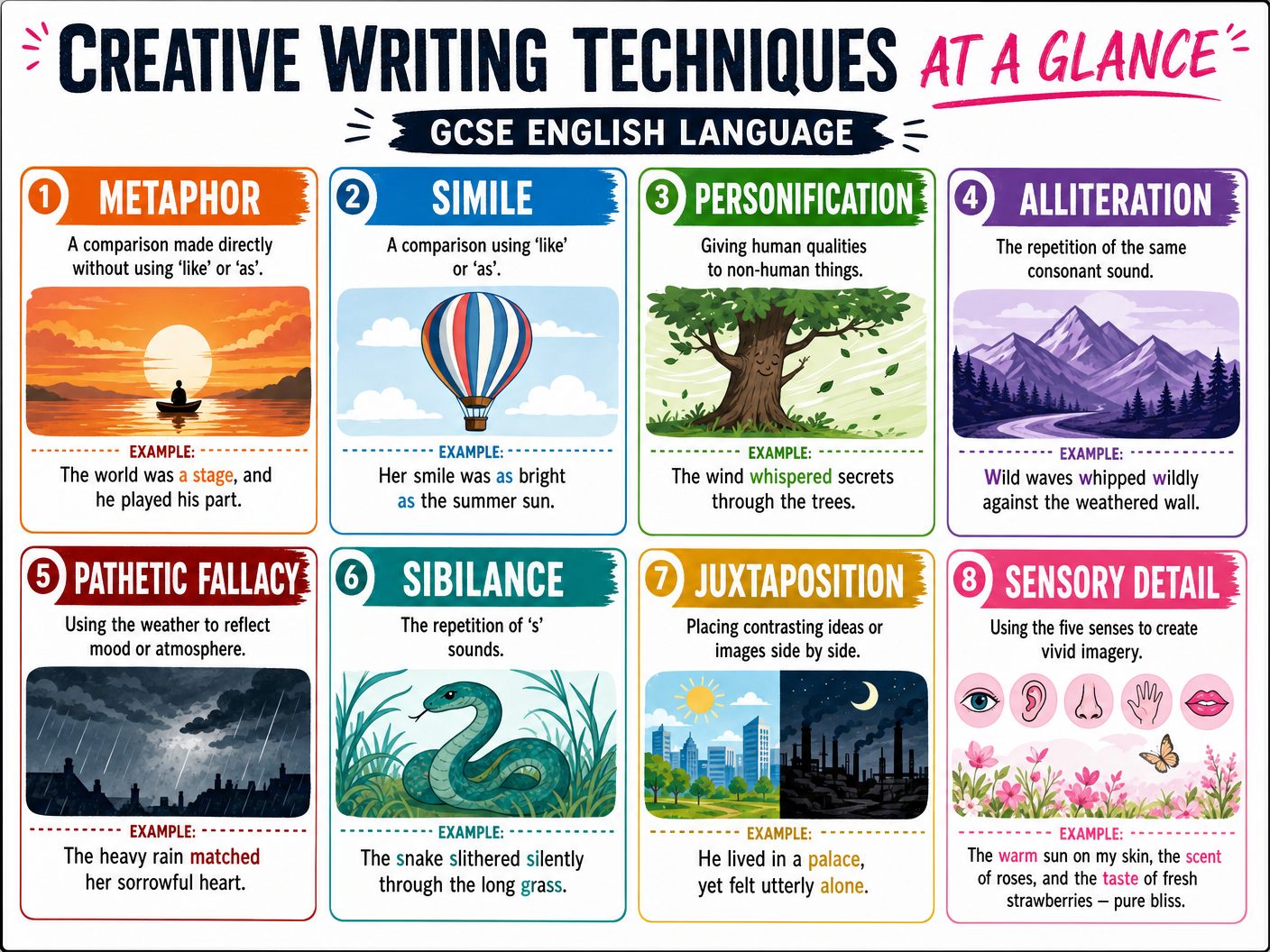
Examiners award high marks for the precise identification and analysis of language features. You must go beyond simply 'spotting' techniques; you must explain why the writer chose them and the effect they have on the reader.
 Open full-size image (opens in a new tab)
Key Language Features to Identify
| Feature | Definition | Effect on Reader | Example |
|---|---|---|---|
| Metaphor | A direct comparison stating one thing is another. | Creates vivid imagery and strong associations. | 'The city was a concrete jungle.' |
| Simile | A comparison using 'like' or 'as'. | Helps the reader visualise an unfamiliar concept by comparing it to a familiar one. | 'The wind howled like a wounded animal.' |
| Personification | Giving human qualities to non-human things. | Makes descriptions more relatable and dramatic. | 'The shadows danced on the wall.' |
| Pathetic Fallacy | When the weather or environment reflects human emotions. | Establishes mood and atmosphere seamlessly. | 'Heavy rain matched her sorrowful heart.' |
| Alliteration | Repetition of consonant sounds at the start of words. | Creates rhythm, draws attention to key phrases, and can mimic sounds. | 'Wild waves whipped wildly.' |
| Sibilance | Repetition of 's' or 'sh' sounds. | Can create a sinister, secretive, or soothing atmosphere. | 'The snake slithered silently.' |
| Juxtaposition | Placing contrasting ideas side by side. | Highlights differences and creates tension or surprise. | 'A palace of gold in a sea of poverty.' |
Analysing Structure
Structural analysis is often challenging for candidates. You need to look at how the text is built, rather than just the words used. Consider the narrative perspective (first, second, or third person), the use of chronological or non-chronological order, shifts in focus (e.g., from outside to inside, or past to present), and how the opening and ending connect (cyclical structure).
Evaluating Critically
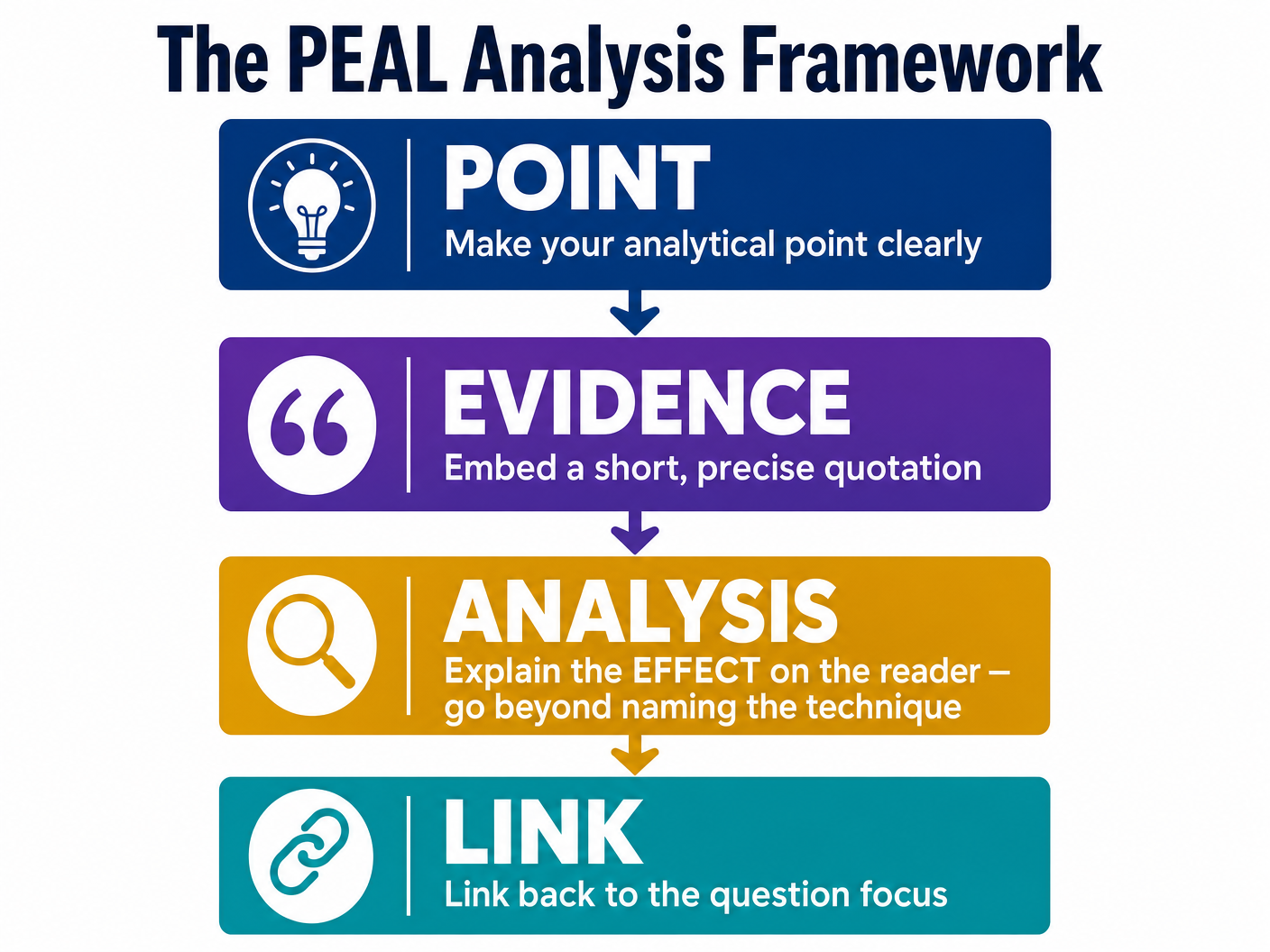
Evaluation questions ask for your opinion on a statement about the text. A successful response uses the statement as a springboard. You must provide evidence to support your view, analyse the writer's methods, and link back to the evaluation focus.
 Open full-size image (opens in a new tab)
Writing Skills
Creative Writing
The most successful creative writing pieces at GCSE level follow the 'one-scene rule'. Rather than attempting to write an entire novel in 45 minutes, focus on a single, vivid scene or moment in time. Use sensory description (sight, sound, smell, touch, taste) to build a rich, immersive atmosphere.
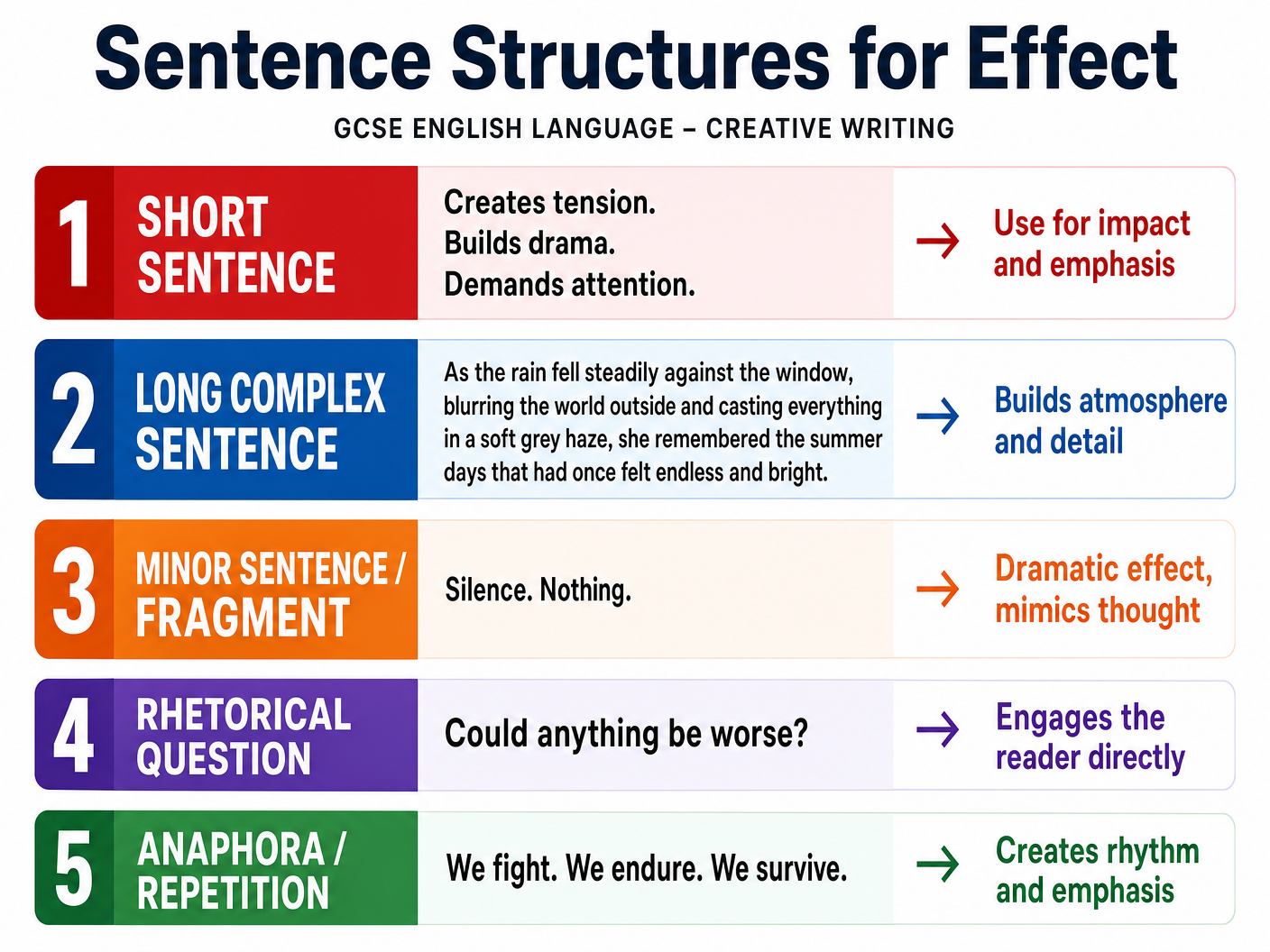
Sentence Structures for Effect:
 Open full-size image (opens in a new tab)
Examiners explicitly look for a variety of sentence structures. Use short sentences to build tension, and longer, complex sentences to layer descriptive detail.
Transactional/Non-Fiction Writing
When writing to argue or persuade (such as a speech, letter, or article), you must adapt your tone and register to suit the specified audience and purpose. A formal letter to a headteacher requires a very different vocabulary set than a lively article for a teenage magazine.
Technical Accuracy (SPaG)
Spelling, Punctuation, and Grammar (SPaG) account for a substantial number of marks. Accurate punctuation is expected, but ambitious punctuation (semicolons, colons, dashes) will push you into the higher mark bands. Ensure your paragraphs are cohesive, using discourse markers (e.g., 'Furthermore', 'Conversely') to guide the reader through your argument.
Check what you remember
Read the wording for your board, then hide it and explain Register in your own words. Rough notes are fine. This is a self-check, with no mark or grade.
Reference: OCR
The level of formality or informality in a piece of writing, determined by the audience and purpose.
Interactive Diagrams
2 interactive diagrams to visualise key concepts
Conceptual Flow Outline
English Language Exam Approach Flowchart
Conceptual Flow Outline
Creative Writing Structure Strategy
Worked Examples
3 worked examples — open one to explore the question and available guidance.
Practice Questions
Try the question, then reveal an answer plan or example response
List four things you learn about the setting from the first paragraph of the text.
Hint: Only look at paragraph one. You do not need to write in full sentences or analyse language.
How does the writer use language to describe the heat of the desert?
Hint: Focus on specific words, phrases, and techniques (like metaphor or simile). Discuss the effect on the reader.
A student said, 'The writer successfully makes the reader feel sympathy for the main character in this extract.' To what extent do you agree?
This prompt needs an extract from your set text. Use the extract provided by your teacher or exam paper; this question card does not include one.
Hint: You must evaluate the statement. Give your opinion, support it with quotations, and analyse the methods the writer uses to create sympathy.
Write a story with the title 'The Discovery'.
Hint: Plan your structure. Start in medias res, build tension, and ensure your ending is deliberate.
Write the text for a speech to your school assembly arguing that school uniforms should be abolished.
Hint: Consider your audience (students and teachers). Use persuasive techniques (AFOREST) and maintain a formal but engaging register.
Ready to test yourself interactively?
Active recall beats reading alone. Answer questions on Writing imaginatively and creatively with instant AI scoring and mark scheme guidance.
A week of Premium from your first lesson · Then the free plan continues · No card, no charge
Exam technique
How to turn what you know into marks
How to approach the question
Always deconstruct the question first. Highlight the command word (e.g., 'Evaluate', 'Explain') and the specific focus (e.g., 'the writer's attitude to the sea'). For writing tasks, immediately identify the Form, Audience, and Purpose (FAP).
How to structure your answer
For reading analysis: use PEAL (Point, Evidence, Analysis, Link). For creative writing: Plan -> Hook Opening -> Developed Middle (using sensory detail) -> Climax/Shift -> Satisfying Ending.
Timing
For reading sections, aim for roughly 1 minute per mark (e.g., an 8-mark question should take 8-10 minutes). For the 40-mark writing section, spend 5 minutes planning, 35 minutes writing, and 5 minutes proofreading.
Common pitfalls
- Feature-spotting: Naming a technique without explaining its effect on the reader.
- Poor time management: Spending too long on low-tariff reading questions and rushing the high-tariff writing section.
- Lack of planning in the writing section, leading to a rambling, unstructured response.
- Forgetting to proofread, losing easily avoidable SPaG marks.
What the command words want
- Compare
- Ensure you are writing about both texts in relation to the specific question focus. Use comparative discourse markers (e.g., 'Similarly', 'In contrast').
- Evaluate
- Provide a personal judgement supported by evidence. Discuss how successfully the writer has achieved a specific effect.
- Identify/List
- Keep answers brief; you do not need full sentences. Just extract the facts.
- Write a [text type]
- Ensure your response looks and sounds like the requested form (e.g., an article needs a headline; a letter needs appropriate salutations).
- How does the writer use language
- Focus on words, phrases, and techniques. Quote accurately and analyse the connotations of specific words.
- How does the writer use structure
- Look at the whole text. Where does the focus shift? How does the opening connect to the ending? Are there changes in narrative perspective?
Watch or listen (optional)
Test your understanding of Writing imaginatively and creatively
Active recall beats re-reading. Take an instant quiz now to test what you’ve learned and lock it into long-term memory.
A week of Premium from your first lesson · Then the free plan continues · No card, no charge