Study Notes
Overview
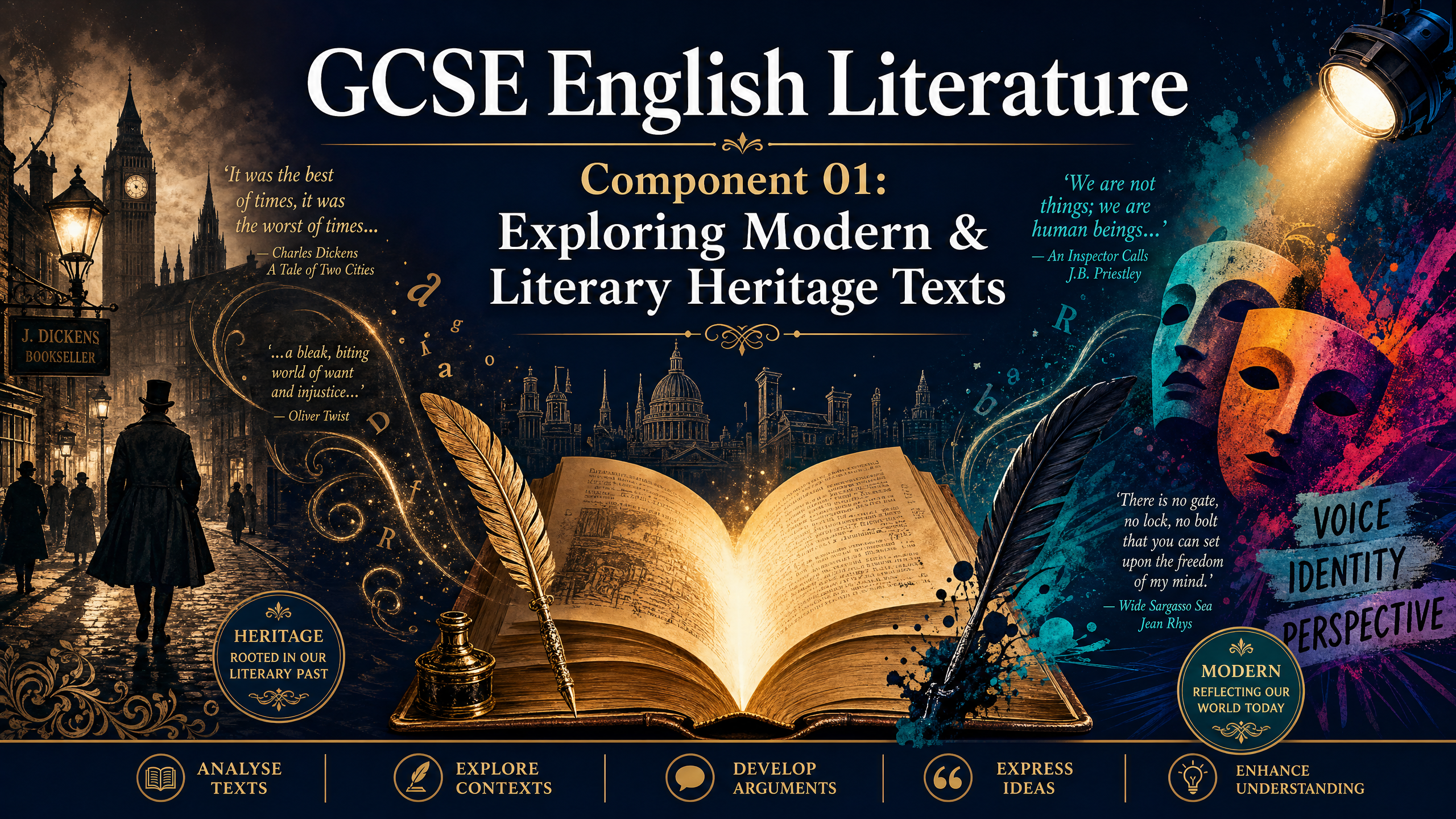
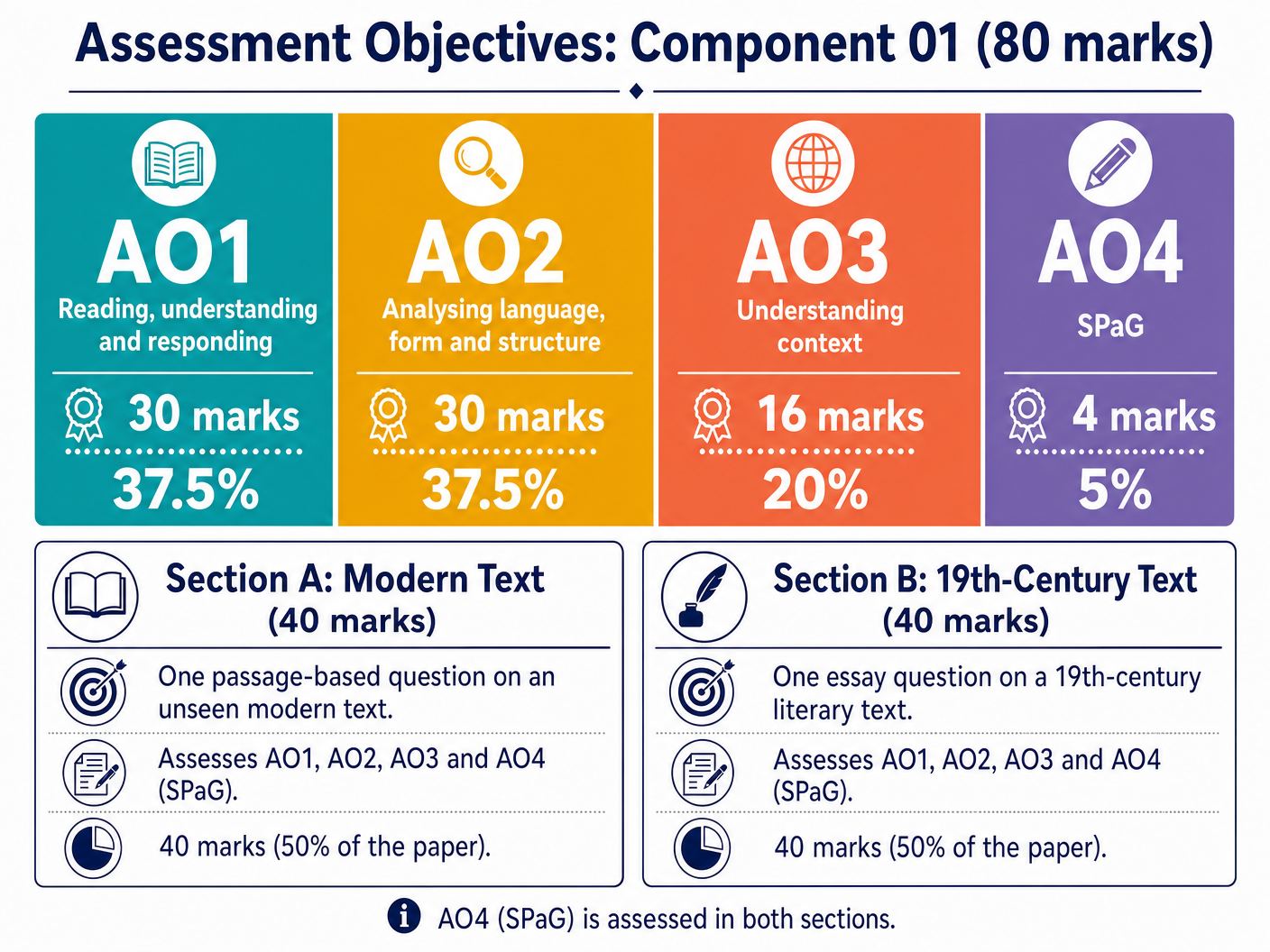
Component 01, 'Exploring modern and literary heritage texts', is a rigorous 2-hour, closed-book examination worth 80 marks (50% of your GCSE). Examiners are looking for candidates who can maintain a critical, conceptualised argument while moving fluidly between close textual analysis and broader contextual understanding. The paper is split equally between a modern text (prose or drama) and a 19th-century prose text. Crucially, the modern text section includes an unseen comparative element, where candidates must evaluate how writers present similar themes across different texts. Success here requires moving beyond simple plot recall (AO1) to perceptive analysis of writer's methods (AO2) and seamless integration of context (AO3).
Section A: Modern Prose or Drama
The Comparative Challenge
In Section A, you must not only answer on your studied modern text (e.g., An Inspector Calls, Animal Farm, or Lord of the Flies) but also compare it with an unseen extract of the same genre.
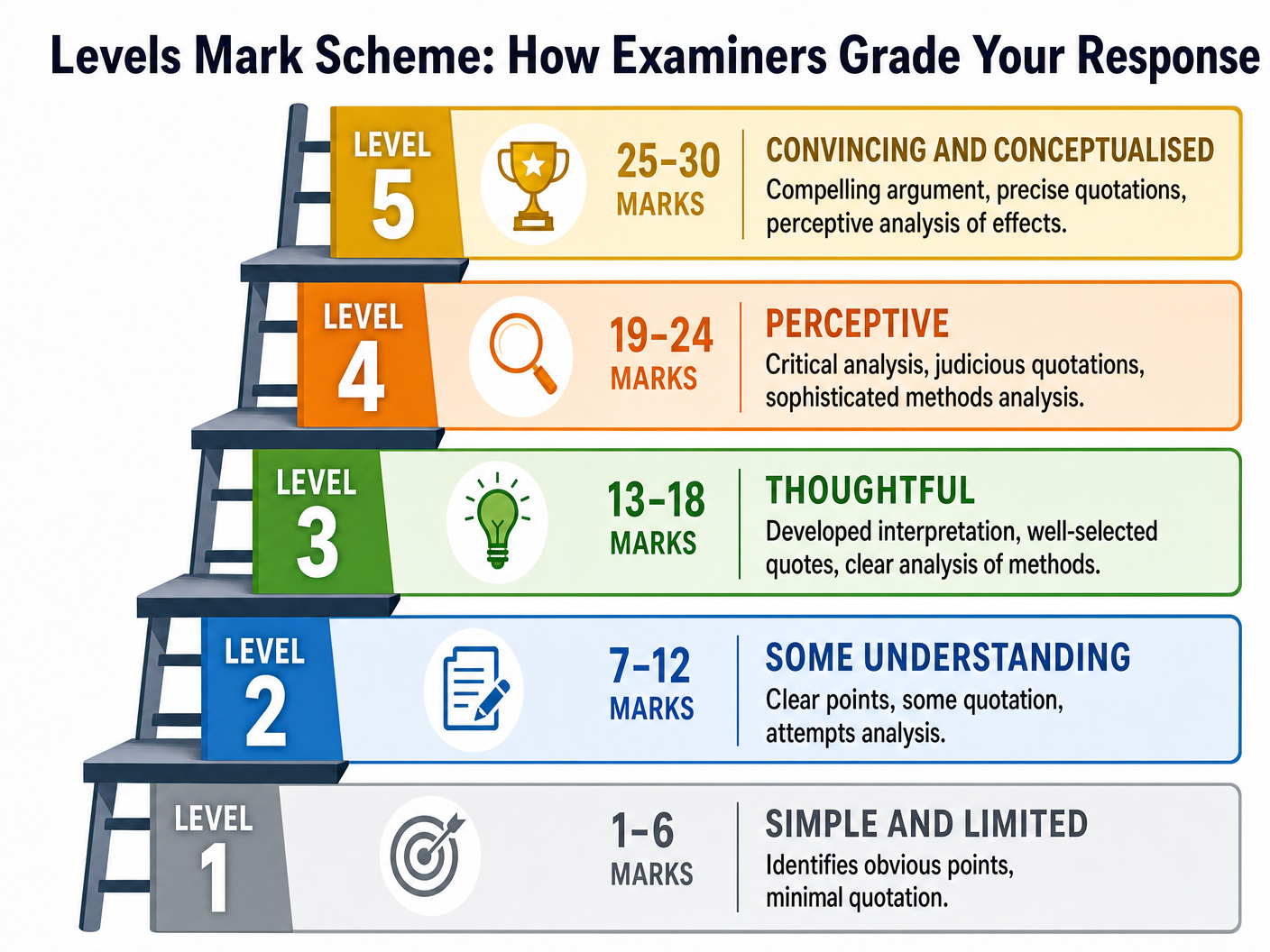
Examiner Expectation: Candidates who score highly (Levels 4-5) do not treat the unseen text as an afterthought. They weave comparisons throughout their response, using analytical connectives ("Similarly, Priestley...", "In stark contrast, the unseen writer...") to evaluate differing methods and effects.
Key Focus Areas
- Character Construction: How are characters used as vehicles for the writer's social message?
- Dramatic/Narrative Tension: How does the writer manipulate time, perspective, or stagecraft?
- Social Commentary: What is the text's underlying political or moral argument?
Section B: 19th-Century Prose
Mastering the Heritage Text
Section B focuses on a 19th-century novel (e.g., A Christmas Carol, Jekyll and Hyde, or Frankenstein). This is an essay-based question where you must demonstrate whole-text knowledge without the safety net of an extract.
Essential Themes to Prepare
- Duality and the Divided Self: The conflict between outward respectability and inner desires.
- Social Responsibility: The moral obligations of the wealthy towards the poor.
- Science vs. Religion/Nature: The anxieties of the Victorian era regarding progress and evolution.
Key Quotes Strategy: Because this is a closed-book exam, you must memorize 'Swiss Army Knife' quotes—short, precise phrases that can be applied to multiple themes. For example, Hyde being described as "hardly human" can apply to themes of evolution, evil, the supernatural, and violence.
Writer's Methods (AO2)
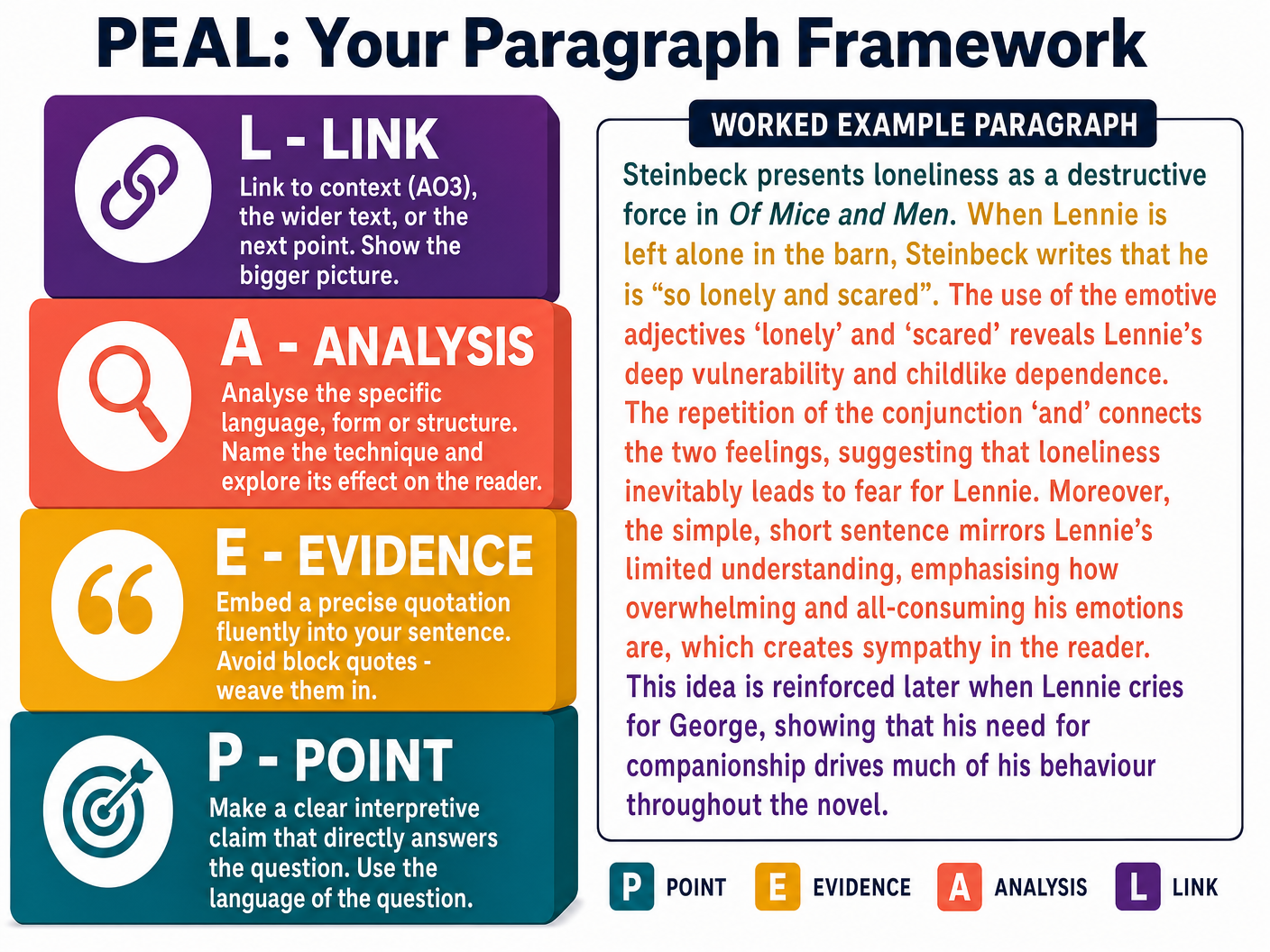
Examiners heavily reward candidates who analyse how meaning is created. Move beyond "feature spotting" (just naming a metaphor) to exploring its specific effect.
- Form: Is it a novella? A didactic play? A gothic tragedy? How does the form dictate the reader's experience?
- Structure: Look at cyclical structures, foreshadowing, shifts in narrative perspective, or the manipulation of time (e.g., the ghosts in A Christmas Carol).
- Language: Zoom in on word classes. Don't just say "the writer uses a verb"; say "the writer's use of the violent dynamic verb 'clubbed' highlights..."
Context (AO3)
Context must illuminate your analysis, not sit isolated in a separate paragraph.
Weak (Level 2): "Dickens wrote this in 1843. Poor people lived in workhouses."
Strong (Level 5): "Dickens's use of the allegorical figures Ignorance and Want serves as a stark warning to his affluent Victorian readership, forcing them to confront the devastating consequences of the 1834 Poor Law."
Visual Resources
3 diagrams and illustrations
Interactive Diagrams
1 interactive diagram to visualise key concepts
Conceptual Flow Outline
How Assessment Objectives combine to create a top-tier response.
Worked Examples
2 detailed examples with solutions and examiner commentary
Practice Questions
Test your understanding — click to reveal model answers
How does the writer present the conflict between different generations in your studied modern text?
Hint: Don't just describe the arguments. Analyse *how* the writer uses language and structure to show the divide. Consider context: what do the different generations represent historically?
Starting with this extract, explore how the writer creates a sense of fear and tension. (30 marks)
Hint: Look closely at the extract for sensory language, sentence lengths, and withholding of information. Then find 2-3 other moments in the text where fear is prominent.
Compare how the writers of your studied text and the unseen extract present characters who abuse their power.
Hint: You must balance your essay. Try to find a similarity in *theme* but a difference in *method* (e.g., both show power as corrupting, but one uses physical violence while the other uses psychological manipulation).
How is the setting important to the overall meaning of your 19th-century text?
Hint: Setting is more than just a backdrop. How does the setting reflect the characters' minds (pathetic fallacy)? How does it represent societal issues of the 19th century?