OCR · GCSE · English Literature
Course version: J352 · Version from Sept 2017
Exploring poetry and Shakespeare (02)
OCR Component 02 is your chance to showcase critical analysis of Shakespeare and poetry. This guide breaks down the AOs, gives you clear frameworks for comparison, and helps you turn feature-spotting into high-level analysis.
- 3 min read
- 2 worked examples
- 4 practice questions
- 8 key terms
Study Notes
Overview
 Open full-size image (opens in a new tab)
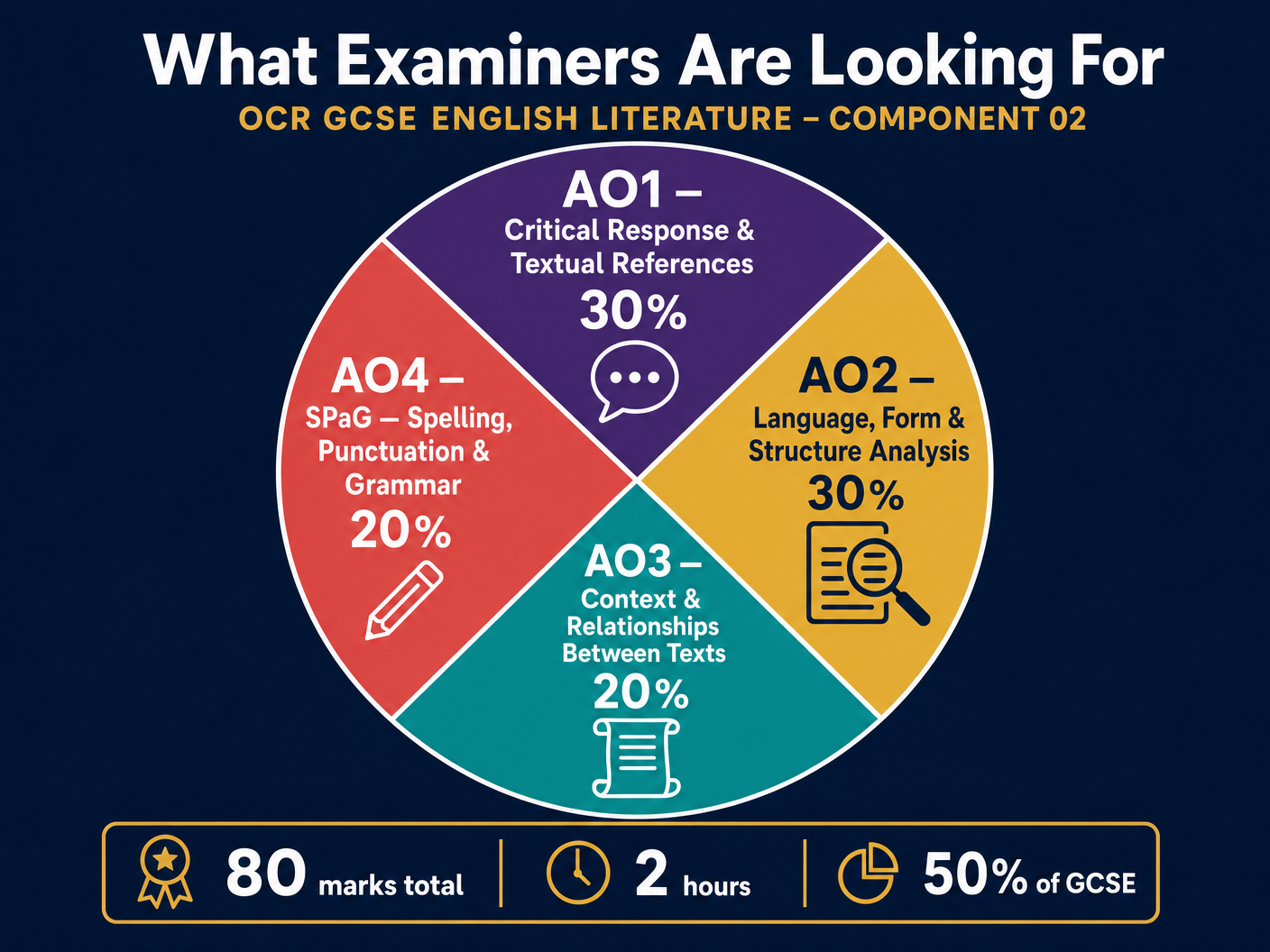
Component 02, 'Exploring poetry and Shakespeare', is a closed-text, 2-hour written examination worth 80 marks (50% of your total GCSE). Examiners are looking for a conceptualised, sustained argument. You must demonstrate a deep understanding of your chosen Shakespeare play and the OCR Poetry Anthology cluster. The assessment is rigorously balanced across four Assessment Objectives (AOs): AO1 (critical response), AO2 (language, form, and structure), AO3 (context), and AO4 (SPaG, assessed on Shakespeare only).
Section A: Shakespeare
The Demands of the Paper
For Section A, you will answer one question on your studied Shakespeare play. This could be an extract-based question, where you must balance your analysis between the provided passage and the wider play, or a discursive whole-text question focusing on a character or theme.
Examiner Expectations
- Sustained Interpretation (AO1): Develop an informed personal response. Do not just retell the plot.
- Close Analysis (AO2): Zoom in on specific dramatic methods. How does Shakespeare use stagecraft, verse vs. prose, or specific imagery to shape audience response?
- Integrated Context (AO3): Connect the text to its Elizabethan or Jacobean context. How would contemporary audiences react compared to modern ones?
Section B: Exploring Poetry
The Comparative Challenge
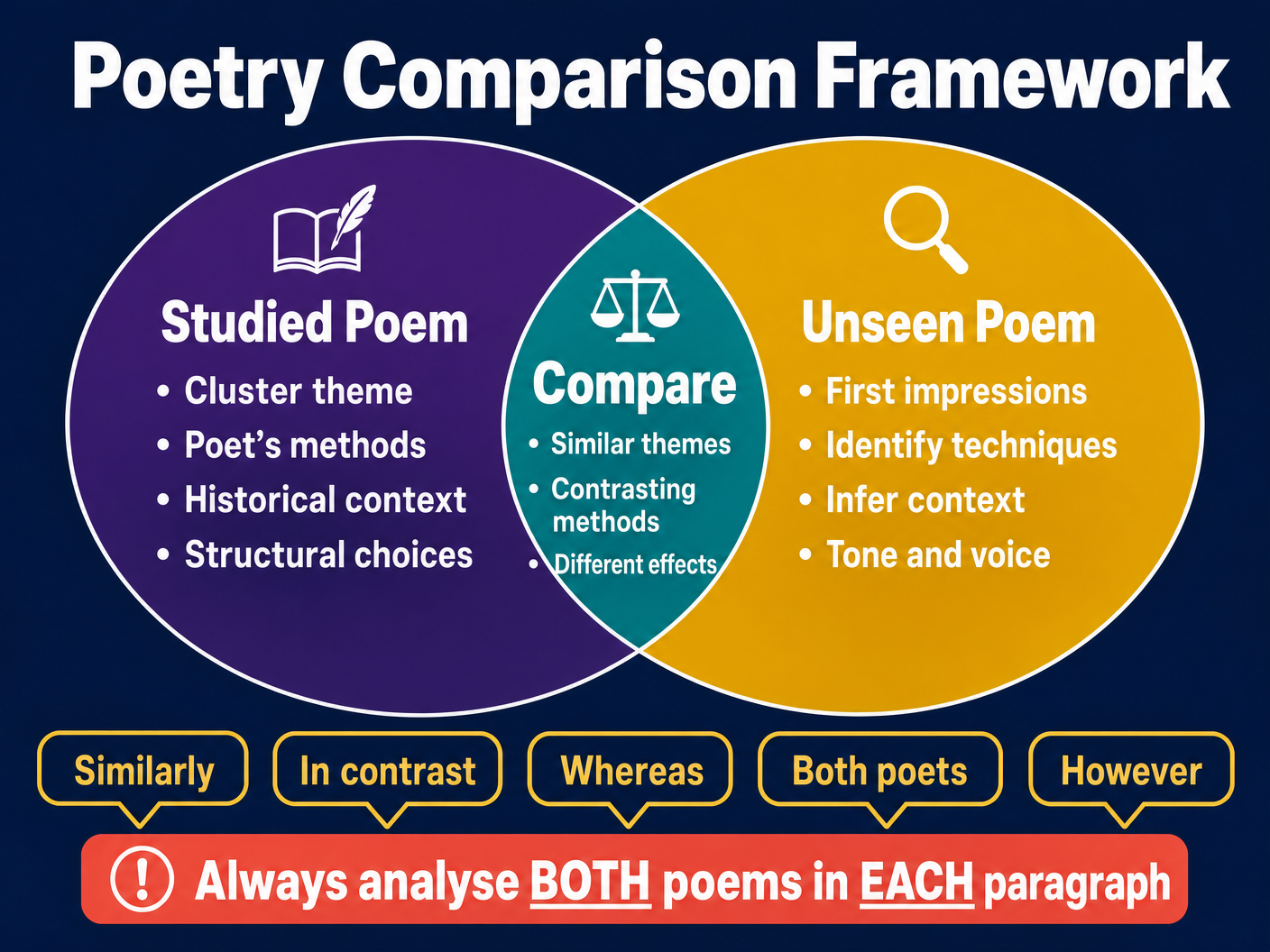
Section B requires you to compare one poem from your studied cluster (Love and Relationships, Conflict, or Youth and Age) with an unseen poem. This is a test of your comparative skills as much as your poetic analysis.
 Open full-size image (opens in a new tab)
Key Strategies for Poetry
- Discuss Both Poems (AO1/AO2): The most common pitfall is writing about the poems sequentially. You must compare them in every paragraph using comparative connectives.
- Analyse Form and Structure (AO2): Do not just focus on language. Does the poem use enjambment to reflect a lack of control? Is it a rigid sonnet reflecting tight constraints?
- Contextual Links (AO3): How do the poets' backgrounds or the eras in which they wrote influence their perspectives on the theme?
Writer's Methods (AO2)
 Open full-size image (opens in a new tab)
Examiners heavily reward candidates who move beyond 'feature-spotting'. Identifying a metaphor is Level 2; explaining why that specific metaphor is used and what effect it creates pushes you into Level 4/5.
 Open full-size image (opens in a new tab)
Structuring Your Analysis
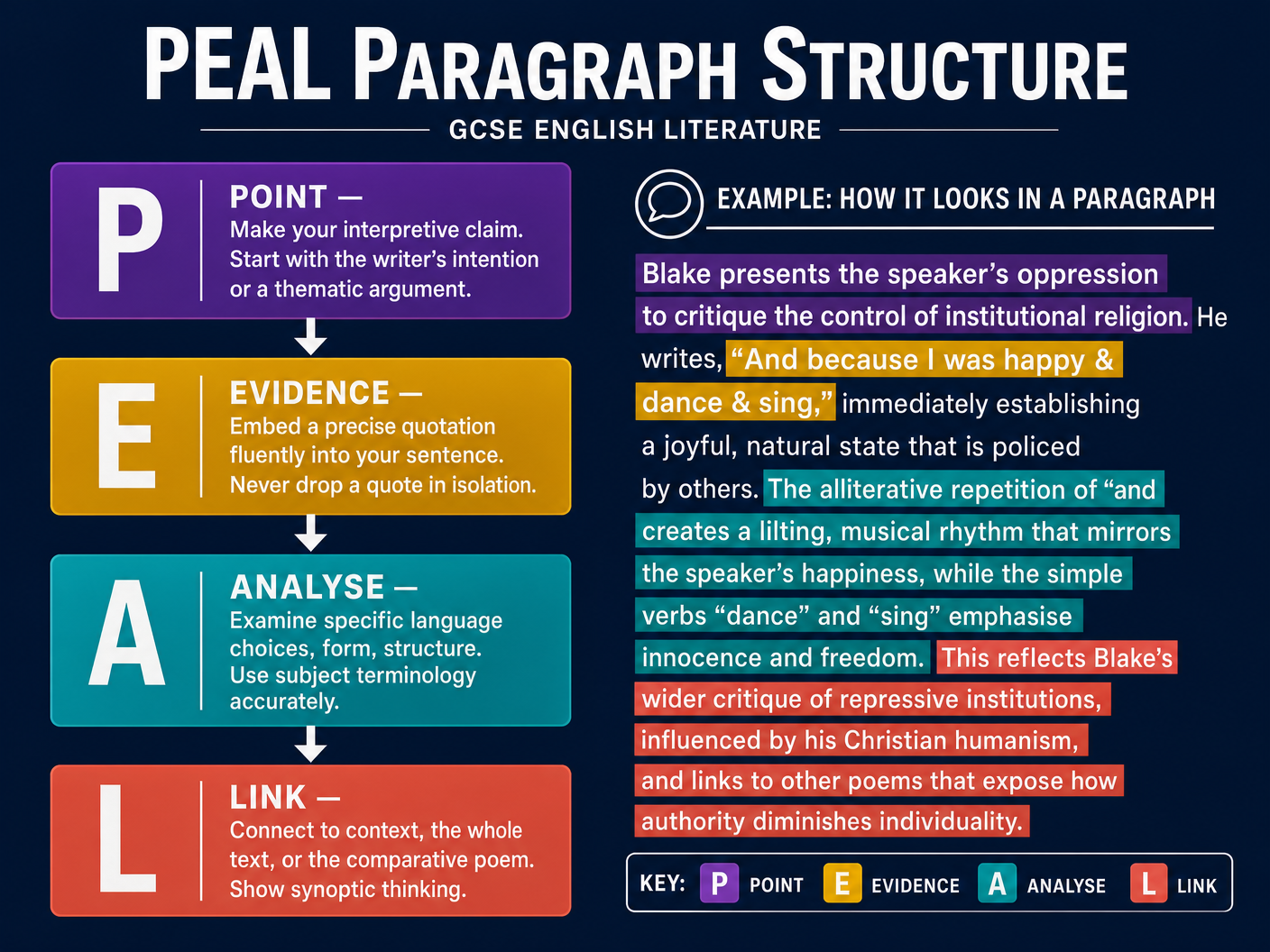
Use the PEAL structure to ensure you hit all AOs:
- Point: Make a conceptual claim.
- Evidence: Embed a precise quotation.
- Analyse: Examine the writer's methods (AO2).
- Link: Connect to context (AO3) or the comparative text.
Check what you remember
Read the wording for your board, then hide it and explain Iambic Pentameter in your own words. Rough notes are fine. This is a self-check, with no mark or grade.
Reference: OCR
A line of verse with five metrical feet, each consisting of one short (or unstressed) syllable followed by one long (or stressed) syllable.
Interactive Diagrams
1 interactive diagram to visualise key concepts
Conceptual Flow Outline
The Progression of Deep Analysis (AO2 to AO3)
Worked Examples
2 worked examples — open one to explore the question and available guidance.
Practice Questions
Try the question, then reveal an answer plan or example response
Starting with this extract, explore how Shakespeare presents the relationship between [Character A] and [Character B].
This prompt needs an extract from your set text. Use the extract provided by your teacher or exam paper; this question card does not include one.
Hint: Look for shifts in power dynamics in the extract, and track how this relationship evolves or deteriorates across the whole play.
Compare how poets present the power of nature in [Studied Poem] and the unseen poem.
Hint: Consider whether nature is presented as a destructive force, a healing force, or an indifferent force in both poems.
How does Shakespeare use the supernatural to create tension in the play?
Hint: Focus on audience reaction. How would a Jacobean audience react to the supernatural compared to a modern audience?
Compare how the writers present the passing of time in [Studied Poem] and the unseen poem.
Hint: Look at the structure of the poems. Does the poem move chronologically? Are there flashbacks? Does the rhythm speed up or slow down?
Ready to test yourself interactively?
Active recall beats reading alone. Answer questions on Exploring poetry and Shakespeare (02) with instant AI scoring and mark scheme guidance.
A week of Premium from your first lesson · Then the free plan continues · No card, no charge
Exam technique
How to turn what you know into marks
How to approach the question
Deconstruct the prompt: identify the focus (theme/character) and ensure you address both bullet points (extract and whole text).
How to structure your answer
Use the PEAL structure. Ensure every paragraph drives your central thesis forward.
Timing
For a 40-mark question (30+4 for Shakespeare), spend 5 minutes planning and 40-45 minutes writing.
Common pitfalls
- Feature-spotting without analysing the effect on the reader/audience.
- Bolting on context as a separate 'history' paragraph.
- Writing about the studied and unseen poems sequentially rather than comparing them continuously.
- Retelling the plot instead of analysing the writer's methods.
What the command words want
- Compare
- Must discuss both texts simultaneously, focusing on similarities and differences in methods and attitudes.
- Explore
- Requires wide-ranging analysis covering multiple aspects of the text.
- How does... present
- Focus heavily on AO2 methods: language choices, structure, form, and stagecraft.
- Starting with this extract
- Requires a roughly 50/50 split between analysing the provided extract and referencing the wider text.
Watch or listen (optional)
Test your understanding of Exploring poetry and Shakespeare (02)
Active recall beats re-reading. Take an instant quiz now to test what you’ve learned and lock it into long-term memory.
A week of Premium from your first lesson · Then the free plan continues · No card, no charge