OCR · GCSE · English Literature
Course version: J352 · Version from Sept 2017
th century prose
Master the 19th-century prose component of your GCSE English Literature exam. This guide covers the core texts, critical analysis of writers' methods, and essential historical context to help you achieve top marks.
- 5 min read
- 2 worked examples
- 4 practice questions
- 8 key terms
Study Notes
Overview
The 19th-century prose component is a cornerstone of GCSE English Literature. Examiners are looking for your ability to critically evaluate a text, understanding not just the plot, but how the writer has crafted the narrative to convey deeper meanings. Whether you are studying A Christmas Carol, The Strange Case of Dr Jekyll and Mr Hyde, or Frankenstein, success relies on your ability to analyse language, form, and structure (AO2), and to seamlessly integrate relevant social and historical context (AO3). This guide provides the tools to move beyond simple narrative summary into the perceptive, critical analysis required for Level 5 and 6 responses.
Listen to our comprehensive revision podcast for a deep dive into the core concepts:
Plot/Content Overview
While the specific plot depends on your set text, all 19th-century prose texts share common structural features. They often involve a protagonist undergoing a profound transformation or facing a moral crisis. For example, Scrooge's journey from misanthropy to redemption, Jekyll's tragic experiment with his own duality, or Victor Frankenstein's disastrous creation. Understanding the chronological sequence of events is vital, but examiners reward candidates who can explain why events occur in a specific order and how this structure shapes the reader's response.
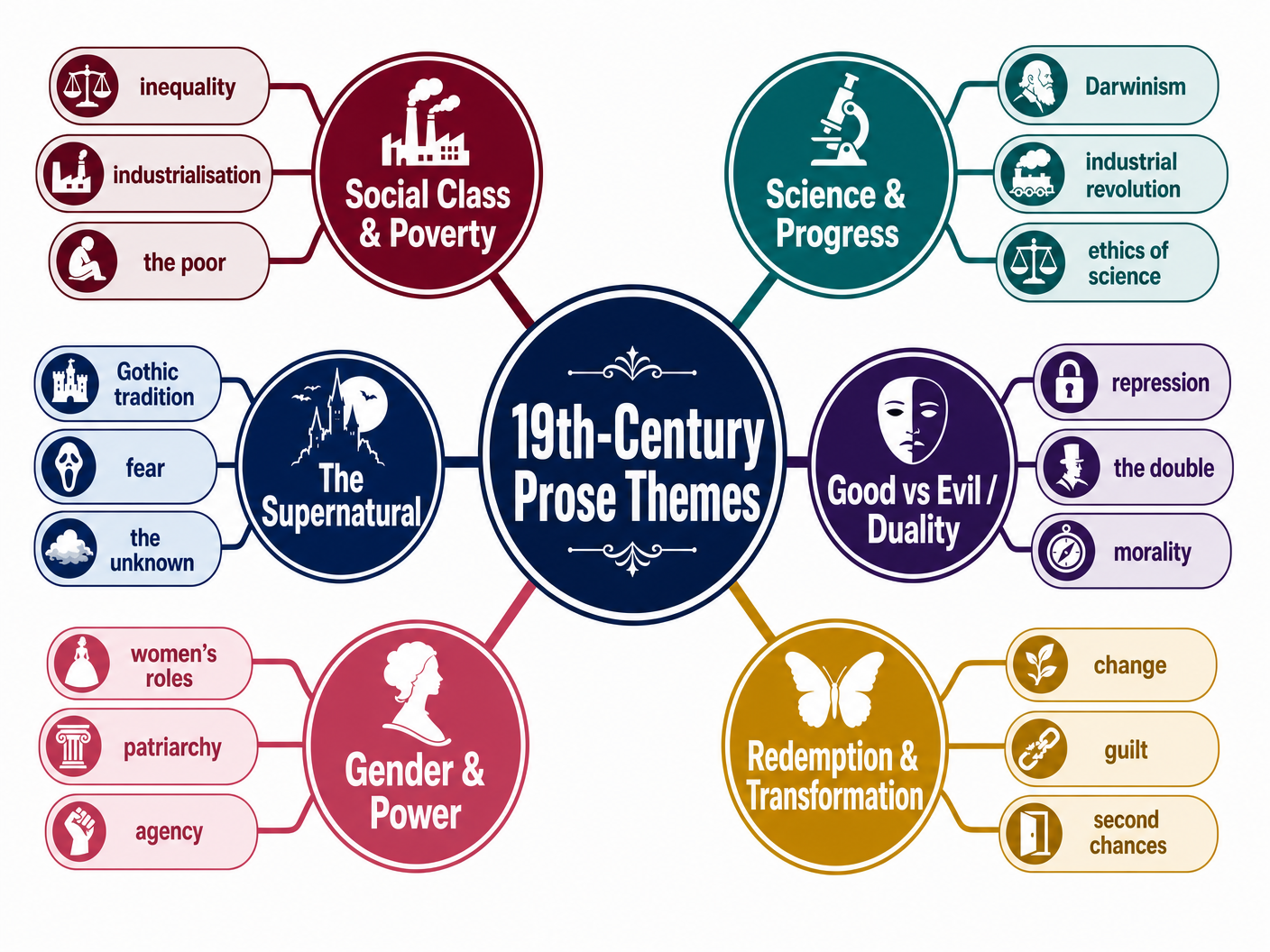
Themes
 Open full-size image (opens in a new tab)
Theme 1: Social Class and Inequality
19th-century writers frequently used their novels to critique the stark social divisions of their time. In A Christmas Carol, Dickens exposes the brutal reality of poverty and challenges the Malthusian view that the poor were a surplus population.
Key Quotes:
- "Are there no prisons?" (Stave 1) - Scrooge echoing the harsh utilitarian views of the era.
- "This boy is Ignorance. This girl is Want." (Stave 3) - Dickens allegorising the destructive consequences of societal neglect.
Theme 2: Duality and the Divided Self
The tension between outward respectability and inner desires is a hallmark of Victorian literature, most explicitly explored in Jekyll and Hyde.
Key Quotes:
- "Man is not truly one, but truly two." (Chapter 10) - Jekyll's thesis on human nature.
- "My devil had been long caged, he came out roaring." (Chapter 10) - The violent consequence of repression.
Theme 3: Science, Ambition, and Ethics
Texts like Frankenstein interrogate the limits of human knowledge and the moral responsibilities of the creator.
Key Quotes:
- "I will pioneer a new way, explore unknown powers..." (Chapter 3) - Victor's hubristic ambition.
- "You are my creator, but I am your master; obey!" (Chapter 20) - The inversion of power.
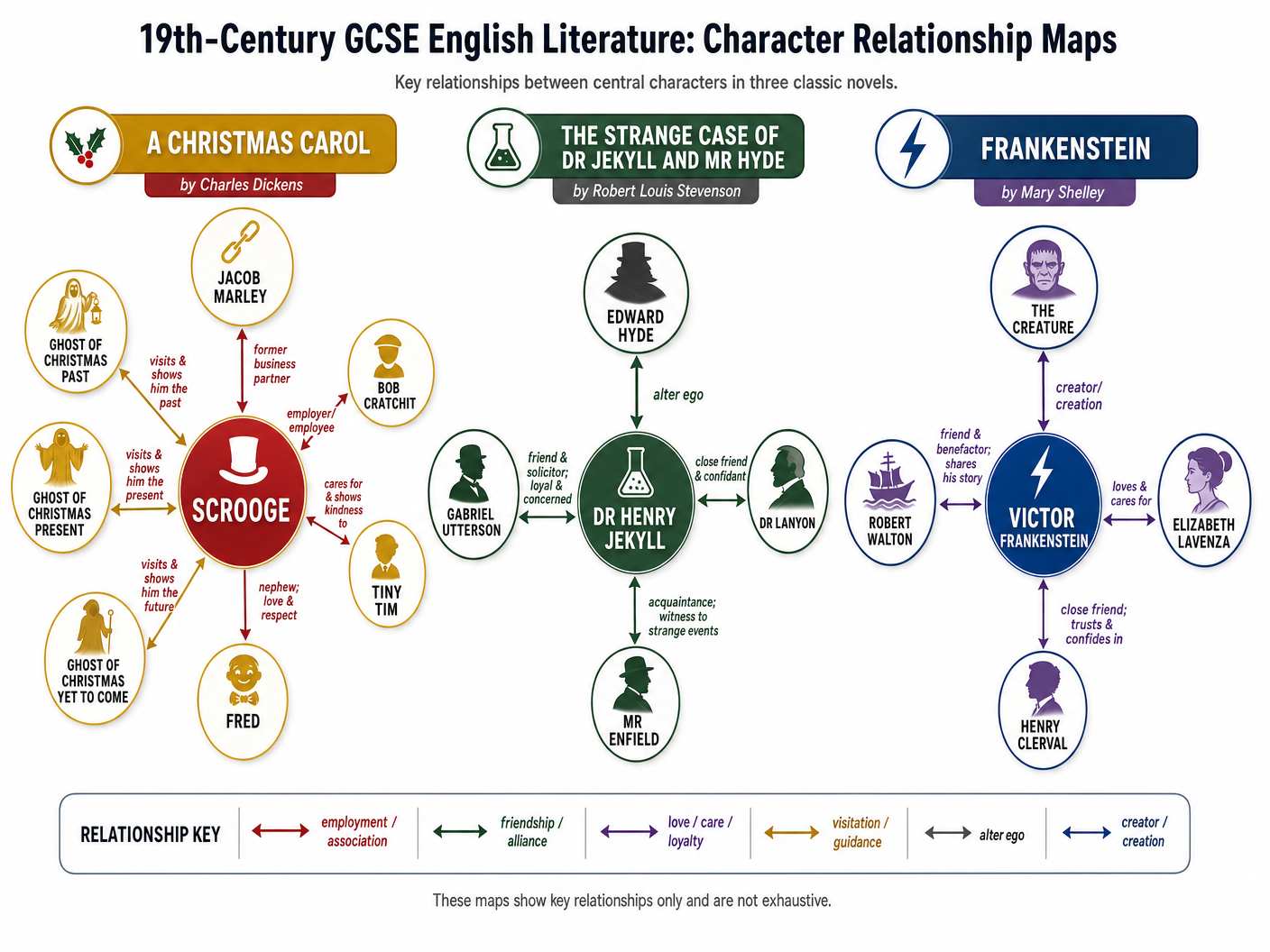
Character Analysis
 Open full-size image (opens in a new tab)
The Protagonist in Crisis
Role: Central figure whose internal conflict drives the narrative.
Key Traits: Often isolated, ambitious, or deeply flawed at the outset.
Character Arc: Experiences a profound disruption to their worldview, leading to either redemption (Scrooge) or destruction (Jekyll, Frankenstein).
Essential Quotes:
- "Hard and sharp as flint..." (Scrooge)
- "A large, well-made, smooth-faced man of fifty..." (Jekyll)
Writer's Methods
Examiners heavily reward the analysis of methods (AO2). This includes:
- Language: Word choice, imagery, and semantic fields. (e.g., Dickens's use of cold/ice imagery to describe Scrooge's emotional state).
- Form: The type of text. (e.g., The epistolary elements in Frankenstein or the fragmented narrative of Jekyll and Hyde).
- Structure: How the story is built. (e.g., The circular structure of A Christmas Carol ending where it began but with a transformed protagonist).
 Open full-size image (opens in a new tab)
Context
Context (AO3) must be integrated, not bolted on. It involves understanding the societal anxieties of the time: the impact of the Industrial Revolution, fears surrounding scientific advancement (galvanism, Darwinism), the strict moral codes of Victorian society, and the stark realities of urban poverty. A strong response links a specific textual detail to a relevant contextual factor to illuminate the writer's intention.
Check what you remember
Read the wording for your board, then hide it and explain Pathetic Fallacy in your own words. Rough notes are fine. This is a self-check, with no mark or grade.
Reference: OCR
The attribution of human emotions or characteristics to inanimate objects or to nature, especially weather.
Interactive Diagrams
1 interactive diagram to visualise key concepts
Conceptual Flow Outline
Common Narrative Arc in 19th-Century Prose
Worked Examples
2 worked examples — open one to explore the question and available guidance.
Practice Questions
Try the question, then reveal an answer plan or example response
Starting with this extract, explore how the writer presents the influence of setting on the characters. (30 marks + 4 AO4)
This prompt needs an extract from your set text. Use the extract provided by your teacher or exam paper; this question card does not include one.
Hint: Consider how the physical environment reflects the psychological or moral state of the characters.
How does the writer present the theme of responsibility in the novel? (30 marks + 4 AO4)
Hint: Think about personal responsibility versus social responsibility.
Explore how the writer presents the relationship between [Character A] and [Character B]. (30 marks + 4 AO4)
Hint: Look at power dynamics and how they shift throughout the narrative.
How is the concept of fear presented in the text? (30 marks + 4 AO4)
Hint: Consider both physical fear and psychological/moral terror.
Ready to test yourself interactively?
Active recall beats reading alone. Answer questions on th century prose with instant AI scoring and mark scheme guidance.
A week of Premium from your first lesson · Then the free plan continues · No card, no charge
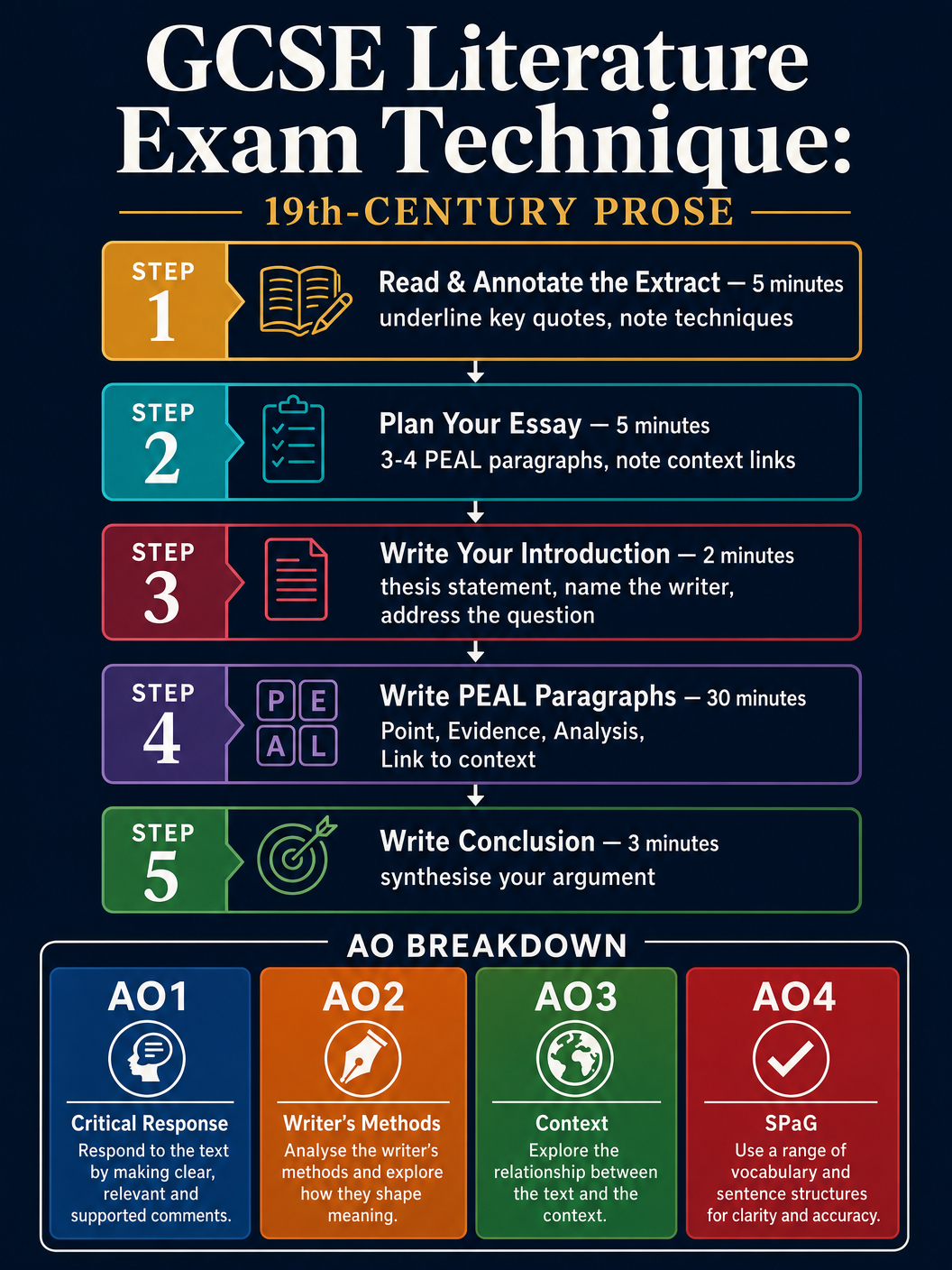
Exam technique
How to turn what you know into marks
How to approach the question
Deconstruct the question: underline the command word, the focus (theme/character), and ensure you plan to cover both the extract and the wider text.
How to structure your answer
Use PEAL paragraphs. Point (argument) → Evidence (embedded quote) → Analysis (zoom in on language/structure - AO2) → Link (connect to context/writer's message - AO3).
Timing
For a 30+4 mark question, spend 5 minutes planning, 40-45 minutes writing.
Common pitfalls
- Feature spotting without analysing the effect on the reader.
- Bolting on historical context in a separate paragraph rather than integrating it into the analysis.
- Retelling the plot instead of evaluating the writer's methods.
What the command words want
- Explore
- Provide a wide-ranging analysis covering multiple aspects of the text; balance breadth with analytical depth.
- Evaluate
- Make clear judgements supported by textual evidence; consider alternative interpretations.
- How does... present
- Focus heavily on AO2 methods: language choices, structural shifts, narrative form.
- Starting with this extract
- Maintain a 50/50 split between detailed extract analysis and references to the wider text.
Watch or listen (optional)
Test your understanding of th century prose
Active recall beats re-reading. Take an instant quiz now to test what you’ve learned and lock it into long-term memory.
A week of Premium from your first lesson · Then the free plan continues · No card, no charge