AQA · A-Level · English Language
Course version: 7702 · Version from Sept 2017
Writing about language issues in a variety of forms to communicate their…
Full specification wording
Writing skills: writing about language issues in a variety of forms to communicate their ideas to a non-specialist audience.
This skill is about adapting your knowledge of language study for readers who have not studied linguistics.
Checked against the AQA 7702 specification (opens in a new tab) on .
- Point 3 of 3
- 4 key terms
Study notes
From the checked teaching notes for this specification point.
The idea
This skill is about adapting your knowledge of language study for readers who have not studied linguistics. You must choose a form that suits the purpose, such as a broadsheet opinion article, a blog post, a letter to an editor, a speech or a leaflet, and shape content, tone and structure accordingly. A non-specialist audience needs key terms explained in accessible language, concrete examples and a clear line of argument. For instance, an article arguing that regional accents face prejudice might open with an anecdote, define 'accent prejudice' in plain terms, use a short example of a hiring decision, and close with a recommendation. You still draw on linguistic concepts, but you translate them rather than display jargon. Assessment rewards a consistent form, an appropriate register, coherent organisation and ideas that remain accurate while being accessible.
What earns the marks
- Selects a form and register that fit the stated purpose and audience, sustaining conventions such as headline, salutation or direct address throughout.
- Explains linguistic concepts in accessible terms, defining or illustrating terminology rather than assuming specialist knowledge.
- Uses concrete examples, anecdotes or analogies to make abstract language issues vivid for a general reader.
- Organises ideas coherently with a clear opening, developed argument and purposeful conclusion suited to the chosen form.
- Maintains an appropriate tone, for example persuasive, informative or reflective, without becoming overly technical or patronising.
- Keeps linguistic claims accurate while simplifying expression, so accessibility does not become distortion.
Common mistakes and how to put them right
Writing an essay for an examiner rather than the named audience.
Put it right by adopting the conventions and address of the chosen form.
Overloading the piece with unexplained terminology.
Put it right by defining terms briefly or replacing them with plain equivalents.
Losing the argument in decoration such as jokes or rhetorical questions.
Put it right by ensuring every device advances the central point.
Exam tips
- Plan the form first, noting its typical features, then map your argument onto that structure.
- Read your draft as if you were the intended reader and remove anything that assumes specialist study.
- Keep one clear central argument and use examples to support it rather than listing many issues.
Try the lesson
The start of the Writing skills: writing about language issues in a variety of forms to communicate their ideas to a non-specialist audience. lesson, made from checked teaching notes for this specification point.
Have a go first
When adapting a piece of linguistic research into an article for a non-specialist audience, which approach is most appropriate?
Listen
This skill is about adapting your knowledge of language study for readers who have not studied linguistics. You must choose a form that suits the purpose, such as a broadsheet opinion article, a blog post, a letter to an editor, a speech or a leaflet, and shape content, tone and structure accordingly. A non-specialist audience needs key terms explained in accessible language, concrete examples and a clear line of argument. For instance, an article arguing that regional accents face prejudice might open with an anecdote, define 'accent prejudice' in plain terms, use a short example of a hiring decision, and close with a recommendation. You still draw on linguistic concepts, but you translate them rather than display jargon. Assessment rewards a consistent form, an appropriate register, coherent organisation and ideas that remain accurate while being accessible. A strong answer earns marks for these points. Selects a form and register that fit the stated purpose and audience, sustaining conventions such as headline, salutation or direct address throughout. Explains linguistic concepts in accessible terms, defining or illustrating terminology rather than assuming specialist knowledge. Uses concrete examples, anecdotes or analogies to make abstract language issues vivid for a general reader. Organises ideas coherently with a clear opening, developed argument and purposeful conclusion suited to the chosen form. A common slip: Writing an essay for an examiner rather than the named audience. Instead, adopting the conventions and address of the chosen form. Exam tip: Plan the form first, noting its typical features, then map your argument onto that structure.
See it
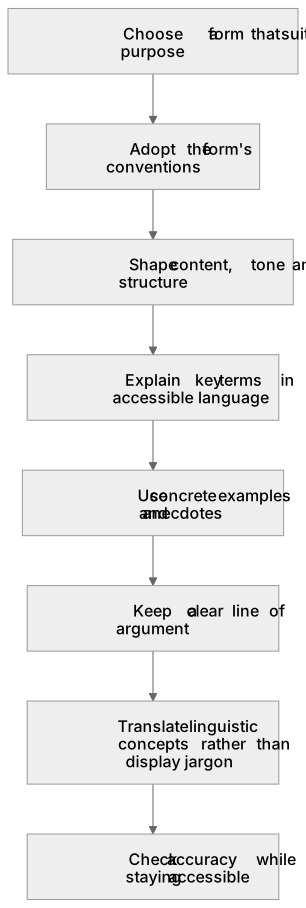
Put it in order
Put these steps in the order they happen.
- 1. Use concrete examples and anecdotes
- 2. Check accuracy while staying accessible
- 3. Keep a clear line of argument
- 4. Choose a form that suits purpose
- 5. Adopt the form's conventions
- 6. Translate linguistic concepts rather than display jargon
- 7. Shape content, tone and structure
- 8. Explain key terms in accessible language
Key words
Say what each word means before you turn the card.
Audience and purpose
Try answering aloud or in your head before turning the card.
Form and genre conventions
Try answering aloud or in your head before turning the card.
Accessibility and register
Try answering aloud or in your head before turning the card.
Accuracy in public communication
Try answering aloud or in your head before turning the card.
See every definition
- Audience and purpose
- The readers a piece is written for and the aim it is meant to achieve, which together shape content, tone and structure.
- Form and genre conventions
- The typical features of a chosen form, such as a headline, salutation or direct address, which must be sustained throughout.
- Accessibility and register
- Explaining linguistic concepts in plain terms and choosing a tone, such as persuasive, informative or reflective, that suits a non-specialist reader.
- Accuracy in public communication
- Keeping linguistic claims accurate while simplifying expression, so that accessibility does not become distortion.
Label the diagram
Some boxes have lost their names. Pick the right name for each number.
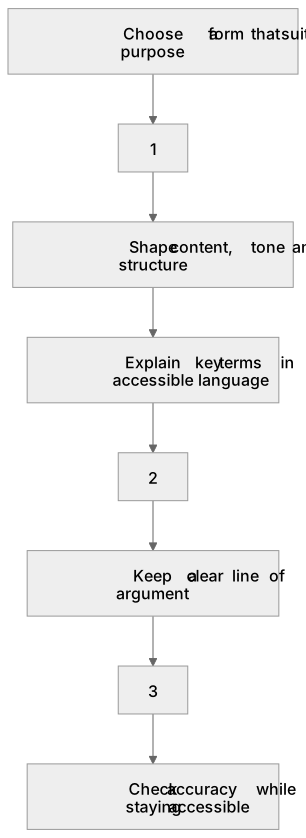
1Box 1
2Box 2
3Box 3
There is more to this lesson
The full lesson goes on to check your understanding and help you earn the marks. Create a free account to carry on, with your progress saved.
A week of Premium from your first lesson · Then the free plan continues · No card, no charge
Test your understanding of Writing skills: writing about language issues in a variety of forms to communicate their ideas to a non-specialist audience.
Active recall beats re-reading. Take an instant quiz now to test what you’ve learned and lock it into long-term memory.
A week of Premium from your first lesson · Then the free plan continues · No card, no charge