AQA · A-Level · English Language
Course version: 7702 · Version from Sept 2017
Writing analytically about texts as parts of discourses about language
Full specification wording
Writing skills: writing analytically about texts as parts of discourses about language
This skill means treating any text about language not as a neutral description but as a contribution to an ongoing debate.
Checked against the AQA 7702 specification (opens in a new tab) on .
- Point 2 of 3
- 4 key terms
Study notes
From the checked teaching notes for this specification point.
The idea
This skill means treating any text about language not as a neutral description but as a contribution to an ongoing debate. A discourse is a patterned way of talking and thinking about a topic, carrying assumptions, values and typical vocabulary. To write analytically, identify the discourse a text belongs to, quote its linguistic evidence, and explain what that framing includes, excludes or assumes. For example, a newspaper column calling texting 'an assault on literacy' draws on a decline discourse, using metaphors of damage and crisis. You would quote the metaphor, name the discourse, and analyse how it positions readers to accept a particular view of young people and standard English. Analysis therefore links close language evidence to wider arguments about language, rather than summarising the text or agreeing with it.
What earns the marks
- Identifies the discourse or competing discourses a text participates in, such as decline, diversity, identity or prescriptivism, rather than only labelling its topic.
- Supports the identification with precise textual evidence, quoting or referencing specific lexical choices, metaphors, pronouns or syntactic patterns.
- Explains how those choices construct a stance and position the reader, for example through inclusive 'we' or alarmist metaphor.
- Links the text to wider debates about language, showing how it takes up, modifies or challenges existing arguments.
- Maintains an analytical register, using cautious modality and evaluative verbs such as 'constructs', 'implies' or 'positions' rather than simply asserting agreement or disagreement.
- Structures the analysis so each paragraph moves from evidence to interpretation to significance for the discourse.
- Distinguishes between describing a text's content, identifying its discourse and diagnosing its persuasive effect on readers.
Common mistakes and how to put them right
Summarising what the text says instead of analysing how it frames language.
Put it right by making every paragraph begin from a quoted choice and its effect.
Treating a discourse label as a conclusion rather than a tool.
Put it right by using the label to open analysis of evidence, not to replace it.
Assuming the text's viewpoint is simply true or false.
Put it right by analysing how the text persuades and what assumptions it relies on.
Confusing description with diagnosis.
Put it right by moving from what the text says to how it positions readers and what it assumes.
Exam tips
- Underline the text's key evaluative words and metaphors before writing, then build your analysis around them.
- Name the discourse explicitly but briefly, then spend most words on evidence and effect.
- Use hedged analytical phrasing such as 'this suggests' or 'this positions readers to' to keep a scholarly tone.
Try the lesson
The start of the Writing skills: writing analytically about texts as parts of discourses about language lesson, made from checked teaching notes for this specification point.
Have a go first
Which sentence best describes what it means to treat a text as part of a discourse about language?
Listen
This skill means treating any text about language not as a neutral description but as a contribution to an ongoing debate. A discourse is a patterned way of talking and thinking about a topic, carrying assumptions, values and typical vocabulary. To write analytically, identify the discourse a text belongs to, quote its linguistic evidence, and explain what that framing includes, excludes or assumes. For example, a newspaper column calling texting 'an assault on literacy' draws on a decline discourse, using metaphors of damage and crisis. You would quote the metaphor, name the discourse, and analyse how it positions readers to accept a particular view of young people and standard English. Analysis therefore links close language evidence to wider arguments about language, rather than summarising the text or agreeing with it. A strong answer earns marks for these points. Identifies the discourse or competing discourses a text participates in, such as decline, diversity, identity or prescriptivism, rather than only labelling its topic. Supports the identification with precise textual evidence, quoting or referencing specific lexical choices, metaphors, pronouns or syntactic patterns. Explains how those choices construct a stance and position the reader, for example through inclusive 'we' or alarmist metaphor. Links the text to wider debates about language, showing how it takes up, modifies or challenges existing arguments. A common slip: Summarising what the text says instead of analysing how it frames language. Instead, making every paragraph begin from a quoted choice and its effect. Exam tip: Underline the text's key evaluative words and metaphors before writing, then build your analysis around them.
See it
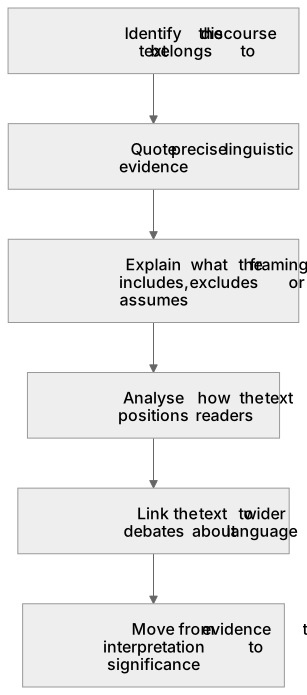
Put it in order
Put these steps in the order they happen.
- 1. Explain what the framing includes, excludes or assumes
- 2. Quote precise linguistic evidence
- 3. Identify the discourse a text belongs to
- 4. Move from evidence to interpretation to significance
- 5. Link the text to wider debates about language
- 6. Analyse how the text positions readers
Key words
Say what each word means before you turn the card.
Discourse and ideology
Try answering aloud or in your head before turning the card.
Language attitudes and debates
Try answering aloud or in your head before turning the card.
Positioning and reader address
Try answering aloud or in your head before turning the card.
Evidence-based interpretation
Try answering aloud or in your head before turning the card.
See every definition
- Discourse and ideology
- A patterned way of talking and thinking about a topic, carrying assumptions, values and typical vocabulary.
- Language attitudes and debates
- The ongoing debate about language to which a text about language contributes rather than neutrally describing.
- Positioning and reader address
- How textual choices construct a stance and position the reader, for example through inclusive 'we' or alarmist metaphor.
- Evidence-based interpretation
- Analysis that links close language evidence to wider arguments about language, rather than summarising the text or agreeing with it.
Label the diagram
Some boxes have lost their names. Pick the right name for each number.
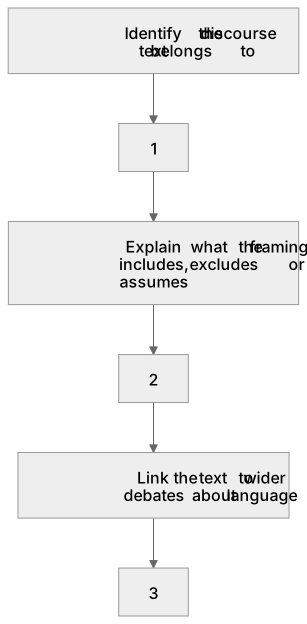
1Box 1
2Box 2
3Box 3
There is more to this lesson
The full lesson goes on to check your understanding and help you earn the marks. Create a free account to carry on, with your progress saved.
A week of Premium from your first lesson · Then the free plan continues · No card, no charge
Test your understanding of Writing skills: writing analytically about texts as parts of discourses about language
Active recall beats re-reading. Take an instant quiz now to test what you’ve learned and lock it into long-term memory.
A week of Premium from your first lesson · Then the free plan continues · No card, no charge