AQA · A-Level · English Language
Course version: 7702 · Version from Sept 2017
Writing discursively about language issues in an academic essay
Full specification wording
Writing skills: writing discursively about language issues in an academic essay
This skill is about writing an academic essay that discusses language issues in a discursive way.
Checked against the AQA 7702 specification (opens in a new tab) on .
- Point 1 of 3
- 4 key terms
Study notes
From the checked teaching notes for this specification point.
The idea
This skill is about writing an academic essay that discusses language issues in a discursive way. Discursive writing explores more than one side of a debate, weighs evidence and reaches a reasoned position. For example, an essay on whether social media is damaging young people's language might present arguments about reduced attention and informal register, then counter-arguments about creativity, code-switching and new literacies, before concluding that the effects depend on context and genre. You need a clear line of argument, coherent paragraphs, precise linguistic terminology, relevant examples and references to discourses such as prescriptivism or language change. The essay should sound academic: formal register, measured tone, signposted development and conclusions that follow from the evidence discussed.
What earns the marks
- Establish a clear focus and line of argument about a language issue, making the debate and your position evident to the reader.
- Organise the essay into coherent paragraphs that develop the argument, using discourse markers and topic sentences to guide the reader.
- Present and weigh different perspectives on the issue, using evidence, examples and linguistic concepts rather than assertion alone.
- Use accurate terminology and reference relevant discourses about language, such as standard language ideology or language and power, to support analysis.
- Maintain an academic register and a reasoned, evaluative tone, and reach a conclusion that follows from the discussion.
Common mistakes and how to put them right
Writing a one-sided argument that lists opinions without considering counter-arguments.
Put it right by including and evaluating at least one alternative perspective before concluding.
Using informal or conversational language, such as slang or rhetorical questions, in an academic essay.
Put it right by maintaining a formal register and precise terminology.
Making claims about language without evidence or examples.
Put it right by supporting each point with a specific linguistic example, study or observed pattern.
Exam tips
- Plan the essay around a clear debate question, noting arguments for and against before you begin writing.
- Use topic sentences and connectives to make the development of your argument easy to follow.
- Reserve time to check that your conclusion answers the question and follows logically from the evidence you have discussed.
Try the lesson
The start of the Writing skills: writing discursively about language issues in an academic essay lesson, made from checked teaching notes for this specification point.
Have a go first
A student is writing an academic essay on the impact of technology on language change. They have just outlined the prescriptivist view that text messaging degrades standard English. Which continuation best demonstrates a discursive approach?
Listen
This skill is about writing an academic essay that discusses language issues in a discursive way. Discursive writing explores more than one side of a debate, weighs evidence and reaches a reasoned position. For example, an essay on whether social media is damaging young people's language might present arguments about reduced attention and informal register, then counter-arguments about creativity, code-switching and new literacies, before concluding that the effects depend on context and genre. You need a clear line of argument, coherent paragraphs, precise linguistic terminology, relevant examples and references to discourses such as prescriptivism or language change. The essay should sound academic: formal register, measured tone, signposted development and conclusions that follow from the evidence discussed. A strong answer earns marks for these points. Establish a clear focus and line of argument about a language issue, making the debate and your position evident to the reader. Organise the essay into coherent paragraphs that develop the argument, using discourse markers and topic sentences to guide the reader. Present and weigh different perspectives on the issue, using evidence, examples and linguistic concepts rather than assertion alone. Use accurate terminology and reference relevant discourses about language, such as standard language ideology or language and power, to support analysis. A common slip: Writing a one-sided argument that lists opinions without considering counter-arguments. Instead, including and evaluating at least one alternative perspective before concluding. Exam tip: Plan the essay around a clear debate question, noting arguments for and against before you begin writing.
See it
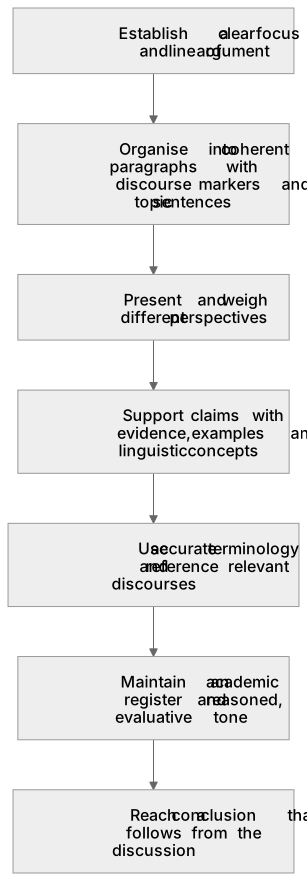
Put it in order
Put these steps in the order they happen.
- 1. Reach a conclusion that follows from the discussion
- 2. Maintain an academic register and reasoned, evaluative tone
- 3. Present and weigh different perspectives
- 4. Use accurate terminology and reference relevant discourses
- 5. Establish a clear focus and line of argument
- 6. Organise into coherent paragraphs with discourse markers and topic sentences
- 7. Support claims with evidence, examples and linguistic concepts
Key words
Say what each word means before you turn the card.
Discursive argument and balanced evaluation
Try answering aloud or in your head before turning the card.
Academic register and cohesion
Try answering aloud or in your head before turning the card.
Evidence-based discussion of language issues
Try answering aloud or in your head before turning the card.
Engagement with language discourses
Try answering aloud or in your head before turning the card.
See every definition
- Discursive argument and balanced evaluation
- Writing that explores more than one side of a debate, weighs evidence and reaches a reasoned position.
- Academic register and cohesion
- A formal register and measured tone with signposted development and coherent paragraphs that guide the reader.
- Evidence-based discussion of language issues
- Presenting and weighing different perspectives using evidence, examples and linguistic concepts rather than assertion alone.
- Engagement with language discourses
- Referencing relevant discourses about language, such as prescriptivism or language change, to support analysis.
Label the diagram
Some boxes have lost their names. Pick the right name for each number.
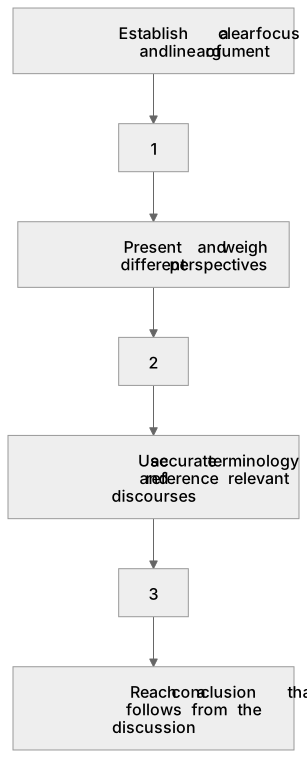
1Box 1
2Box 2
3Box 3
There is more to this lesson
The full lesson goes on to check your understanding and help you earn the marks. Create a free account to carry on, with your progress saved.
A week of Premium from your first lesson · Then the free plan continues · No card, no charge
Test your understanding of Writing skills: writing discursively about language issues in an academic essay
Active recall beats re-reading. Take an instant quiz now to test what you’ve learned and lock it into long-term memory.
A week of Premium from your first lesson · Then the free plan continues · No card, no charge