AQA · GCSE · English Language
Course version: 8700 · Version from Sept 2017
Critical reading and comprehension: comparing texts: comparing two or more texts critically with respect to the above.
Comparing texts critically means reading two or more texts together and judging how each one works, rather than describing them one after the other.
- 2 key terms
Study notes
From the checked teaching notes for this specification point.
The idea
Comparing texts critically means reading two or more texts together and judging how each one works, rather than describing them one after the other. You identify what each text says, how its ideas are shaped by language, structure and form, and how purpose and audience differ. For example, a newspaper article and a charity leaflet may both discuss homelessness, but one reports and one persuades. You compare by selecting short quotations, naming a method in each text, and explaining the effect of the similarity or difference. The phrase 'with respect to the above' means you apply the same critical reading skills to both texts: interpreting ideas, analysing methods, and using evidence. Assessment rewards a clear comparative thread, not a list of separate comments.
What earns the marks
- Selects relevant evidence from both texts, using short embedded quotations rather than long copied chunks.
- Identifies a method in each text, such as word choice, imagery, sentence form or structural shift, and names it accurately.
- Explains the effect of each method on the reader, linking it to purpose, audience or tone.
- Makes an explicit comparative point using connectives such as 'whereas', 'similarly', 'in contrast' or 'both'.
- Comments on how the writers' different perspectives or purposes shape the methods they choose.
- Sustains a comparative focus across a whole response rather than alternating into separate summaries.
Common mistakes and how to put them right
Writing about one text fully and then the other, which produces description rather than comparison.
Put it right: Pair points together, discussing both texts in the same paragraph.
Retelling what happens in each text without naming methods.
Put it right: Attach a method label to every quotation, such as metaphor, rhetorical question or short sentence.
Using quotations that are too long and then paraphrasing them.
Put it right: Embed two or three words and analyse those words closely.
Claiming an effect without explaining how the method creates it.
Put it right: Use 'because' or 'which suggests' to build a causal link between method and effect.
Exam tips
- Plan two or three comparative points before writing, each with a quotation from both texts.
- Use comparative discourse markers deliberately at the start of sentences to signal your thread.
- Keep quotations brief so your analysis, not the quotation, carries the marks.
- Track the writers' purposes in your plan so every comparison links back to why each text was written.
Try the lesson
The start of the Critical reading and comprehension: comparing texts: comparing two or more texts critically with respect to the above. lesson, made from checked teaching notes for this specification point.
Have a go first
When comparing two texts, what does the word 'compare' ask you to do?
Listen
Comparing texts critically means reading two or more texts together and judging how each one works, rather than describing them one after the other. You identify what each text says, how its ideas are shaped by language, structure and form, and how purpose and audience differ. For example, a newspaper article and a charity leaflet may both discuss homelessness, but one reports and one persuades. You compare by selecting short quotations, naming a method in each text, and explaining the effect of the similarity or difference. The phrase 'with respect to the above' means you apply the same critical reading skills to both texts: interpreting ideas, analysing methods, and using evidence. Assessment rewards a clear comparative thread, not a list of separate comments.
See it
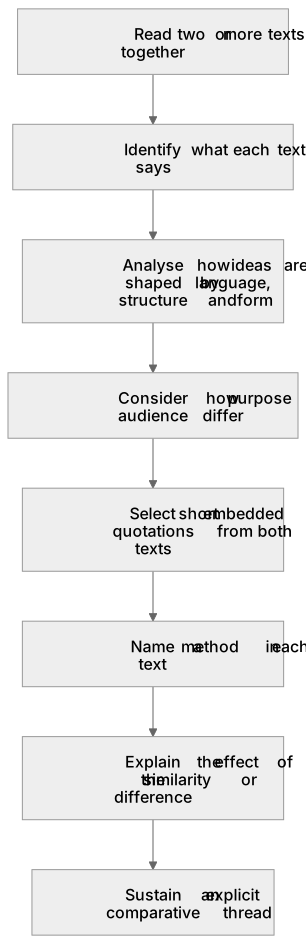
Put it in order
Put these steps in the order they happen.
- 1. Identify what each text says
- 2. Analyse how ideas are shaped by language, structure and form
- 3. Consider how purpose and audience differ
- 4. Select short embedded quotations from both texts
- 5. Name a method in each text
- 6. Explain the effect of the similarity or difference
- 7. Sustain an explicit comparative thread
- 8. Read two or more texts together
Key words
Say what each word means before you turn the card.
Comparative analysis
Try answering aloud or in your head before turning the card.
Language and structure
Try answering aloud or in your head before turning the card.
See every definition
- Comparative analysis
- Selecting short quotations, naming a method in each text, and explaining the effect of the similarity or difference.
- Language and structure
- The methods by which a text's ideas are shaped, such as word choice, imagery, sentence form or structural shift.
Label the diagram
Some boxes have lost their names. Pick the right name for each number.
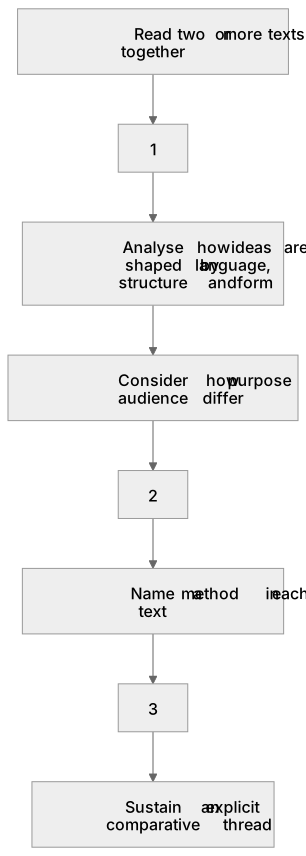
1Box 1
2Box 2
3Box 3
There is more to this lesson
The full lesson goes on to check your understanding and help you earn the marks. Create a free account to carry on, with your progress saved.
7 days Premium · Then the free plan continues · No card, no charge
Test your understanding of Critical reading and comprehension: comparing texts: comparing two or more texts critically with respect to the above.
Active recall beats re-reading. Take an instant quiz now to test what you’ve learned and lock it into long-term memory.
7 days Premium · Then the free plan continues · No card, no charge