AQA · GCSE · English Language
Course version: 8700 · Version from Sept 2017
Critical reading and comprehension: critical reading and comprehension: identifying and interpreting themes, ideas and information in a range of literature and other high-quality writing; reading in different ways for different purposes, and comparing and evaluating the usefulness, relevance and presentation of content for these purposes; drawing inferences and justifying these with evidence; supporting a point of view by referring to evidence within the text; identifying bias and misuse of evidence, including distinguishing between statements that are supported by evidence and those that are not; reflecting critically and evaluatively on text, using the context of the text and drawing on knowledge and skills gained from wider reading; recognising the possibility of different responses to a text
Critical reading means actively interrogating a text rather than simply absorbing it.
- 4 key terms
Study notes
From the checked teaching notes for this specification point.
The idea
Critical reading means actively interrogating a text rather than simply absorbing it. You identify themes, ideas and information, then interpret what they suggest. Purpose shapes method: skimming a review for its verdict differs from close-reading a speech to trace an argument. Comparing sources means judging usefulness, relevance and presentation for a set task. Inferences are conclusions the text implies but does not state, and each must be justified with a quotation or close reference. When you support a viewpoint, evidence from the text does the work. Bias appears in selection, emphasis and omission; misuse of evidence includes claims the text never supports. Reflecting evaluatively means weighing a text against its context and your wider reading, and accepting that other readers may respond differently.
What earns the marks
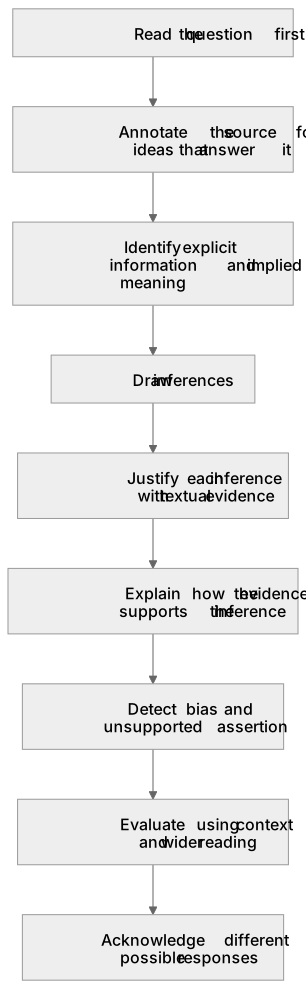
- Identifies explicit information and implied meaning, distinguishing surface detail from deeper theme or attitude.
- Selects and embeds relevant textual evidence, explaining how the quotation supports the inference rather than leaving it to speak for itself.
- Adapts reading approach to purpose, for example scanning for a specific fact versus close analysis of a writer's methods.
- Compares texts or sources for usefulness, relevance and presentation, reaching a judgement tied to the stated purpose.
- Detects bias and unsupported assertion, separating claims evidenced in the text from those merely asserted.
- Evaluates a text using its context and wider reading, acknowledging that different readers may respond differently.
Common mistakes and how to put them right
Retelling the text instead of interpreting it.
Put it right: For each point, ask what the detail suggests and why the writer chose it.
Dropping in a quotation without comment.
Put it right: Follow every quotation with an explanation linking it to your point.
Treating one reading as the only possible response.
Put it right: Phrase alternatives as 'a reader might' and justify each with evidence.
Exam tips
- Read the question first, then annotate the source for ideas that answer it directly.
- Use short, precise quotations and integrate them into your own sentences.
- When comparing sources, judge each against the stated purpose rather than listing similarities.
Try the lesson
The start of the Critical reading and comprehension: critical reading and comprehension: identifying and interpreting themes, ideas and information in a range of literature and other high-quality writing; reading in different ways for different purposes, and comparing and evaluating the usefulness, relevance and presentation of content for these purposes; drawing inferences and justifying these with evidence; supporting a point of view by referring to evidence within the text; identifying bias and misuse of evidence, including distinguishing between statements that are supported by evidence and those that are not; reflecting critically and evaluatively on text, using the context of the text and drawing on knowledge and skills gained from wider reading; recognising the possibility of different responses to a text lesson, made from checked teaching notes for this specification point.
Have a go first
A travel article states: 'The coastal path is the finest in the country.' Which statement about this sentence is accurate?
Listen
Critical reading means actively interrogating a text rather than simply absorbing it. You identify themes, ideas and information, then interpret what they suggest. Purpose shapes method: skimming a review for its verdict differs from close-reading a speech to trace an argument. Comparing sources means judging usefulness, relevance and presentation for a set task. Inferences are conclusions the text implies but does not state, and each must be justified with a quotation or close reference. When you support a viewpoint, evidence from the text does the work. Bias appears in selection, emphasis and omission; misuse of evidence includes claims the text never supports. Reflecting evaluatively means weighing a text against its context and your wider reading, and accepting that other readers may respond differently.
See it
Key words
Say what each word means before you turn the card.
Interpretation of themes and ideas
Try answering aloud or in your head before turning the card.
Reading for different purposes
Try answering aloud or in your head before turning the card.
Evidence-based inference
Try answering aloud or in your head before turning the card.
Bias and evaluation
Try answering aloud or in your head before turning the card.
See every definition
- Interpretation of themes and ideas
- Identifying themes, ideas and information in a text and interpreting what they suggest, rather than simply absorbing or retelling the text.
- Reading for different purposes
- Reading in different ways for different purposes, since purpose shapes method, such as skimming a review for its verdict versus close-reading a speech to trace an argument.
- Evidence-based inference
- A conclusion the text implies but does not state, which must be justified with a quotation or close reference.
- Bias and evaluation
- Bias appears in selection, emphasis and omission, while reflecting evaluatively means weighing a text against its context and wider reading and accepting that other readers may respond differently.
Label the diagram
Some boxes have lost their names. Pick the right name for each number.
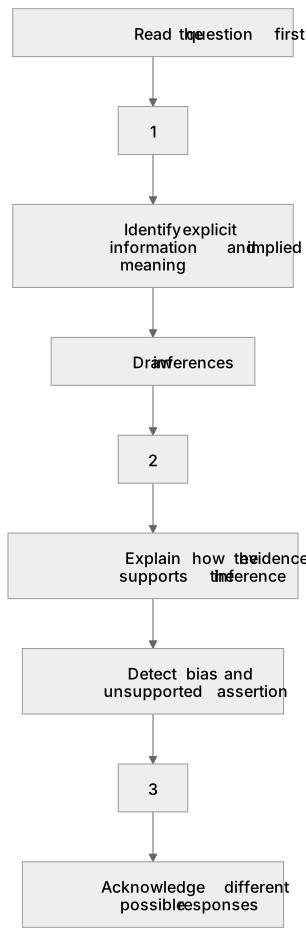
1Box 1
2Box 2
3Box 3
There is more to this lesson
The full lesson goes on to check your understanding and help you earn the marks. Create a free account to carry on, with your progress saved.
7 days Premium · Then the free plan continues · No card, no charge
Test your understanding of Critical reading and comprehension: critical reading and comprehension: identifying and interpreting themes, ideas and information in a range of literature and other high-quality writing; reading in different ways for different purposes, and comparing and evaluating the usefulness, relevance and presentation of content for these purposes; drawing inferences and justifying these with evidence; supporting a point of view by referring to evidence within the text; identifying bias and misuse of evidence, including distinguishing between statements that are supported by evidence and those that are not; reflecting critically and evaluatively on text, using the context of the text and drawing on knowledge and skills gained from wider reading; recognising the possibility of different responses to a text
Active recall beats re-reading. Take an instant quiz now to test what you’ve learned and lock it into long-term memory.
7 days Premium · Then the free plan continues · No card, no charge