AQA · GCSE · English Language
Course version: 8700 · Version from Sept 2017
Critical reading and comprehension: evaluation of a writer’s choice of vocabulary, form, grammatical and structural features: explaining and illustrating how vocabulary and grammar contribute to effectiveness and impact, using linguistic and literary terminology accurately to do so and paying attention to detail; analysing and evaluating how form and structure contribute to the effectiveness and impact of a text
This skill asks you to move beyond spotting a technique and instead judge how a writer's choices create effects for a reader.
- 4 key terms
Study notes
From the checked teaching notes for this specification point.
The idea
This skill asks you to move beyond spotting a technique and instead judge how a writer's choices create effects for a reader. Take a short sentence such as 'The door slammed.' The verb 'slammed' is blunt and monosyllabic, and the clipped grammar mirrors sudden violence, so the vocabulary and syntax together create shock. You then explain that effect and weigh how far it works. For form, consider whether the text is a first-person monologue or a news report; for structure, track shifts in focus, tense or paragraph length. Evaluation means judging effectiveness, not just labelling devices, and it must be anchored in precise quotation and accurate terminology such as 'imperative', 'caesura' or 'cyclical structure'.
What earns the marks
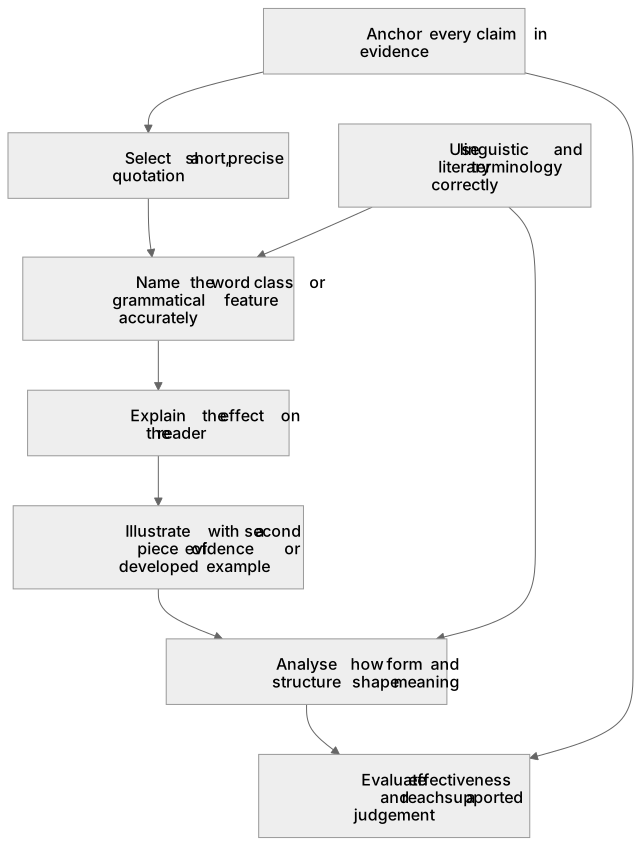
- Selects a short, precise quotation and names the word class or grammatical feature accurately, for example identifying an imperative verb or a fronted adverbial rather than vaguely calling it 'descriptive language'.
- Explains the effect of vocabulary or grammar on the reader, linking word choice or sentence construction to mood, pace, tension or characterisation.
- Illustrates the point with a second piece of evidence or a developed example so the analysis is supported rather than asserted.
- Uses linguistic and literary terminology correctly and consistently, for example 'sibilance', 'passive voice', 'juxtaposition' or 'narrative perspective'.
- Analyses how form and structure shape meaning, such as how a cyclical ending or a shift from long to short paragraphs controls the reader's response.
- Evaluates effectiveness by weighing the impact of choices, considering alternative readings or judging how successfully the writer achieves a purpose.
Common mistakes and how to put them right
Feature-spotting without explaining effect.
Put it right: Add what the image suggests and how it makes the reader feel or think.
Using terminology inaccurately, such as calling any short sentence 'caesura' or any repetition 'anaphora'.
Put it right: Check the definition and apply the term only when the feature genuinely matches.
Treating structure as a list of parts, for example 'there is a beginning, middle and end'.
Put it right: Comment on how the ordering, shifts or contrasts shape meaning and reader response.
Offering a personal opinion with no textual support, such as 'this is a really effective sentence'.
Put it right: Quote the words and explain the specific effect that makes it effective.
Exam tips
- Plan quickly by choosing two or three rich quotations that let you discuss vocabulary, grammar, form and structure together rather than many shallow points.
- Embed short quotations inside your own sentences so your analysis flows and the focus stays on the writer's choices.
- Use evaluative verbs such as 'creates', 'reinforces', 'undermines' and 'positions' to show judgement rather than description.
- Leave time to reread your response and check that every terminology term you used is accurate and every claim is tied to evidence.
Try the lesson
The start of the Critical reading and comprehension: evaluation of a writer’s choice of vocabulary, form, grammatical and structural features: explaining and illustrating how vocabulary and grammar contribute to effectiveness and impact, using linguistic and literary terminology accurately to do so and paying attention to detail; analysing and evaluating how form and structure contribute to the effectiveness and impact of a text lesson, made from checked teaching notes for this specification point.
Have a go first
Which term describes the writer's choice of words in a text?
Listen
This skill asks you to move beyond spotting a technique and instead judge how a writer's choices create effects for a reader. Take a short sentence such as 'The door slammed.' The verb 'slammed' is blunt and monosyllabic, and the clipped grammar mirrors sudden violence, so the vocabulary and syntax together create shock. You then explain that effect and weigh how far it works. For form, consider whether the text is a first-person monologue or a news report; for structure, track shifts in focus, tense or paragraph length. Evaluation means judging effectiveness, not just labelling devices, and it must be anchored in precise quotation and accurate terminology such as 'imperative', 'caesura' or 'cyclical structure'.
See it
Key words
Say what each word means before you turn the card.
Precision of quotation and terminology
Try answering aloud or in your head before turning the card.
Effect on the reader
Try answering aloud or in your head before turning the card.
Form, structure and whole-text shaping
Try answering aloud or in your head before turning the card.
Critical evaluation and judgement
Try answering aloud or in your head before turning the card.
See every definition
- Precision of quotation and terminology
- Selecting a short, precise quotation and naming the word class or grammatical feature accurately, using linguistic and literary terminology correctly and consistently.
- Effect on the reader
- Explaining the effect of vocabulary or grammar on the reader, linking word choice or sentence construction to mood, pace, tension or characterisation.
- Form, structure and whole-text shaping
- Analysing how form and structure shape meaning, such as how a cyclical ending or a shift from long to short paragraphs controls the reader's response.
- Critical evaluation and judgement
- Evaluating effectiveness by weighing the impact of choices, considering alternative readings or judging how successfully the writer achieves a purpose.
Label the diagram
Some boxes have lost their names. Pick the right name for each number.
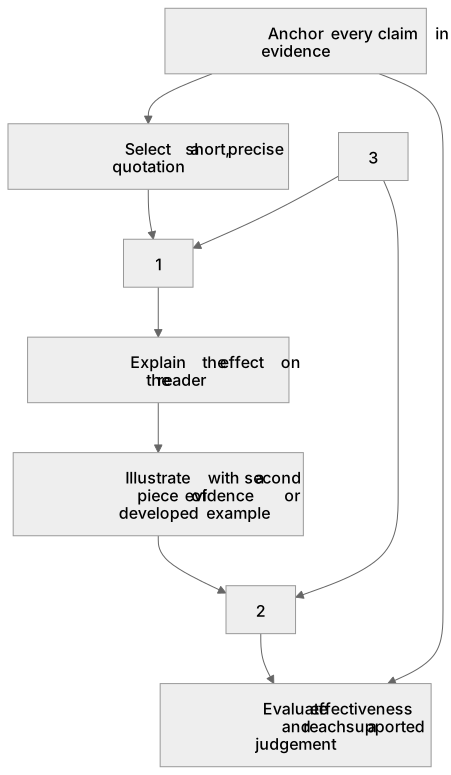
1Box 1
2Box 2
3Box 3
There is more to this lesson
The full lesson goes on to check your understanding and help you earn the marks. Create a free account to carry on, with your progress saved.
7 days Premium · Then the free plan continues · No card, no charge
Test your understanding of Critical reading and comprehension: evaluation of a writer’s choice of vocabulary, form, grammatical and structural features: explaining and illustrating how vocabulary and grammar contribute to effectiveness and impact, using linguistic and literary terminology accurately to do so and paying attention to detail; analysing and evaluating how form and structure contribute to the effectiveness and impact of a text
Active recall beats re-reading. Take an instant quiz now to test what you’ve learned and lock it into long-term memory.
7 days Premium · Then the free plan continues · No card, no charge