AQA · GCSE · English Language
Course version: 8700 · Version from Sept 2017
Critical reading and comprehension: summary and synthesis: identifying the main theme or themes; summarising ideas and information from a single text; synthesising from more than one text
This skill asks you to read closely, decide what a text is really about, and then express that economically.
- 4 key terms
Study notes
From the checked teaching notes for this specification point.
The idea
This skill asks you to read closely, decide what a text is really about, and then express that economically. Identifying the main theme means looking past surface details to the central idea the writer keeps returning to, such as loss, ambition or the pressure to conform. Summarising a single text means selecting the few points that carry the most weight and compressing them into your own words, without copying long quotations or drifting into your own opinions. Synthesising from more than one text is harder: you must bring together ideas from two or more sources, show where they agree, where they differ, and combine them into one coherent account. A practical method is to annotate each source, write a one-sentence gist for each, then group related points under headings before drafting.
What earns the marks
- Selects the central idea or ideas rather than peripheral detail, showing that the whole text has been understood.
- Compresses content into concise own words, keeping only the information that matters to the task.
- Uses evidence from the text accurately, quoting briefly or referring precisely to support the summary.
- When more than one text is used, draws on both and combines their ideas rather than treating them separately.
- Shows awareness of agreement and difference between sources, for example where one text supports or contradicts another.
- Maintains a clear line of argument so the summary reads as a coherent whole rather than a list.
Common mistakes and how to put them right
Retelling the text in order instead of selecting the most important ideas.
Put it right: Decide the main theme first, then choose only the details that support it.
Copying long phrases from the source.
Put it right: Paraphrase in your own words and quote only a few key words.
Writing about only one text when the task asks for synthesis.
Put it right: Plan points from each text and deliberately link them.
Adding personal opinion or evaluation when the task asks only for summary.
Put it right: Keep to what the text says and save judgement for analysis tasks.
Exam tips
- Read the question first so you know which ideas to look for as you read.
- Annotate each source with a short gist sentence before you start writing.
- Use connectives such as similarly, whereas and in contrast to show synthesis clearly.
- Keep quotations short and integrate them into your own sentences.
- Check that every paragraph links back to the main theme or themes.
Try the lesson
The start of the Critical reading and comprehension: summary and synthesis: identifying the main theme or themes; summarising ideas and information from a single text; synthesising from more than one text lesson, made from checked teaching notes for this specification point.
Have a go first
A paragraph explains that bees pollinate flowers, produce honey and support many plants. What is the main theme of the paragraph?
Listen
This skill asks you to read closely, decide what a text is really about, and then express that economically. Identifying the main theme means looking past surface details to the central idea the writer keeps returning to, such as loss, ambition or the pressure to conform. Summarising a single text means selecting the few points that carry the most weight and compressing them into your own words, without copying long quotations or drifting into your own opinions. Synthesising from more than one text is harder: you must bring together ideas from two or more sources, show where they agree, where they differ, and combine them into one coherent account. A practical method is to annotate each source, write a one-sentence gist for each, then group related points under headings before drafting.
See it
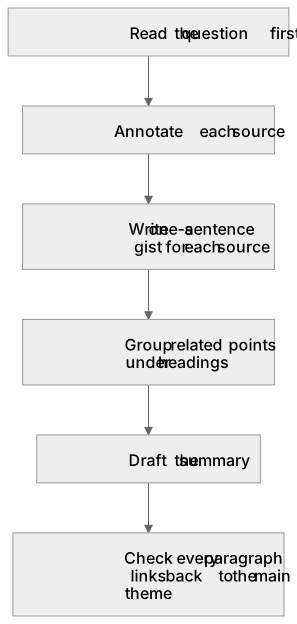
Put it in order
Put these steps in the order they happen.
- 1. Annotate each source
- 2. Write a one-sentence gist for each source
- 3. Group related points under headings
- 4. Draft the summary
- 5. Check every paragraph links back to the main theme
- 6. Read the question first
Key words
Say what each word means before you turn the card.
Identifying central ideas
Try answering aloud or in your head before turning the card.
Selecting relevant information
Try answering aloud or in your head before turning the card.
Concise paraphrase
Try answering aloud or in your head before turning the card.
Combining ideas from multiple texts
Try answering aloud or in your head before turning the card.
See every definition
- Identifying central ideas
- Looking past surface details to the main theme or themes the writer keeps returning to, showing the whole text has been understood.
- Selecting relevant information
- Choosing the few points that carry the most weight and keeping only the information that matters to the task.
- Concise paraphrase
- Compressing content into your own words, without copying long quotations or drifting into your own opinions.
- Combining ideas from multiple texts
- Bringing together ideas from two or more sources, showing where they agree and differ, and combining them into one coherent account.
Label the diagram
Some boxes have lost their names. Pick the right name for each number.
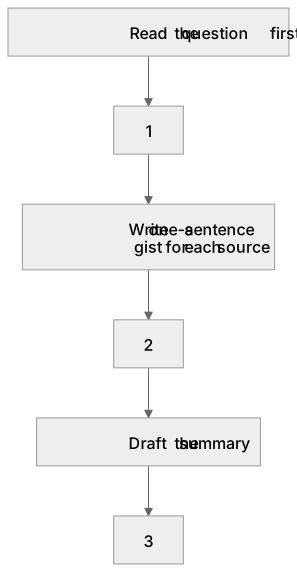
1Box 1
2Box 2
3Box 3
There is more to this lesson
The full lesson goes on to check your understanding and help you earn the marks. Create a free account to carry on, with your progress saved.
7 days Premium · Then the free plan continues · No card, no charge
Test your understanding of Critical reading and comprehension: summary and synthesis: identifying the main theme or themes; summarising ideas and information from a single text; synthesising from more than one text
Active recall beats re-reading. Take an instant quiz now to test what you’ve learned and lock it into long-term memory.
7 days Premium · Then the free plan continues · No card, no charge