AQA · GCSE · English Language
Course version: 8700 · Version from Sept 2017
Spoken language: spoken Standard English: expressing ideas using Standard English whenever and wherever appropriate.
Standard English is a dialect: a shared set of grammar and vocabulary rules, not an accent and not automatically formal.
- 3 key terms
Study notes
From the checked teaching notes for this specification point.
The idea
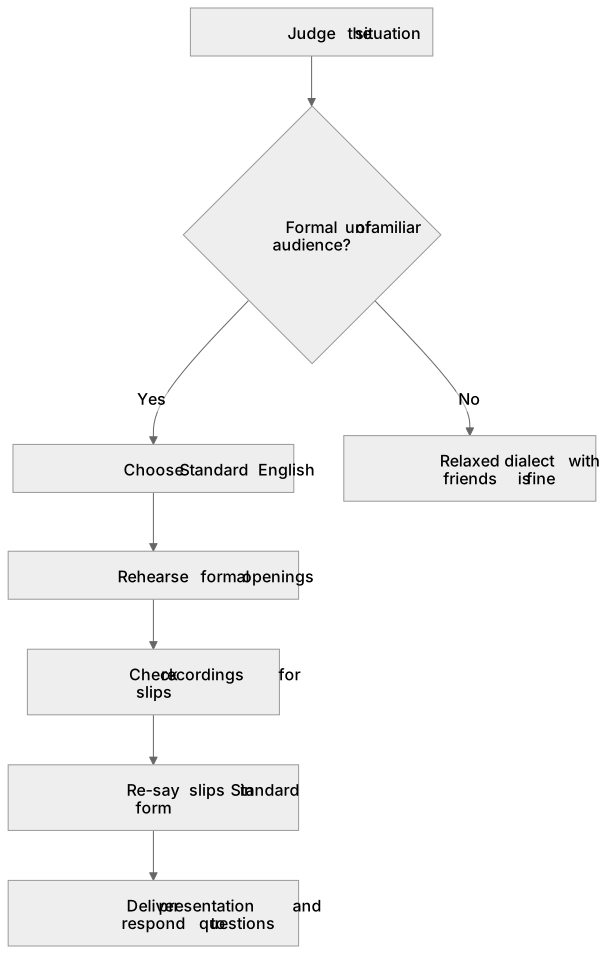
Standard English is a dialect: a shared set of grammar and vocabulary rules, not an accent and not automatically formal. You already use it when you say 'we were' rather than 'we was', or 'those books' rather than 'them books'. The skill is choosing it deliberately: in a presentation, a discussion with a teacher, or a job interview, Standard English keeps your meaning clear for any listener. In relaxed talk with friends, dialect forms are fine and often warmer. So 'whenever and wherever appropriate' asks you to judge the situation, not to abandon your own speech. For the spoken-language endorsement, deliver a prepared formal presentation and respond to questions or feedback using appropriate Standard English. Prepare by rehearsing formal openings, then check recordings for slips such as 'he don't' or double negatives, and re-say them in Standard form.
What earns the marks
- Uses grammatical forms consistently, for example matching singular and plural subjects to verbs: 'she goes', 'they go'.
- Avoids non-standard constructions such as double negatives ('I didn't see nothing') and 'them' as a determiner ('them shoes').
- Chooses vocabulary suited to a formal or unfamiliar audience, avoiding slang that the listener may not share.
- Adapts register to context, switching between relaxed dialect with peers and Standard English in presentations, discussions or interviews.
- Speaks with enough fluency and clarity that Standard English grammar is audible and not obscured by mumbling or unfinished sentences.
Common mistakes and how to put them right
Believing Standard English means speaking in a posh accent.
Put it right: Accent and dialect are separate from grammar, so a regional accent can carry perfectly standard grammar.
Using non-standard verb agreement under pressure, such as 'we was' or 'they was'.
Put it right: Rehearse the standard forms 'we were' and 'they were' until they become automatic.
Assuming Standard English must be used everywhere, including with close friends.
Put it right: Appropriateness depends on audience and purpose, so match your register to the situation.
Thinking Standard English is always formal.
Put it right: It is a dialect used across formal and informal situations, so formality is a separate choice about register.
Exam tips
- Rehearse two or three formal sentences you can use to open a discussion, so you begin in Standard English before nerves set in.
- Record yourself speaking for a minute, listen for non-standard grammar, and re-record the same content in Standard English.
- In group tasks, listen to others and respond in full standard sentences rather than one-word agreements.
- If you slip into dialect, correct yourself calmly and continue; the endorsement assesses your overall spoken language, not a single error.
Try the lesson
The start of the Spoken language: spoken Standard English: expressing ideas using Standard English whenever and wherever appropriate. lesson, made from checked teaching notes for this specification point.
Have a go first
Which sentence is an example of spoken Standard English?
Listen
Standard English is a dialect: a shared set of grammar and vocabulary rules, not an accent and not automatically formal. You already use it when you say 'we were' rather than 'we was', or 'those books' rather than 'them books'. The skill is choosing it deliberately: in a presentation, a discussion with a teacher, or a job interview, Standard English keeps your meaning clear for any listener. In relaxed talk with friends, dialect forms are fine and often warmer. So 'whenever and wherever appropriate' asks you to judge the situation, not to abandon your own speech. For the spoken-language endorsement, deliver a prepared formal presentation and respond to questions or feedback using appropriate Standard English. Prepare by rehearsing formal openings, then check recordings for slips such as 'he don't' or double negatives, and re-say them in Standard form. A strong answer earns marks for these points. Uses grammatical forms consistently, for example matching singular and plural subjects to verbs: 'she goes', 'they go'. Avoids non-standard constructions such as double negatives ('I didn't see nothing') and 'them' as a determiner ('them shoes'). Chooses vocabulary suited to a formal or unfamiliar audience, avoiding slang that the listener may not share. Adapts register to context, switching between relaxed dialect with peers and Standard English in presentations, discussions or interviews. A common slip: Believing Standard English means speaking in a posh accent. Instead, accent and dialect are separate from grammar, so a regional accent can carry perfectly standard grammar. Exam tip: Rehearse two or three formal sentences you can use to open a discussion, so you begin in Standard English before nerves set in.
See it
Key words
Say what each word means before you turn the card.
Standard English
Try answering aloud or in your head before turning the card.
Register
Try answering aloud or in your head before turning the card.
Dialect
Try answering aloud or in your head before turning the card.
See every definition
- Standard English
- A dialect made up of a shared set of grammar and vocabulary rules, not an accent and not automatically formal.
- Register
- The choice of language matched to the situation, switching between relaxed dialect with peers and Standard English in presentations, discussions or interviews.
- Dialect
- A shared set of grammar and vocabulary rules, which can be used in relaxed talk with friends, where dialect forms are fine and often warmer.
There is more to this lesson
The full lesson goes on to check your understanding and help you earn the marks. Create a free account to carry on, with your progress saved.
A week of Premium from your first lesson · Then the free plan continues · No card, no charge
Test your understanding of Spoken language: spoken Standard English: expressing ideas using Standard English whenever and wherever appropriate.
Active recall beats re-reading. Take an instant quiz now to test what you’ve learned and lock it into long-term memory.
A week of Premium from your first lesson · Then the free plan continues · No card, no charge