Pearson Edexcel · A-Level · English Language
Component 1: Language Variation
This study guide covers Component 1: Language Variation for GCSE English Language. It provides essential skills for analysing how language changes over time and across different social and geographical contexts, while critically evaluating attitudes towards these variations.
- 6 min read
- 3 worked examples
- 3 practice questions
- 8 key terms
Study Notes
Overview
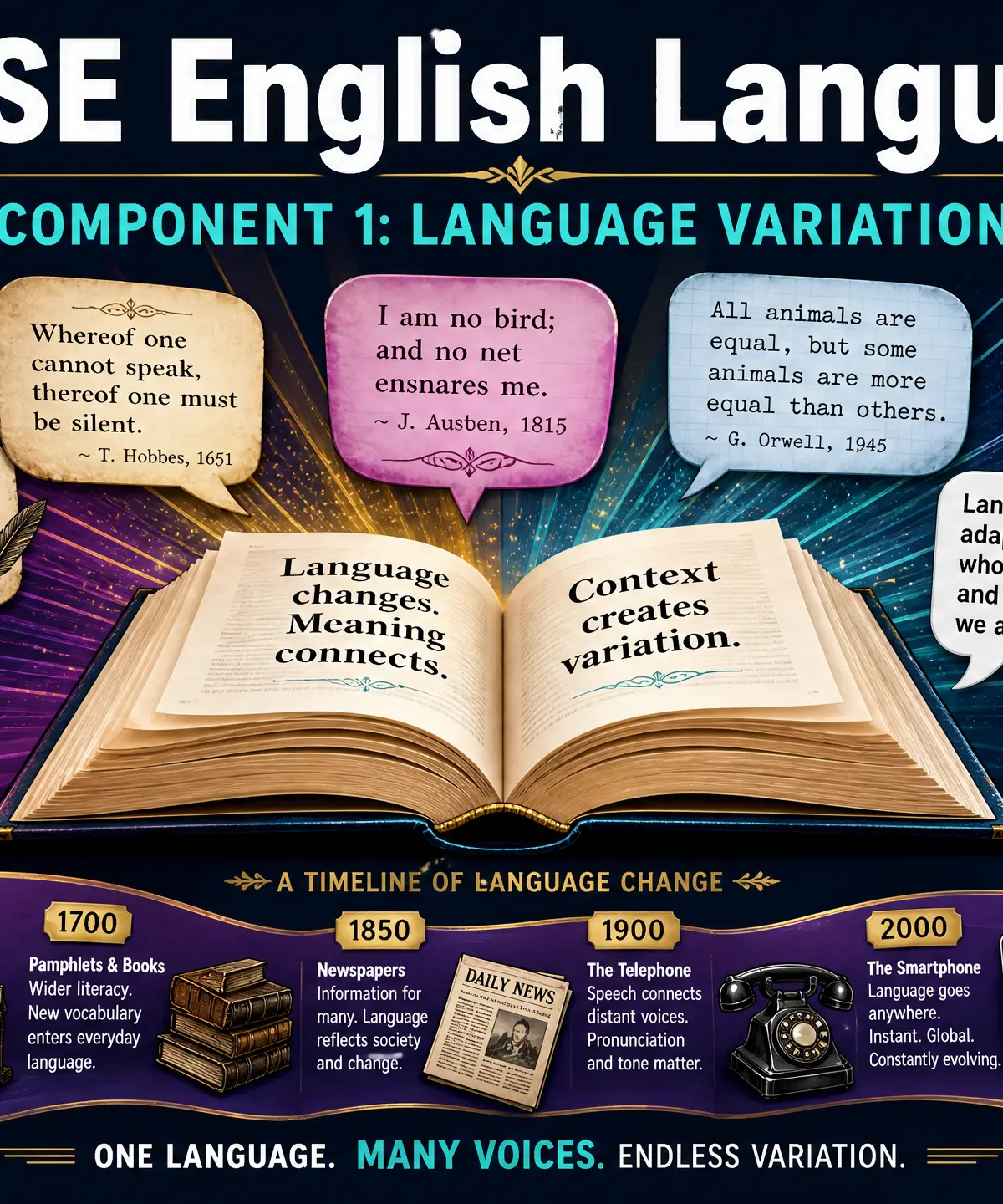
Component 1: Language Variation introduces you to the dynamic nature of the English language. Rather than treating language as a fixed set of rules, this component asks you to explore how language choices create personal identities and how English has evolved from around 1550 to the present day. You will apply linguistic frameworks to written, spoken, and multimodal data, demonstrating your ability to analyse context, evaluate attitudes, and synthesise your knowledge.
The 7 Language Frameworks
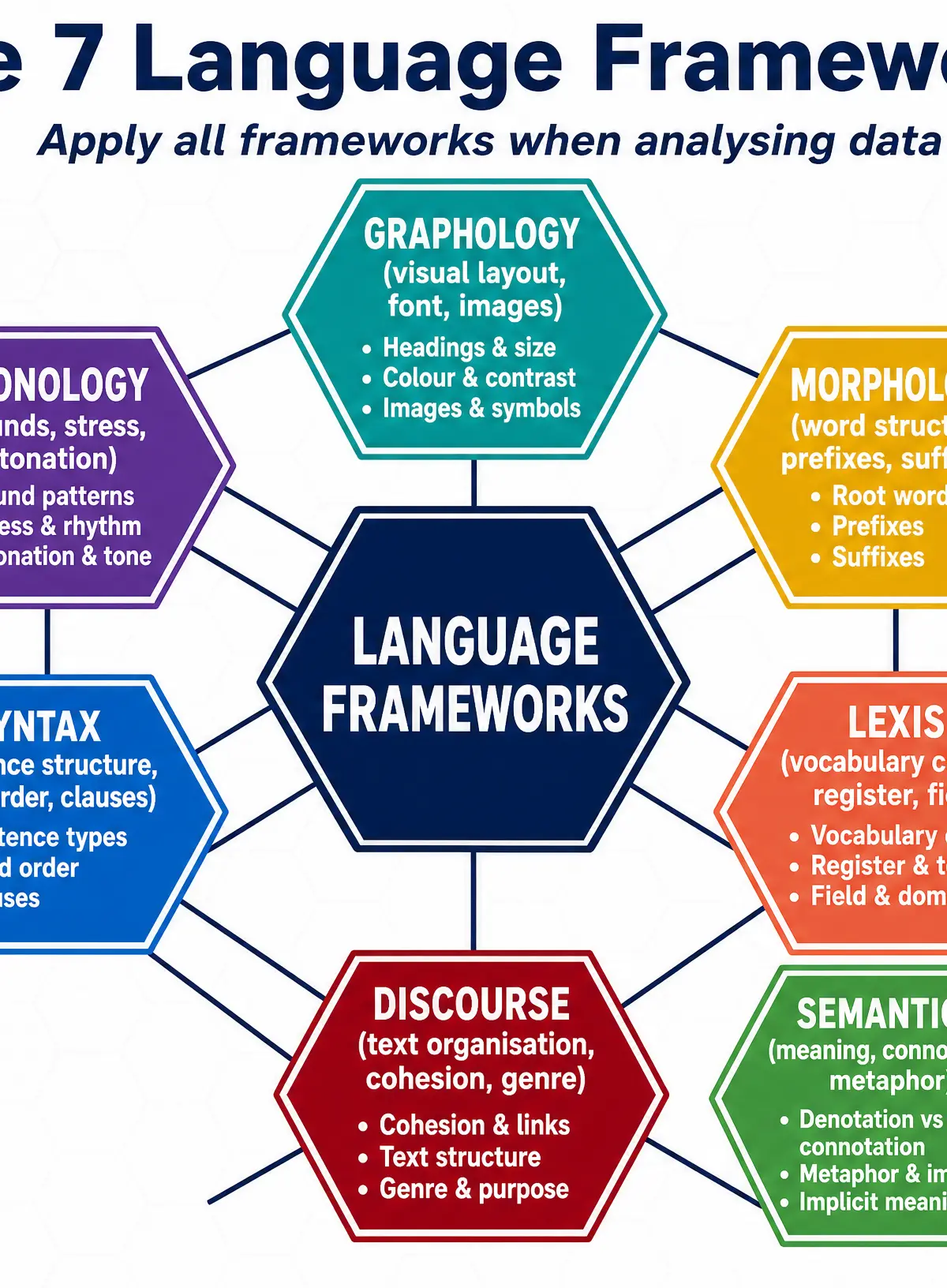
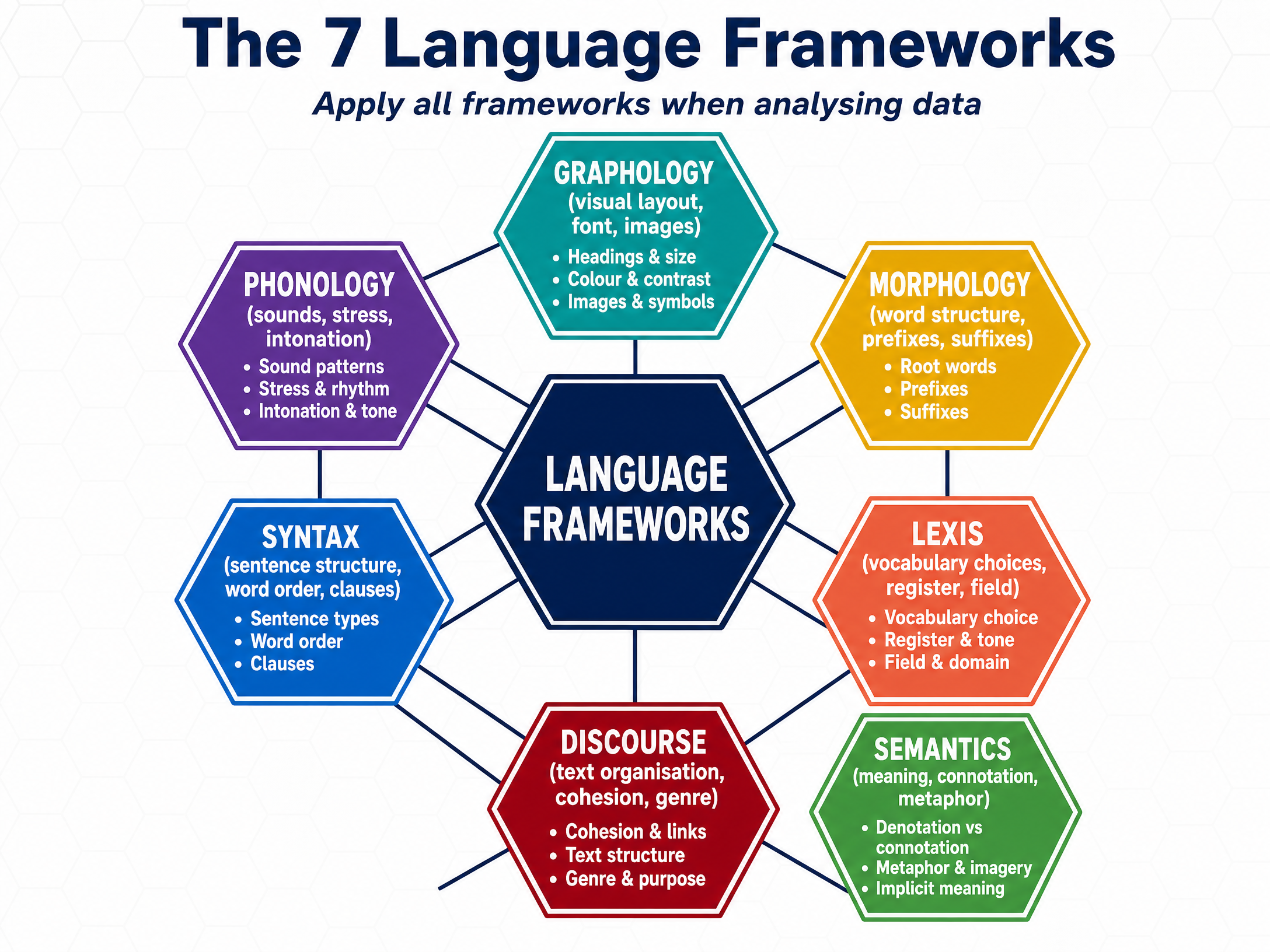
To analyse any piece of language data effectively, you must use the seven language frameworks. Examiners look for consistent, accurate application of these frameworks.
1. Graphology
Graphology is the visual presentation of language. This includes layout, font choices, use of images, colour, and spatial organisation. In multimodal texts like websites or advertisements, graphology is crucial for creating meaning and guiding the reader's attention.
2. Phonology
Phonology is the sound system of language. In spoken data, this involves analysing stress, intonation, rhythm, and pitch. You may also look at sound patterning like alliteration or assonance. The phonemic reference sheet provided in your exam is essential for transcribing and discussing specific sounds accurately.
3. Morphology
Morphology studies the structure of words. You should look at how words are formed using prefixes, suffixes, and root words. In historical texts, you might identify archaic morphological features, such as the '-eth' suffix in Early Modern English verbs (e.g., 'speaketh').
4. Syntax
Syntax refers to sentence structure and the order of words. Analysing syntax involves identifying sentence types (simple, compound, complex) and examining clause structures. Variations in syntax can indicate formality, regional dialect, or historical period.
5. Lexis
Lexis is vocabulary. When analysing lexis, go beyond simply spotting 'formal' or 'informal' words. Consider the semantic field (groups of related words), the use of specialist terminology (jargon), and how lexical choices reflect the speaker's identity, purpose, and the text's field.
6. Semantics
Semantics is the study of meaning. This includes the literal meaning of words (denotation) and their associated feelings or ideas (connotation). It also covers semantic change over time—such as amelioration (a word gaining a more positive meaning) or pejoration (a word gaining a more negative meaning).
7. Discourse
Discourse looks at language above the level of the sentence—how whole texts are organised. In spoken data, this includes turn-taking, adjacency pairs, and discourse markers. In written texts, it involves paragraphing, cohesion, and genre conventions.
Types of Language Variation
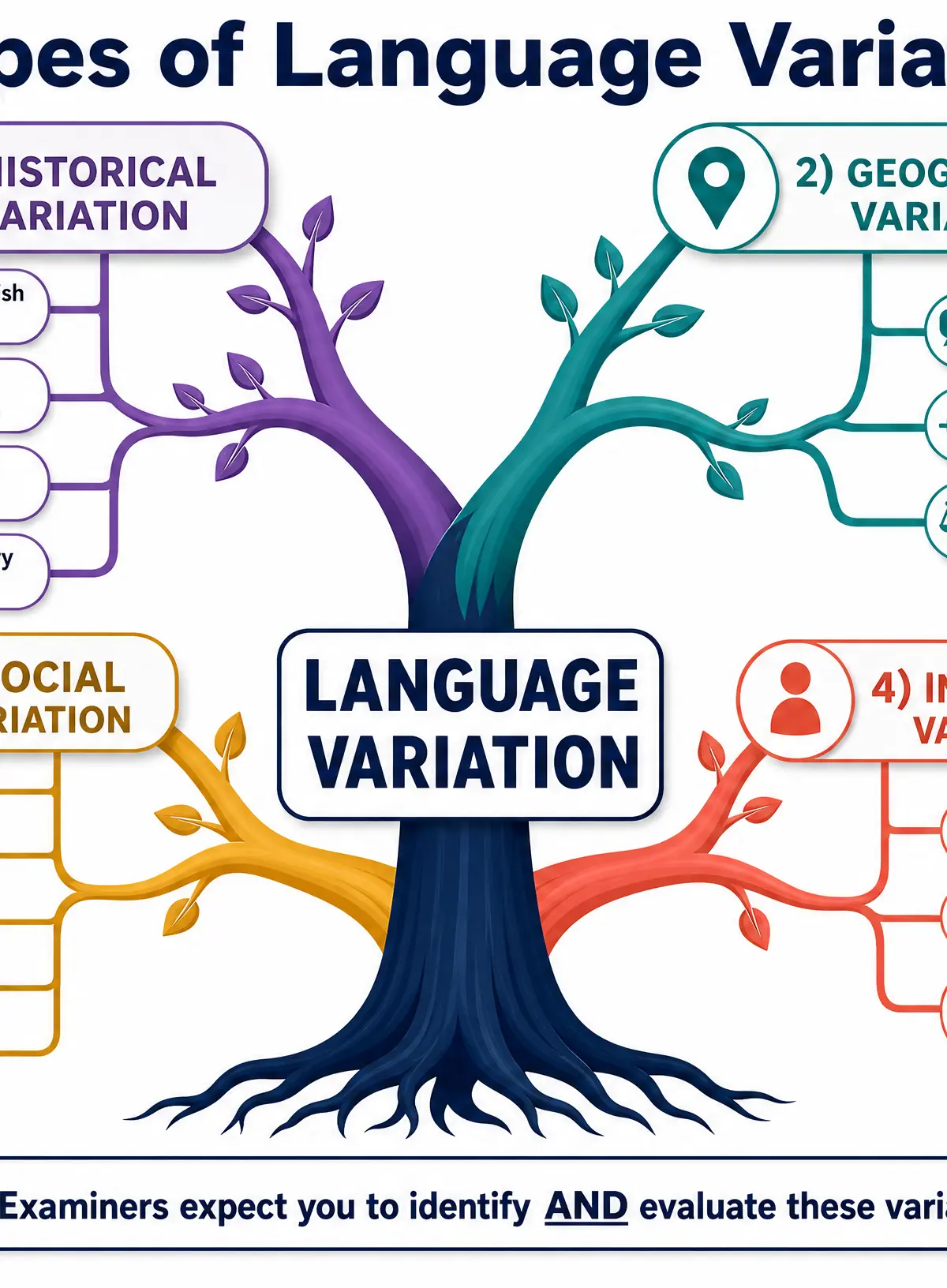
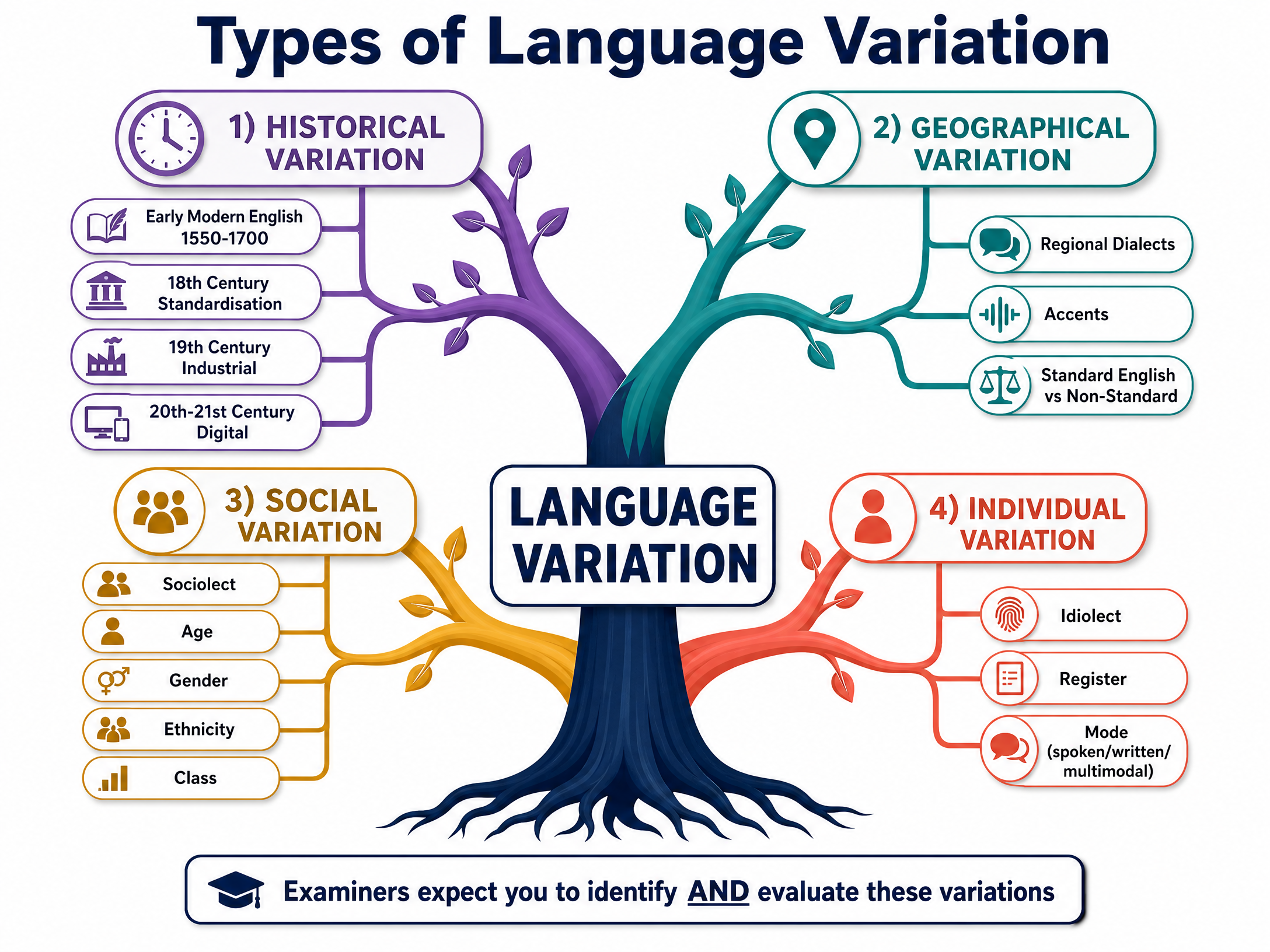
Language variation is generally categorised into four main areas. Examiners expect you to identify these variations and, crucially, evaluate the attitudes towards them.
Historical Variation
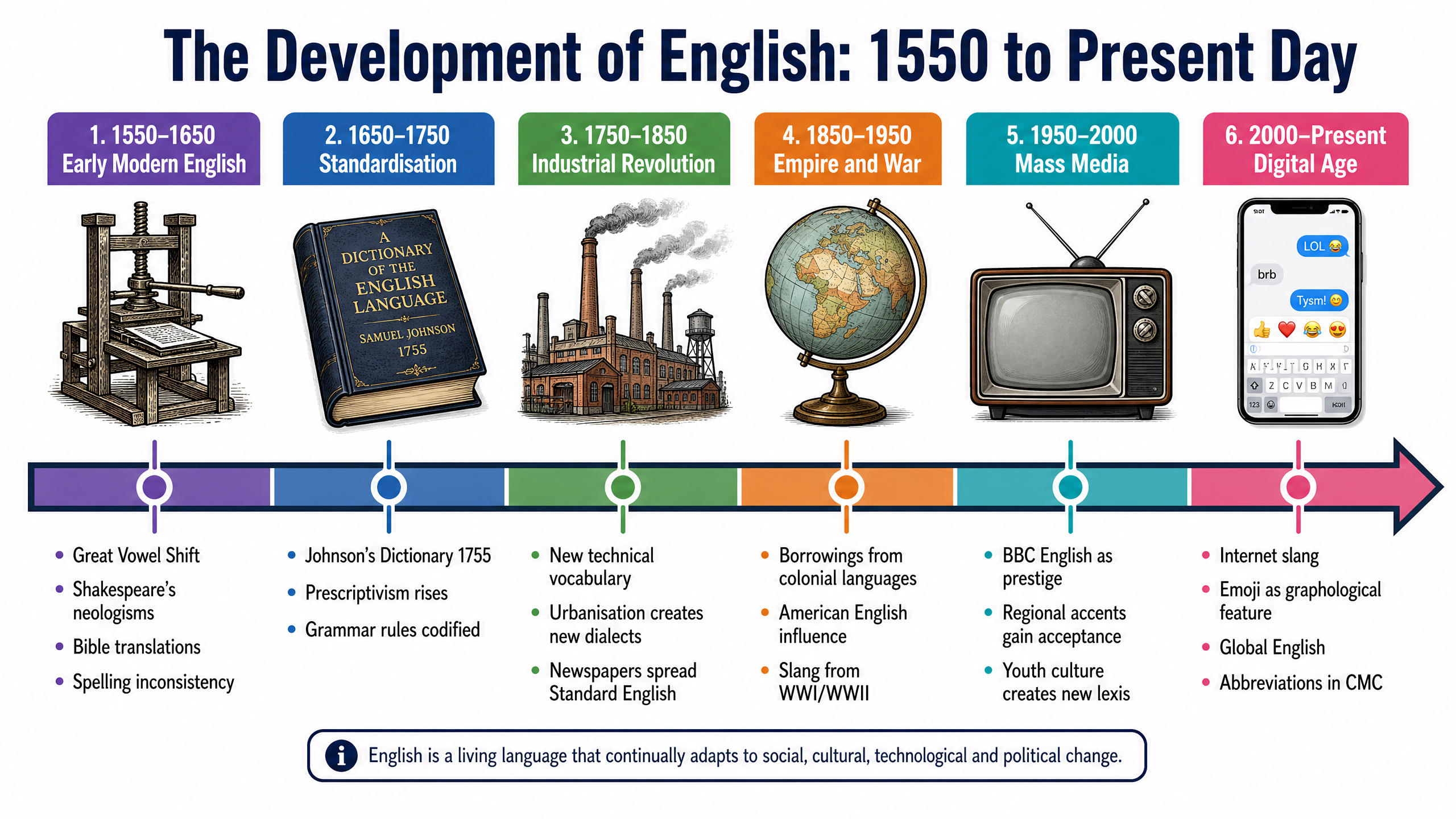
Language changes over time. You need to be familiar with the development of English from 1550 onwards.
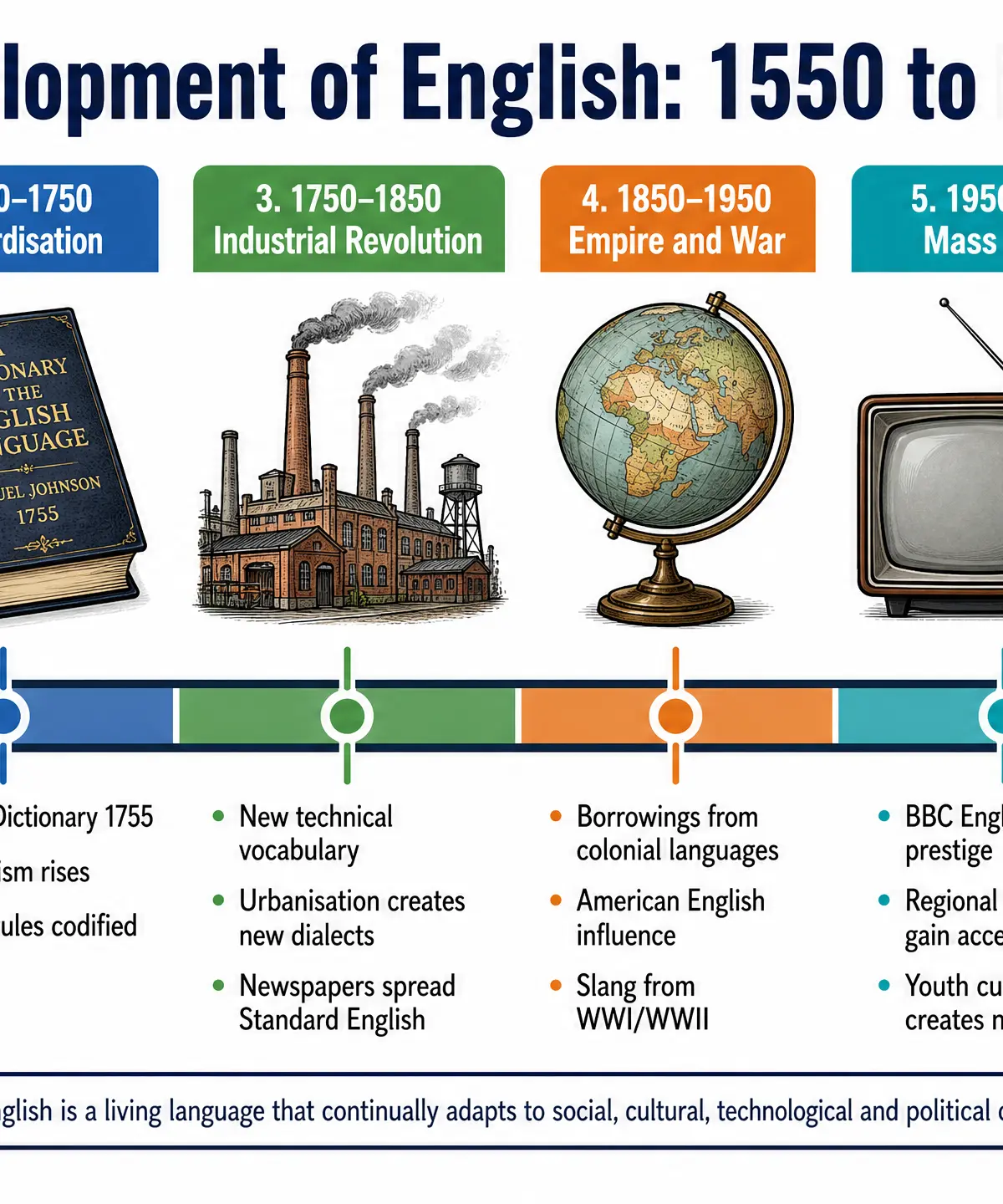
- Early Modern English (c. 1550-1700): Characterised by inconsistent spelling, the Great Vowel Shift, and rapid vocabulary expansion (neologisms).
- Standardisation (c. 1700-1850): The rise of dictionaries (like Samuel Johnson's in 1755) and grammar books led to prescriptivist attitudes—the belief that there is one 'correct' way to use language.
- Late Modern to Present Day: Influenced by the Industrial Revolution, global expansion, mass media, and the digital age, leading to new registers, global varieties of English, and new multimodal forms of communication.
Geographical Variation
This encompasses regional dialects and accents.
- Dialect: Variations in vocabulary and grammar specific to a region.
- Accent: Variations in pronunciation only.
- Standard English: The prestige dialect, often associated with education and formal contexts, though it is linguistically no more 'correct' than any other dialect.
Social Variation (Sociolect)
Language varies according to social groups. Factors include age, gender, social class, ethnicity, and occupation. People use language to signal their belonging to an 'in-group' or to distance themselves from an 'out-group'.
Individual Variation (Idiolect)
Every person has a unique linguistic fingerprint, known as their idiolect. This is shaped by their geographical background, social networks, education, and personal experiences.
Contextual Factors: Mode, Field, Function, Audience
Every language choice is driven by context. You must always link your analysis to:
- Mode: Is the text spoken, written, or multimodal?
- Field: What is the subject matter or topic?
- Function: What is the purpose of the text (e.g., to inform, persuade, entertain, express identity)?
- Audience: Who is the text aimed at, and what is the relationship between the producer and receiver?
How to Analyse Data
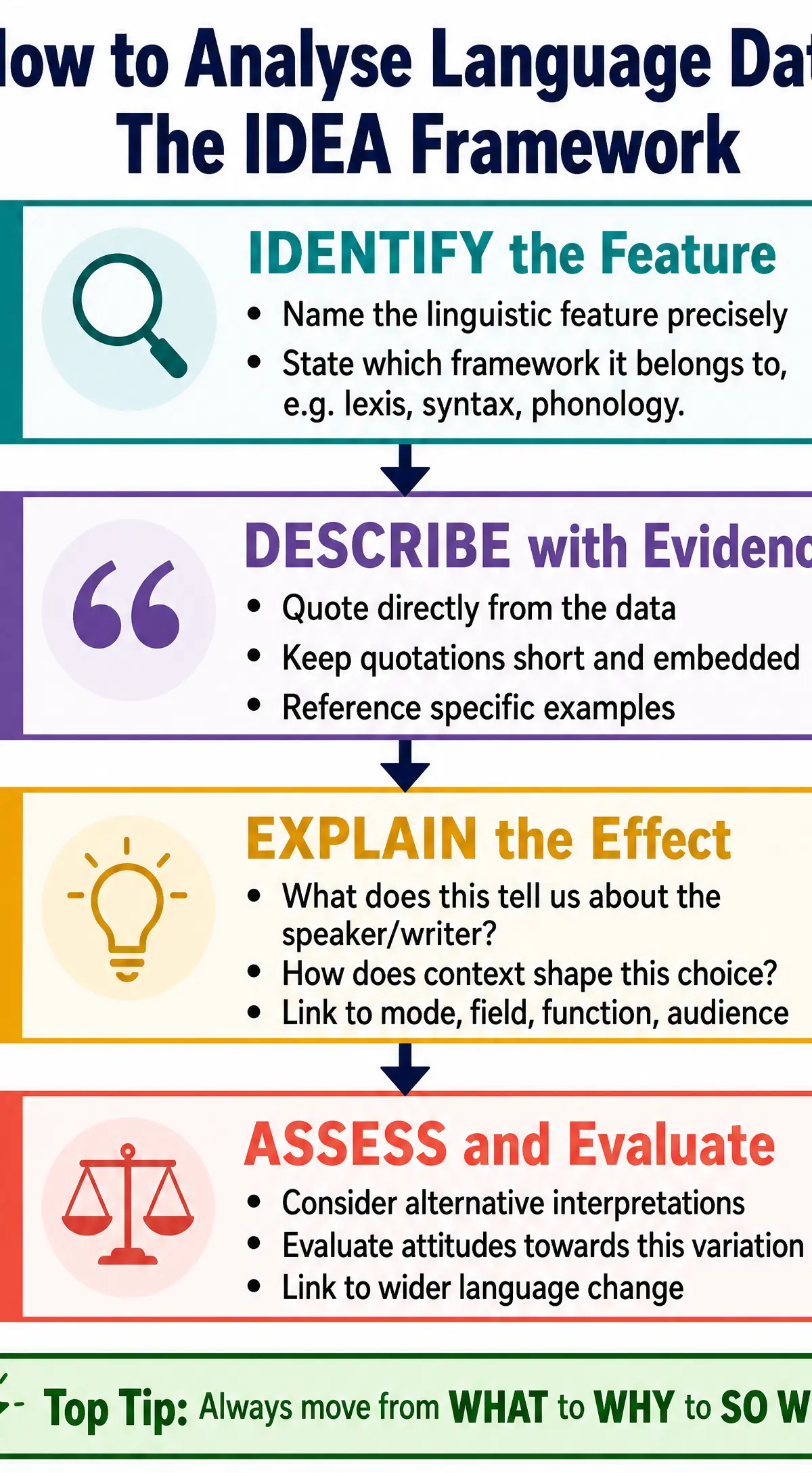
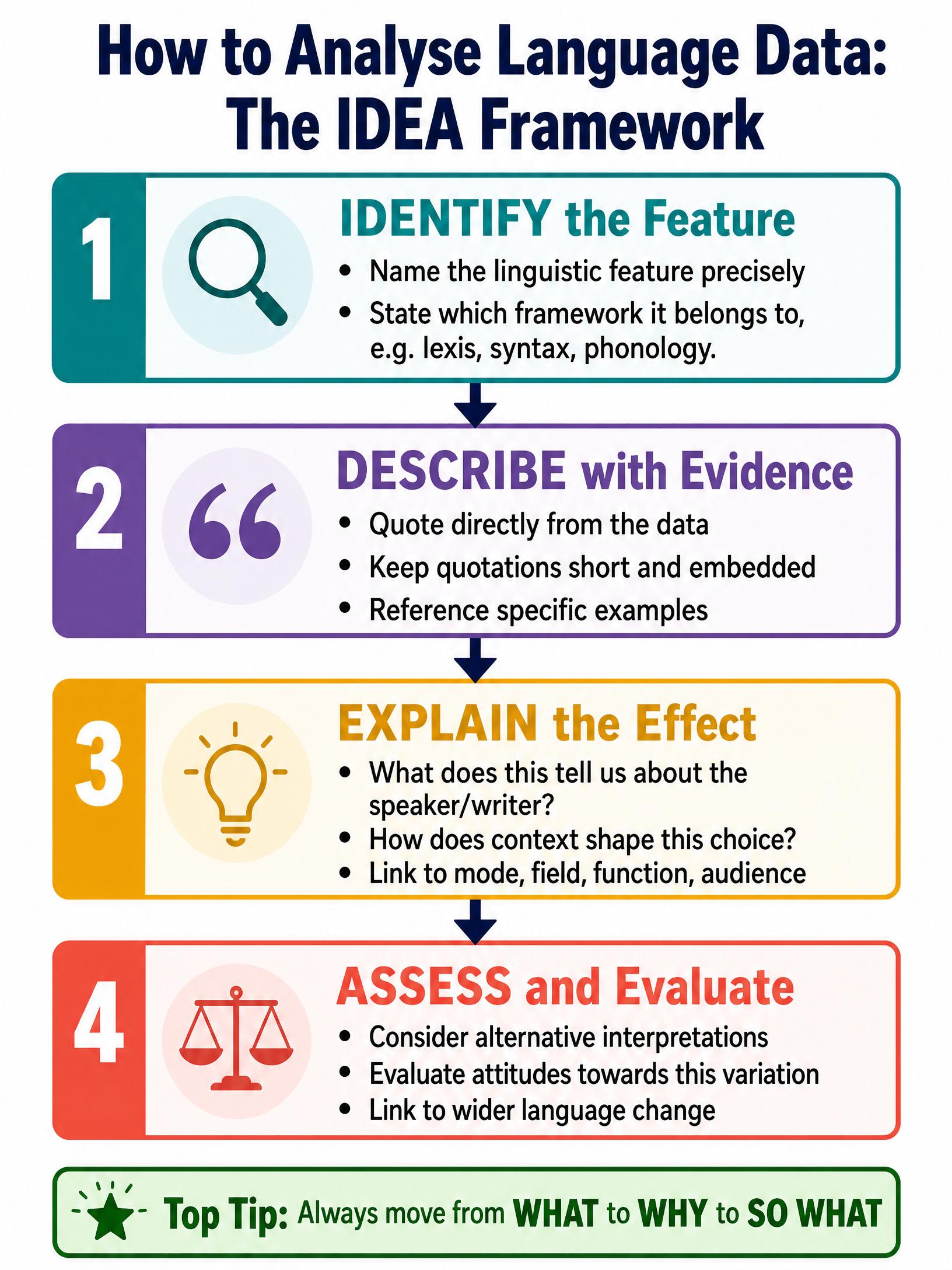
When approaching exam data, use the IDEA framework:
- Identify: Name the specific linguistic feature and its framework.
- Describe: Provide a short, embedded quotation from the data.
- Explain: Explain the effect of this choice. What does it reveal about the context, mode, field, function, or audience?
- Assess/Evaluate: Consider attitudes towards this language use. Is it viewed positively or negatively? Why?
Listen to the Podcast
For a comprehensive overview of this topic, including exam tips and a quick-fire quiz, listen to our exclusive revision podcast:
Visual Resources
4 diagrams and illustrations
Interactive Diagrams
2 interactive diagrams to visualise key concepts
Conceptual Flow Outline
Exam Approach Flowchart for Data Analysis
Conceptual Flow Outline
Categories of Language Variation
Worked Examples
3 worked examples — open one to explore the question and available guidance.
Practice Questions
Test your understanding — click to reveal model answers
Define the term 'sociolect' and give one example of how it might be used.
Hint: Think about social groups rather than geographical regions.
Explain the difference between a prescriptivist and a descriptivist attitude to language.
Hint: One judges language, the other observes it.
Read the provided transcript of a conversation between two colleagues. Analyse how the speakers use language to manage their relationship. (10 marks)
Hint: Look at discourse features like turn-taking, interruptions, and terms of address.
Test your understanding of Component 1: Language Variation
Active recall beats re-reading. Take an instant quiz now to test what you’ve learned and lock it into long-term memory.
7 days Premium · Then free forever · No card, no charge