Pearson Edexcel · A-Level · English Language
Component 3 – Topic area: Language and Power
This component assesses your ability to analyse how language reflects and shapes power across different contexts and time periods. You will apply linguistic frameworks to evaluate attitudes towards language and its users from c1550 to the present day.
- 5 min read
- 1 worked example
- 5 practice questions
- 8 key terms
Study Notes
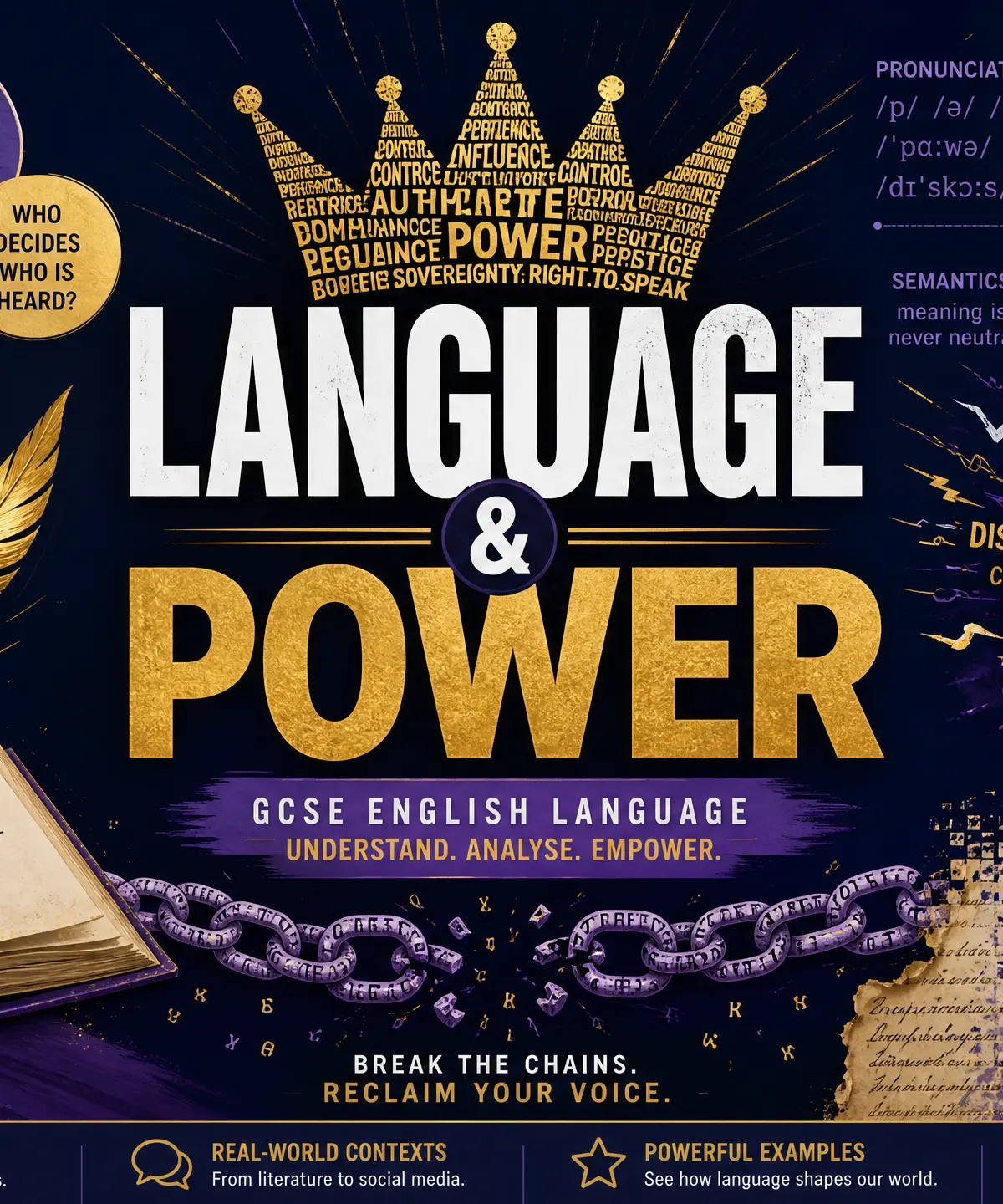
Overview
Component 3: Language and Power is a fascinating area of study that asks you to look critically at how language works in the real world. It is not just about identifying features; it is about understanding how language reflects power dynamics, shapes personal and social identities, and has evolved over centuries. You will be expected to apply specific linguistic frameworks to unseen data from various time periods (c1550 to present day) and modes (written, spoken, and multimodal).
Analytical Frameworks
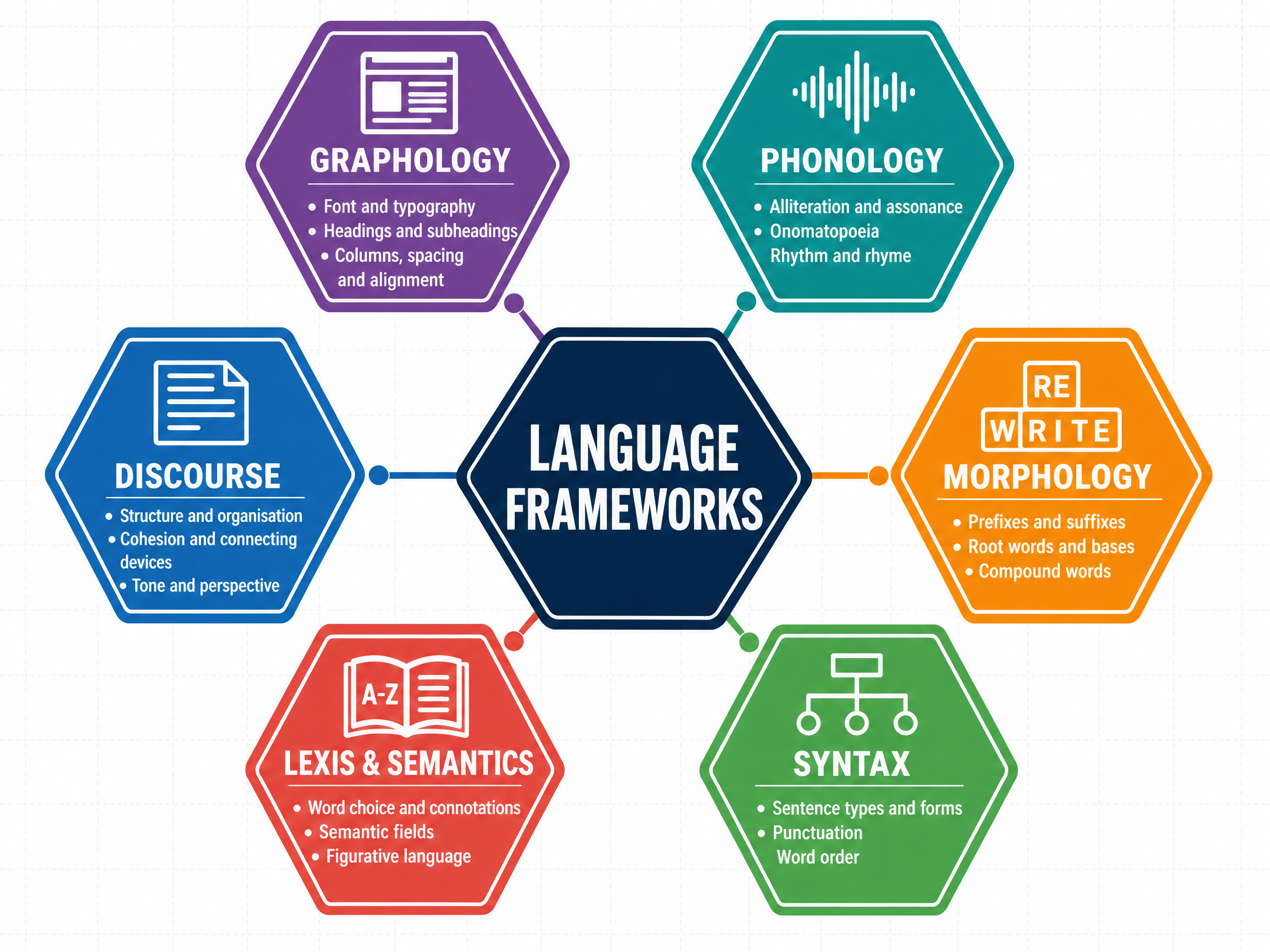
To succeed in this component, you must confidently apply the six core language frameworks. These are the lenses through which you will analyse any text.
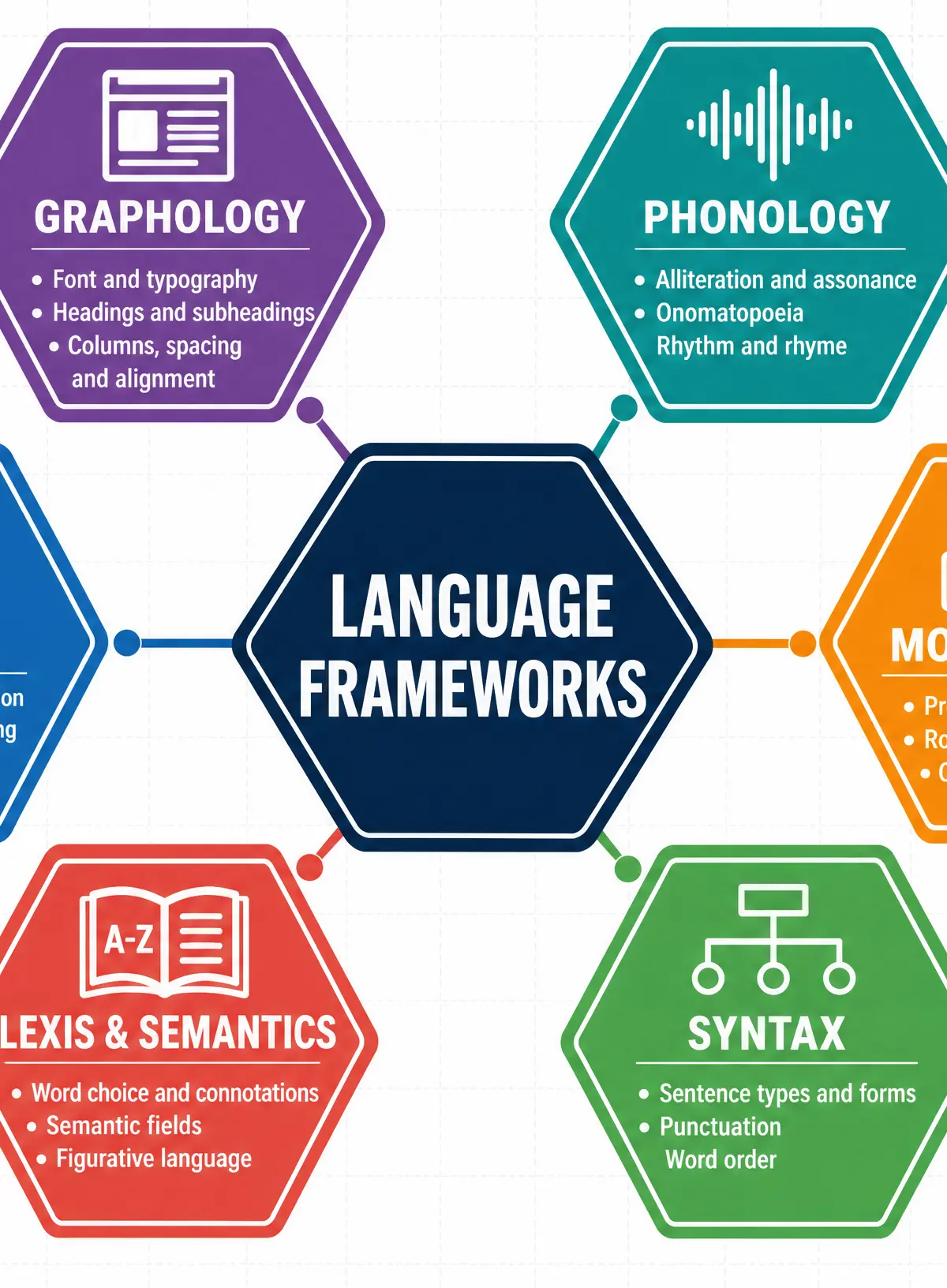
1. Graphology
This relates to the visual appearance of text. Consider how layout, typography, images, and spatial organisation contribute to meaning and influence the reader. Even in historical texts, the presentation carries significant weight regarding authority and purpose.
2. Phonology
This involves the study of sound patterns. Look for features such as alliteration, assonance, rhythm, and rhyme in written texts, and intonation, stress, and accent in spoken data. These elements can create emphasis, establish tone, or reveal geographical and social origins.
3. Morphology
Morphology is the study of word structure. Pay attention to how words are formed using prefixes, suffixes, and root words. The creation of new words (neologisms) or the adaptation of existing ones often reflects societal changes and shifting power structures.
4. Syntax
This refers to sentence structure and grammar. Analyse whether sentences are simple, compound, or complex. Is the syntax formal and elaborate, suggesting authority or legal standing, or is it fragmented and informal, suggesting a more egalitarian or conversational relationship?
5. Lexis and Semantics
Lexis refers to vocabulary, while semantics refers to meaning. This is a crucial framework. Look for semantic fields, connotations, archaic vocabulary, and the level of formality (register). Word choices are never neutral; they always position the reader and reflect the writer's stance.
6. Discourse
Discourse analysis looks at the text as a whole. How is it structured and organised? What cohesive devices (e.g., pronouns, connectives) hold it together? How do shifts in topic or tone guide the reader's response and establish control over the narrative?
Language Change Over Time
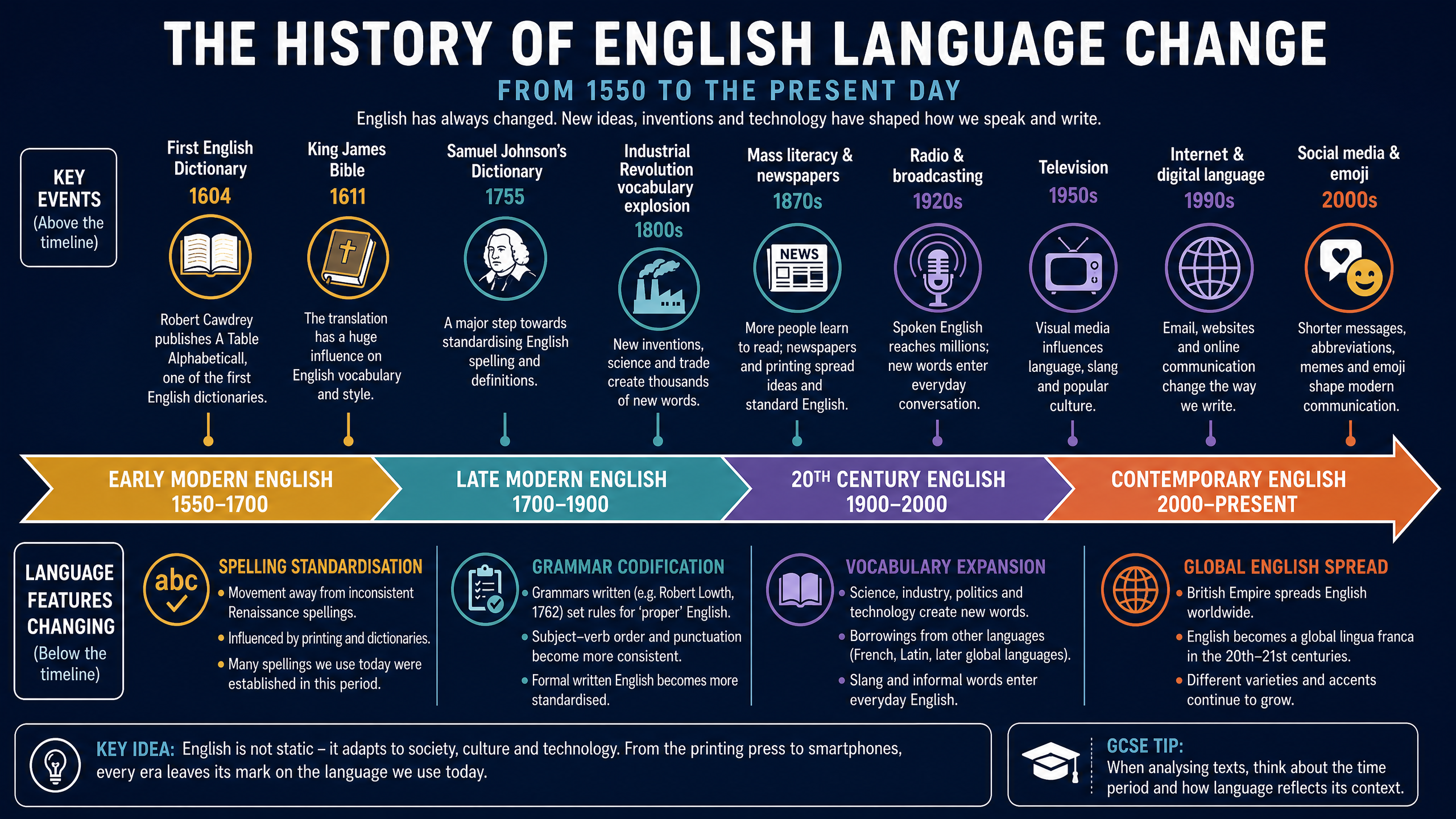
You must demonstrate an understanding of how English has developed from around 1550 to the present day. This requires synthesising your linguistic knowledge with an awareness of historical, cultural, and technological contexts.
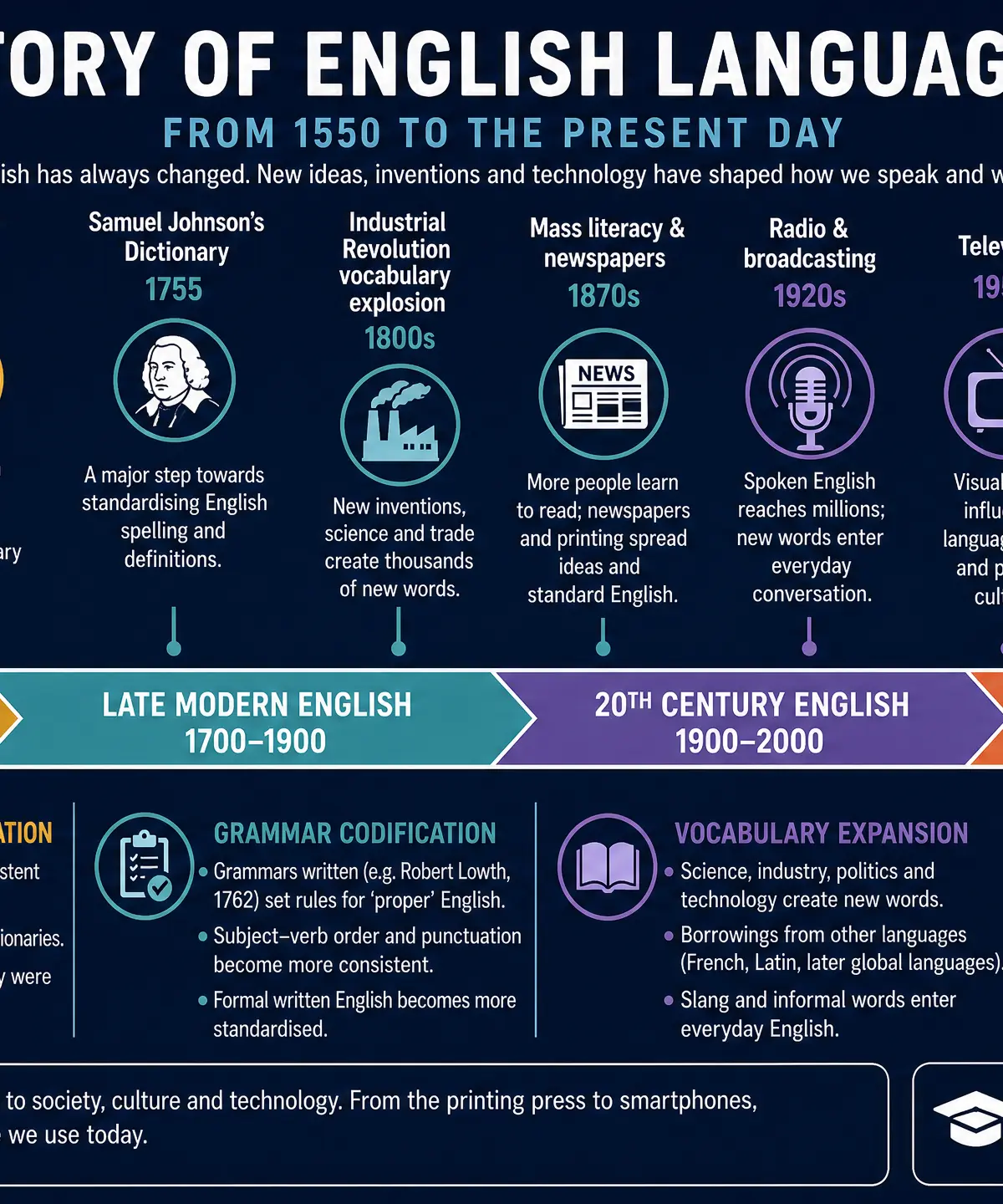
Early Modern English (c1550 - 1700)
This period saw the introduction of the printing press, leading to the gradual standardisation of spelling. The translation of the King James Bible (1611) had a profound influence on vocabulary and style.
Late Modern English (1700 - 1900)
The 18th century was characterised by a desire to codify and fix the language. Dictionaries (like Samuel Johnson's in 1755) and prescriptive grammars attempted to establish rules for 'correct' English. The 19th century brought the Industrial Revolution, necessitating a vast expansion of vocabulary to describe new technologies and scientific discoveries.
20th Century and Contemporary English (1900 - Present)
The rise of broadcasting established Received Pronunciation as a standard, though recent decades have seen greater acceptance of regional diversity. The internet and digital communication have accelerated language change, blurring the lines between written and spoken modes and introducing new conventions (e.g., emojis, abbreviations).
Analysing Power
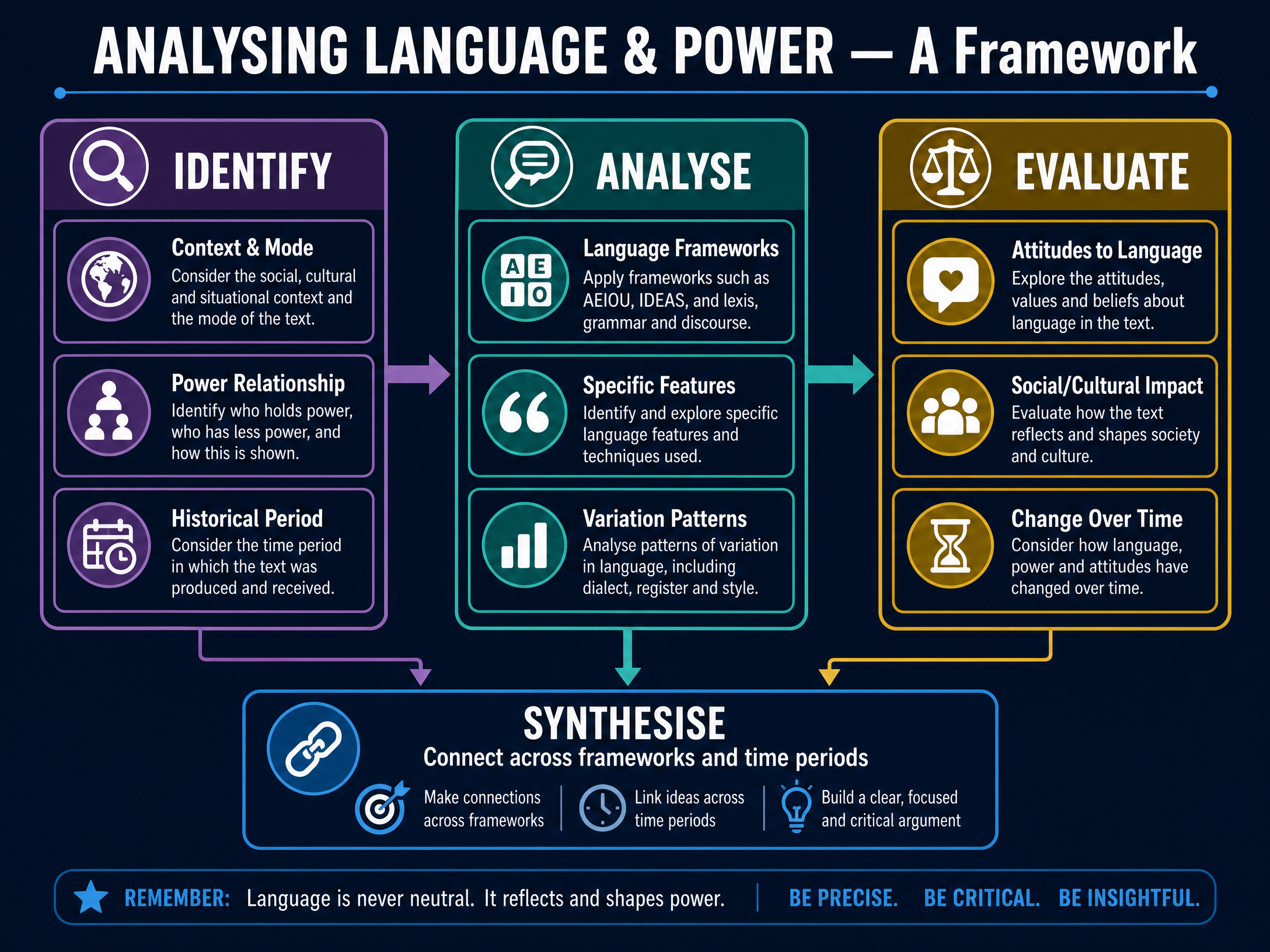
When evaluating texts, you must consider the power dynamics at play. Use the following framework to guide your analysis:
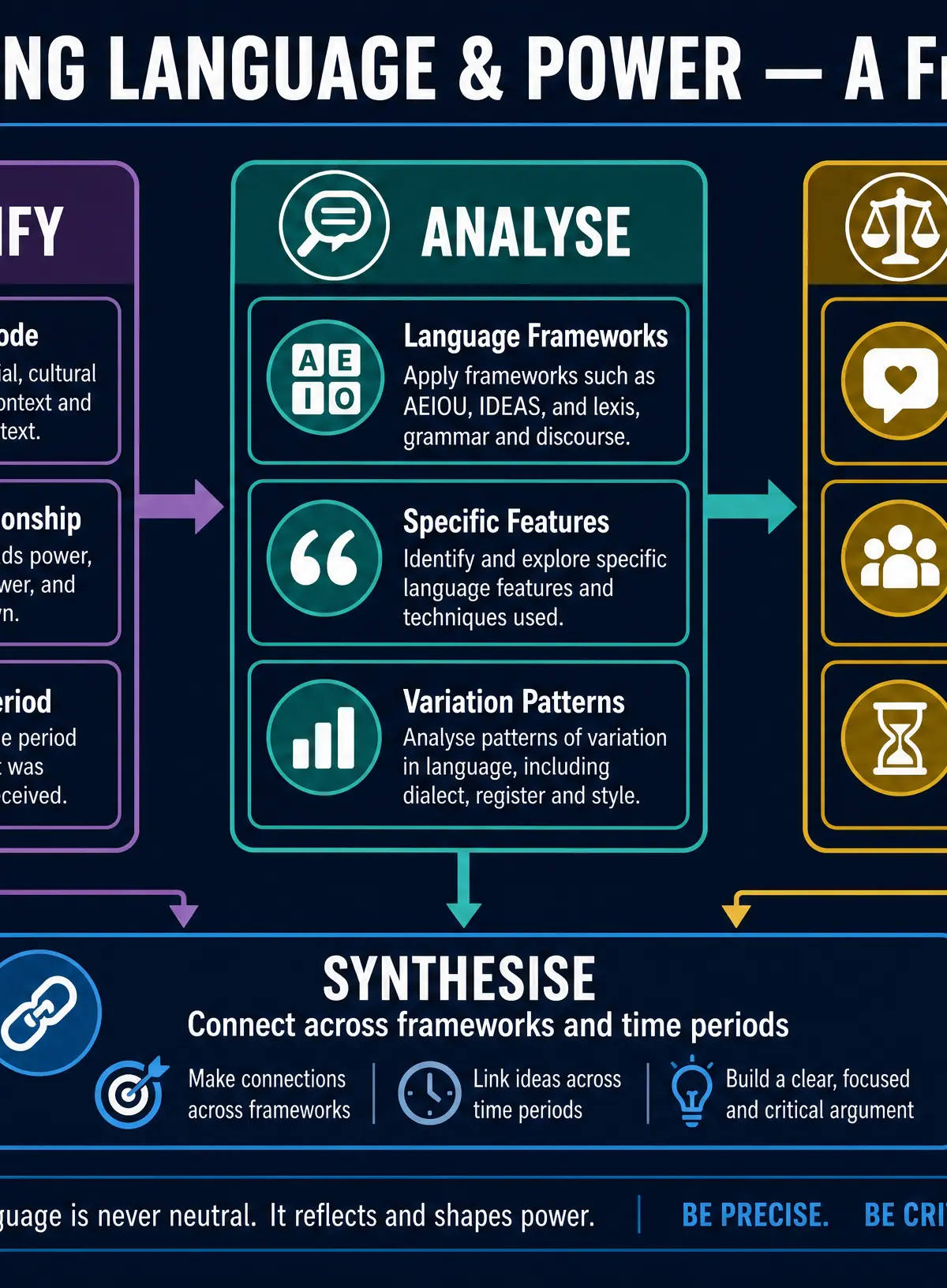
Instrumental vs. Influential Power
Instrumental power is used to maintain authority and enforce rules (e.g., legal documents, commands). Influential power is used to persuade or influence behaviour without explicit authority (e.g., advertising, political speeches).
Contextual Factors
Always consider:
- Mode: Is the text written, spoken, or multimodal? How does this affect its reception?
- Field: What is the subject matter? How does the specific terminology (jargon) establish expertise?
- Function: What is the text trying to achieve (e.g., inform, persuade, entertain)?
- Audience: Who is being addressed, and how are they positioned by the writer?
Attitudes to Language
A key aspect of this component is evaluating how people view language.
- Prescriptivism: The belief that there are strict rules for 'correct' English and that deviations are errors. This view often aligns with maintaining social hierarchies.
- Descriptivism: The objective observation of how language is actually used, recognising that all varieties have validity and that language change is natural and inevitable.
Visual Resources
3 diagrams and illustrations
Interactive Diagrams
2 interactive diagrams to visualise key concepts
Conceptual Flow Outline
Analytical Process Flowchart
Conceptual Flow Outline
Timeline of Language Change
Worked Examples
1 worked example — open one to explore the question and available guidance.
Practice Questions
Test your understanding — click to reveal model answers
Identify two features of graphology in a modern newspaper front page and explain how they establish authority.
Hint: Look at headlines, fonts, and layout.
Analyse how the writer uses syntax to create a persuasive tone in a charity appeal leaflet.
Hint: Look for imperatives, rhetorical questions, and sentence lengths.
Evaluate the view that standardisation in the 18th century was entirely driven by a desire for social control.
Hint: Consider both prescriptivist attitudes and the practical need for clear communication.
Compare how attitudes towards regional accents are presented in a 1950s BBC broadcast transcript and a contemporary YouTube vlog.
Hint: Focus on the shift from prescriptivism/Received Pronunciation to descriptivism/diversity.
How does the writer of a political manifesto use lexis and semantics to establish influential power?
Hint: Look for semantic fields, inclusive pronouns, and emotive language.
Test your understanding of Component 3 – Topic area: Language and Power
Active recall beats re-reading. Take an instant quiz now to test what you’ve learned and lock it into long-term memory.
7 days Premium · Then free forever · No card, no charge