Pearson Edexcel · A-Level · English Language
Component 3 – Topic area: Regional Language Variation
This topic area tests your ability to analyse how English varies across different geographical regions and social groups, both today and historically. You will need to apply the six language frameworks to data, evaluate attitudes towards different dialects, and understand how factors like prestige, identity, and mobility shape language change.
- 7 min read
- 1 worked example
- 3 practice questions
- 8 key terms
Study Notes
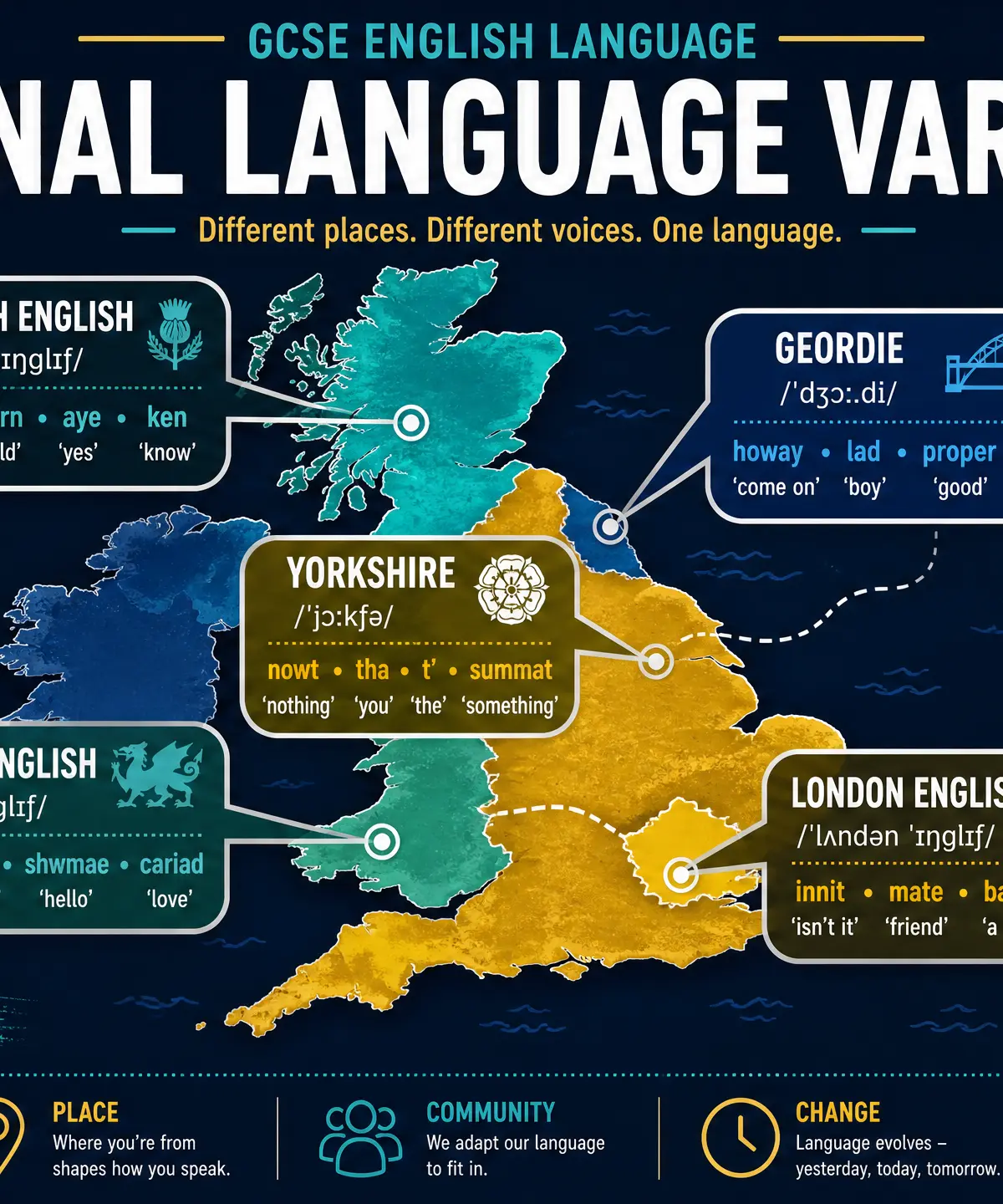
Overview
Component 3 focuses on Regional Language Variation. This is a fascinating area of linguistics that looks at how English isn't just one single, uniform entity, but a dynamic, ever-changing spectrum of voices. You are expected to demonstrate an understanding of how geographical location, social class, and historical context influence the way people speak and write.
In the exam, you will be presented with unseen data—this could be transcripts of spoken conversations, written texts, or multimodal data—from different time periods (c.1550 to the present day). Your task is to apply linguistic frameworks to analyse this data, compare different varieties, and critically evaluate the attitudes people hold towards these varieties.
The Core Concepts: Dialect vs. Accent
It is vital that you distinguish between these two terms accurately in your exam responses:
- Accent: Refers only to pronunciation. It is the way sounds are produced. For example, pronouncing 'bath' with a short /a/ or a long /ɑː/ is a matter of accent.
- Dialect: A broader term that encompasses differences in grammar, vocabulary (lexis), and often pronunciation. For example, using the word 'bairn' for child, or saying 'we was' instead of 'we were', are features of dialect.
The Dialect Continuum
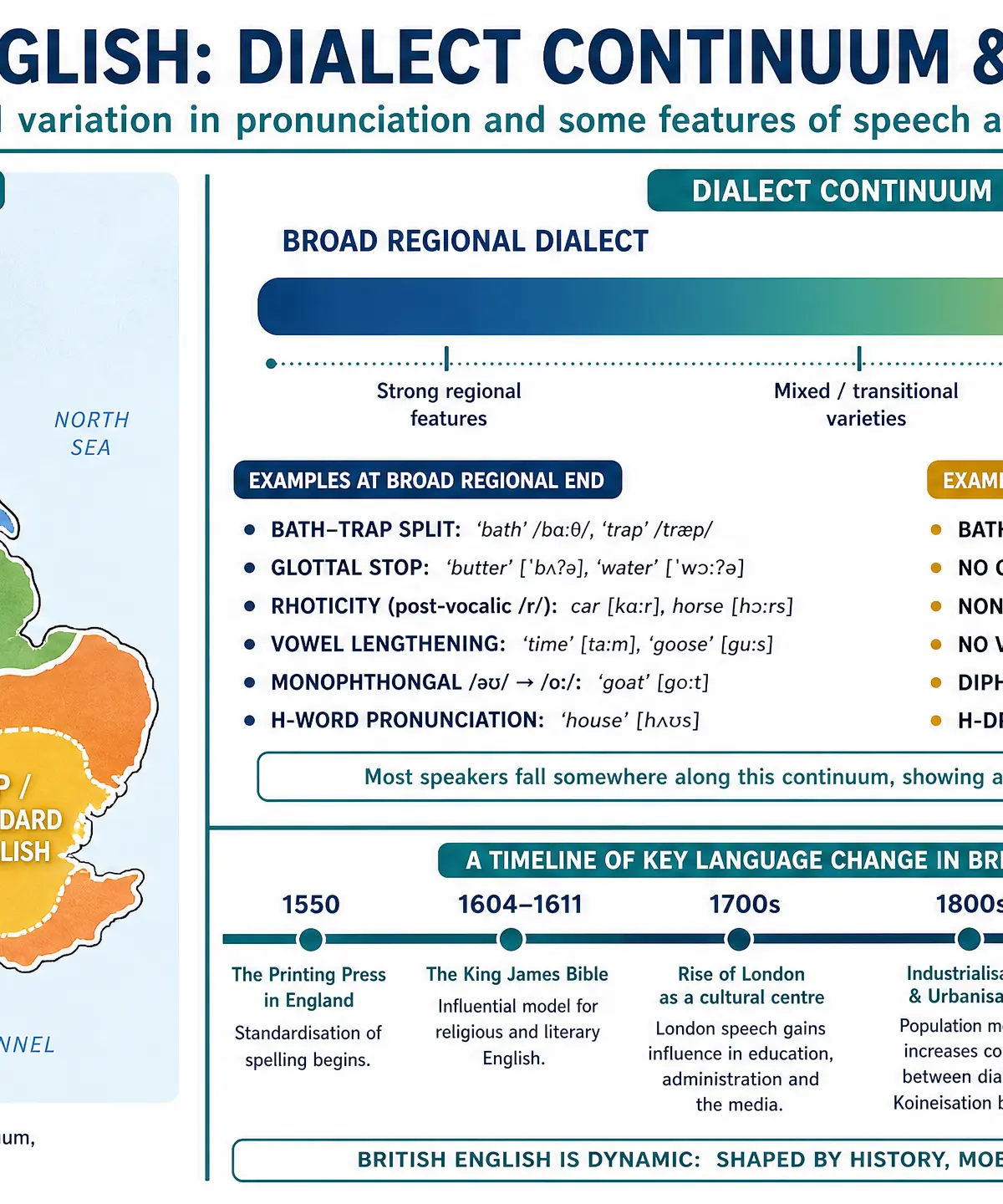
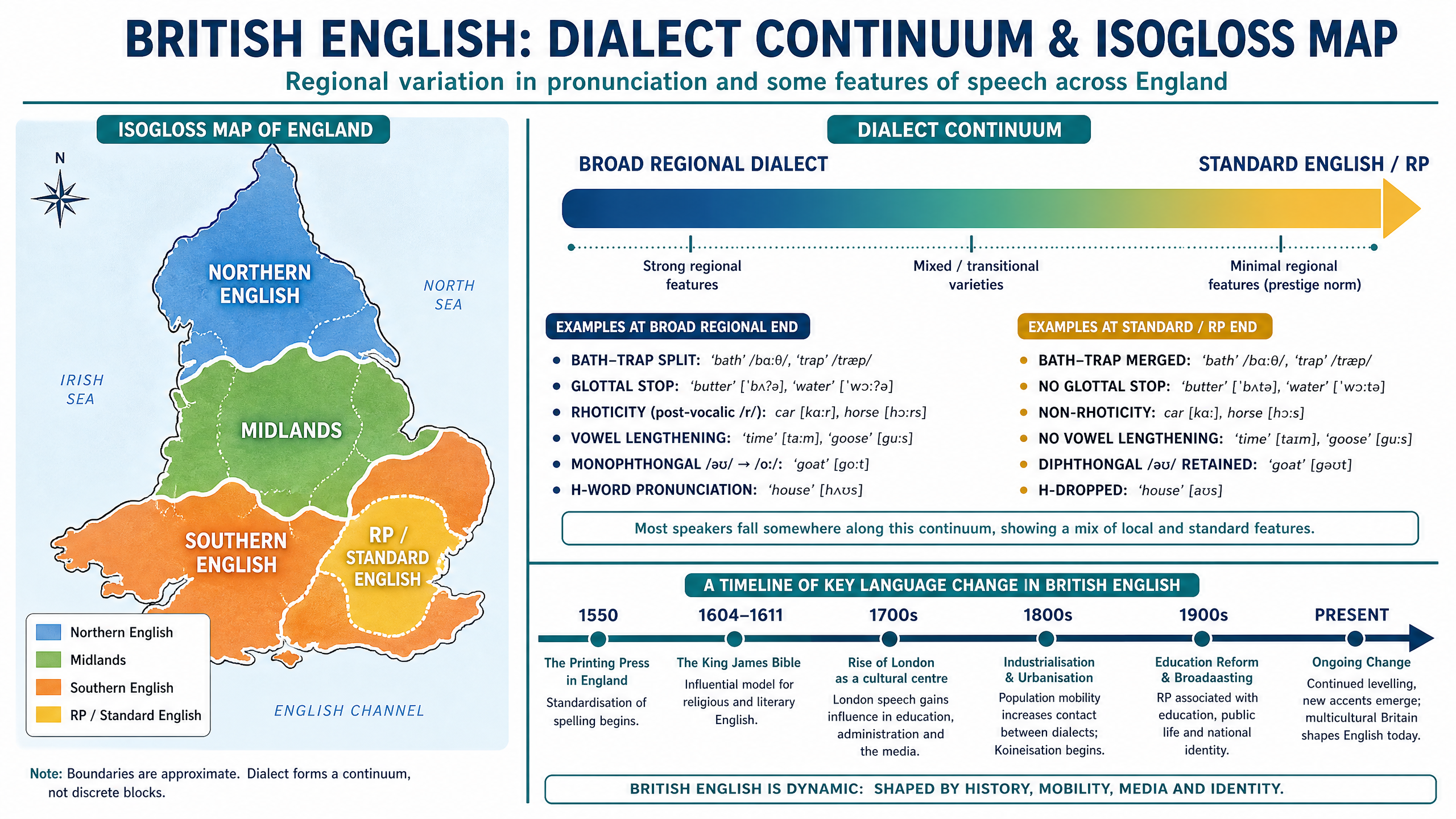
English variation is best understood as a continuum rather than discrete, isolated boxes. At one end of the spectrum, we have Broad Regional Dialects (e.g., broad Geordie or strong Yorkshire dialect), which feature highly localised vocabulary and non-standard grammar.
At the other end, we find Standard English and Received Pronunciation (RP). Standard English is the dialect associated with education, formal writing, and institutions. RP is the prestige accent historically associated with the upper classes and broadcasting. Most speakers sit somewhere in the middle, and many people code-switch, adjusting their language along this continuum depending on who they are talking to and the context of the situation.
Applying the Six Language Frameworks
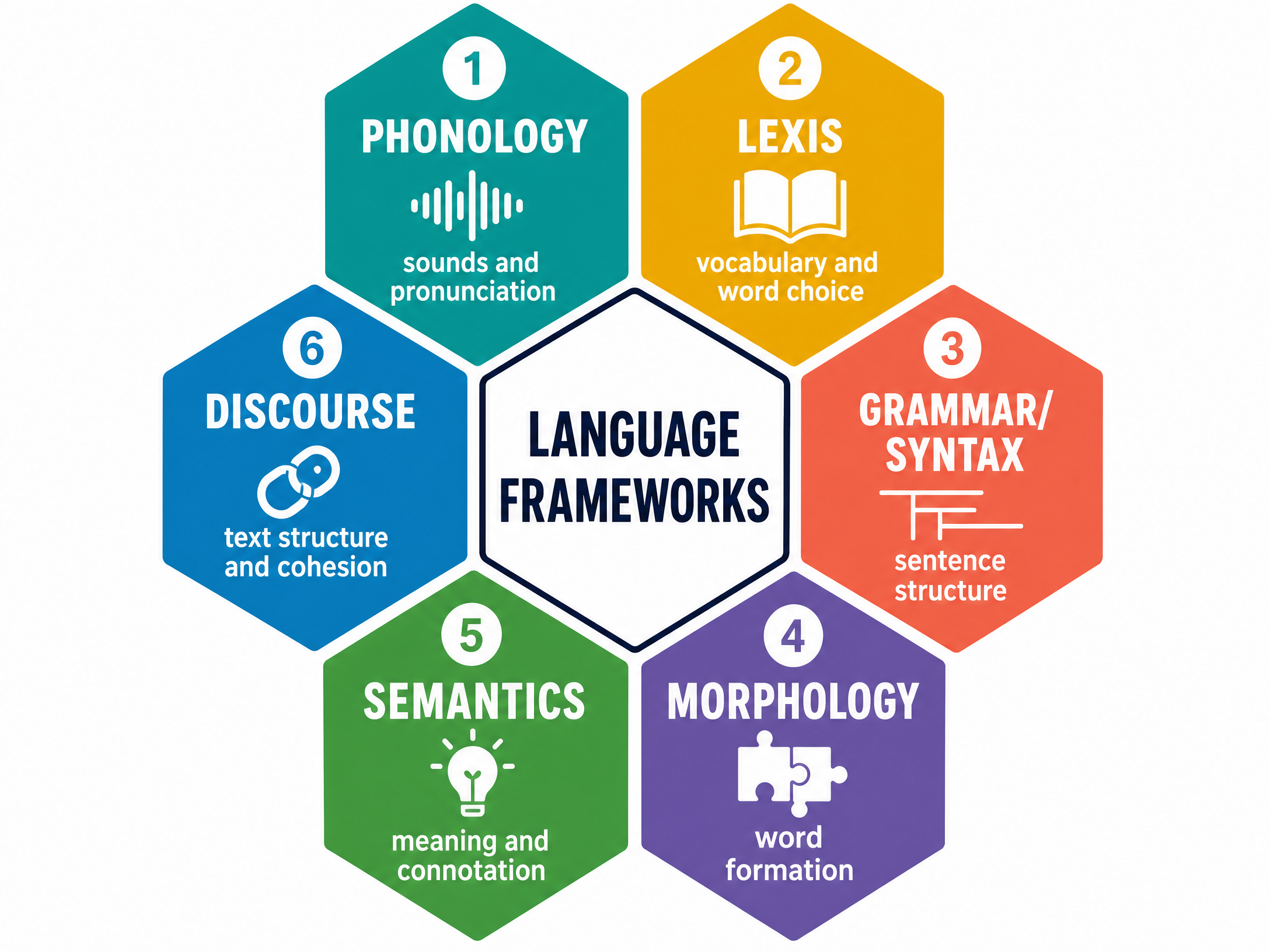
To secure high marks, you must systematically apply the six language frameworks to the data provided.
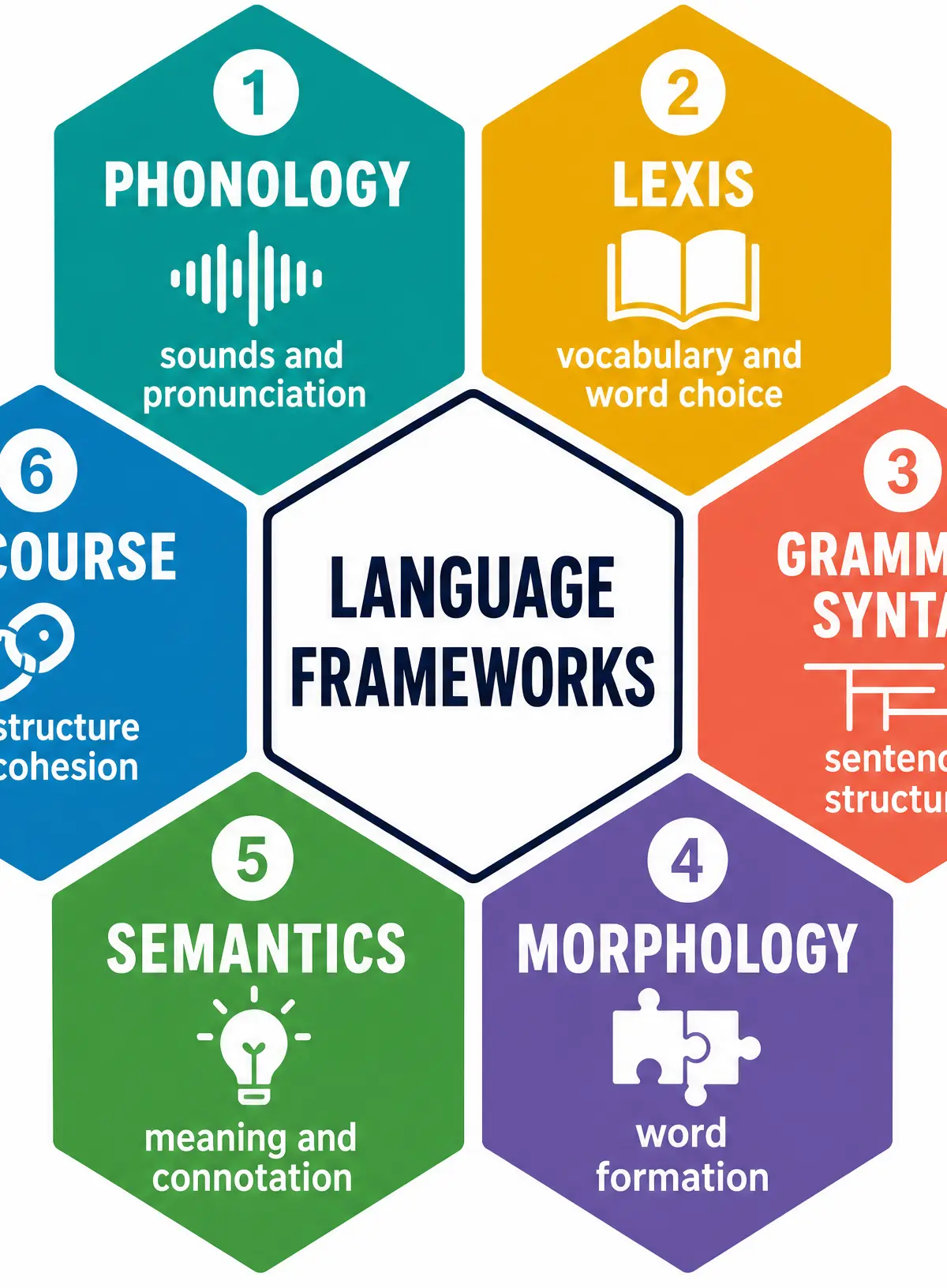
1. Phonology (Sounds and Pronunciation)
Examiners will often provide phonetic transcriptions. Look out for these common regional phonological variables:
| Feature | Definition | Regional Association | Example |
|---|---|---|---|
| The BATH-TRAP split | Using a long /ɑː/ in words like 'bath' and 'grass', versus a short /a/. | Long /ɑː/ is typically Southern; short /a/ is typically Northern. | Southern: /bɑːθ/ Northern: /baθ/ |
| Glottal Stop | The closure of the vocal cords to replace a consonant, usually /t/. | Common in many urban accents (e.g., Cockney, Estuary English, Glasgow). | 'butter' pronounced as /bʌʔə/ |
| Rhoticity | Pronouncing the /r/ sound after a vowel. | South West England, Scotland, Ireland. | 'car' pronounced with a hard 'r' at the end. |
| H-dropping | Omitting the initial /h/ sound in words. | Widespread across many working-class and regional English accents. | 'house' becomes 'ouse'. |
| TH-fronting | Replacing 'th' sounds with 'f' or 'v'. | Originally London/Cockney, now widespread (MLE, Estuary). | 'think' becomes 'fink', 'brother' becomes 'bruvver'. |
2. Lexis (Vocabulary)
Regional dialects are rich in distinctive vocabulary. When analysing data, identify the specific lexical items and discuss what they reveal about the speaker's regional identity.
- Geordie: bairn (child), canny (good/nice), howay (come on).
- Yorkshire: nowt (nothing), summat (something), nesh (cold/soft).
- Scottish English: wee (small), ken (know), aye (yes).
3. Grammar and Syntax
Non-standard grammar is a key feature of regional dialects. Crucially, examiners do not view these as 'mistakes', but as systematic features of a particular variety.
- Multiple Negation: Using more than one negative in a clause (e.g., "I didn't do nothing"). Common in many working-class dialects.
- Pronoun Variation: Using 'them' as a demonstrative adjective (e.g., "Look at them cars"), or variations in reflexive pronouns (e.g., "He did it hisself").
- Unmarked Plurals: Omitting the plural 's' after nouns of measurement (e.g., "five mile", "ten pound").
4. Morphology (Word Formation)
Look for dialectal affixes or older morphological forms. For example, some Northern dialects retain the '-en' plural ending from Old English (e.g., shoon for shoes), though this is increasingly rare.
5. Semantics (Meaning)
Words can have different meanings or connotations depending on the region. The word 'dinner' might mean the midday meal in the North, but the evening meal in the South. Semantic shift over time is also a key area for analysis when looking at historical texts.
6. Discourse (Text Structure)
In spoken data, analyse how conversations are structured. Look at turn-taking, overlaps, and the use of discourse markers.
- Quotative 'like': (e.g., "And I was like, 'no way'.") Very common in youth sociolects and spreading across regions.
- Tag questions: (e.g., "It's cold, innit?") Often used to seek solidarity or check understanding, with variations like 'innit' strongly associated with London and urban varieties.
Evaluating Attitudes to Language
This is a critical area for accessing Level 4 and 5 marks. You must evaluate why people hold certain views about language.
Prestige
- Overt Prestige: The status associated with Standard English and RP. These varieties are viewed as 'correct', educated, and authoritative. They are often required for social mobility and formal professional contexts.
- Covert Prestige: The status associated with non-standard, regional, or working-class dialects. These varieties signal solidarity, authenticity, toughness, and group identity. A speaker might deliberately use a strong regional accent to show they are 'one of the locals' and not a snob.
Linguistic Prejudice
Historically, regional accents (particularly Northern, Birmingham, and working-class London accents) have faced prejudice, often being stereotyped as less intelligent or less trustworthy. Conversely, RP has been stereotyped as posh or unfriendly. In the exam, interrogate these attitudes. If a text complains about 'lazy' modern speech, evaluate the prescriptivist ideology behind that complaint.
Language Change Over Time (c.1550 - Present)
You must understand the historical forces that have shaped regional variation:
- Standardisation (15th-18th Centuries): The introduction of the printing press (1476) required a standard written form. The dialect of London/East Midlands became dominant due to its economic and political power. The King James Bible (1611) and Johnson's Dictionary (1755) further codified 'correct' English.
- Dialect Levelling (19th-20th Centuries): Industrialisation brought people from different regions together in cities. Improved transport and the rise of broadcasting (the BBC) led to extreme regional differences smoothing out.
- Modern Developments (Late 20th Century - Present):
- Estuary English: A widespread variety blending RP and South-Eastern features.
- Multicultural London English (MLE): A vibrant urban sociolect influenced by Caribbean, South Asian, and West African languages, now spreading beyond London.
Listen to the Podcast
For a deep dive into how to approach exam questions on this topic, listen to our comprehensive audio guide:
Visual Resources
2 diagrams and illustrations
Interactive Diagrams
2 interactive diagrams to visualise key concepts
Conceptual Flow Outline
Analytical approach for Component 3 Data Questions
Conceptual Flow Outline
The relationship between language variety, prestige, and identity
Worked Examples
1 worked example — open one to explore the question and available guidance.
Practice Questions
Test your understanding — click to reveal model answers
Define the term 'isogloss' and provide one example of a linguistic feature that might be mapped using one. (4 marks)
Hint: Think about the geographical boundaries of pronunciation.
Explain the difference between overt and covert prestige, using examples of regional language variation to support your answer. (8 marks)
Hint: Link overt prestige to Standard English/RP and covert prestige to non-standard regional dialects.
Evaluate the view that regional dialects are disappearing in the 21st century. (12 marks)
Hint: Discuss dialect levelling, but also counter-argue with the emergence of new varieties like MLE.
Test your understanding of Component 3 – Topic area: Regional Language Variation
Active recall beats re-reading. Take an instant quiz now to test what you’ve learned and lock it into long-term memory.
7 days Premium · Then free forever · No card, no charge