Eduqas · GCSE · English Language
Course version: C700QS · Version from Mar 2026
AO9: Use spoken Standard English effectively in speeches and presentations.
Full specification wording
Assessment - Assessment Objectives and Weightings: AO9: Use spoken Standard English effectively in speeches and presentations.
AO9 is assessed through the spoken element of the course, not through written scripts.
Checked against the Eduqas C700QS specification (opens in a new tab) on .
- Point 11 of 11
- 4 key terms
Study notes
From the checked teaching notes for this specification point.
The idea
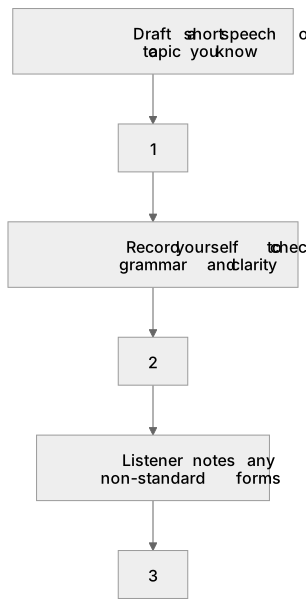
AO9 is assessed through the spoken element of the course, not through written scripts. It asks you to use spoken Standard English effectively when you give a speech or presentation. 'Spoken Standard English' means the grammar, vocabulary and pronunciation expected in formal public speaking: complete sentences, subject–verb agreement, standard word forms and clear articulation, rather than slang or non-standard dialect forms. 'Effectively' means your choices serve your audience and purpose: register stays formal, technical terms are explained, and delivery is fluent and audible. Prepare by drafting a short speech on a topic you know, reading it aloud, and recording yourself to check grammar and clarity. Rehearse in front of a listener who notes any non-standard forms, then revise.
Common mistakes and how to put them right
Thinking AO9 is tested in the written exam.
Put it right: It is assessed through your spoken speech or presentation, so practise speaking aloud, not just writing.
Believing Standard English means speaking in an accent.
Put it right: It concerns grammar, vocabulary and clear articulation, not regional accent, so keep your natural voice while using standard forms.
Assuming a script read word-for-word guarantees success.
Put it right: Effective delivery needs fluency, eye contact and audience awareness, so rehearse rather than simply reading.
Treating slang or filler as harmless.
Put it right: Repeated non-standard forms and fillers weaken effectiveness, so identify and replace them during rehearsal.
Exam tips
- Record a two-minute speech, listen back, and list every non-standard grammatical form to correct before your assessed presentation.
- Rehearse with a listener who signals when your register slips into informal chat, then practise the standard alternative.
- Plan your opening and closing sentences carefully, since clear structure and controlled language make effective Standard English easier to sustain.
Try the lesson
The start of the Assessment - Assessment Objectives and Weightings: AO9: Use spoken Standard English effectively in speeches and presentations. lesson, made from checked teaching notes for this specification point.
Have a go first
Which sentence uses spoken Standard English most effectively for a formal school presentation?
Listen
AO9 is assessed through the spoken element of the course, not through written scripts. It asks you to use spoken Standard English effectively when you give a speech or presentation. Spoken Standard English' means the grammar, vocabulary and pronunciation expected in formal public speaking: complete sentences, subject–verb agreement, standard word forms and clear articulation, rather than slang or non-standard dialect forms. Effectively' means your choices serve your audience and purpose: register stays formal, technical terms are explained, and delivery is fluent and audible. Prepare by drafting a short speech on a topic you know, reading it aloud, and recording yourself to check grammar and clarity. Rehearse in front of a listener who notes any non-standard forms, then revise. Exam tip: Record a two-minute speech, listen back, and list every non-standard grammatical form to correct before your assessed presentation.
See it
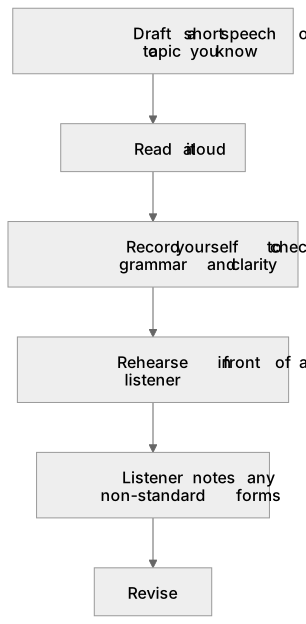
Put it in order
Put these steps in the order they happen.
- 1. Record yourself to check grammar and clarity
- 2. Read it aloud
- 3. Draft a short speech on a topic you know
- 4. Revise
- 5. Listener notes any non-standard forms
- 6. Rehearse in front of a listener
Key words
Say what each word means before you turn the card.
Spoken Standard English
Try answering aloud or in your head before turning the card.
Effectively
Try answering aloud or in your head before turning the card.
Register
Try answering aloud or in your head before turning the card.
Rehearsal
Try answering aloud or in your head before turning the card.
See every definition
- Spoken Standard English
- The grammar, vocabulary and pronunciation expected in formal public speaking, using complete sentences, subject–verb agreement, standard word forms and clear articulation rather than slang or non-standard dialect forms.
- Effectively
- Making choices that serve your audience and purpose, with register staying formal, technical terms explained, and delivery fluent and audible.
- Register
- The level of formality in your language, which stays formal for a speech or presentation and should not slip into informal chat.
- Rehearsal
- Practising your speech aloud, including in front of a listener who notes any non-standard forms, so that you can revise before the assessed presentation.
Label the diagram
Some boxes have lost their names. Pick the right name for each number.
1Box 1
2Box 2
3Box 3
There is more to this lesson
The full lesson goes on to check your understanding and help you earn the marks. Create a free account to carry on, with your progress saved.
A week of Premium from your first lesson · Then the free plan continues · No card, no charge
Test your understanding of Assessment - Assessment Objectives and Weightings: AO9: Use spoken Standard English effectively in speeches and presentations.
Active recall beats re-reading. Take an instant quiz now to test what you’ve learned and lock it into long-term memory.
A week of Premium from your first lesson · Then the free plan continues · No card, no charge