OCR · GCSE · English Language
Communicating Clearly and Effectively
This guide focuses on mastering OCR GCSE English Language Topic 2.4: Communicating Clearly and Effectively. It provides a comprehensive breakdown of the reading and writing skills required to excel in your exams, moving beyond simple feature-spotting to sophisticated analysis and production of language.
- 7 min read
- 3 worked examples
- 5 practice questions
- 8 key terms
Check what you remember
Read the wording for your board, then hide it and explain Register in your own words. Rough notes are fine. This is a self-check, with no mark or grade.
Reference: OCR
The level of formality in a piece of writing. It can range from highly formal (e.g., a legal document) to very informal (e.g., a text message to a friend).
Study Notes

Overview
Welcome to your deep-dive into Communicating Clearly and Effectively for OCR GCSE English Language (J351). This skill is the absolute bedrock of the qualification, accounting for a significant portion of your marks across both Paper 1 (Explorations in Creative Reading and Writing) and Paper 2 (Writers' Viewpoints and Perspectives). Mastery here is not just about knowing literary terms; it's about becoming a skilled decoder and creator of texts. Examiners are looking for candidates who can dissect how writers use language and structure to influence a reader (AO2) and then apply those same principles with flair and precision in their own writing (AO5/AO6). This guide will equip you with the analytical frameworks and creative strategies needed to achieve top-band marks.
Reading Skills
Identifying Information & Ideas
This is the foundation of all reading comprehension. AO1 requires you to identify and interpret both explicit (obvious) and implicit (suggested) information and ideas. In an unseen text, this means reading carefully to understand not just what is stated, but what is hinted at through the writer's choices.
- Explicit Information: Facts, statements, and details directly present in the text. For example, "The sky was blue."
- Implicit Information: Ideas not stated directly but can be inferred from the text. For example, if a character is described as having trembling hands and a pale face, you can infer they are scared or nervous, even if the text doesn't say it.
Analysing Language
This is where the highest marks for reading are won or lost. AO2 is about analysing the language, form, and structure used by a writer to create meanings and effects. You must go beyond simply labelling a technique.
Key Language Features to Identify
| Feature | Definition | Effect on Reader | Example |
|---|---|---|---|
| Metaphor | A figure of speech where a word or phrase is applied to an object or action to which it is not literally applicable. | Creates a powerful image by drawing a direct comparison, making an abstract idea more concrete. | "The city was a jungle." |
| Simile | A figure of speech comparing one thing with another thing of a different kind, using 'like' or 'as'. | Softens the comparison, making it feel more descriptive and less absolute than a metaphor. | "He was as brave as a lion." |
| Pathetic Fallacy | The attribution of human feelings and responses to inanimate things or animals, especially in nature. | Creates atmosphere and mood that reflects the emotional state of a character or the tone of the narrative. | "The miserable rain wept down the windowpane." |
| Personification | Giving human qualities or abilities to something that is not human. | Helps the reader to understand, sympathise with, or react emotionally to non-human subjects. | "The wind whispered through the trees." |
| Alliteration | The occurrence of the same letter or sound at the beginning of adjacent or closely connected words. | Can create a specific mood (e.g., soft sounds for peace, hard sounds for conflict) and makes the phrase more memorable. | "The sweet smell of success." |
| Sibilance | A specific type of alliteration involving the repetition of soft consonant sounds like 's' or 'sh'. | Often used to create a sinister, soft, or sly tone. It can sound menacing or soothing depending on context. | "The snake slithered silently." |
| Juxtaposition | Placing two contrasting ideas, characters, or descriptions close together. | Highlights the differences between them and can create a sense of shock, surprise, or irony. | "The pristine new building stood beside the crumbling ruins." |
| Imperative Verb | A verb that gives a command or instruction. | Creates a sense of authority, urgency, or control. It directly involves the reader. | "Stop what you are doing and listen." |
Analysing Structure
Structure is the writer's blueprint. It's how they organise and shape the text to guide the reader's journey. When analysing structure, consider:
- Openings: How does the writer hook the reader from the first line?
- Shifts in Focus: Where does the narrative perspective or topic change? Why?
- Narrative Perspective: Is it first-person (I), third-person limited (he/she knows one character's thoughts), or third-person omniscient (he/she knows all)? How does this affect what we know?
- Sentence Length Variation: Are sentences long and complex, or short and simple? Short sentences can create tension, while long sentences can be descriptive or build a complex argument.
- Paragraph Structure: How are paragraphs used to group ideas or signal a change?
- Cyclical Structure: Does the text end where it began? This can suggest a lack of change or a sense of inevitability.
- Flashback/Foreshadowing: Does the writer play with time to reveal information or build suspense?
Evaluating Critically
Evaluation (AO4) is about forming a judgement. You need to weigh up the writer's methods and decide how successful they are. Use phrases like "To a great extent...", "The writer is highly effective in creating...", or "While the writer attempts to..., it is less successful because...". Always back up your opinion with evidence from the text.
Comparing Writers' Viewpoints
For Paper 2, you will need to compare how two writers present their viewpoints on a similar topic. A good framework is:
- Identify Viewpoints: What is the main opinion or perspective of each writer?
- Compare Methods: How do they use language and structural techniques to convey their viewpoint? Compare their choices.
- Evaluate Effectiveness: Which writer do you find more convincing and why? Link back to their methods.
Writing Skills
Creative Writing
This is your chance to show off your descriptive or narrative flair. Examiners reward writing that is engaging, well-structured, and technically accurate.
- Show, Don't Tell: Instead of telling the reader a character is angry, show it: "He clenched his fists, his jaw tight, a muscle twitching in his cheek."
- Sensory Description: Engage all five senses—sight, sound, smell, touch, taste—to create a vivid world.
- Varied Sentence Structures: Mix simple, compound, and complex sentences to control pace and rhythm.
- Engaging Openings: Start with action, dialogue, or a mystery to hook the reader.
- Satisfying Endings: Provide a sense of closure, even if it's a cliffhanger. A circular narrative can be very effective.
- One-Scene Rule: For short stories in an exam, it's often best to focus on a single, significant moment in time rather than a sprawling plot.
Transactional/Non-Fiction Writing
Here, you must adapt your writing to a specific form, audience, and purpose (TAP). Whether it's a letter, article, speech, or leaflet, the register and tone must be perfect.
- Structure: Follow the conventions of the form. A formal letter needs addresses and a proper sign-off. An article needs a headline and subheadings.
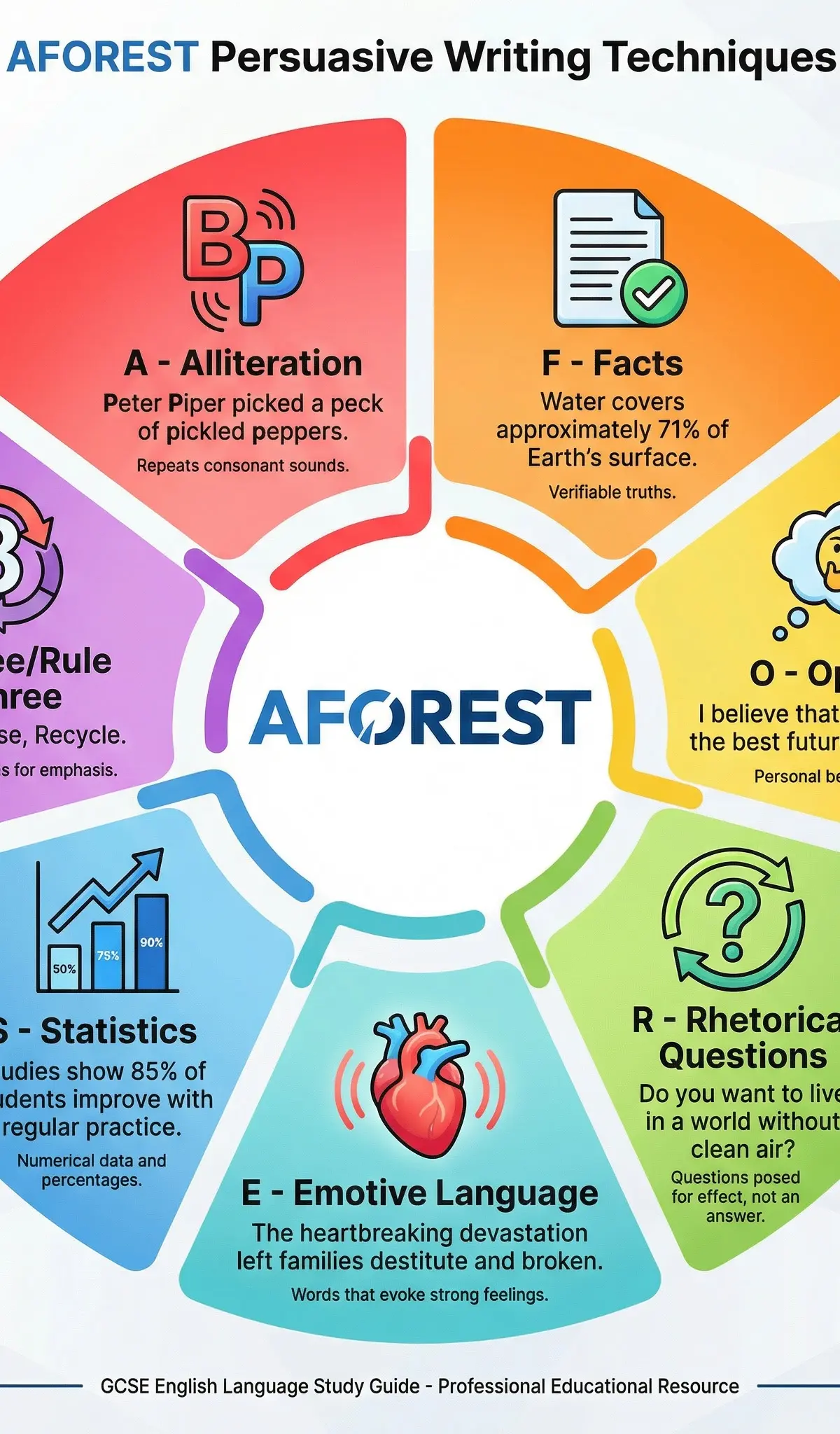
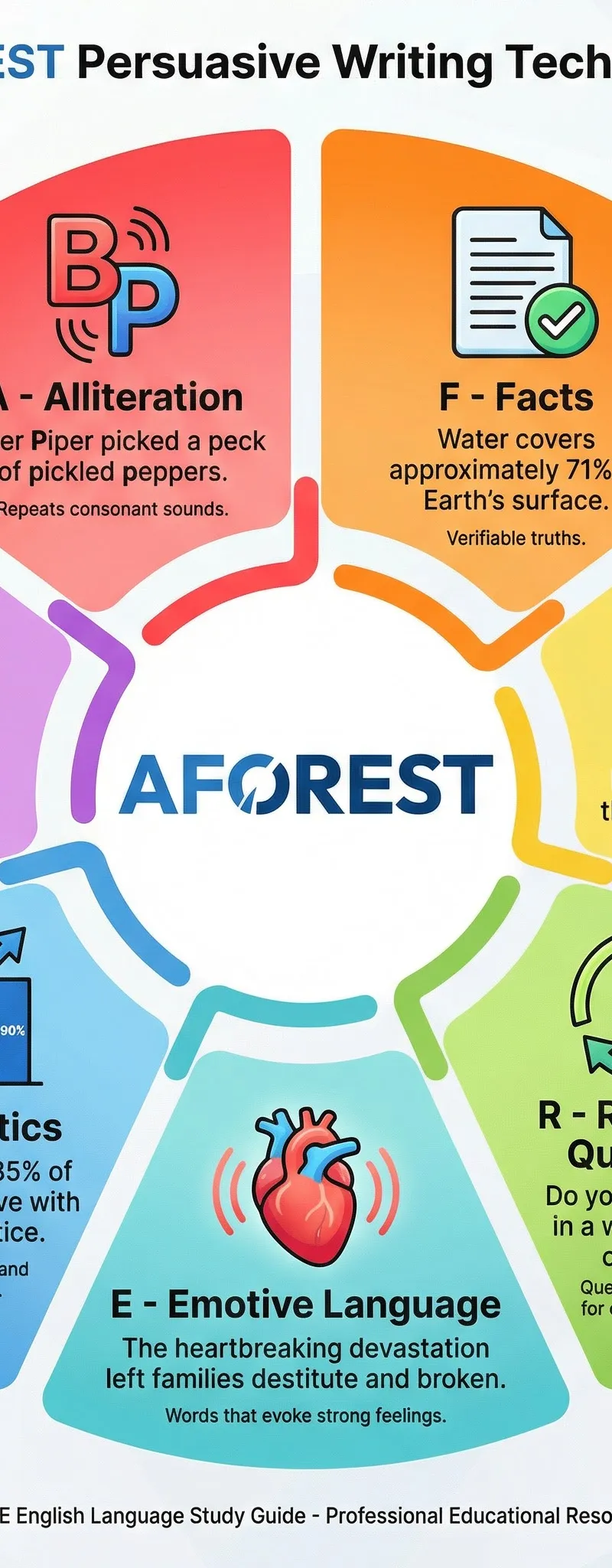
- AFOREST Persuasive Techniques: Use these tools to build a convincing argument. See the memory hook below!
- Purpose-Form-Audience Framework: Always plan with TAP in mind. Who are you writing for? What do you want to achieve? What is the best format?
Technical Accuracy (SPaG)
Spelling, Punctuation, and Grammar (SPaG) are worth 20% of your writing marks (AO6). This is not just about avoiding mistakes; it's about using ambitious punctuation to add clarity and style.
- Ambitious Punctuation: Master the use of semicolons (to link two closely related independent clauses), colons (to introduce a list, explanation, or quotation), dashes (for emphasis or interruption), and parenthetical commas (to add extra information).
- Paragraph Cohesion: Use discourse markers (e.g., "Furthermore", "In contrast", "Consequently") to link your paragraphs and create a logical flow of ideas.
Visual Resources
2 diagrams and illustrations
Interactive Diagrams
2 interactive diagrams to visualise key concepts
Conceptual Flow Outline
A flowchart detailing a systematic approach to tackling any question in the OCR GCSE English Language exam.
Conceptual Flow Outline
A framework for comparing the viewpoints and methods of two writers in Paper 2.
Worked Examples
3 worked examples — open one to explore the question and available guidance.
Practice Questions
Try the question, then reveal an answer plan or example response
Identify two phrases from a text (not provided) that show the character is nervous.
Hint: This is an AO1 question. Look for explicit details about the character's actions or appearance.
Explain how the writer uses language to describe the old house.
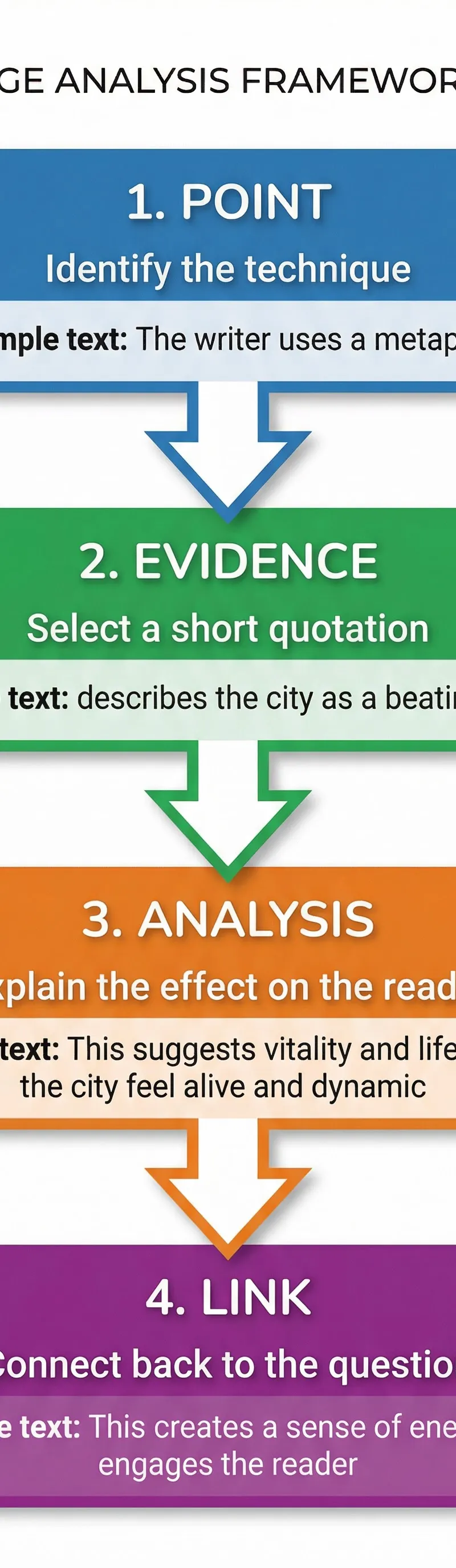
Hint: Use the PEAL structure. Find a good quotation, identify the technique, and explain its effect.
Write a description of a busy market.
Hint: Focus on sensory details. What can you see, hear, smell, and feel? Use varied sentence structures to create pace.
Evaluate how successfully the writer creates a sense of mystery.
Hint: This is an AO4 question. You need to judge the writer's success. Use phrases like 'highly successful' and explain why, using evidence.
Write a formal letter to your headteacher persuading them to introduce a four-day school week.
Hint: Remember TAP! The form is a formal letter, the audience is your headteacher (formal register), and the purpose is to persuade. Use AFOREST and structure your argument logically.
Exam technique
How to turn what you know into marks
How to approach the question
1. **Deconstruct the Question**: Underline the command word (How, Evaluate, Compare) and the focus (language, structure, viewpoint). 2. **Skim the Text**: Get a general sense of the content and tone. 3. **Active Reading**: Reread the relevant section, annotating for techniques and key quotations related to the question focus. 4. **Plan Your Answer**: For reading, jot down your PEAL points. For writing, plan your TAP and structure.
How to structure your answer
Reading: Use the PEAL structure for every analytical paragraph. Writing: Plan first (TAP, key ideas). Start with a strong hook. Develop your points logically in the middle. End with a satisfying and conclusive statement. Always leave time to proofread.
Timing
As a general guide, allow just over one minute per mark. For a 4-mark question, spend about 5 minutes. For an 8-mark question, aim for 10 minutes. For the 40-mark writing questions (24 for content/organisation, 16 for SPaG), you should allocate a full 45 minutes, including 5-10 minutes for planning and 5 for proofreading.
Common pitfalls
- Feature-spotting: Identifying a technique (e.g., 'The writer uses a metaphor') without explaining its specific effect on the reader.
- Not embedding quotations: Dropping long, unedited quotes into your answer instead of weaving short, precise evidence into your sentences.
- Writing without a plan: Launching into a creative or transactional piece without considering structure, leading to a rambling and incoherent response.
- Forgetting to proofread: Losing crucial AO6 marks due to avoidable spelling, punctuation, and grammar errors.
- Retelling the story: Summarising what happens in the text instead of analysing how the writer has crafted it.
What the command words want
- Compare
- Discuss both similarities and differences between how two writers present their ideas. Use comparative connectives like 'Similarly', 'In contrast', 'Whereas'.
- Evaluate
- Give your personal, evidence-based judgement on how well the writer has achieved something. Argue 'to what extent' they were successful.
- Identify/List
- Find and write down specific information. This requires no analysis.
- Write a [text type]
- Your cue to focus on TAP. Match the conventions of the form (e.g., letter layout), sustain the correct register, and use ambitious vocabulary.
- How does the writer use language
- This is your cue for PEAL. Name the technique, give the evidence, and explain the EFFECT of the word choices on the reader.
- How does the writer use structure
- Focus on the bigger picture: shifts in focus, sentence structure changes, openings/endings. Explain how the organisation of the text creates meaning or tension.
Watch or listen (optional)
Test your understanding of Communicating Clearly and Effectively
Active recall beats re-reading. Take an instant quiz now to test what you’ve learned and lock it into long-term memory.
7 days Premium · Then the free plan continues · No card, no charge