OCR · GCSE · English Language
Communicating information and ideas (01)
This topic tests your ability to read closely, analyse language and structure, and produce highly effective original writing. You will be assessed on how well you understand writers' methods and how successfully you can apply those methods in your own creative and transactional writing.
- 5 min read
- 3 worked examples
- 5 practice questions
- 8 key terms
Study Notes
Overview
This unit focuses on the core skills of reading and writing. In the reading section, you are required to respond to unseen literary prose texts, demonstrating your ability to draw inferences, analyse language and structure, and compare writers' viewpoints. In the writing section, you must produce original creative and transactional writing that applies narrative techniques and linguistic conventions to create deliberate effects on the reader.
Listen to our comprehensive revision podcast to kickstart your study session:
Reading Skills
Identifying Information & Ideas
When approaching an unseen text, your first task is to locate both explicit and implicit information. Explicit information is clearly stated on the page, whereas implicit information requires you to read between the lines. Examiners reward candidates who can draw perceptive inferences and justify their points of view using close, judiciously selected textual evidence.
Analysing Language
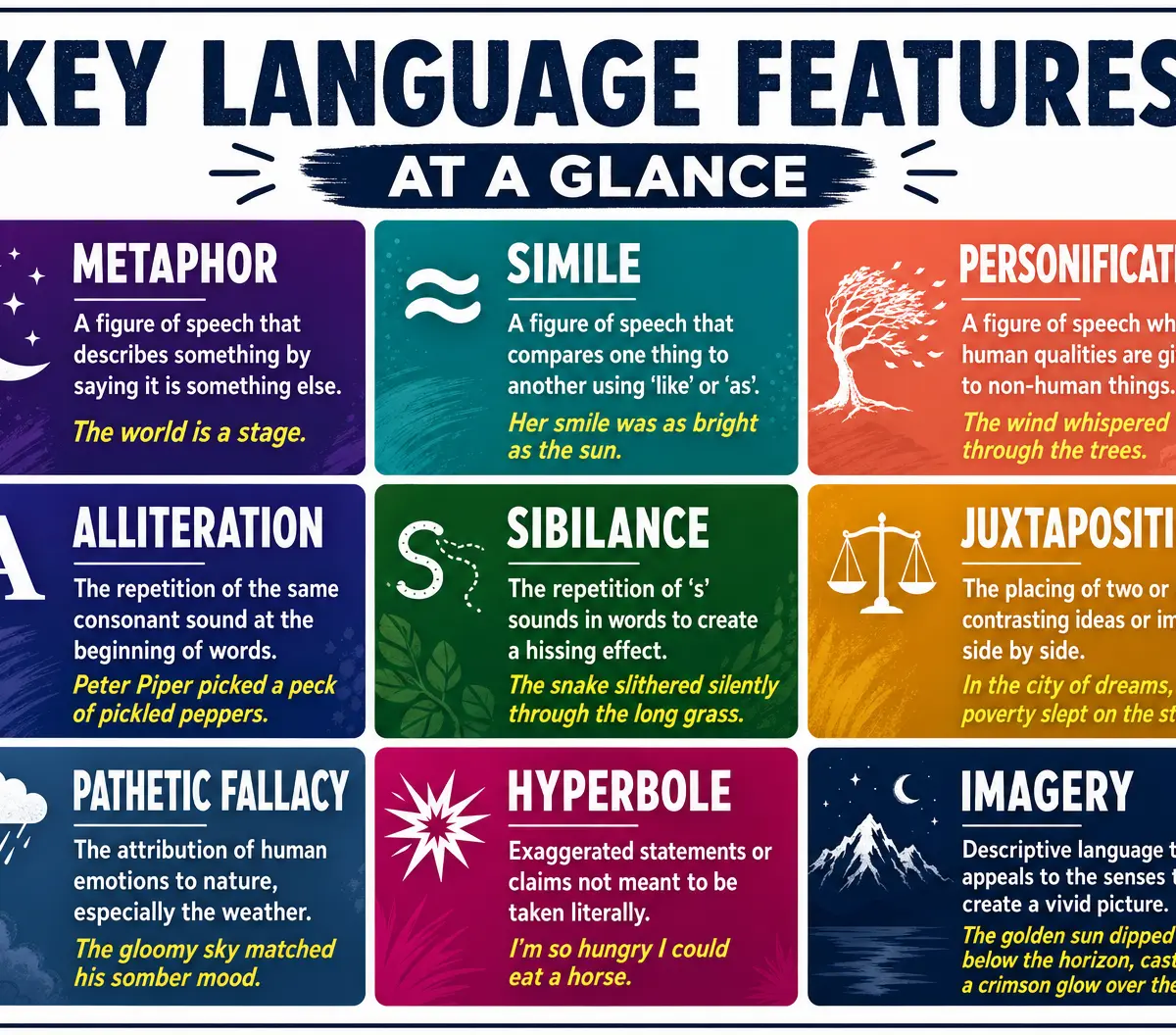
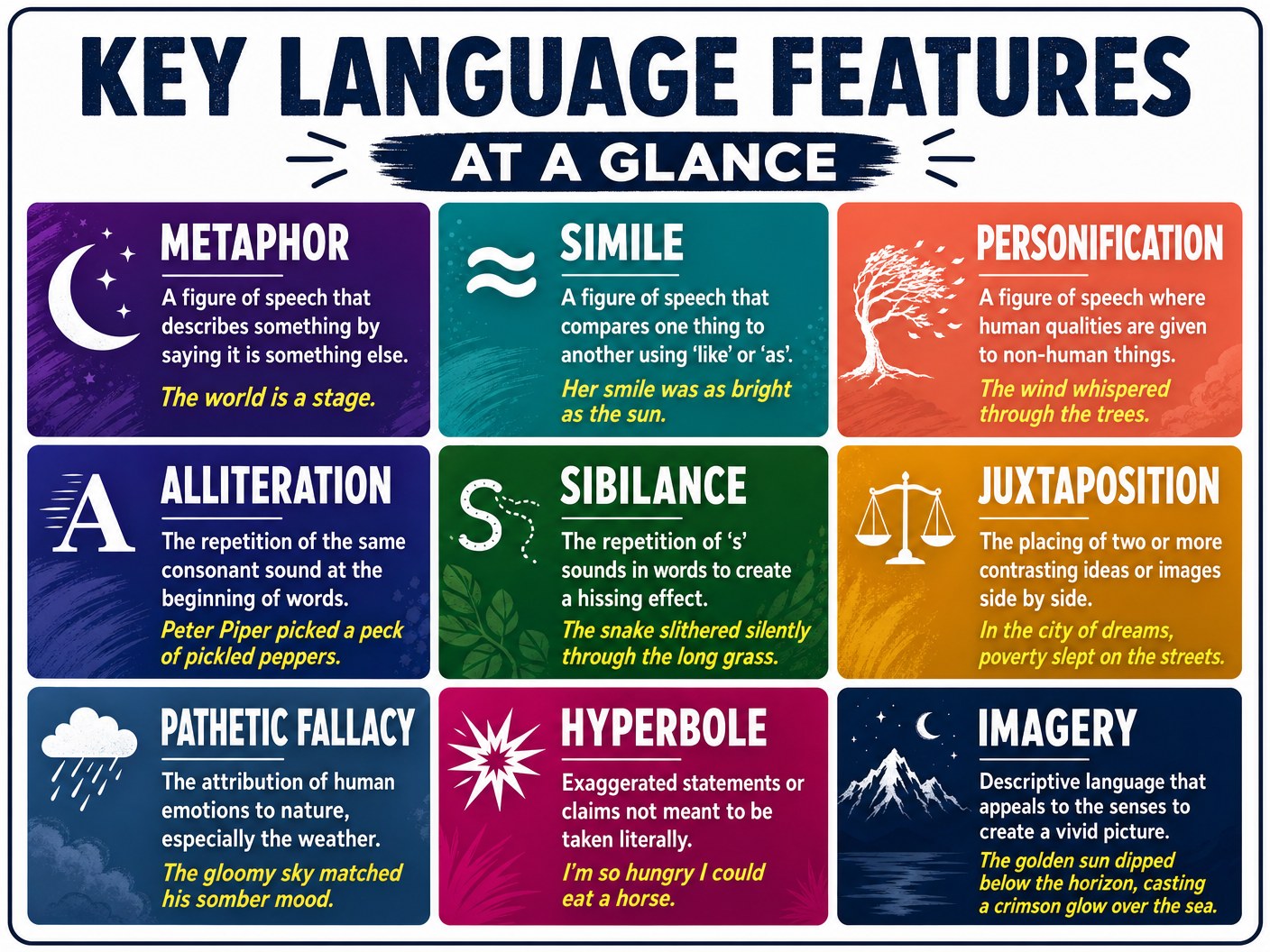
Key Language Features to Identify
| Feature | Definition | Effect on Reader | Example |
|---|---|---|---|
| Metaphor | Describing something by saying it is something else | Creates vivid imagery, forces the reader to see the subject in a new, often startling way | 'The classroom was a zoo.' |
| Simile | Comparing two things using 'like' or 'as' | Helps the reader visualise an unfamiliar concept by comparing it to a familiar one | 'Her smile was as bright as the sun.' |
| Personification | Giving human qualities to non-human things | Brings the inanimate to life, often reflecting the mood of a scene or character | 'The wind whispered through the trees.' |
| Pathetic Fallacy | Giving human emotions to nature/weather | Establishes atmosphere and often foreshadows narrative events | 'The gloomy sky matched his somber mood.' |
| Alliteration | Repetition of consonant sounds at the start of words | Draws attention to a phrase, affecting pace and tone (e.g., harsh 'c' sounds create aggression) | 'The cruel, cold wind cut through him.' |
| Sibilance | Repetition of 's' sounds | Creates a hissing, whispering, or soothing auditory effect | 'The snake slithered silently.' |
| Juxtaposition | Placing contrasting ideas side by side | Highlights differences, creating tension or emphasizing a specific trait | 'In the city of dreams, poverty slept on the streets.' |
Analysing Structure
Structural analysis is often the differentiator between mid-tier and top-tier candidates. When analysing structure, consider the journey the writer takes the reader on. Look for:
- Openings: Are we dropped in medias res (into the middle of the action)?
- Shifts in focus: Does the writer move from a panoramic view of a setting to a tight close-up on a character?
- Narrative perspective: Who is telling the story, and how reliable are they?
- Sentence length variation: Are short sentences used to build tension, followed by complex sentences for descriptive flow?
- Paragraph structure: Does a single-sentence paragraph create a sudden, jarring impact?
- Cyclical structure: Does the ending return to an image from the beginning, creating a sense of inevitability or entrapment?
Evaluating Critically
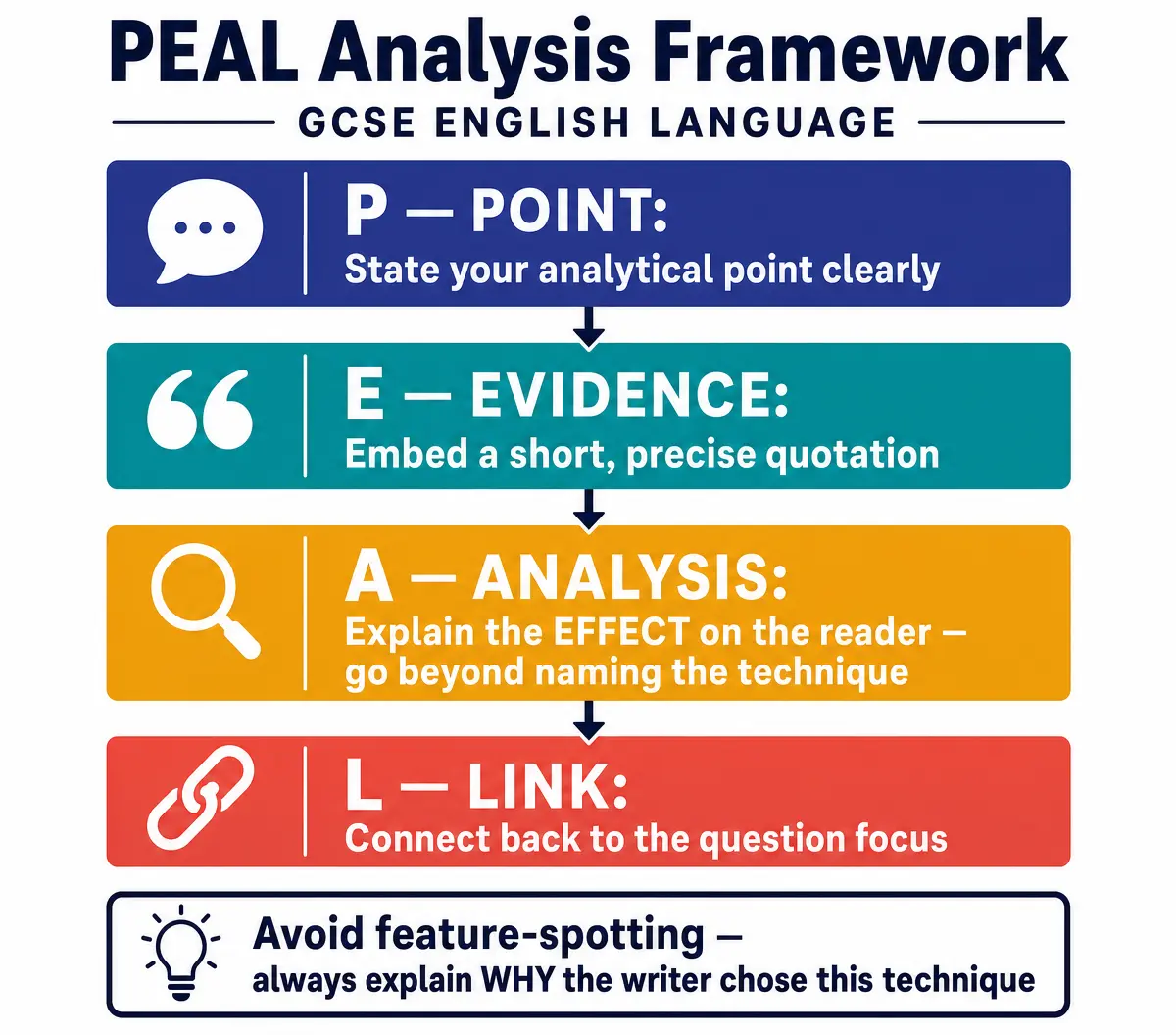
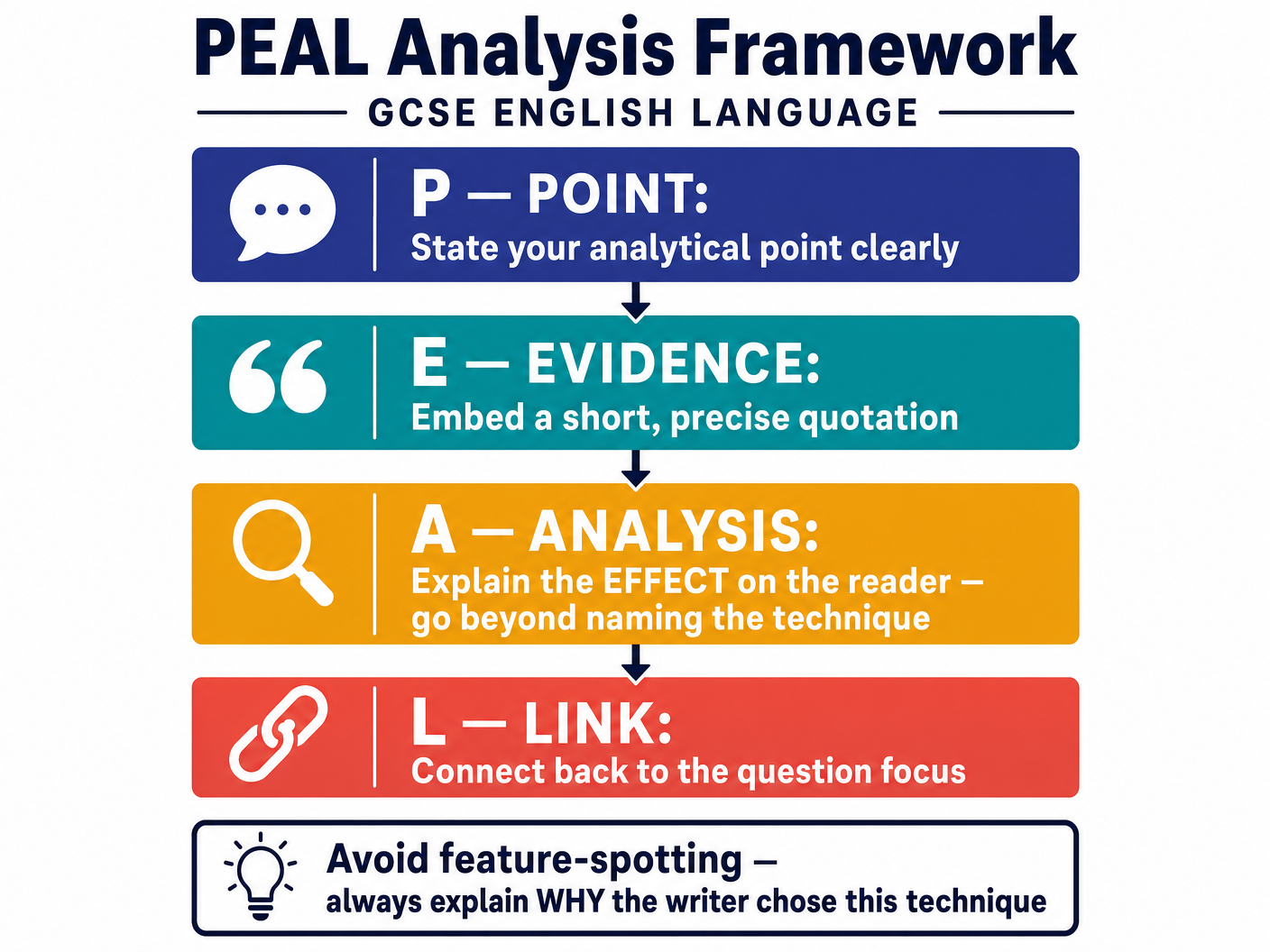
Evaluation requires you to form a judgement about how successfully a writer has achieved their aims. You must express your opinions with supporting evidence. Use the statement-evidence-analysis-link framework to ensure your evaluation is grounded in the text rather than vague personal opinion.
Comparing Writers' Viewpoints
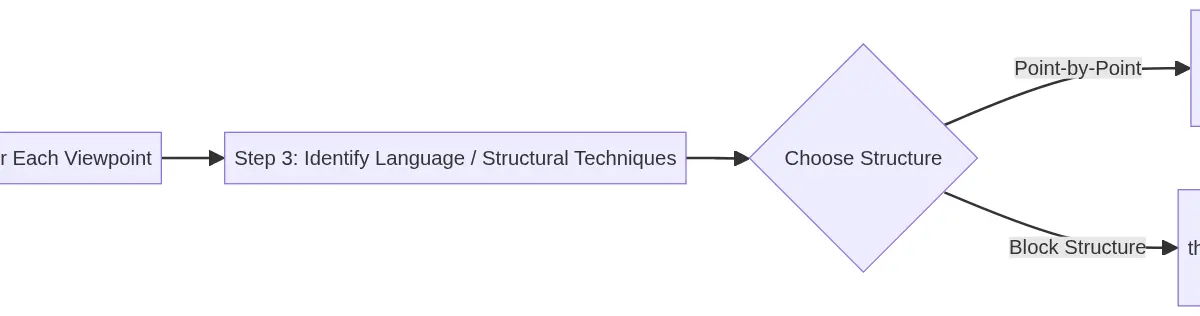
When comparing texts, you must identify the differing viewpoints, compare the methods the writers use to convey those viewpoints, and evaluate their effectiveness. Use comparison connectives such as 'similarly', 'in contrast', and 'whereas' to explicitly link the texts throughout your response.
Writing Skills
Creative Writing
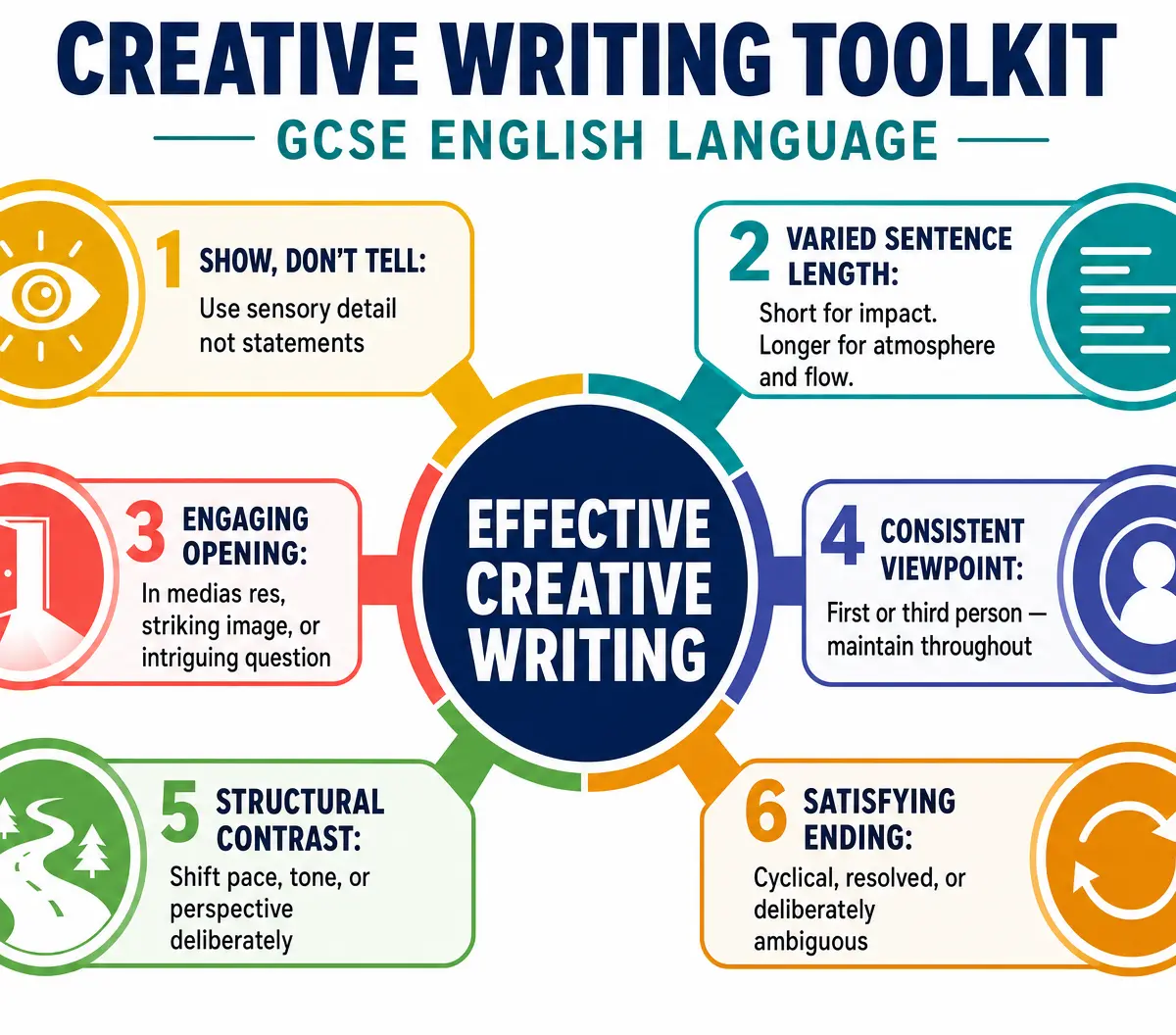
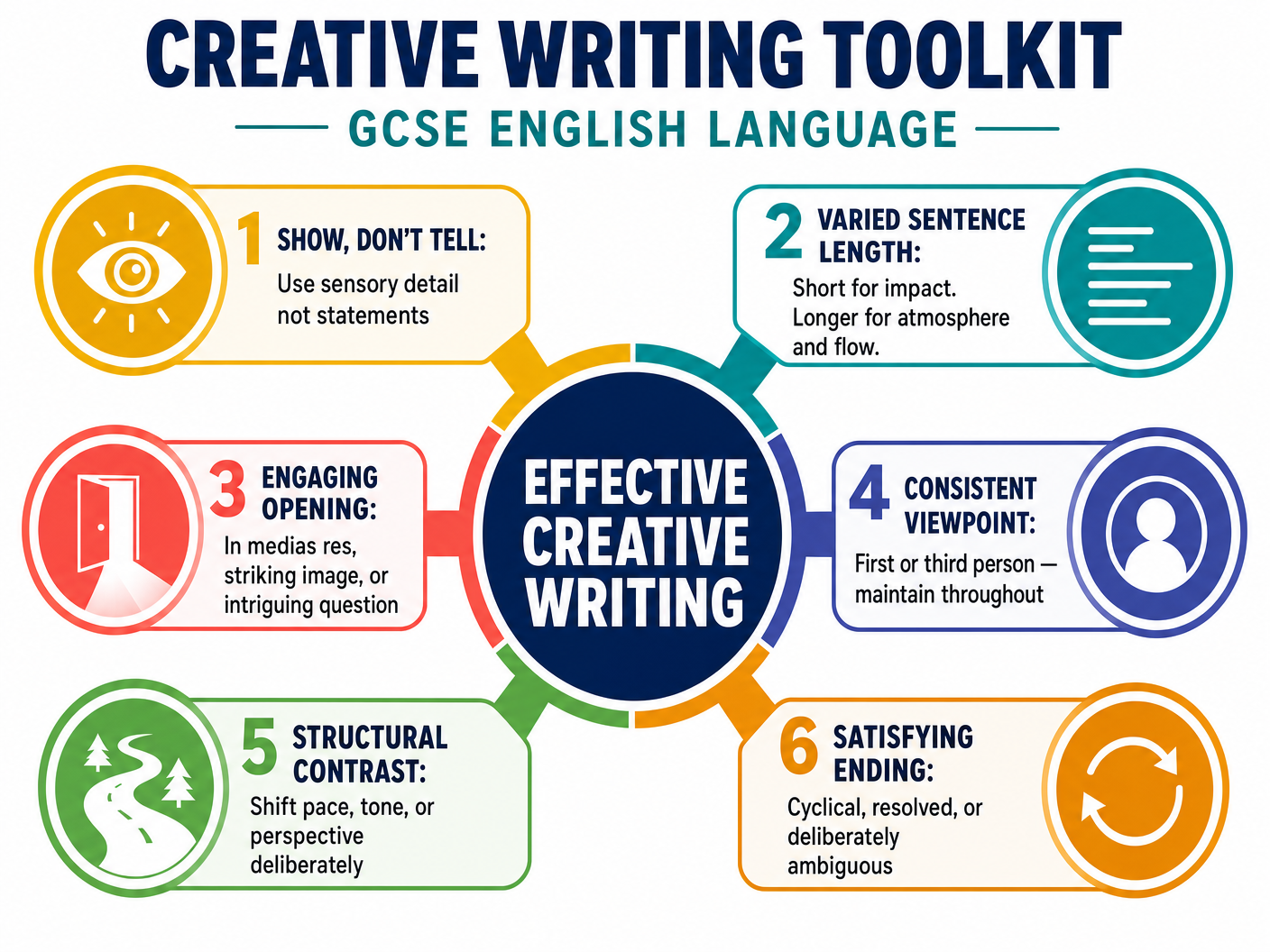
Original creative writing must maintain a consistent viewpoint and be structured to create deliberate effects rather than just telling a chronological story. Apply the 'show, don't tell' principle: use sensory description to evoke mood rather than stating emotions explicitly. Employ varied sentence structures and ensure your opening is engaging and your ending is satisfying.
Transactional/Non-Fiction Writing
For letters, articles, speeches, and leaflets, you must adapt your tone and register to suit the specified purpose and audience. Use the AFOREST framework to embed persuasive techniques effectively, but remember that a coherent, logical structure is just as important as individual rhetorical devices.
Technical Accuracy (SPaG)
Spelling, punctuation, and grammar (SPaG) constitute a significant portion of your writing marks. Use ambitious punctuation (semicolons, colons, dashes, parenthetical commas) to demonstrate control. Ensure paragraph cohesion by using appropriate discourse markers to guide the reader through your argument or narrative.
Visual Resources
5 diagrams and illustrations

Interactive Diagrams
2 interactive diagrams to visualise key concepts
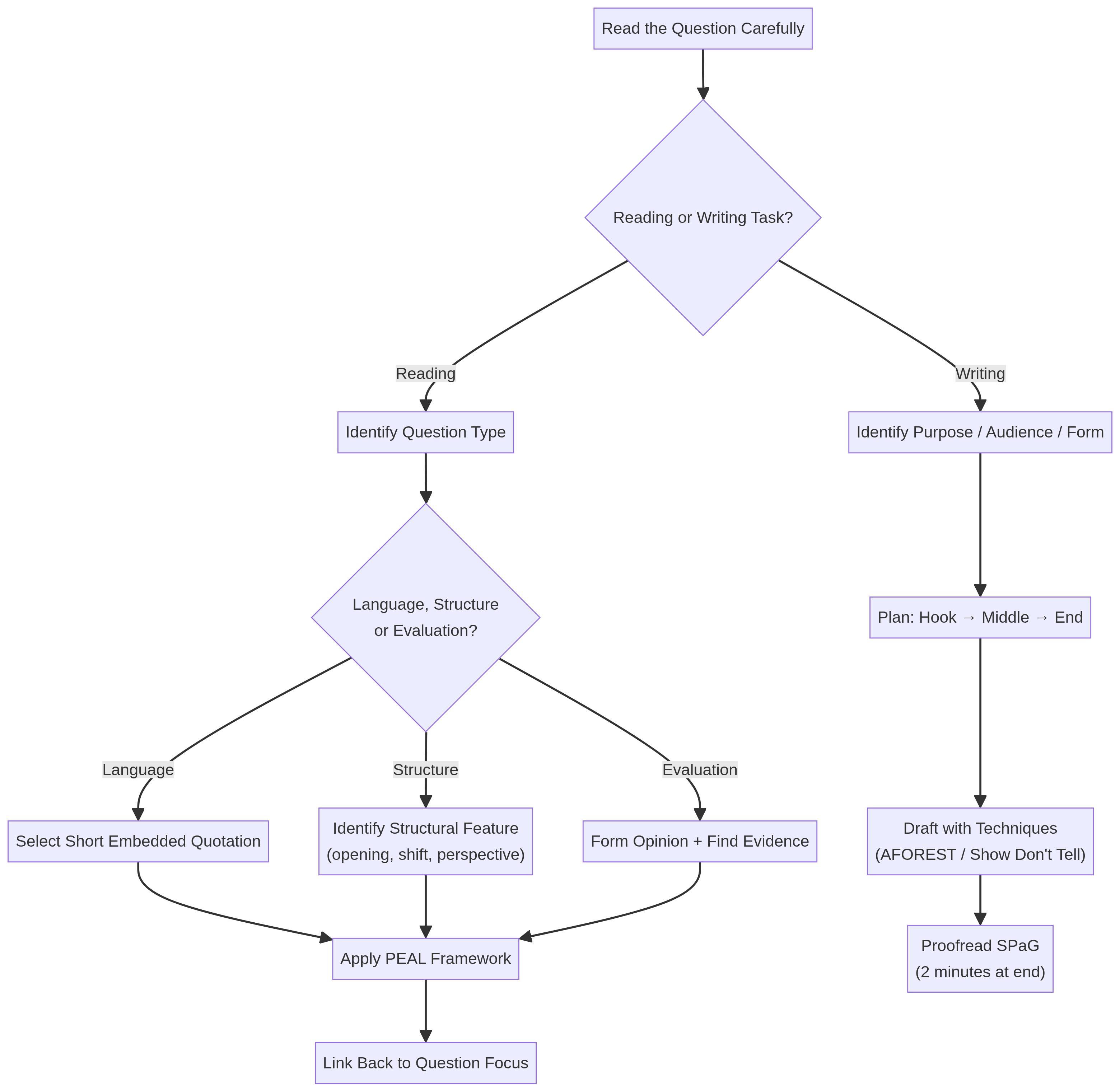
Conceptual Flow Outline
English Language exam approach flowchart
Conceptual Flow Outline
Framework for comparing writers' viewpoints
Worked Examples
3 worked examples — open one to explore the question and available guidance.
Practice Questions
Test your understanding — click to reveal model answers
Read lines 1-5. List four things we learn about the setting.
Hint: Only look at the specified lines. Keep your answers brief. You do not need to write in full sentences.
How does the writer use language to describe the character's fear?
Hint: Identify a technique, quote it, and explain its effect. Focus on connotations of specific words.
Evaluate the statement: 'The ending of the story is highly effective in creating a sense of mystery.'
Hint: Take a clear stance. Use evidence to support your view. Analyse how the writer's structural and linguistic choices create that mystery.
Write a story with the title 'The Discovery'.
Hint: Plan your structure. Use 'show, don't tell'. Vary your sentence lengths for impact. Ensure your SPaG is accurate.
Compare how the writers of Text A and Text B convey their perspectives on city life.
Hint: Identify the viewpoint in each text. Compare them explicitly using connectives. Analyse the methods each writer uses.