OCR · GCSE · English Language
Presenting information and ideas
This topic tests your ability to read and understand unseen non-fiction texts from different centuries, analysing how writers use language and structure to present their views. It also assesses your ability to write effectively for different purposes and audiences, adapting your own language and structure to achieve specific effects.
- 6 min read
- 3 worked examples
- 5 practice questions
- 8 key terms
Study Notes
Overview
Presenting information and ideas is a core skill in GCSE English Language. It tests your ability to act as both a critical reader and an effective writer. In the reading section, you will encounter unseen non-fiction texts—typically one from the 19th century and another from the 20th or 21st century. Your task is to decode not just what the writers are saying, but how and why they are saying it. In the writing section, you must reverse this process, deploying language and structural techniques to present your own ideas persuasively or informatively.
Listen to our revision podcast for an overview of the core concepts and examiner tips:

Reading Skills
Identifying Information & Ideas
The foundation of reading comprehension is the ability to locate specific information. Examiners distinguish between explicit information (stated directly on the page) and implicit information (suggested or hinted at). When asked to identify four things about a subject, look for explicit facts and write them concisely. When asked what you understand or can infer, look for implicit clues. Crucial examiner tip: Always anchor your inferences with a short quotation from the text. A point without evidence will not receive credit.
Analysing Language
When you analyse language, you are exploring the writer's toolkit. You must identify the technique, quote the specific words used, and crucially, explain the effect on the reader. This is the difference between a Level 2 (simple/supported) and a Level 4 (perceptive/detailed) response.
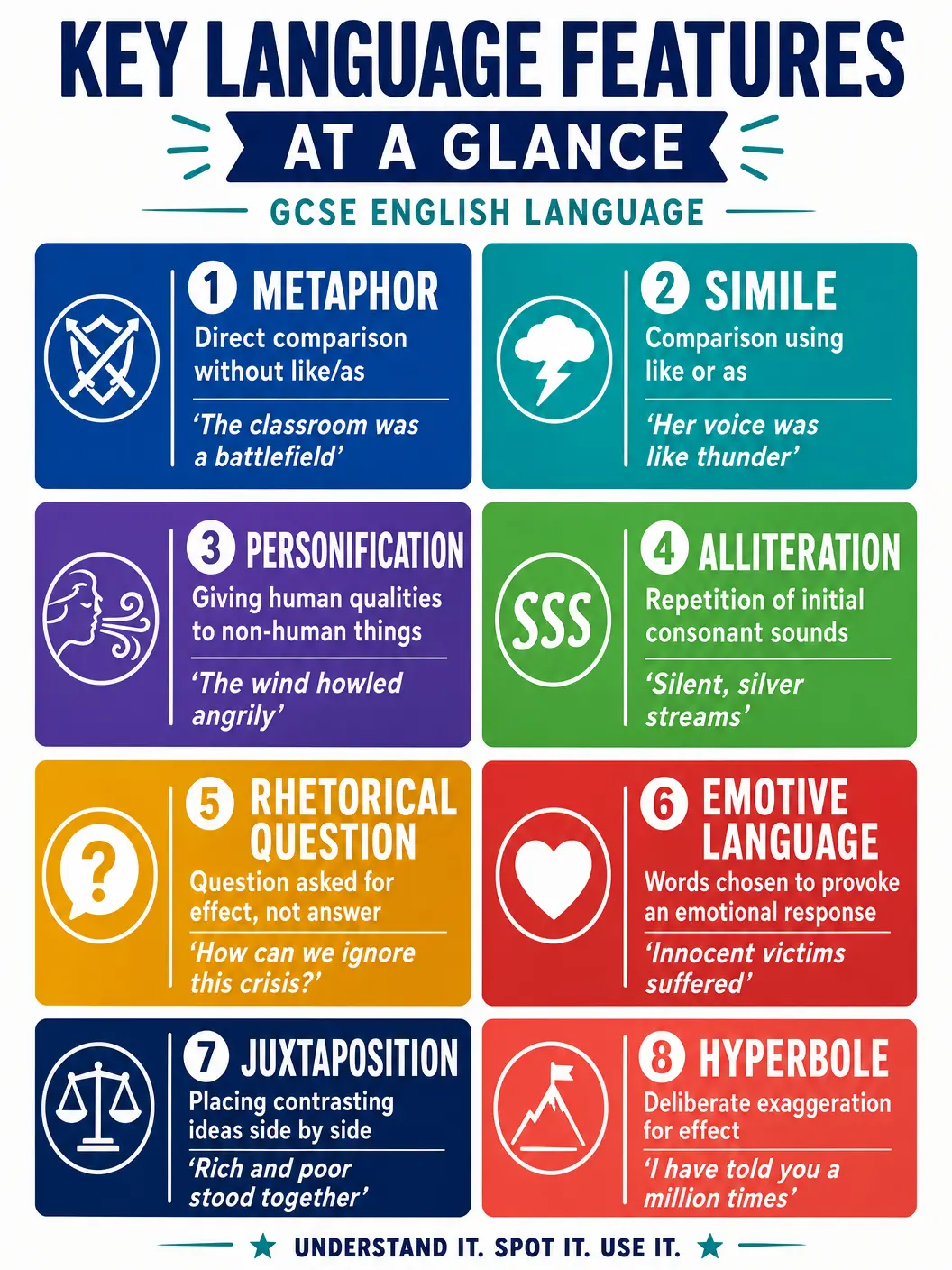
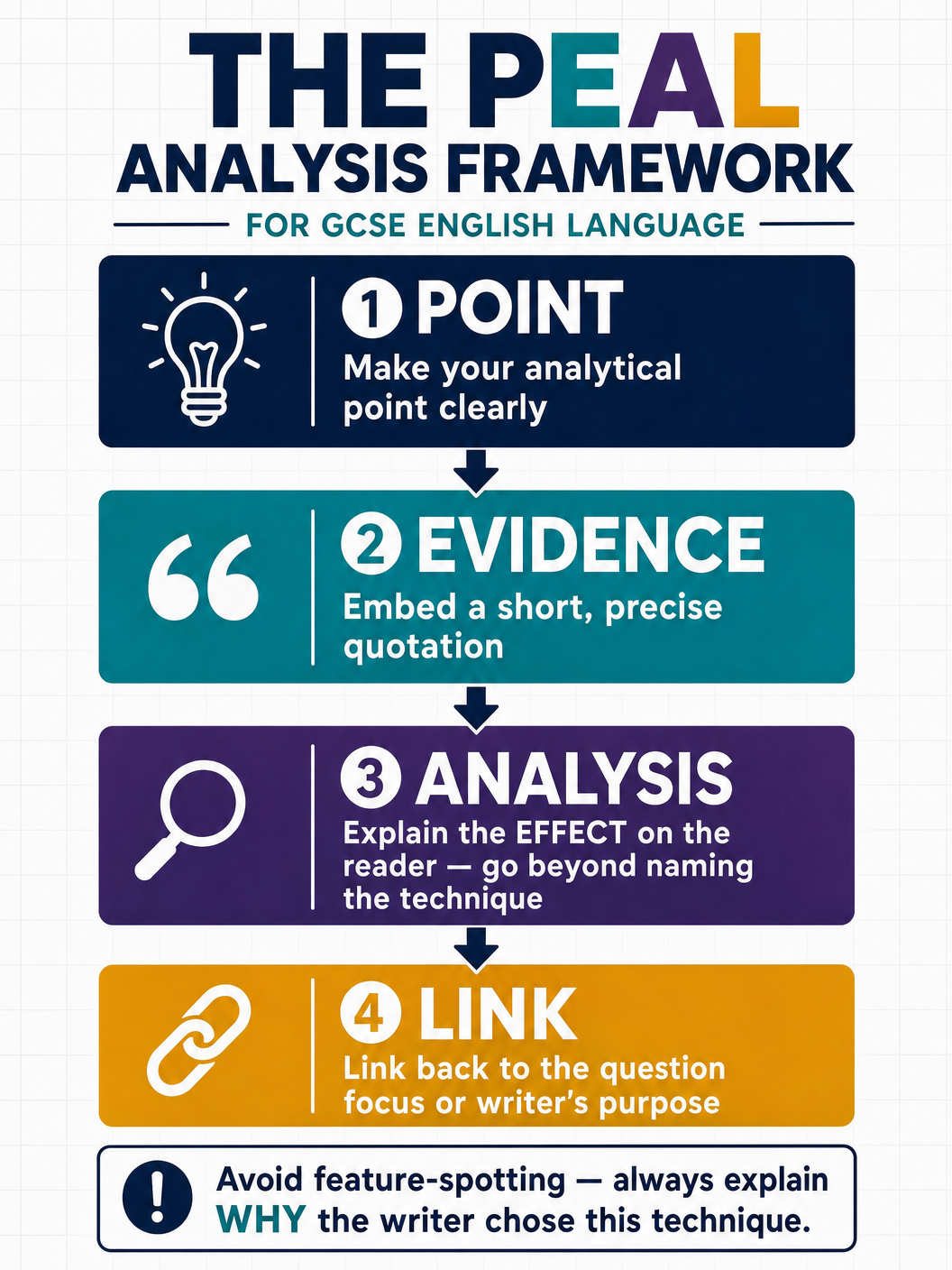
Key Language Features to Identify
| Feature | Definition | Effect on Reader | Example |
|---|---|---|---|
| Metaphor | Direct comparison without using 'like' or 'as'. | Creates a vivid, striking image; transfers the qualities of one thing to another. | 'The classroom was a battlefield.' |
| Simile | Comparison using 'like' or 'as'. | Helps the reader visualize the unfamiliar by comparing it to the familiar. | 'Her voice was like thunder.' |
| Personification | Giving human qualities to non-human things. | Brings inanimate objects to life, often creating a specific mood or atmosphere. | 'The wind howled angrily.' |
| Emotive Language | Words chosen deliberately to provoke an emotional response. | Manipulates the reader to feel sympathy, anger, fear, or joy, aligning them with the writer's view. | 'Innocent victims suffered needlessly.' |
| Semantic Field | A group of words related to a single topic or theme. | Builds a cumulative atmosphere or reinforces a central idea throughout a paragraph. | Words like 'blood', 'wounds', 'combat' (semantic field of war). |
Analysing Structure
Structure is how the text is built. Think of language as the bricks and structure as the architecture. When analysing structure, look at the text on three levels:
- Whole text level: How does it begin and end? Is there a cyclical structure? Does the focus narrow down or zoom out?
- Paragraph level: Are paragraphs long and descriptive, or short and punchy? Is there a sudden shift in topic or tone?
- Sentence level: Does the writer use varied sentence lengths? A short sentence following a long, complex one creates sudden emphasis or shock.
Evaluating Critically
Evaluation questions ask for your opinion on a statement about the text. You must form a judgment and justify it with evidence.
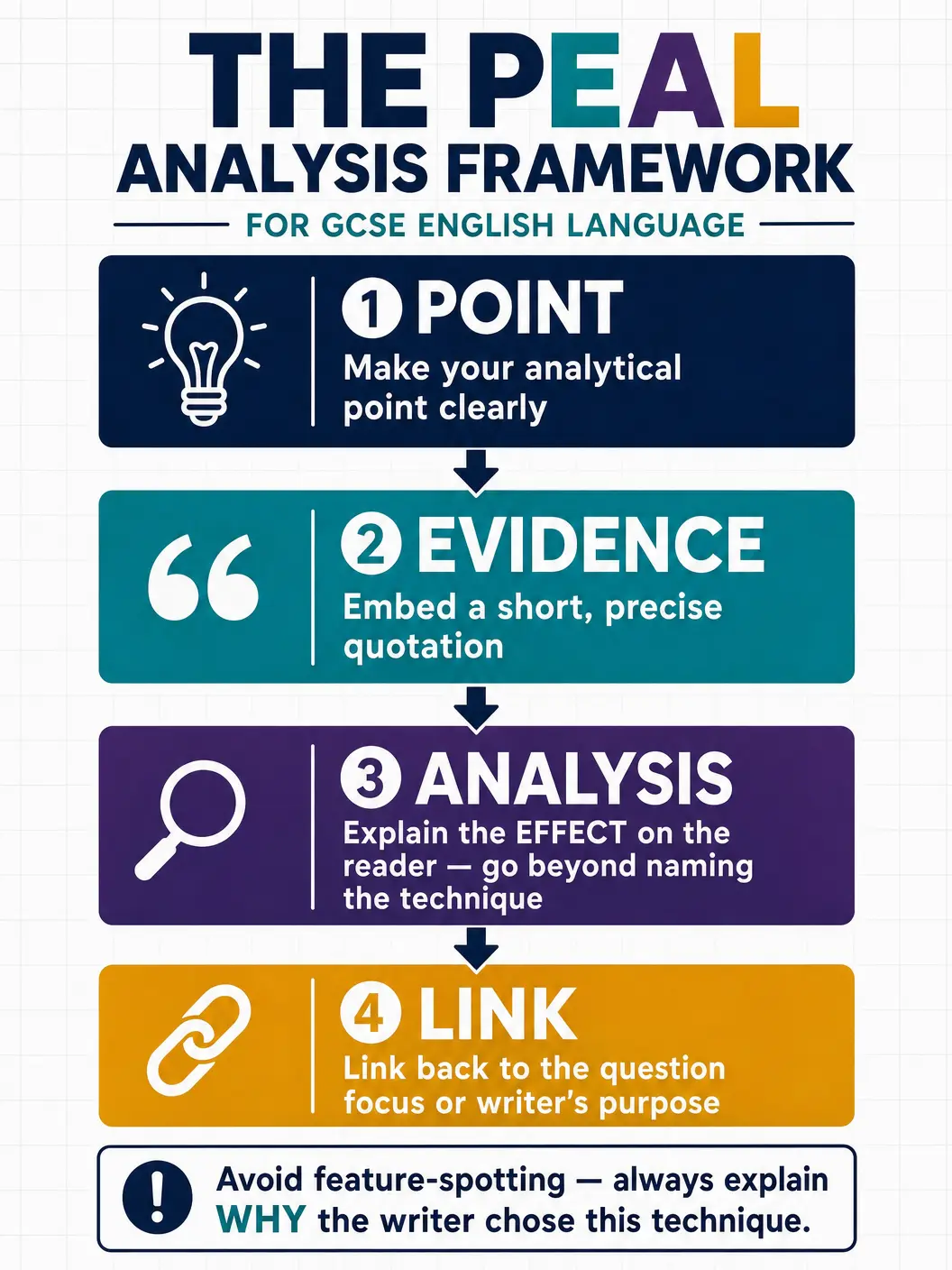
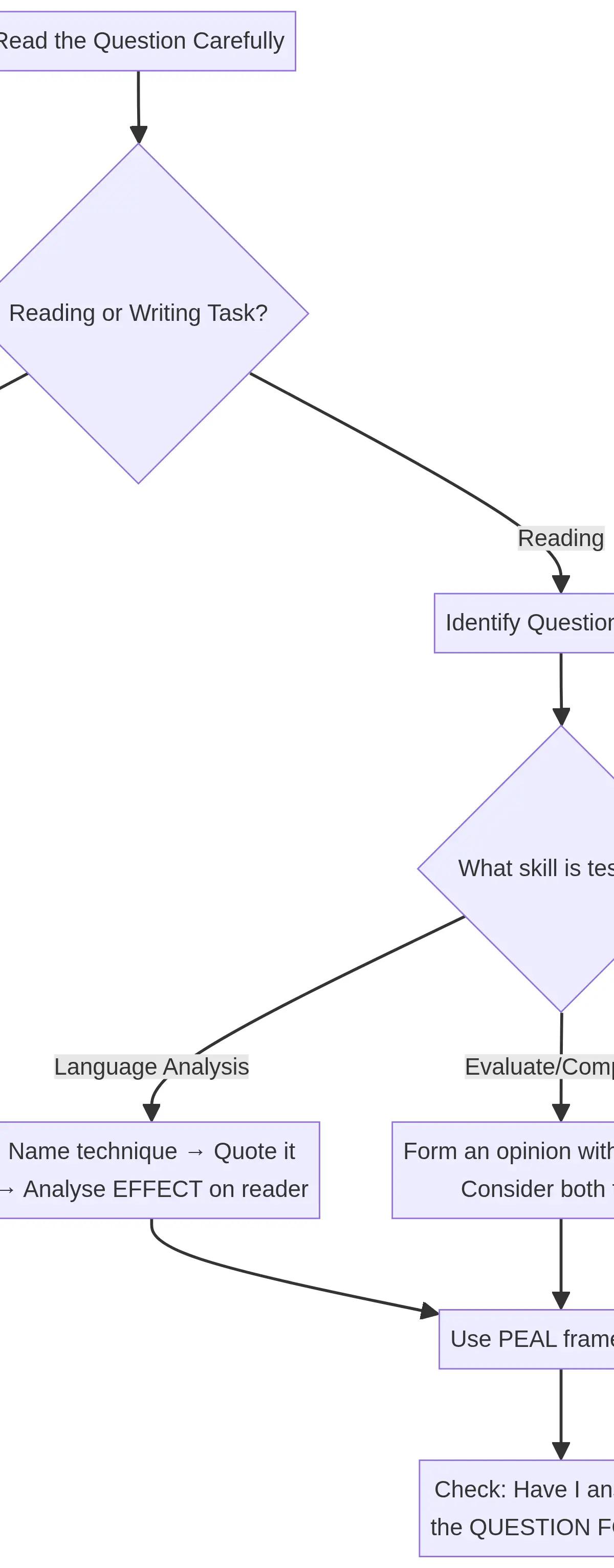
The most effective structure for this is PEAL:
- Point: Make a clear statement agreeing or disagreeing (or partially agreeing) with the prompt.
- Evidence: Embed a short, precise quotation.
- Analysis: Explain how the writer's methods (language/structure) create the effect mentioned in the prompt.
- Link: Link back to your overall evaluation.
Comparing Writers' Viewpoints
When synthesising and comparing texts, you must look across centuries. You need to identify what the writers think (their viewpoint), how they present it (their methods), and evaluate the differences.
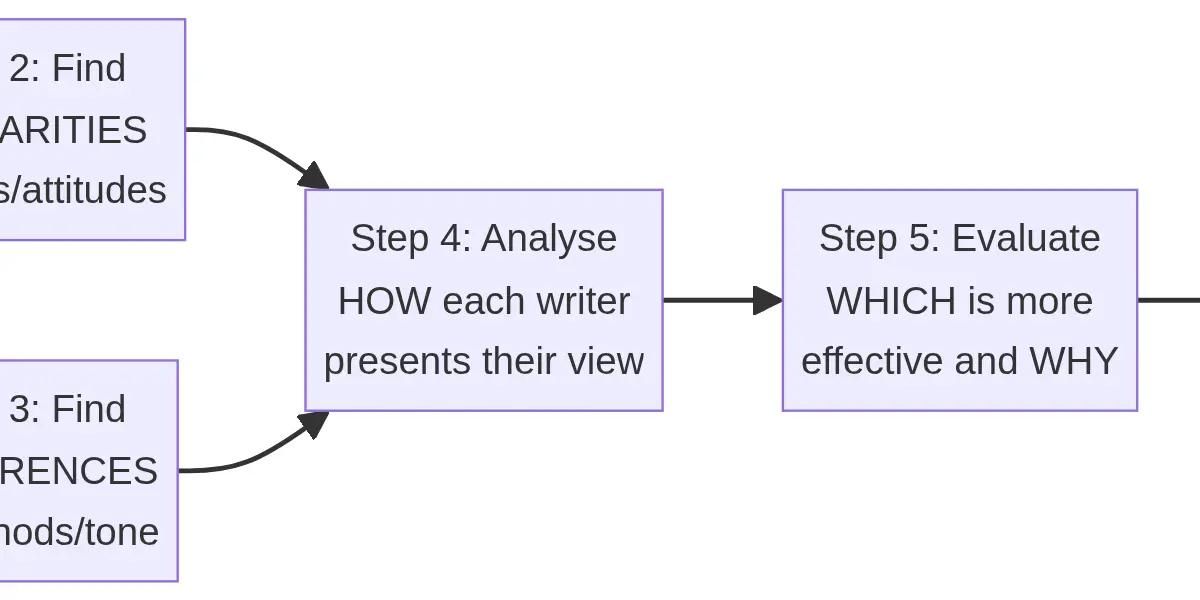
Use comparative discourse markers: Similarly, Likewise, In contrast, Conversely, Whereas. A strong comparison paragraph might start: 'Both writers express frustration at the situation, but whereas the 19th-century writer uses formal, detached language to convey intellectual disapproval, the modern writer uses colloquial, emotive language to express personal anger.'
Writing Skills
Transactional/Non-Fiction Writing
In the writing section, you will be given a specific Purpose, Audience, and Form (PAF). For example: Write an article (Form) for a broadsheet newspaper (Audience) arguing your point of view on climate change (Purpose).
You must adapt your register to fit the PAF. An article needs a headline and subheadings. A formal letter needs appropriate sign-offs. A speech needs direct address ('You may think...').
To write persuasively, use the AFOREST techniques, but use them judiciously. A single, well-developed anecdote is often more powerful than a string of rhetorical questions.
Technical Accuracy (SPaG)
Spelling, Punctuation, and Grammar (SPaG) account for a significant portion of your writing marks. Examiners look for:
- Sentence variety: Use simple, compound, and complex sentences deliberately.
- Ambitious vocabulary: Choose precise, sophisticated words over generic ones.
- Advanced punctuation: Demonstrate control of semicolons (;), colons (:), dashes (—), and parenthetical commas.
- Cohesion: Use discourse markers (Furthermore, Consequently, Nevertheless) to link paragraphs logically.
Visual Resources
4 diagrams and illustrations

Interactive Diagrams
2 interactive diagrams to visualise key concepts
Conceptual Flow Outline
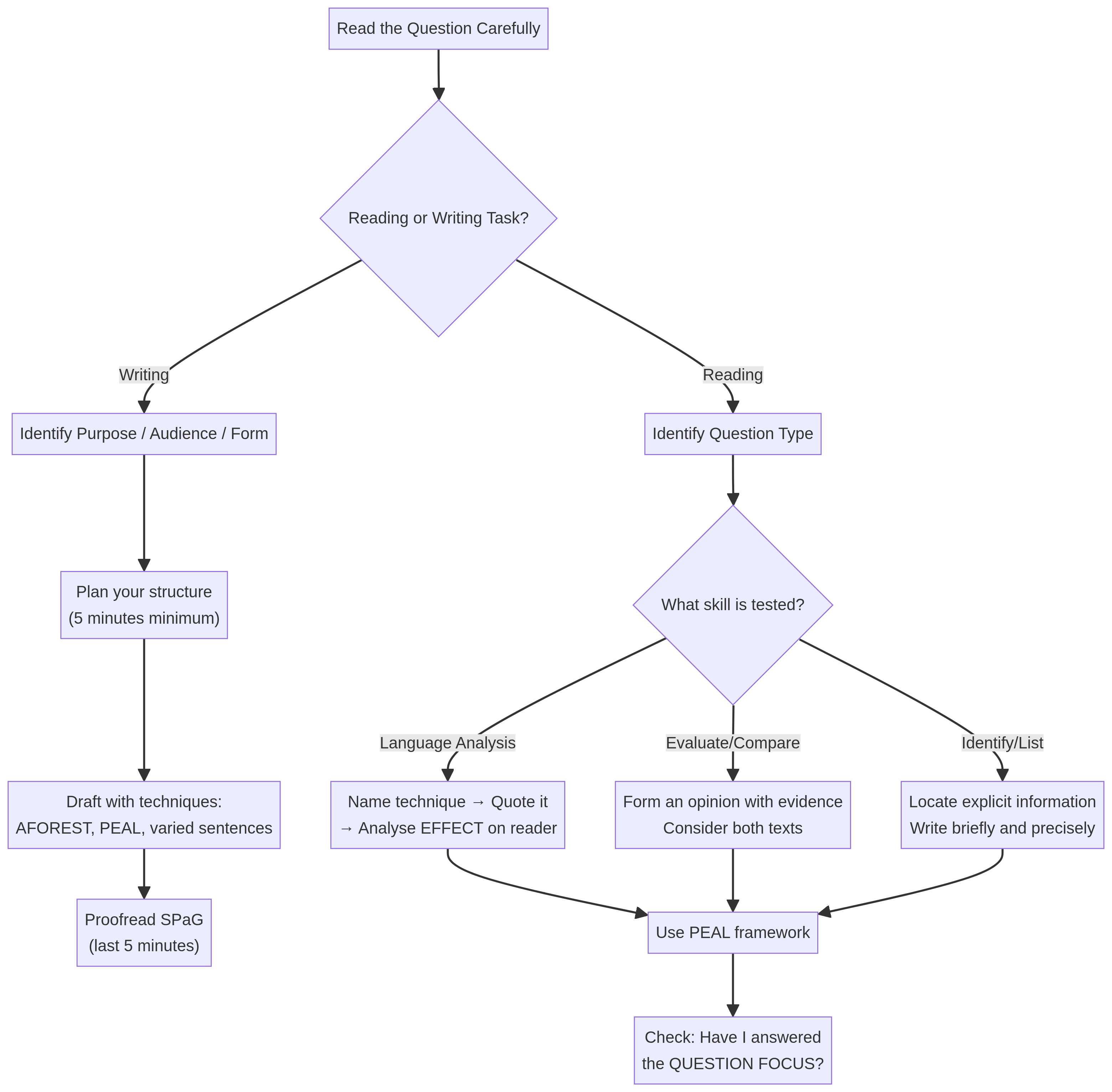
GCSE English Language Exam Approach
Conceptual Flow Outline
Framework for Comparing Texts
Worked Examples
3 worked examples — open one to explore the question and available guidance.
Practice Questions
Test your understanding — click to reveal model answers
Read the extract. List four things you learn about the narrator's journey.
Hint: Look for explicit facts. You do not need to write in full sentences, but your points must be accurate to the text.
How does the writer use language to describe the crowd?
Hint: Identify 2-3 specific language features (e.g., metaphors, verbs). Quote them and explain the effect they have on the reader's impression of the crowd.
A student said, 'The writer successfully creates a sense of panic in this section.' To what extent do you agree?
Hint: Evaluate the statement. State your agreement, select evidence that shows panic, and analyse the methods the writer uses to create that feeling.
Write a speech to be given to your school assembly arguing that school uniforms should be abolished.
Hint: Consider your Purpose (argue), Audience (students and teachers), and Form (speech). Use direct address, rhetorical questions, and varied sentence structures.
Compare how the writers of Source A and Source B convey their perspectives on travel.
Hint: Identify the viewpoint in each text. Compare them using discourse markers. Analyse the different methods (language/structure) each writer uses.