OCR · GCSE · English Language
Reading information and ideas
This topic focuses on the core reading and writing skills required for GCSE English Language. You will learn how to identify explicit and implicit information, analyse writers' language and structural choices, evaluate texts critically, and write effectively for different purposes and audiences.
- 9 min read
- 3 worked examples
- 5 practice questions
- 8 key terms
Study Notes
Overview
This study guide covers the essential skills for reading and understanding unseen non-fiction texts from the 19th, 20th, and 21st centuries. In the GCSE English Language exam, you are not tested on your knowledge of specific books or poems. Instead, examiners are testing your ability to read carefully, interpret meaning, analyse the writer's methods, and write your own engaging texts.
The Core Assessment Objectives
- AO1: Identify and interpret explicit and implicit information and ideas. Select and synthesise evidence from different texts.
- AO2: Explain, comment on and analyse how writers use language and structure to achieve effects and influence readers, using relevant subject terminology to support their views.
- AO3: Compare writers' ideas and perspectives, as well as how these are conveyed, across two or more texts.
- AO4: Evaluate texts critically and support this with appropriate textual references.
- AO5/AO6: Communicate clearly, effectively and imaginatively, selecting and adapting tone, style and register for different forms, purposes and audiences. Organise information and ideas, using structural and grammatical features to support coherence and cohesion of texts.
Reading Skills
Identifying Information & Ideas (AO1)
The foundation of all reading questions is your ability to locate information within a text.
- Explicit Information: This is stated clearly and directly by the writer. For example, if the text says, "The train arrived at 8:00 PM," the explicit information is the time of arrival.
- Implicit Information: This is suggested or implied. You have to 'read between the lines' to infer the meaning. If the text says, "She glanced nervously at the clock, tapping her foot rapidly as the hands ticked past 8:00 PM," the implicit information is that she is anxious or impatient because someone or something is late.
When answering AO1 questions, keep your answers concise and always base them strictly on the text provided. Do not use your own outside knowledge.
Analysing Language (AO2)
This is a crucial skill that carries significant marks. You must identify the techniques a writer uses and, most importantly, explain the effect those techniques have on the reader.
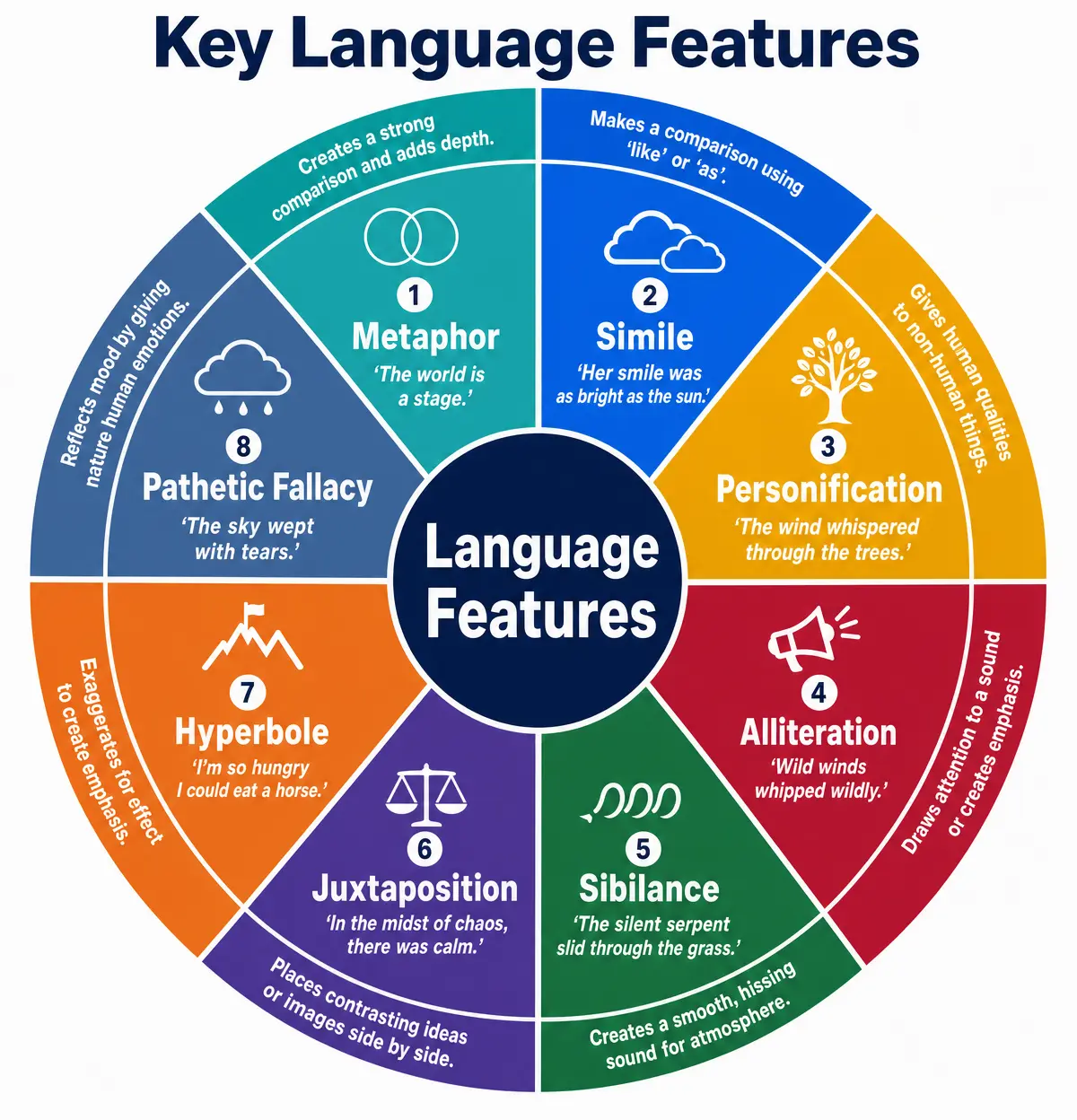
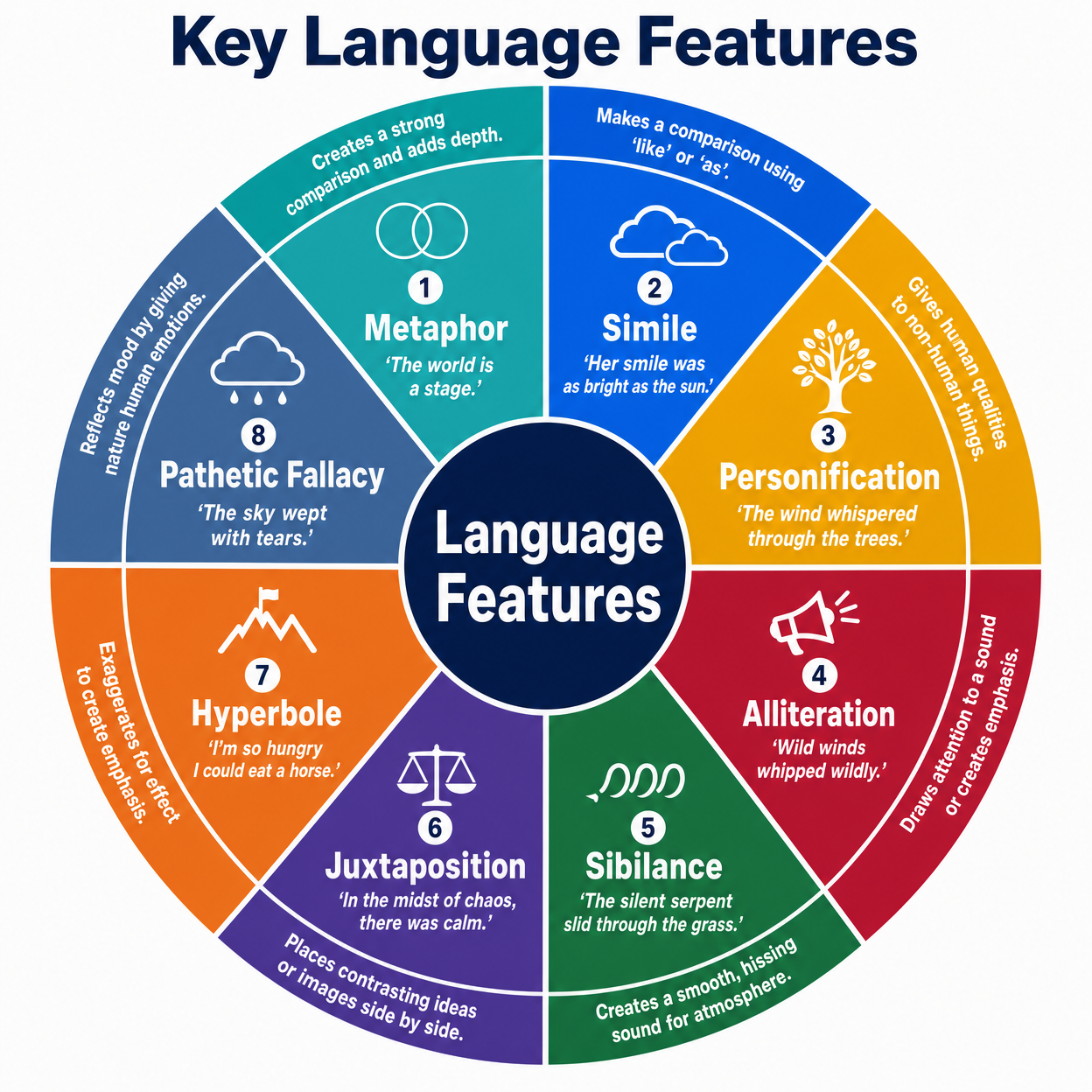
Key Language Features to Identify
| Feature | Definition | Effect on Reader | Example |
|---|---|---|---|
| Metaphor | A comparison stating one thing is another. | Creates a strong, vivid image; helps the reader understand complex ideas by linking them to familiar ones. | "The classroom was a zoo." |
| Simile | A comparison using 'like' or 'as'. | Makes descriptions more relatable and imaginative, allowing the reader to visualise the scene. | "Her smile was as bright as the sun." |
| Personification | Giving human qualities to non-human things. | Brings inanimate objects to life, creating atmosphere or mood. | "The wind whispered through the trees." |
| Alliteration | Repetition of the same consonant sound at the start of words. | Draws attention to a phrase, creates rhythm, or mimics the sound of what is being described. | "Wild winds whipped wildly." |
| Sibilance | Repetition of 's' or 'sh' sounds. | Creates a smooth, hissing, or sometimes sinister atmosphere. | "The silent serpent slid through the grass." |
| Juxtaposition | Placing two contrasting ideas or images side by side. | Highlights the differences between the two elements, creating emphasis or tension. | "In the midst of chaos, there was calm." |
| Hyperbole | Exaggeration used for effect. | Emphasises a point dramatically, often to show strong emotion or create humour. | "I've told you a million times." |
| Pathetic Fallacy | Giving human emotions to nature/weather to reflect the mood. | Sets the tone of a scene and foreshadows events or reflects a character's internal state. | "The sky wept with heavy tears." |
The Golden Rule for Language Analysis: Never just 'feature-spot'. Finding a metaphor earns you very little. Explaining why the writer used that metaphor and how it makes the reader feel earns the marks.
Analysing Structure (AO2)
Structure refers to how the writer has put the text together. You need to look at the whole text, not just individual words or sentences.
Look out for:
- Openings: How does the text begin? Does it hook the reader immediately? Does it set the scene or introduce a character?
- Shifts in Focus: Where does the writer change topic, perspective, or time? Why do they do this? (e.g., moving from a wide description of a landscape to a close-up of a specific person).
- Narrative Perspective: Who is telling the story? (First person 'I', third person 'he/she'). How does this affect our understanding?
- Sentence Length Variation: Short sentences can build tension or show sudden action. Long, complex sentences can provide detailed descriptions or show a flowing thought process.
- Paragraph Structure: Are the paragraphs long and descriptive, or short and punchy?
- Cyclical Structure: Does the text end where it began? This can create a sense of inevitability or completion.
- Flashbacks/Foreshadowing: Does the writer look back at past events or hint at what is to come?
Evaluating Critically (AO4)
Evaluation questions ask you to form a judgement about a text or a specific statement about a text. You are being asked: How well does the writer do this?
To succeed here, you must:
- State your opinion clearly (e.g., "I strongly agree that the writer successfully creates a sense of panic...").
- Provide evidence from the text to support your view.
- Analyse the methods (language and structure) the writer uses to achieve this effect.
- Consider alternative viewpoints (e.g., "However, it could also be argued that...").
Comparing Writers' Viewpoints (AO3)
When you are given two texts, you will often need to compare them. This involves looking at the similarities and differences in the writers' ideas, attitudes, and the methods they use to convey them.
Framework for Comparing Texts:
- Identify the Viewpoints: What does Writer A think about the topic? What does Writer B think?
- Compare the Methods: How does Writer A express their view (e.g., using emotive language)? How does Writer B express theirs (e.g., using statistics)?
- Evaluate Effectiveness: Which text is more persuasive or engaging, and why?
Writing Skills (AO5 & AO6)
Creative Writing
Creative writing tasks often ask you to write a description or a narrative based on an image or a prompt.
Key Techniques:
- Show, Don't Tell: Instead of saying "He was angry," describe his actions: "His fists clenched and his jaw tightened."
- Sensory Description: Use all five senses (sight, sound, smell, touch, taste) to create a vivid picture.
- Varied Sentence Structures: Mix short, punchy sentences with longer, descriptive ones to control the pace and rhythm of your writing.
- Engaging Openings: Start in media res (in the middle of the action) or with a striking description to hook the reader immediately.
- Satisfying Endings: Ensure your narrative has a clear resolution or a thought-provoking final image.
- The One-Scene Rule: For a short exam task, don't try to write an epic novel. Focus on one specific moment, setting, or character and describe it in detail.
Transactional/Non-Fiction Writing
Transactional writing tasks ask you to write for a specific real-world purpose, such as a letter, article, speech, or leaflet. You must adapt your tone and style to suit the given audience and form.
The Purpose-Form-Audience (PFA) Framework:
- Purpose: Why are you writing? (To persuade, argue, advise, inform?)
- Form: What are you writing? (A letter, an article, a speech?)
- Audience: Who are you writing for? (Teenagers, adults, the local council?)
**Persuasive Techniques (AFOREST):**Use the AFOREST mnemonic to remember key persuasive techniques:
- Alliteration / Anecdotes
- Facts
- Opinions (presented as facts)
- Rhetorical Questions
- Emotive Language
- Statistics
- Three (Rule of Three)
Technical Accuracy (SPaG - AO6)
Spelling, Punctuation, and Grammar (SPaG) account for a significant portion of the marks in the writing section.
- Ambitious Vocabulary: Use precise and sophisticated words instead of basic ones (e.g., 'exhilarating' instead of 'good').
- Ambitious Punctuation: Show the examiner you can use a variety of punctuation marks correctly:
- Semicolons (;): To link two closely related independent clauses.
- Colons (:): To introduce a list, an explanation, or a quotation.
- Dashes (—): To add emphasis or a sudden break in thought.
- Parenthetical Commas: To add extra, non-essential information into a sentence.
- Paragraph Cohesion: Use discourse markers (e.g., 'Furthermore', 'Consequently', 'On the other hand') to link your paragraphs and guide the reader through your argument or narrative.
Audio Resource: Listen and Learn
To consolidate your understanding, listen to this 10-minute podcast episode. It covers the core concepts, common mistakes, and includes a quick-fire recall quiz.

Visual Resources
2 diagrams and illustrations
Interactive Diagrams
2 interactive diagrams to visualise key concepts
Conceptual Flow Outline
Exam Approach Flowchart
Conceptual Flow Outline
Synthesis and Comparison Framework
Worked Examples
3 worked examples — open one to explore the question and available guidance.
Practice Questions
Test your understanding — click to reveal model answers
Read the first paragraph of the extract. List four things you learn about the setting.
Hint: Look for explicit facts. You do not need to write full sentences, but you must base your points entirely on the text.
How does the writer use language to describe the character's reaction to the news? (8 marks)
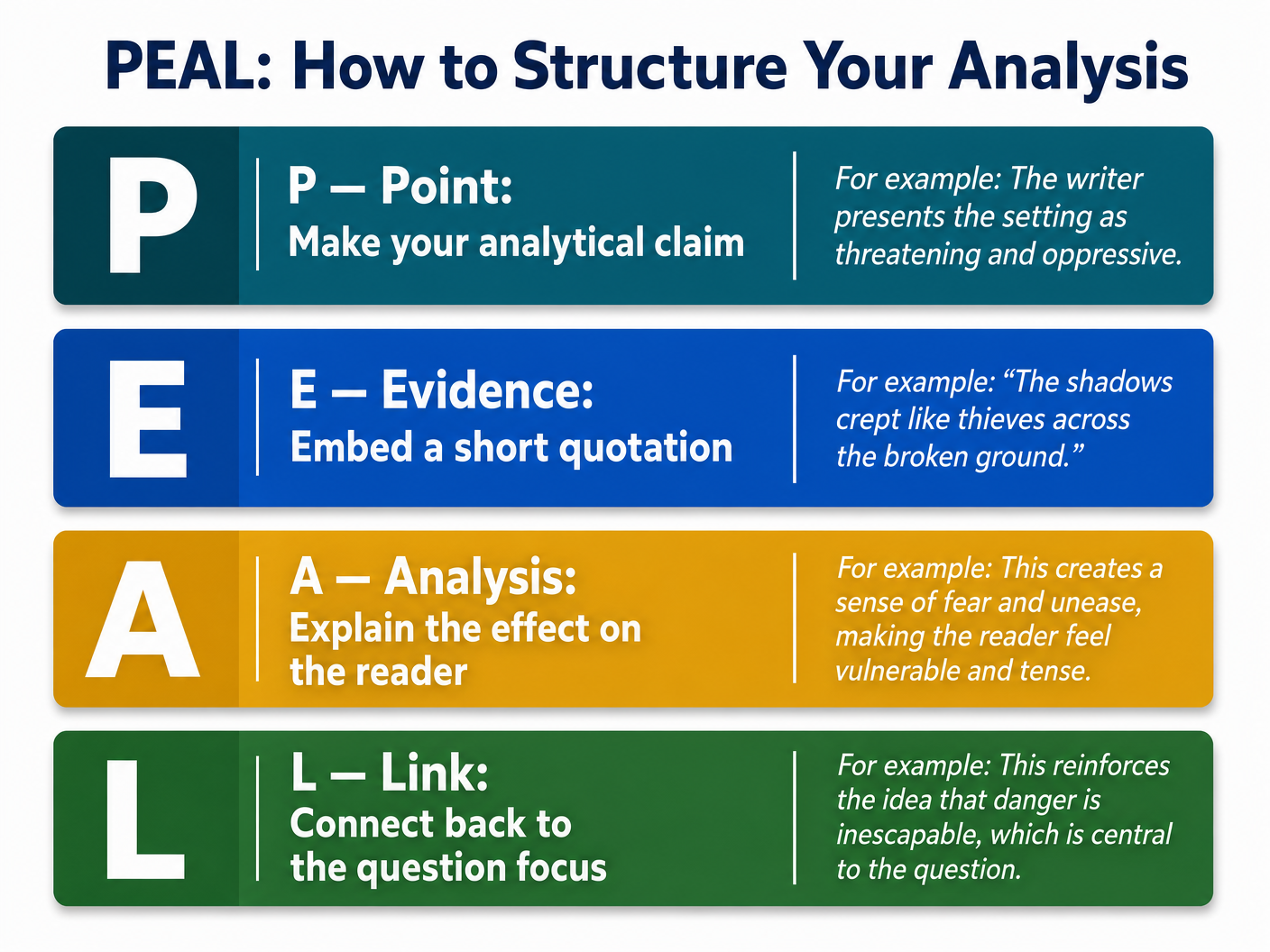
Hint: Identify 2-3 language features. Quote them and explain the effect on the reader. Use the PEAL structure.
A student said, 'In this part of the text, the writer successfully makes the reader feel sympathetic towards the protagonist.' To what extent do you agree? (20 marks)
Hint: Evaluate the statement. State your opinion clearly, use evidence, and analyse the methods the writer uses to create sympathy.
Compare how the writers convey their different attitudes towards technology in Source A and Source B. (16 marks)
Hint: Identify the attitude in Text A and Text B. Compare the methods they use to show these attitudes. Synthesise your points.
Write a speech to be delivered to your school assembly arguing that school uniforms should be abolished. (24 marks for content, 16 marks for technical accuracy)
Hint: Use the PFA framework (Persuade, Speech, Students/Teachers). Use AFOREST techniques and ensure your SPaG is highly accurate.