OCR · GCSE · English Language
Reading meaning and effects
This topic develops your core ability to analyse how writers use language and structure to create specific effects on the reader, and how to apply those same techniques in your own creative and transactional writing. Examiners reward perceptive analysis of methods and a clear, consistent voice in writing tasks.
- 7 min read
- 3 worked examples
- 5 practice questions
- 8 key terms
Study Notes
Overview
GCSE English Language is fundamentally a skills-based qualification. Unlike Literature, where you must memorise quotes and context from set texts, Language tests your ability to read unseen texts closely and write effectively for different purposes. The core skill running through both reading and writing tasks is understanding meaning and effects — how specific choices of vocabulary, structure, and form influence a reader's response.
Whether you are analysing a 19th-century extract or writing a speech arguing for climate action, examiners are looking for the same underlying awareness: that language is a tool used deliberately to construct meaning.
Listen to our comprehensive audio guide for a detailed breakdown of the examiner's perspective:

Reading Skills
Identifying Information & Ideas
These are typically the first questions on the paper, worth 2-4 marks. They ask you to locate explicit or implicit information in unseen fiction or non-fiction texts.
- Explicit information: Information clearly stated in the text. (e.g., "The car was red.")
- Implicit information: Information suggested or implied, requiring you to read between the lines. (e.g., "He shivered and pulled his coat tighter" implies it is cold.)
Examiner Tip: Keep answers brief. Use short quotes or clear paraphrasing. Do not waste time analysing language here — there are no marks for it.
Analysing Language
This is where the serious marks are earned. You must identify techniques and explain their specific effect on the reader. Feature-spotting without analysis limits you to Level 1.
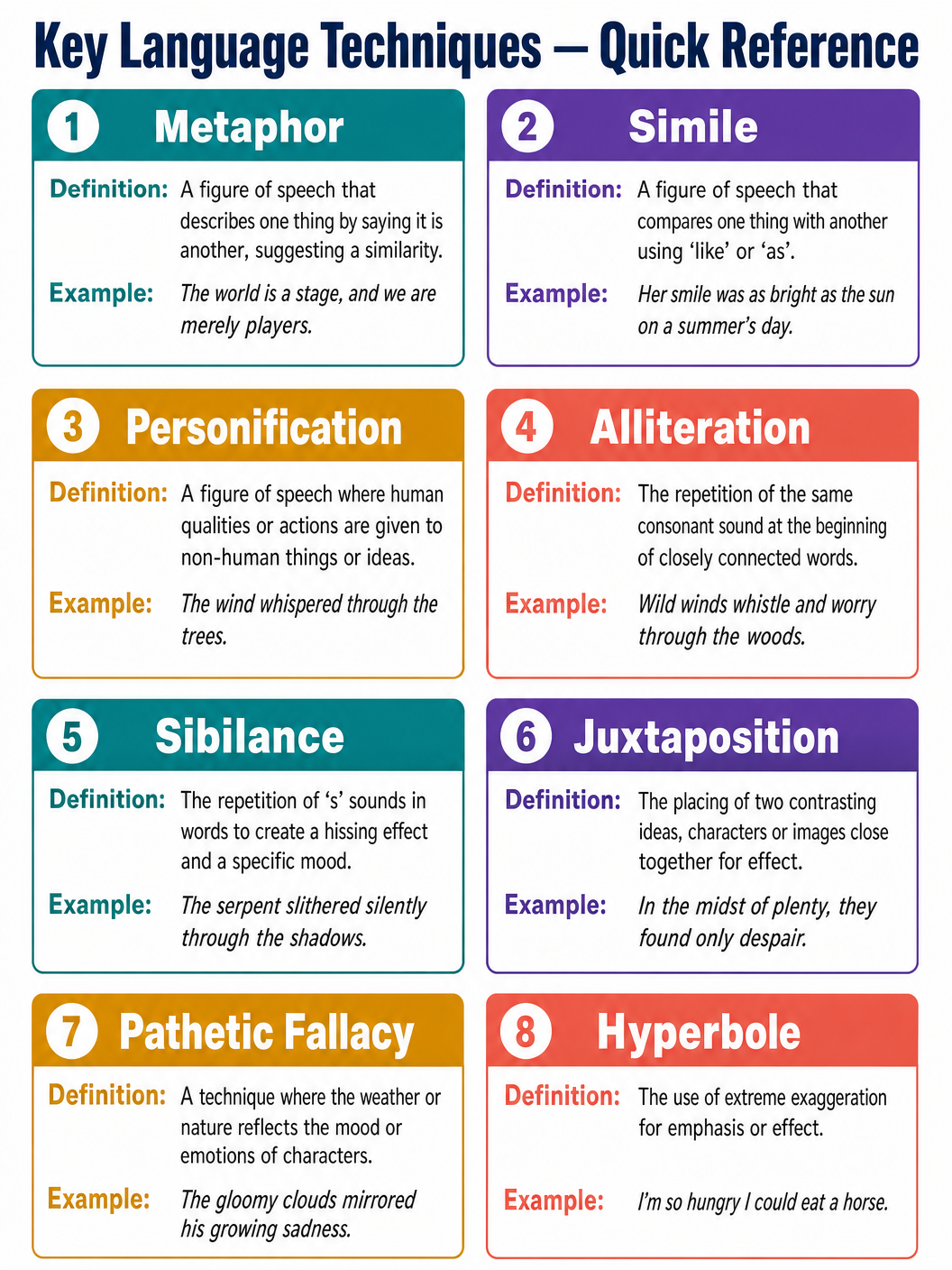
Key Language Features to Identify
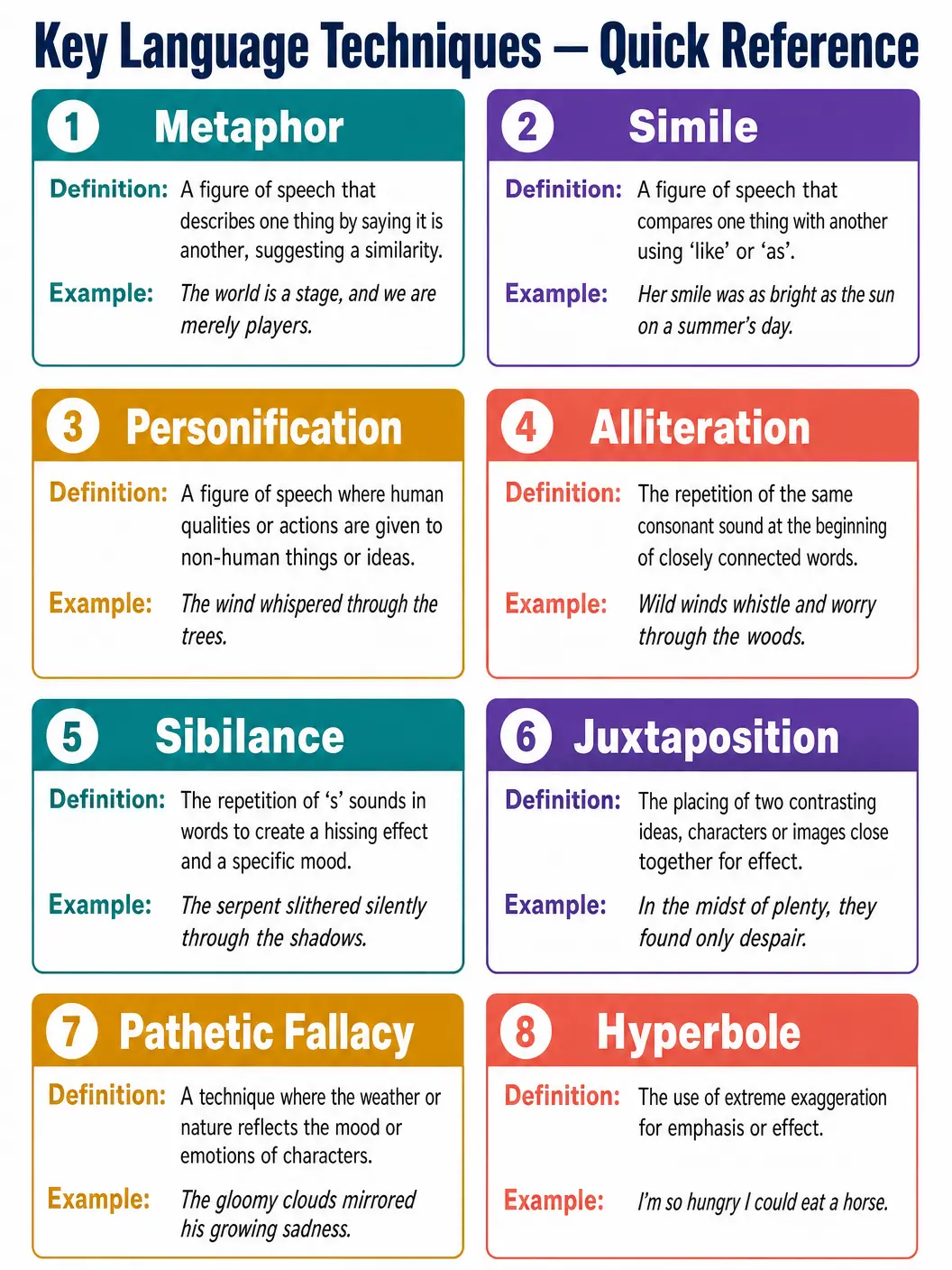
| Feature | Definition | Effect on Reader | Example |
|---|---|---|---|
| Metaphor | Describing something by saying it is something else. | Creates vivid, often surprising imagery; reveals deeper qualities. | "The city was a concrete jungle." |
| Simile | Comparing two things using like or as. | Helps the reader visualise the unfamiliar by comparing it to the familiar. | "His hands were as cold as ice." |
| Personification | Giving human qualities to non-human things. | Makes descriptions more dynamic; can create a sense of threat or comfort. | "The wind whispered through the trees." |
| Pathetic Fallacy | When the weather or environment reflects human emotions. | Sets the tone and atmosphere; foreshadows events. | "Thunder crashed as the argument began." |
| Alliteration | Repetition of consonant sounds at the start of words. | Creates rhythm; draws attention to specific phrases; can mimic sounds. | "The wild winds whipped the waves." |
| Sibilance | Repetition of 's' or 'sh' sounds. | Can create a soft, soothing mood or a sinister, hissing effect. | "The snake slithered silently." |
| Juxtaposition | Placing contrasting ideas close together. | Highlights differences; creates tension or surprise. | "In the midst of the chaotic war zone, a single white dove landed." |
Analysing Structure
Structural analysis requires you to look at the text as a whole construct. How does the writer guide the reader's focus from the beginning, through the middle, to the end?
- Openings: How does the text begin? Does it drop the reader in media res (in the middle of the action) or establish setting first?
- Shifts in Focus: When does the writer move from describing the setting to introducing a character, or from an external view to internal thoughts?
- Narrative Perspective: Who is telling the story? Is it first-person (I), creating intimacy, or third-person (he/she/they), creating distance?
- Sentence Length: Short sentences create tension, speed, and impact. Long, complex sentences can reflect confusion, overwhelming detail, or a slow pace.
- Cyclical Structure: Does the ending return to an idea or image from the beginning? This creates a sense of inevitability or lack of progress.
Evaluating Critically
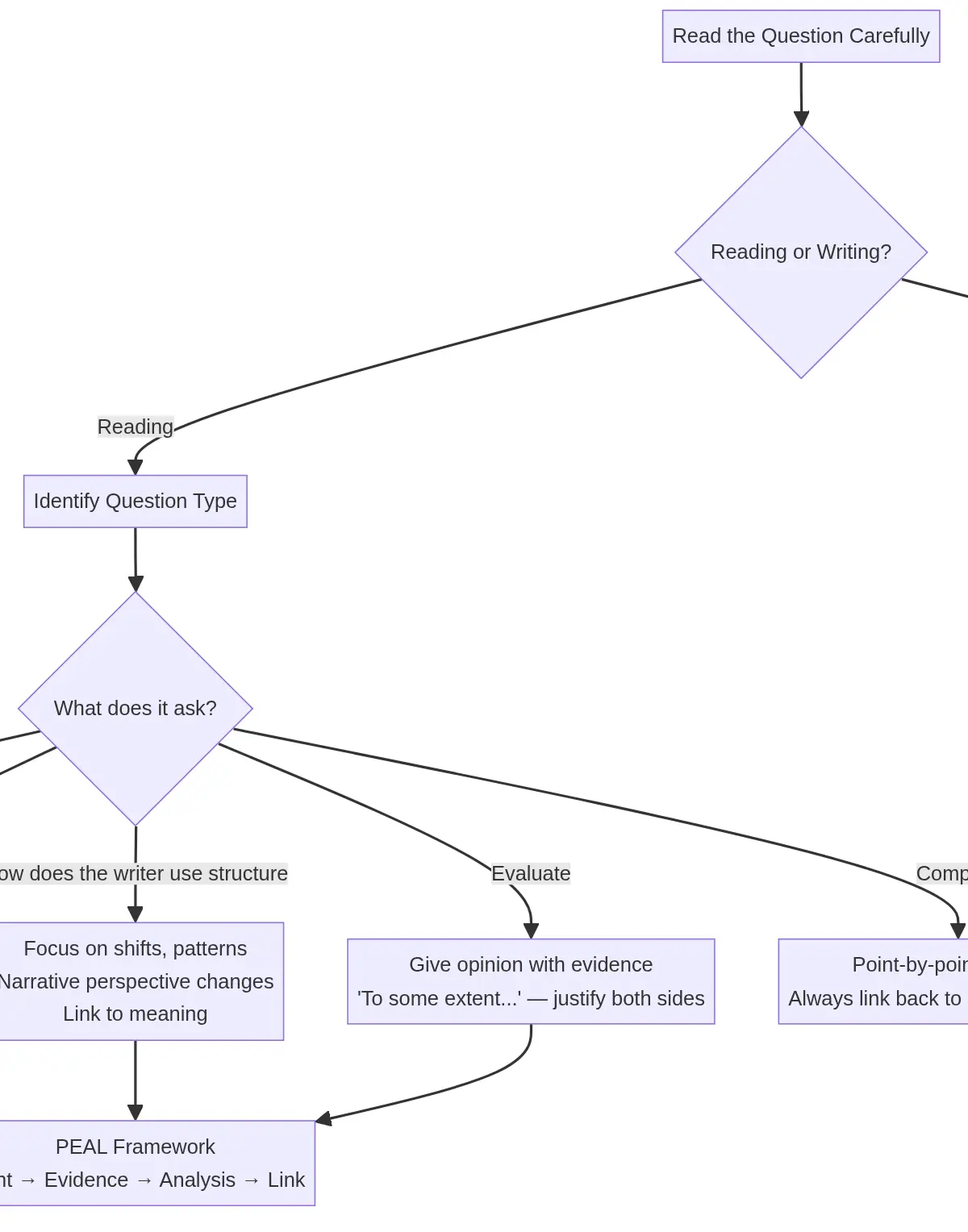
Evaluation questions ask for your opinion on a statement about the text. (e.g., "A student said, 'The writer makes the ending feel incredibly tense.' To what extent do you agree?")
The Framework:
- State your position clearly: "I completely agree that the ending is tense because..."
- Select evidence: Quote from the text to support your view.
- Analyse methods: Explain how the writer created that tension (language or structure).
- Evaluate effectiveness: Explain why it works well on the reader.
Comparing Writers' Viewpoints
When comparing two non-fiction texts, you must identify how the writers' attitudes differ (or align) and compare the methods they use to convey those attitudes.

Writing Skills
Creative Writing (Fiction)
Creative writing tasks usually ask you to describe a scene or write a narrative based on an image or prompt. Examiners reward quality over quantity.
- Show, Don't Tell: Instead of saying "He was angry," write "His fists clenched until his knuckles turned white."
- Sensory Description: Engage all five senses (sight, sound, smell, touch, taste) to create an immersive environment.
- The One-Scene Rule: Do not try to write an entire novel in 45 minutes. Focus on one specific moment, setting, or interaction in deep detail.
- Varied Sentence Structures: Use short sentences for impact and longer sentences for descriptive flow.
- Engaging Openings & Satisfying Endings: Hook the reader immediately. End with a resolution, a cyclical link back to the start, or a poignant final image.
Transactional/Non-Fiction Writing
These tasks require you to write for a specific purpose (e.g., to argue, persuade, advise) and audience, using an appropriate form (e.g., letter, article, speech).
- Purpose, Form, Audience (PFA): Identify these immediately. A speech to teenagers requires a very different register than a formal letter to a politician.
- Persuasive Techniques (AFOREST): Use Alliteration, Facts, Opinions, Rhetorical questions, Emotive language, Statistics, and the Rule of Three.
- Clear Structure: Use an engaging hook, well-developed paragraphs with clear topic sentences, and a strong, memorable conclusion.
Technical Accuracy (SPaG)
Spelling, Punctuation, and Grammar (SPaG) account for a significant portion of your writing marks (up to 16 marks on some papers).
- Ambitious Vocabulary: Upgrade basic words. Instead of "bad," use "atrocious," "detrimental," or "malignant."
- Advanced Punctuation: Demonstrate control of semicolons (;), colons (:), dashes (—), and parenthetical commas.
- Paragraph Cohesion: Use discourse markers (e.g., Furthermore, Conversely, Consequently) to link your ideas logically.
Visual Resources
4 diagrams and illustrations

Interactive Diagrams
2 interactive diagrams to visualise key concepts
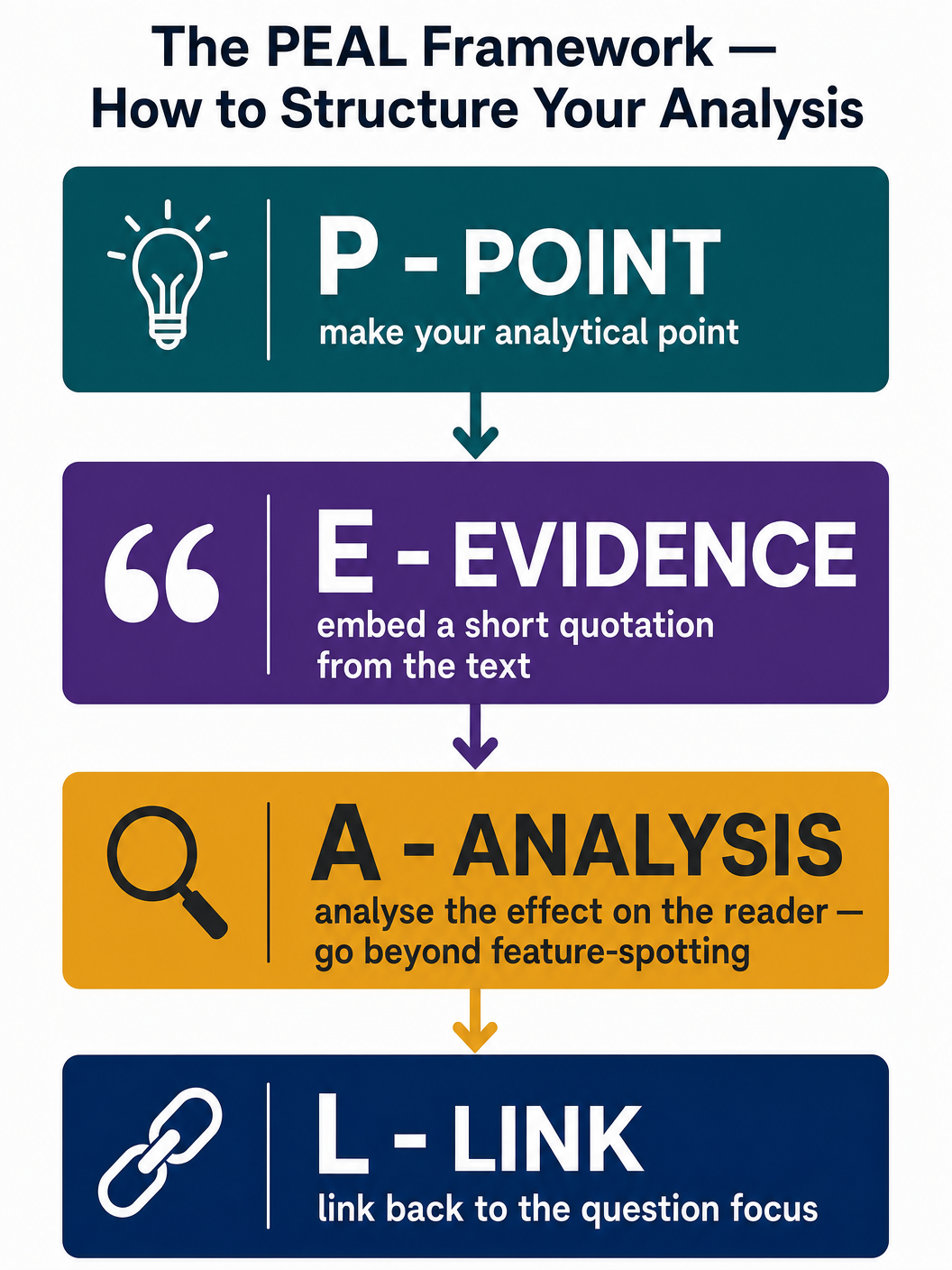
Conceptual Flow Outline
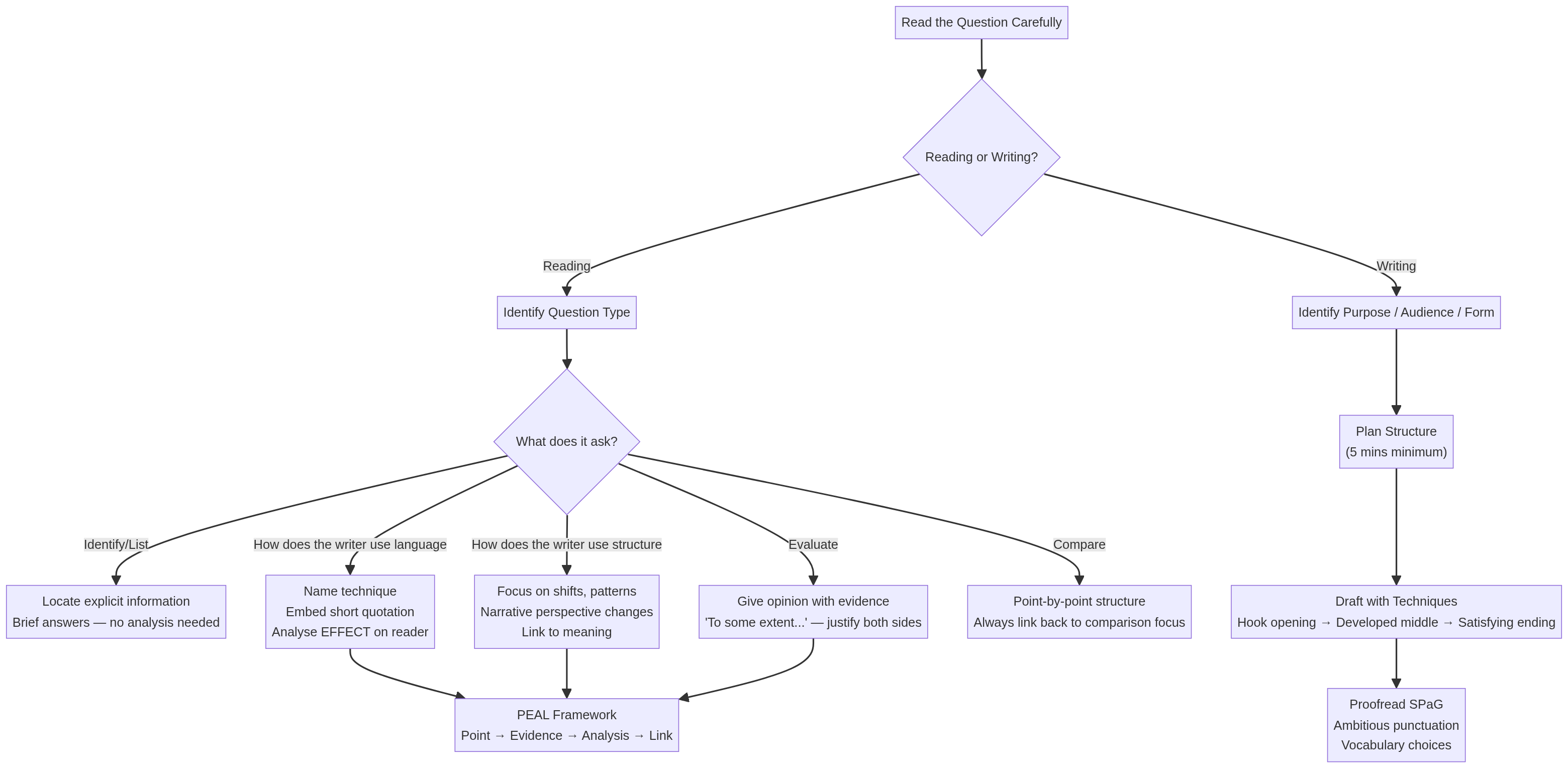
English Language Exam Approach Framework
Conceptual Flow Outline
Comparison Question Framework
Worked Examples
3 worked examples — open one to explore the question and available guidance.
Practice Questions
Test your understanding — click to reveal model answers
List four things we learn about the house in the first paragraph.
Hint: Look for explicit facts. Do not analyse the language.
How does the writer use language to present the weather as frightening?
Hint: Identify a technique, embed a short quote, and explain the specific connotations.
How has the writer structured the text to interest the reader?
Hint: Look at how the text opens, how the focus shifts, and how it ends.
Write a description suggested by this image [an image of a busy market].
Hint: Use sensory details and varied sentence structures. Show, don't tell.
A student said, 'The writer makes the narrator seem completely unreliable.' To what extent do you agree?
Hint: State your opinion clearly, then evaluate the methods the writer uses to create this impression.