OCR · GCSE · English Language
Responding to spoken language
This topic covers the critical analysis of spoken language transcripts and the development of your own spoken communication skills. It assesses your ability to identify spoken features, analyse their effect on an audience, and adapt your own register, tone, and delivery for specific contexts.
- 6 min read
- 3 worked examples
- 5 practice questions
- 8 key terms
Study Notes
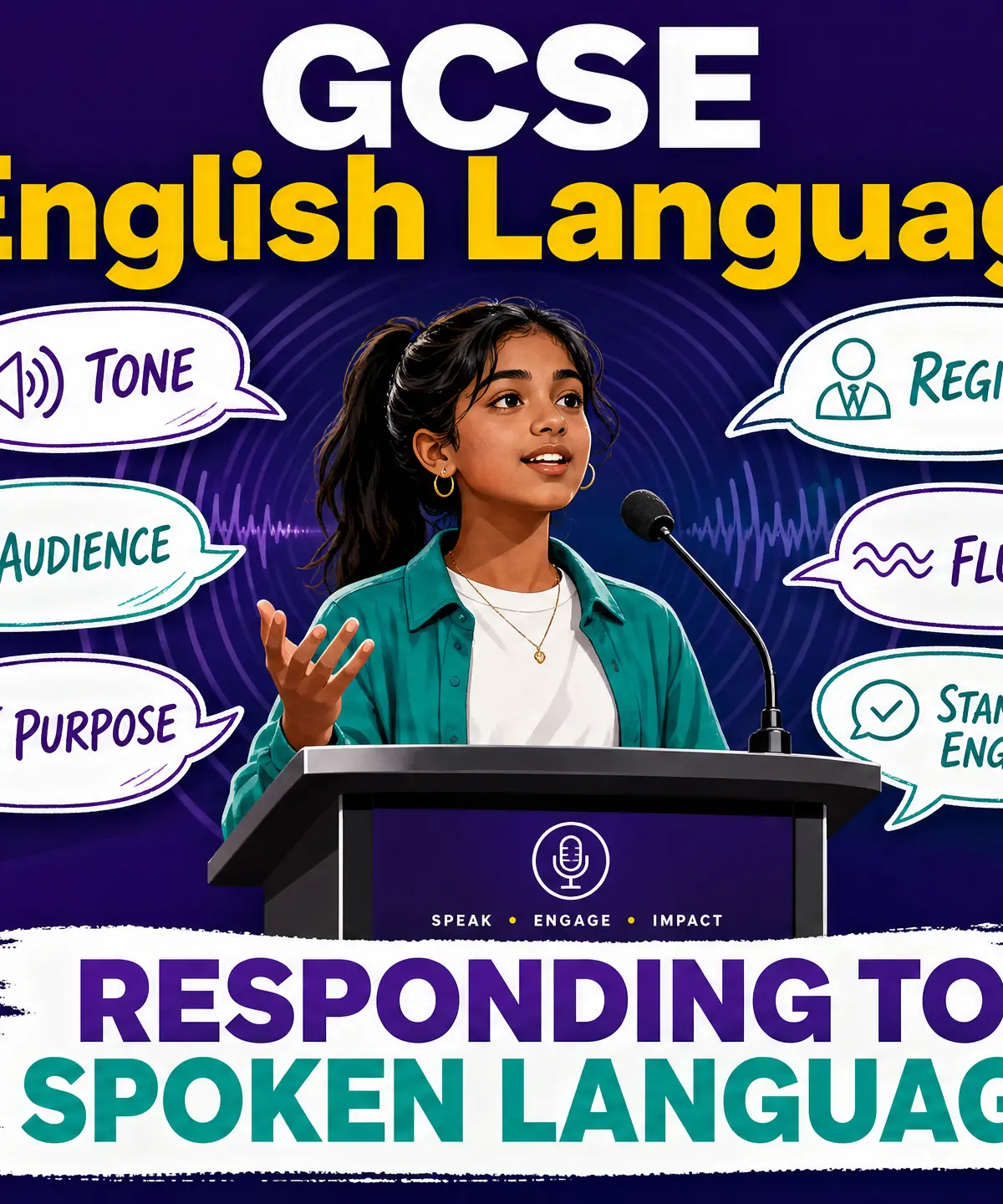
Overview
Responding to Spoken Language is a vital component of the GCSE English Language specification. It assesses your ability to understand, analyse, and evaluate how speakers use language to communicate meaning, convey attitudes, and interact with others in real-time.
Unlike written texts, spoken language is spontaneous, dynamic, and heavily reliant on context. Examiners reward candidates who can identify specific spoken features—such as prosodic elements, non-fluency features, and interactional strategies—and critically analyse their effect on the listener. This topic also encompasses your own Spoken Language Endorsement, where you must demonstrate your ability to speak confidently, adapt your register for a specific audience and purpose, and listen and respond to questions effectively.

Reading Skills: Analysing Transcripts
When analysing a spoken language transcript, you are essentially performing a 'reading' task on a written record of speech. The key is to look beyond the words on the page and imagine the sound, pace, and interaction of the live conversation.
Identifying Information & Ideas
In spoken language, information is often implicit. You must read between the lines. Look for:
- Tone and Attitude: How does the speaker feel about the topic? Is there sarcasm, enthusiasm, or hesitation?
- Power Dynamics: Who holds the floor? Who interrupts? This reveals the relationship between speakers.
- Contextual Clues: What is the setting? A formal interview will yield very different language choices compared to an informal chat between friends.
Analysing Language
When analysing transcripts, you must use specific linguistic terminology. Examiners award marks for accurate identification of features only if you explain their effect.
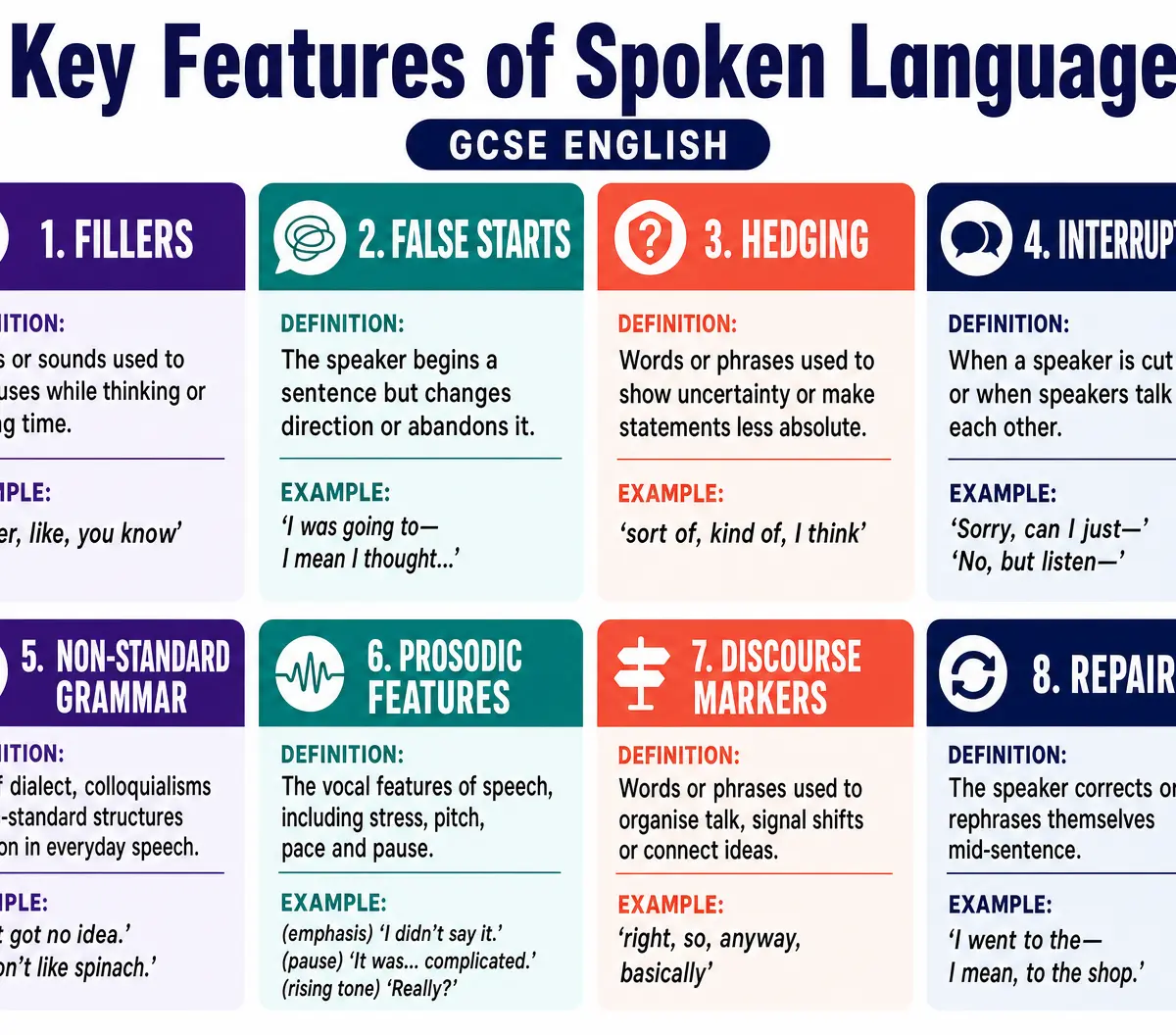
Key Spoken Language Features to Identify
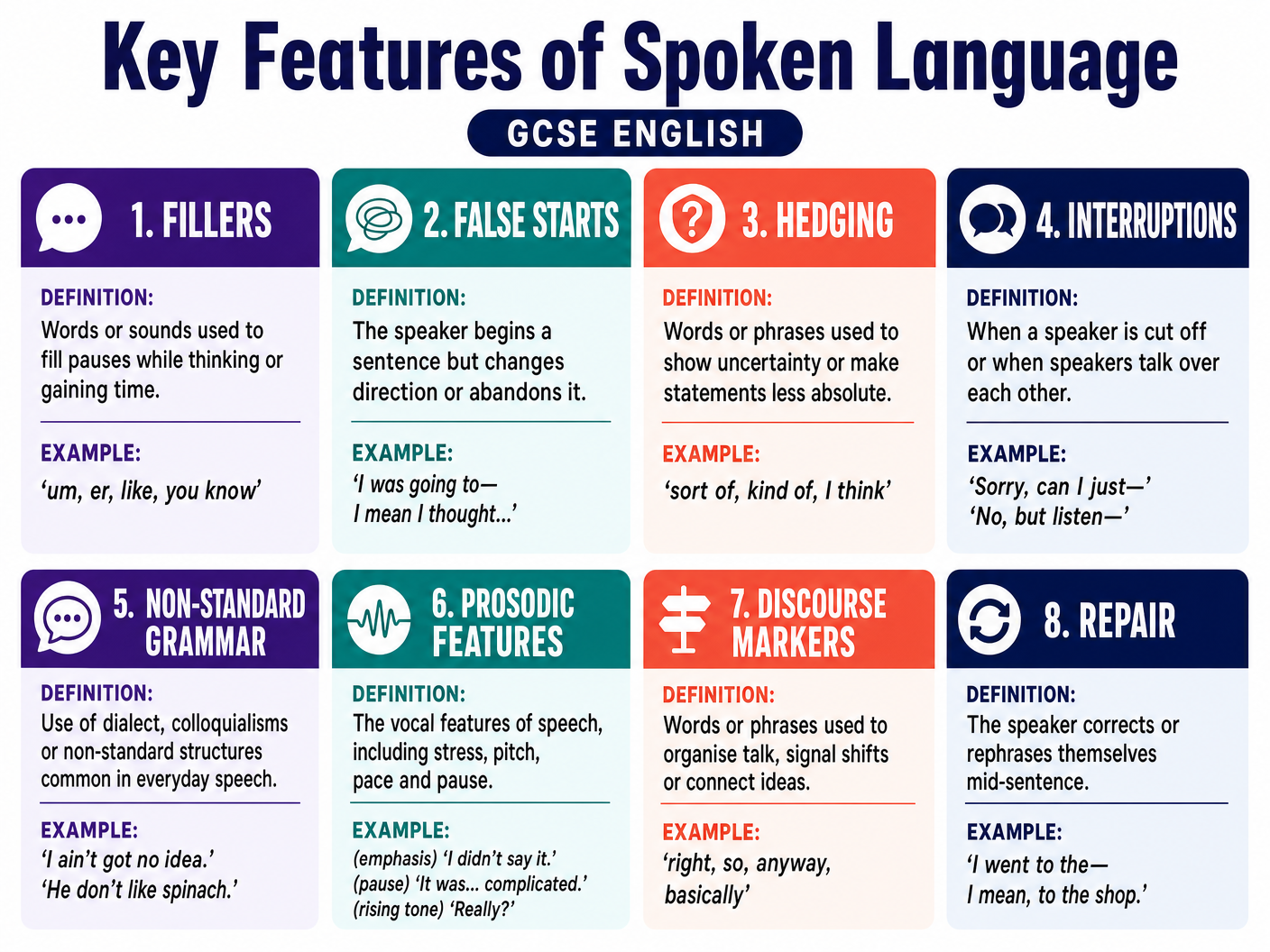
| Feature | Definition | Effect on Listener | Example |
|---|---|---|---|
| Fillers | Meaningless words or sounds used to fill pauses. | Suggests hesitation, thinking time, or lack of confidence. | "um", "er", "like", "you know" |
| False Starts | Beginning an utterance, then abandoning it to start again. | Shows self-correction, nervousness, or careful consideration of words. | "I was going to— I mean, I think that..." |
| Hedging | Words or phrases that soften a statement. | Makes the speaker appear less confrontational, uncertain, or polite. | "sort of", "kind of", "perhaps", "I think" |
| Repair | Correcting a mistake mid-sentence. | Demonstrates self-monitoring and a desire for accuracy. | "I drove to the— I mean, I walked to the shop." |
| Discourse Markers | Words that organise talk and signal shifts. | Helps the listener follow the structure; can signal a change of topic or conclusion. | "right", "so", "anyway", "basically" |
| Prosodic Features | Vocal qualities: stress, pitch, pace, pause. | Conveys emotion, emphasis, and urgency. Essential for understanding meaning. | (pause), (emphasis), (rising intonation) |
| Non-Standard Grammar | Dialect or colloquial structures. | Establishes identity, regional background, or informal register. | "I ain't seen it.", "We was going." |
| Interruptions / Overlaps | Speaking while another person is speaking. | Can indicate dominance, enthusiasm, agreement, or conflict. | Shown as // or [] in transcripts. |
Analysing Structure in Speech
Structure in spoken language is about how the conversation or speech develops over time. Look for:
- Turn-Taking: Are turns equal, or does one speaker dominate?
- Adjacency Pairs: Expected responses (e.g., Question → Answer, Greeting → Greeting). A broken adjacency pair (e.g., Question → Silence) creates tension.
- Topic Shifts: How does the conversation move from one subject to another? Who initiates the shift?
- Openings and Closings: How do the speakers establish contact and how do they politely (or impolitely) end the interaction?
Evaluating Critically
To reach the highest levels, you must evaluate how well the speaker achieves their purpose.
- Do their language choices successfully persuade the audience?
- Does their hesitation undermine their authority?
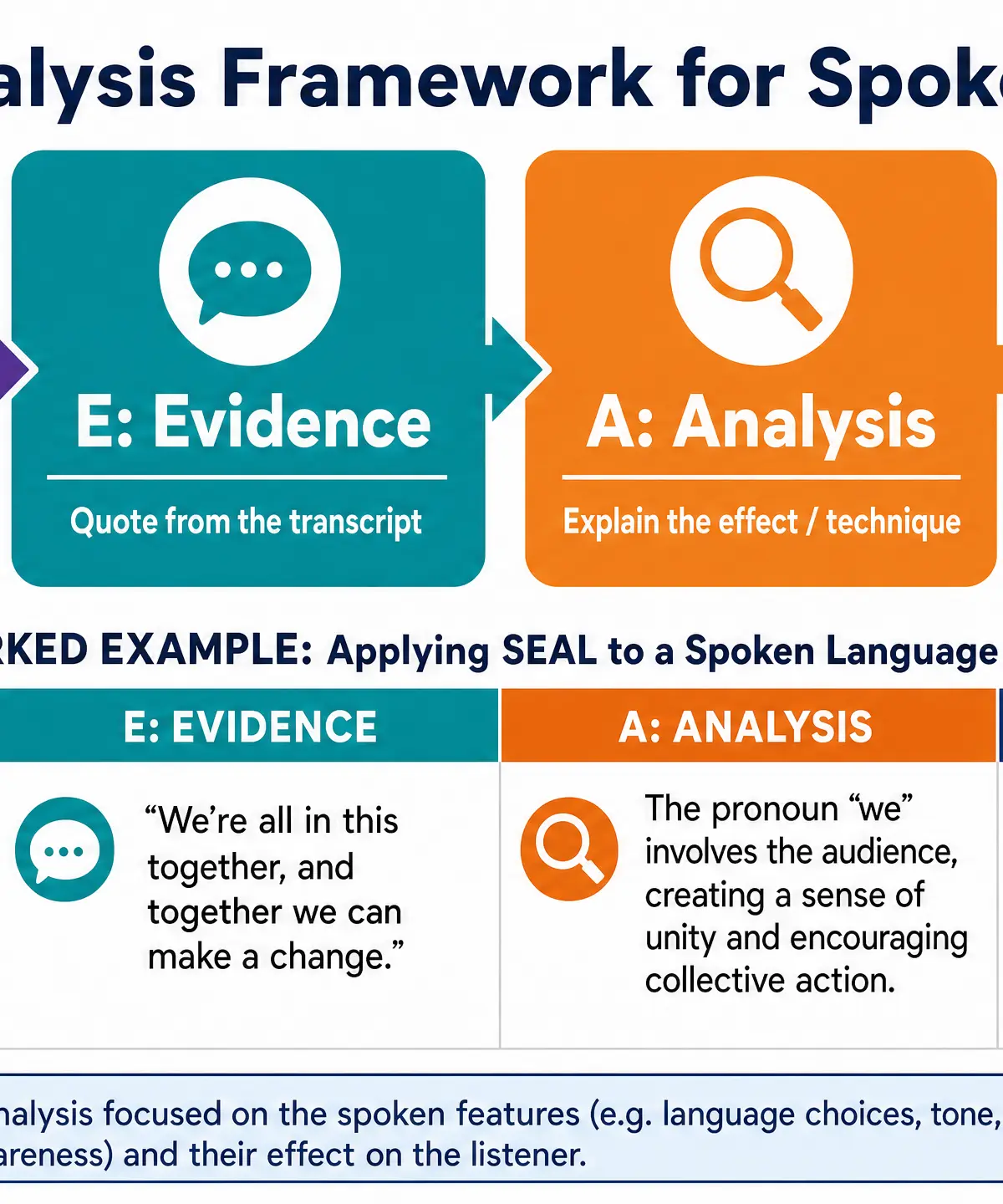
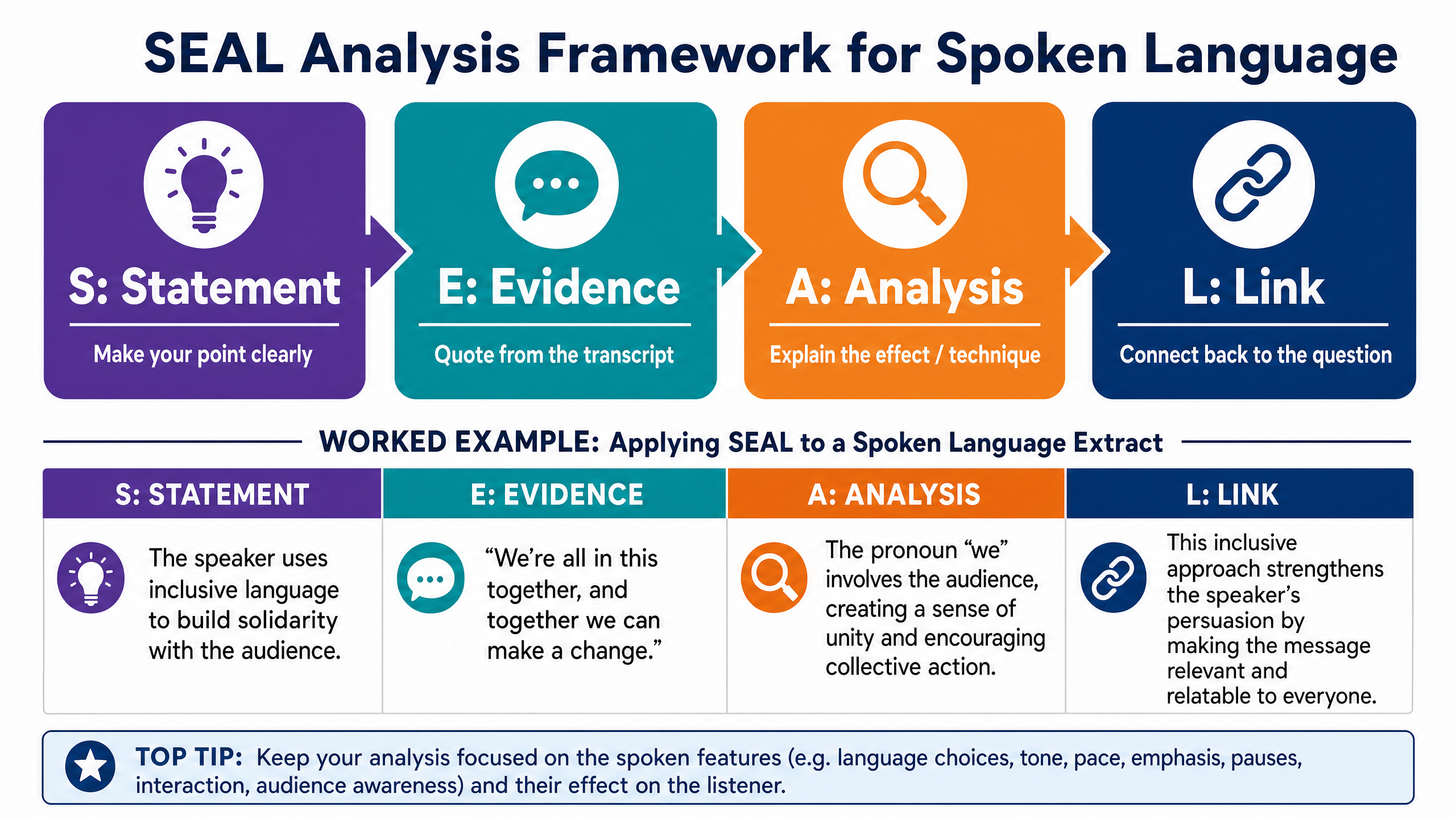
- You must use the SEAL framework: Statement → Evidence → Analysis → Link.
Comparing Speakers' Viewpoints
When comparing two transcripts (e.g., a formal political speech vs. an informal vlog):
- Identify the Viewpoints: What is each speaker's attitude?
- Compare the Contexts: How does the audience and purpose differ?
- Compare the Methods: Contrast their use of spoken features (e.g., Speaker A uses formal discourse markers and deliberate pauses; Speaker B uses fillers and hedging).
- Evaluate Effectiveness: Which approach is more effective for its specific context?
Writing Skills: Your Own Spoken Performance
For your Spoken Language Endorsement, you are assessed on your ability to present information, respond to questions, and use Standard English appropriately.
Planning Your Presentation
Do not write a full script. Spoken language should sound natural, not read.
- Purpose: Are you informing, persuading, or arguing?
- Audience: Who are you speaking to? Your peers? Your teacher?
- Register: Choose a level of formality that matches the context. A formal presentation requires Standard English and sophisticated vocabulary.
Delivery Techniques
- Pace and Pause: Vary your speed. Slow down for complex points. Use deliberate pauses to let important ideas sink in.
- Eye Contact: Engage your audience. This shows confidence and helps you gauge their reaction.
- Body Language: Use gestures to emphasize points, but avoid distracting habits.
Technical Accuracy (Spoken SPaG)
While you aren't marked on spelling or punctuation in a spoken assessment, you are marked on your use of Standard English.
- Avoid slang and non-standard grammar in formal presentations.
- Ensure your vocabulary is ambitious and appropriate for the topic.
- Structure your ideas logically so the audience can follow your argument without needing to read it.
Interactive Diagrams
2 interactive diagrams to visualise key concepts
Conceptual Flow Outline
Exam Approach Flowchart for Spoken Language
Conceptual Flow Outline
Taxonomy of Spoken Language Features
Worked Examples
3 worked examples — open one to explore the question and available guidance.
Practice Questions
Test your understanding — click to reveal model answers
Identify two non-fluency features in the following utterance: 'I was— well, I um, I didn't really know what to do.'
Hint: Look for places where the speaker stops, restarts, or uses sounds to fill silence.
Analyse how the speaker uses hedging in this extract to convey their attitude: 'It's sort of difficult to say, perhaps we should just, you know, wait a bit.'
Hint: Identify the hedging words and explain how they make the speaker sound less decisive.
Evaluate the effectiveness of Speaker A's use of prosodic features to control the conversation: 'I need you to listen to me (pause) RIGHT (stress) NOW.'
Hint: Look at the stage directions in brackets. How do they change the power dynamic?
Compare how two different speakers use discourse markers to structure their arguments. Speaker 1: 'Firstly... Secondly... In conclusion.' Speaker 2: 'Right... so... anyway.'
Hint: Contrast the level of formality and the contexts these markers suggest.
Plan the opening of a presentation to your class about the importance of mental health awareness. Write down three bullet points indicating your prosodic delivery.
Hint: Think about where you would pause, what words you would stress, and your overall pace.