OCR · GCSE · English Language
Using spoken Standard English
This topic focuses on your ability to use Spoken Standard English accurately and effectively in formal contexts. Examiners assess your grammar, vocabulary choices, and control of register to determine your overall spoken language grade.
- 4 min read
- 3 worked examples
- 5 practice questions
- 8 key terms
Study Notes

Overview
The Spoken Language assessment is a mandatory component of your GCSE English Language qualification. While it is reported separately from your final 1-9 grade (awarded as Pass, Merit, or Distinction), it is a crucial test of your communication skills. The core requirement for achieving higher grades is the consistent use of Spoken Standard English.
This means demonstrating control over grammar, selecting ambitious vocabulary, and adapting your tone and register to suit a formal audience and purpose. It is vital to understand that Standard English is not about your accent; it is entirely about the grammatical structures and word choices you employ.
Understanding Standard English
What is Standard English?
Standard English is the variety of English universally accepted as the appropriate form for formal communication, education, and professional environments. It adheres to established grammatical rules.
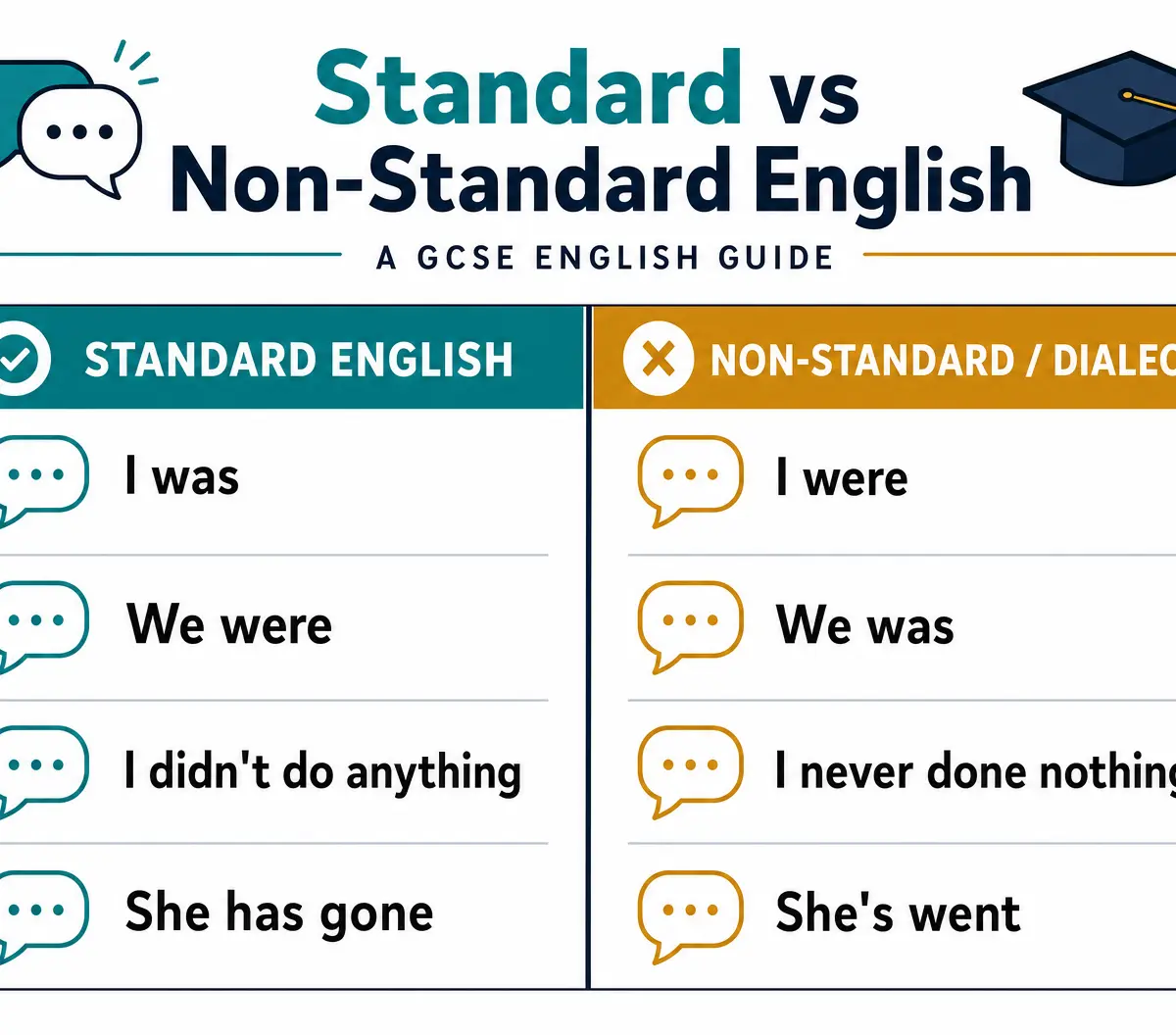
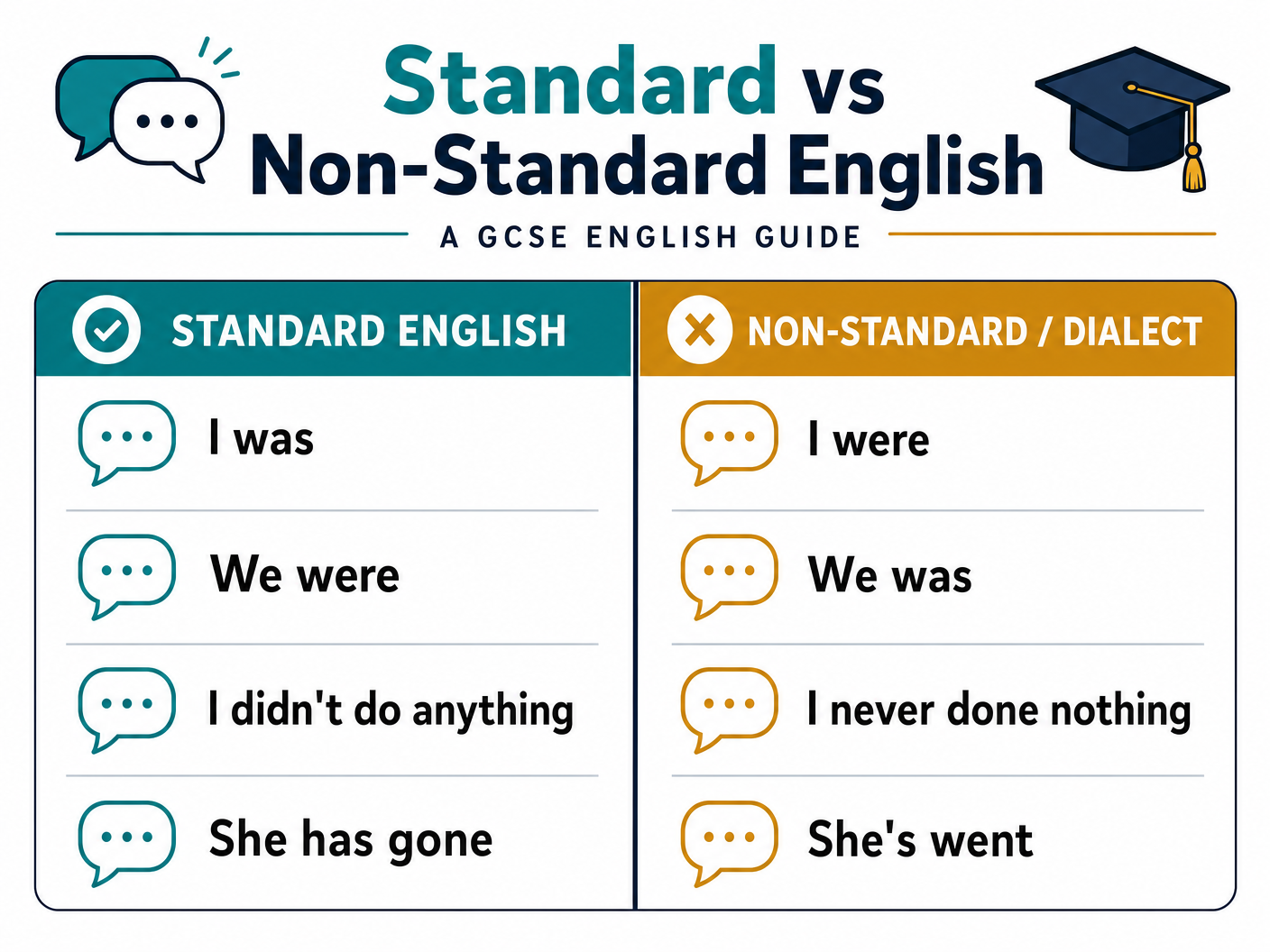
Accent vs. Dialect
Examiners frequently note that candidates confuse accent with dialect.
- Accent: How words are pronounced (e.g., a Geordie, Welsh, or MLE accent). You will never be penalised for your accent.
- Dialect: Regional vocabulary and grammatical structures (e.g., saying "I were" instead of "I was"). Using dialect grammar in a formal assessment will limit your marks.
Key Grammatical Rules for the Exam
To secure marks for Standard English, you must ensure:
- Subject-Verb Agreement: Ensure your subjects and verbs match in number.
- Incorrect: "We was going to the shop."
- Correct: "We were going to the shop."
- Avoidance of Double Negatives: Do not use two negative words in the same clause.
- Incorrect: "I didn't do nothing."
- Correct: "I didn't do anything."
- Correct Verb Tenses: Avoid non-standard past tense forms.
- Incorrect: "She done it yesterday."
- Correct: "She did it yesterday."
Register and Context
Adapting Your Register
Register refers to the level of formality in your language. A presentation to your peers requires a different register than a formal speech to a panel of teachers. You must deliberately adapt your language choices to suit the specified audience and purpose.
| Context | Audience | Appropriate Register | Example Language Choices |
|---|---|---|---|
| Casual Conversation | Friends | Informal / Non-Standard | Slang, colloquialisms, "Yeah, it was well good." |
| Class Discussion | Peers and Teacher | Semi-Formal | Standard grammar, accessible vocabulary. "I think that's a good point because..." |
| Formal Presentation | Examiner / Panel | Highly Formal | Standard grammar, ambitious vocabulary, discourse markers. "Furthermore, the evidence suggests..." |
Features of Spoken Language
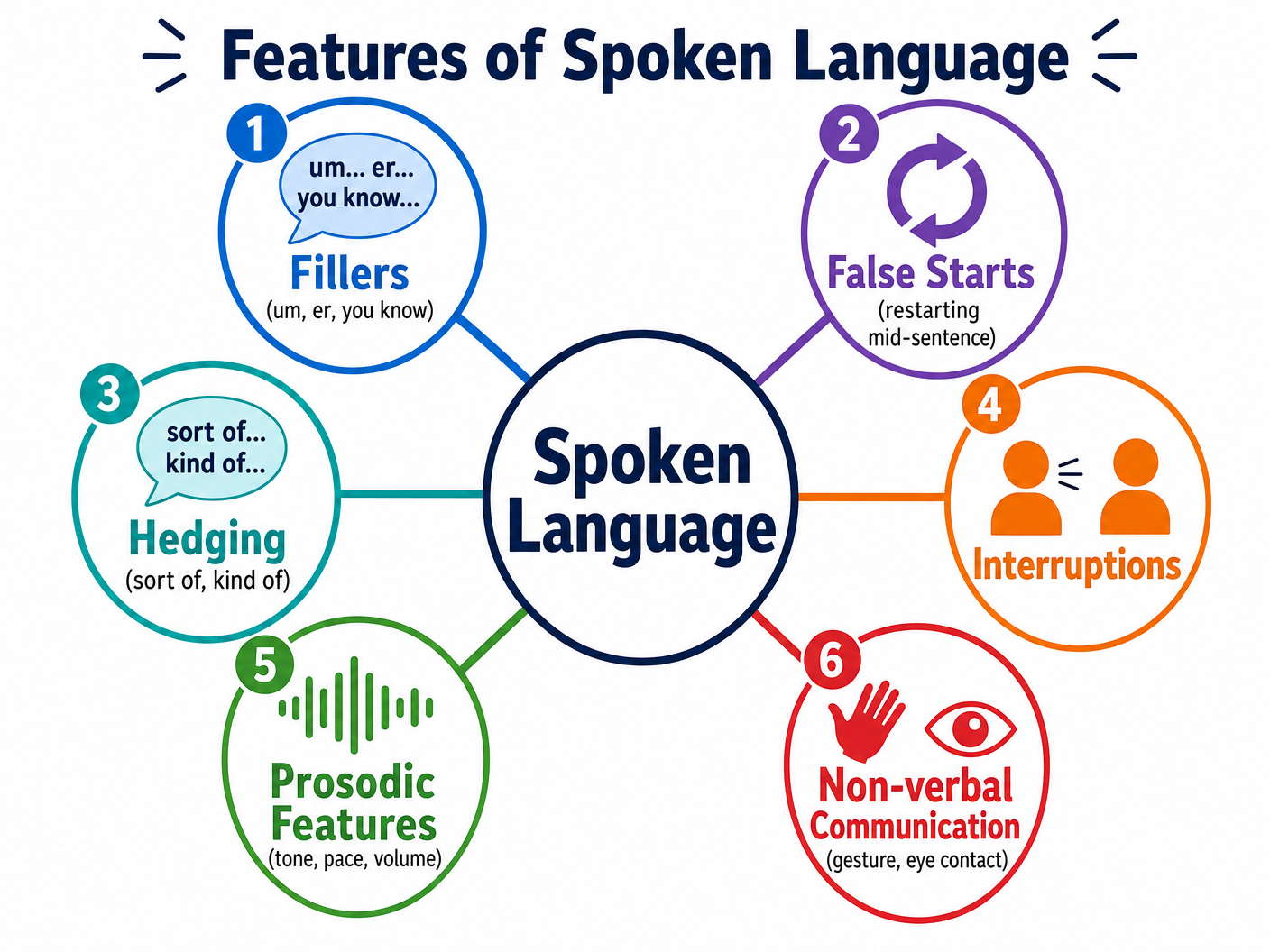
Unlike written text, spoken language happens in real-time and has unique characteristics. Understanding these features helps you control them during your assessment.
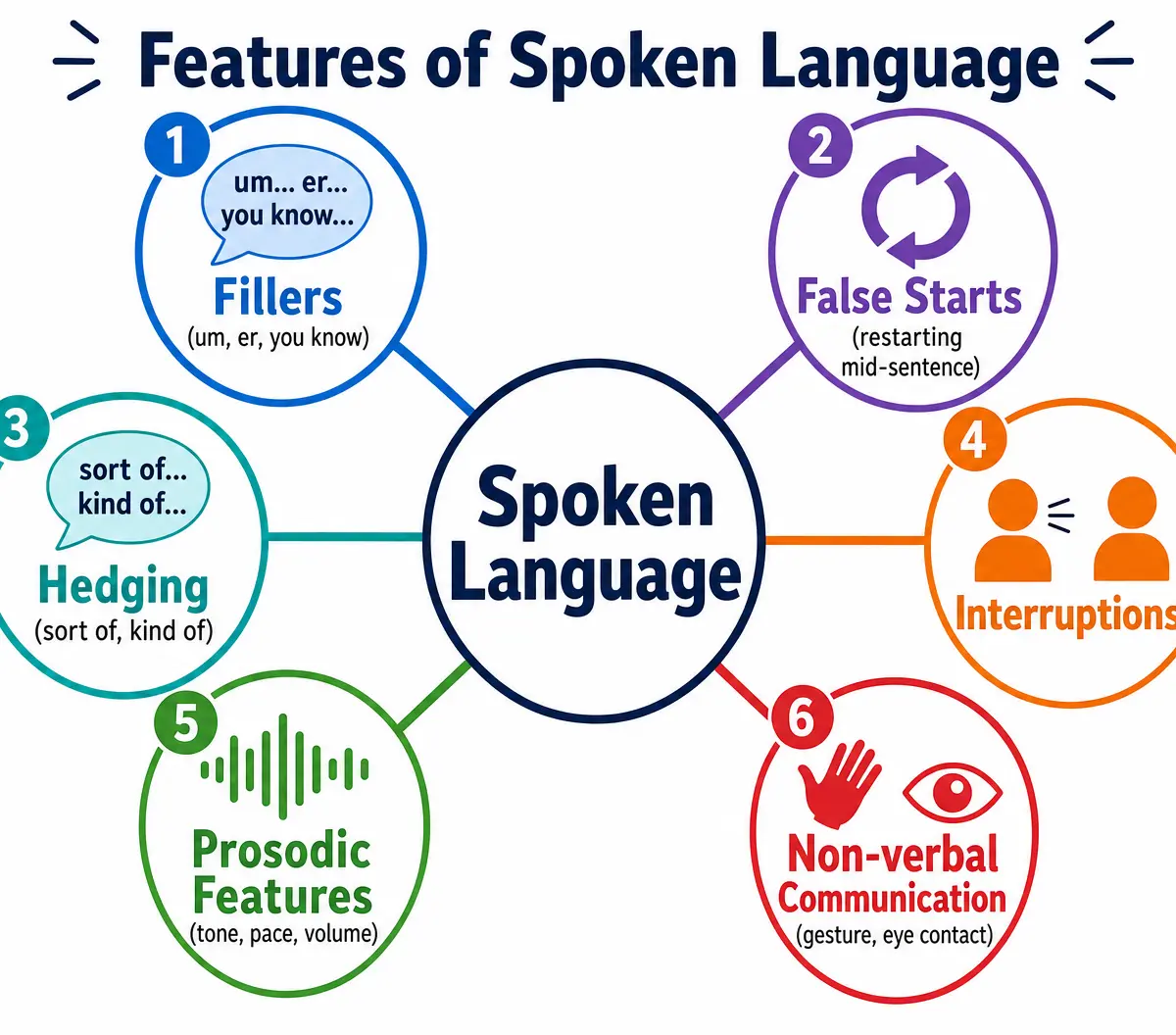
Managing Spoken Features for Marks
- Fillers ("um", "er", "like"): While natural in spontaneous speech, overusing fillers in a prepared presentation indicates a lack of preparation and reduces clarity. Pause silently instead.
- Prosodic Features (tone, pitch, volume, pace): Top candidates use these deliberately. Slow down to emphasise key points, and use vocal inflection to convey emotion and engage the listener.
- Discourse Markers: Use formal signposts to structure your speech (e.g., "Initially", "Conversely", "To conclude"). This demonstrates coherent organisation of ideas.
Listen to the Podcast
Reinforce your learning by listening to our examiner-style breakdown of Spoken Standard English.

Visual Resources
2 diagrams and illustrations
Interactive Diagrams
2 interactive diagrams to visualise key concepts
Conceptual Flow Outline
Spoken Language Assessment Approach Flowchart
Conceptual Flow Outline
Register and Context Framework
Worked Examples
3 worked examples — open one to explore the question and available guidance.
Practice Questions
Test your understanding — click to reveal model answers
Identify the non-standard grammatical feature in this sentence: 'I never saw nothing.'
Hint: Look for words that express a negative meaning.
Explain why the phrase 'We was walking to the park' is incorrect in Standard English.
Hint: Think about the relationship between the subject ('We') and the verb ('was').
Rewrite the following informal paragraph into a formal register suitable for a presentation: 'So yeah, climate change is like, well bad. We gotta do summat about it now or we're all gonna be in dead trouble.'
Hint: Remove fillers, replace slang with ambitious vocabulary, and ensure Standard English grammar.
Discuss how a speaker might use prosodic features to enhance a persuasive presentation.
Hint: Define prosodic features and explain the specific effects of changing pace, volume, and tone.
Evaluate the importance of maintaining a consistent formal register during the unscripted Q&A section of a Spoken Language assessment.
Hint: Consider why candidates often slip up here and what sustaining the register proves to the examiner.