OCR · GCSE · English Language
Using Vocabulary and Sentence Structures
This guide focuses on mastering vocabulary and sentence structures for the OCR GCSE English Language exam. It covers how to analyse their effects in reading (AO2) and use them skilfully in writing (AO6) to maximise marks."
- 7 min read
- 3 worked examples
- 5 practice questions
Study Notes
Overview
Welcome to your guide on Using Vocabulary and Sentence Structures (2.7) for OCR GCSE English Language. This skill is fundamental to success in both Paper 1 and Paper 2. Examiners are looking for two things: your ability to analyse how professional writers use language and structure for effect (AO2), and your own ability to write with technical accuracy and creative flair (AO6). This guide will equip you with the terminology, techniques, and confidence to excel in both.
Reading Skills
Identifying Information & Ideas
This is the foundation of all reading comprehension. You must be able to extract both explicit information (what is directly stated) and implicit information (what is suggested or implied). For instance, a writer might explicitly state, "The house was silent," but the context of a stormy night and a lone character implies a feeling of unease or suspense.
Analysing Language
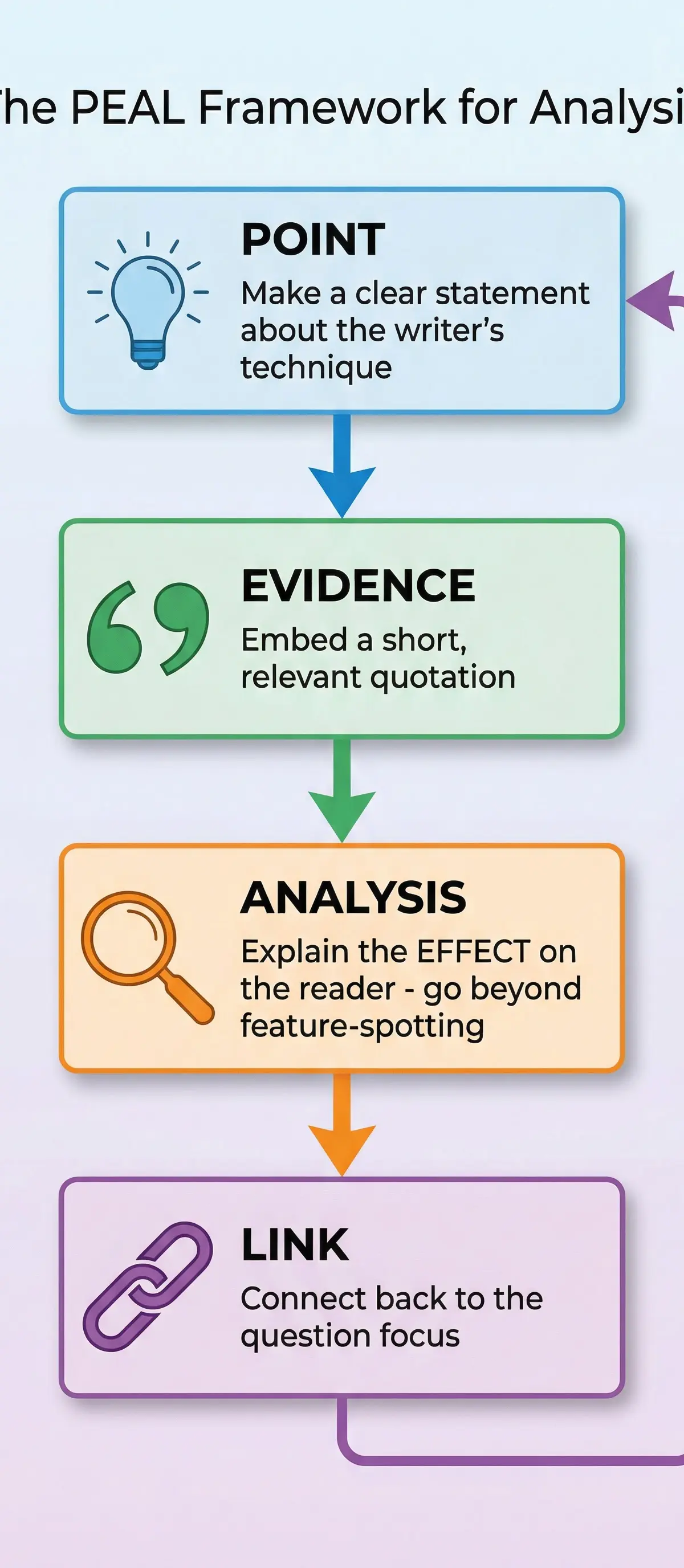
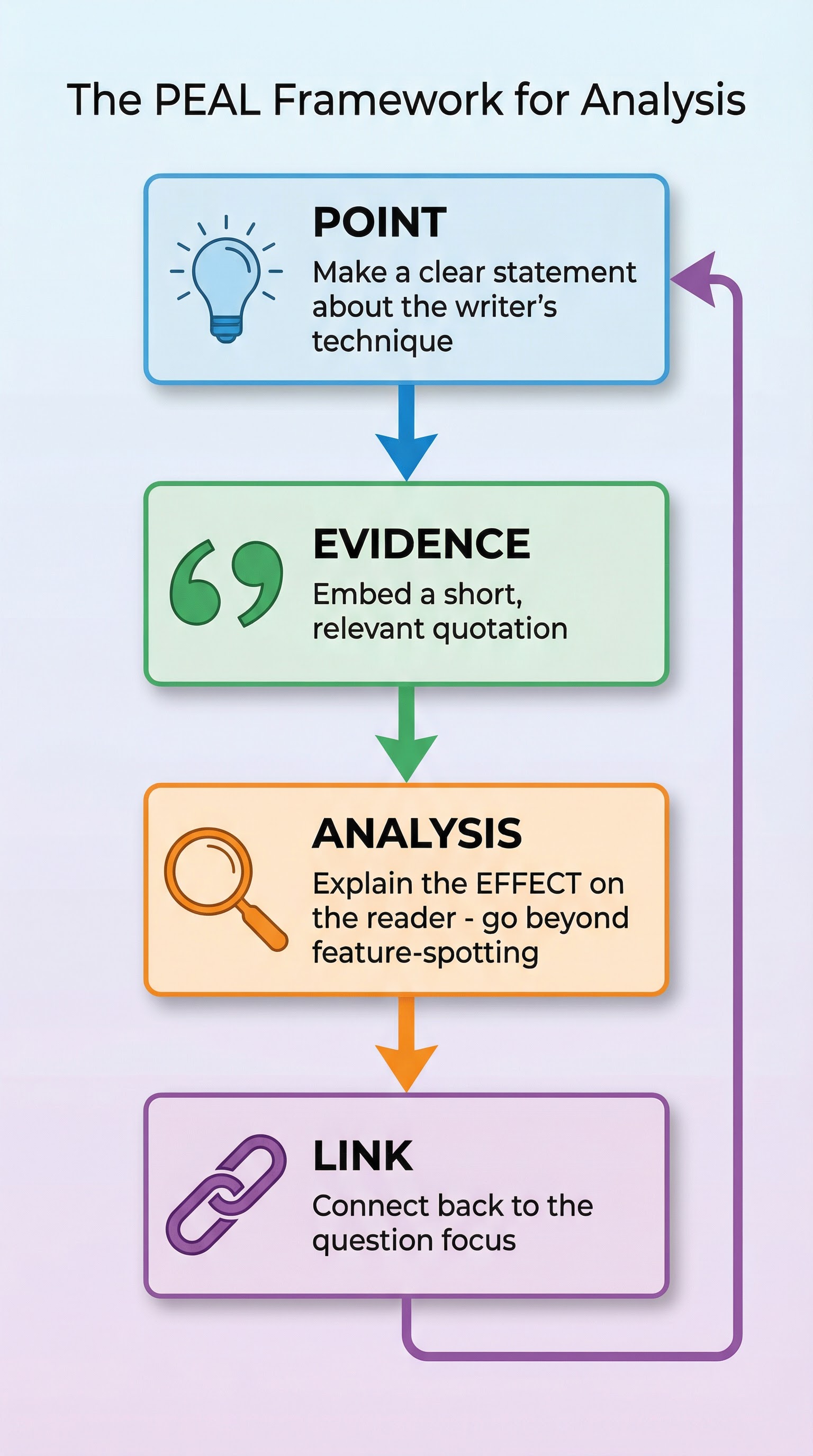
To earn high marks for AO2, you must go beyond simply identifying language features. You need to analyse their effect on the reader. Use the PEAL framework to structure your analysis.
Key Language Features to Identify
| Feature | Definition | Effect on Reader | Example |
|---|---|---|---|
| Metaphor | A figure of speech where a word or phrase is applied to an object or action to which it is not literally applicable. | Creates a powerful, vivid image by drawing a strong comparison. | "The classroom was a zoo." |
| Simile | A figure of speech comparing one thing with another thing of a different kind, using 'as' or 'like'. | Makes a description more vivid and relatable for the reader. | "He was as brave as a lion." |
| Personification | Attributing human qualities or abilities to inanimate objects or animals. | Creates a specific mood and can make the environment seem active or threatening. | "The wind whispered through the trees." |
| Pathetic Fallacy | A type of personification where the weather or environment reflects the mood of a character or scene. | Intensifies the emotional atmosphere of the scene. | "A miserable drizzle fell from the sky as he received the bad news." |
| Alliteration | The occurrence of the same letter or sound at the beginning of adjacent or closely connected words. | Can create a specific sound effect (harsh or soft) and make a phrase more memorable. | "The slippery snake slithered silently." |
| Sibilance | A specific type of alliteration involving the repetition of soft hissing sounds (like 's', 'sh', 'ch'). | Often used to create a sinister, menacing, or soothing tone. | "The sea hissed and spat on the shore." |
| Juxtaposition | Placing two contrasting ideas, characters, or descriptions close together. | Highlights the differences between them and can create a sense of conflict or irony. | "The pristine white snow was stained with a single drop of blood." |
Analysing Structure
Structure is the way a writer organises a text. Think of it as the architecture of the writing. When analysing structure, consider:
- Openings: How does the writer hook the reader?
- Shifts in Focus: Where does the narrative perspective or topic change, and why?
- Sentence Length Variation: How does the writer manipulate sentence length to control pace and tension? A sequence of short, simple sentences can speed up the action, while a long, complex sentence can slow it down for descriptive detail.
- Paragraphing: Short paragraphs can have a dramatic impact. Longer paragraphs can build detailed arguments or descriptions.
- Cyclical Structure: Does the ending of the text link back to the beginning? This can create a sense of inevitability or resolution.
- Flashbacks/Foreshadowing: How does the writer play with time to build suspense or provide context?
Evaluating Critically
Evaluation questions (e.g., Paper 1, Q4) ask for your informed opinion on how effective a writer has been. You must make a judgement and support it with evidence from the text. A good structure is:
- Statement: Make a clear judgement (e.g., "To a large extent, the writer successfully creates a tense atmosphere...").
- Evidence: Select a quotation that supports your point.
- Analysis: Explain how the language and structural features in the evidence work to create the effect.
- Link: Connect your analysis back to the overall judgement you made in your statement.
Comparing Writers' Viewpoints
For comparison questions (Paper 2, Q4), you need to synthesise information from two texts. Identify the writers' different perspectives on a topic and then compare the methods they use to convey those viewpoints. Do they use different language? Is the tone different? How do they structure their arguments?
Writing Skills
Creative Writing
Whether you are writing a description or a narrative, the key is to be deliberate and controlled.
- Show, Don't Tell: Instead of telling the reader a character is nervous, show it: "He tapped his fingers incessantly on the table, his gaze darting towards the door."
- Sensory Description: Engage all five senses—sight, sound, smell, touch, and taste—to create an immersive world for the reader.
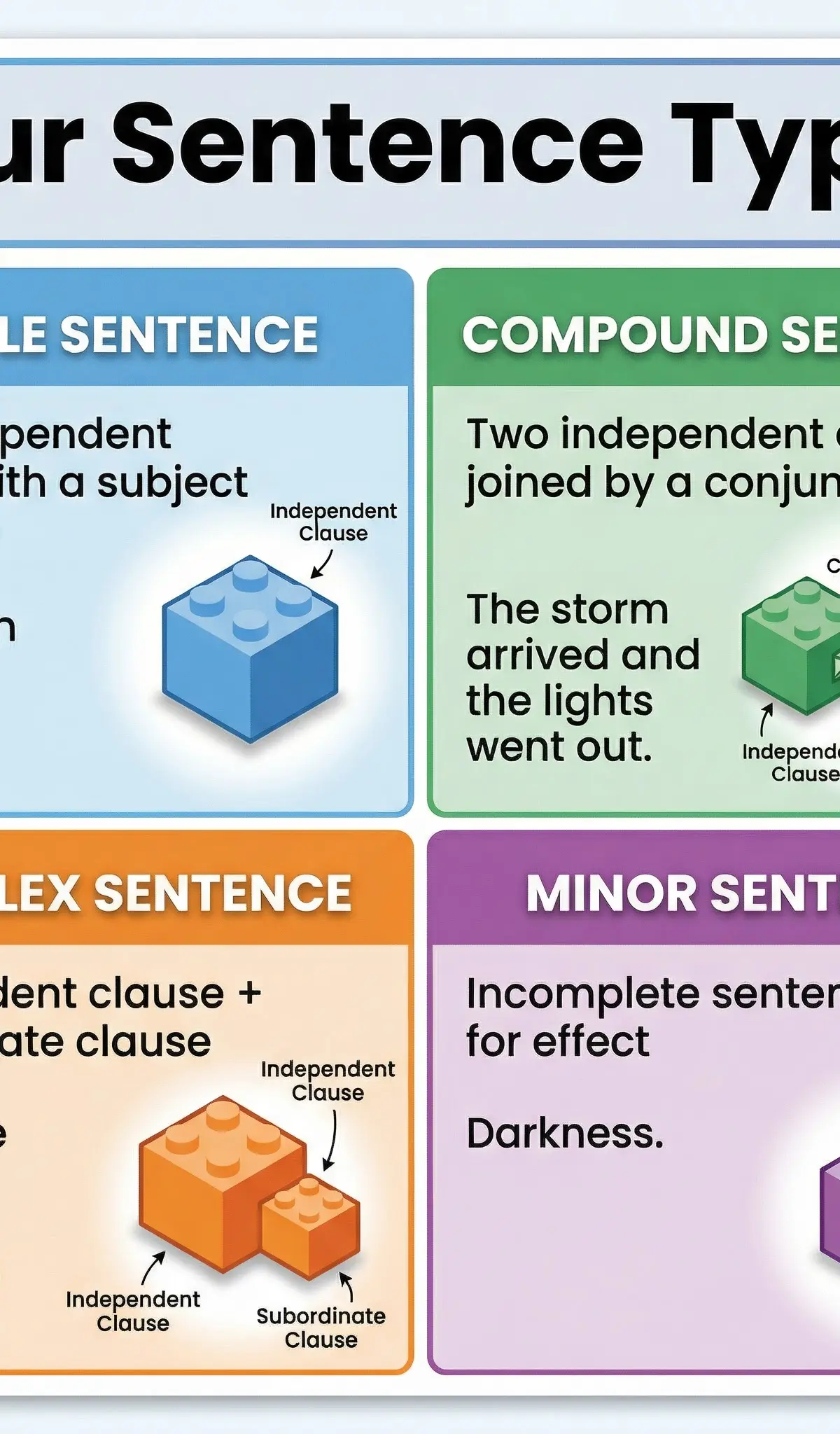
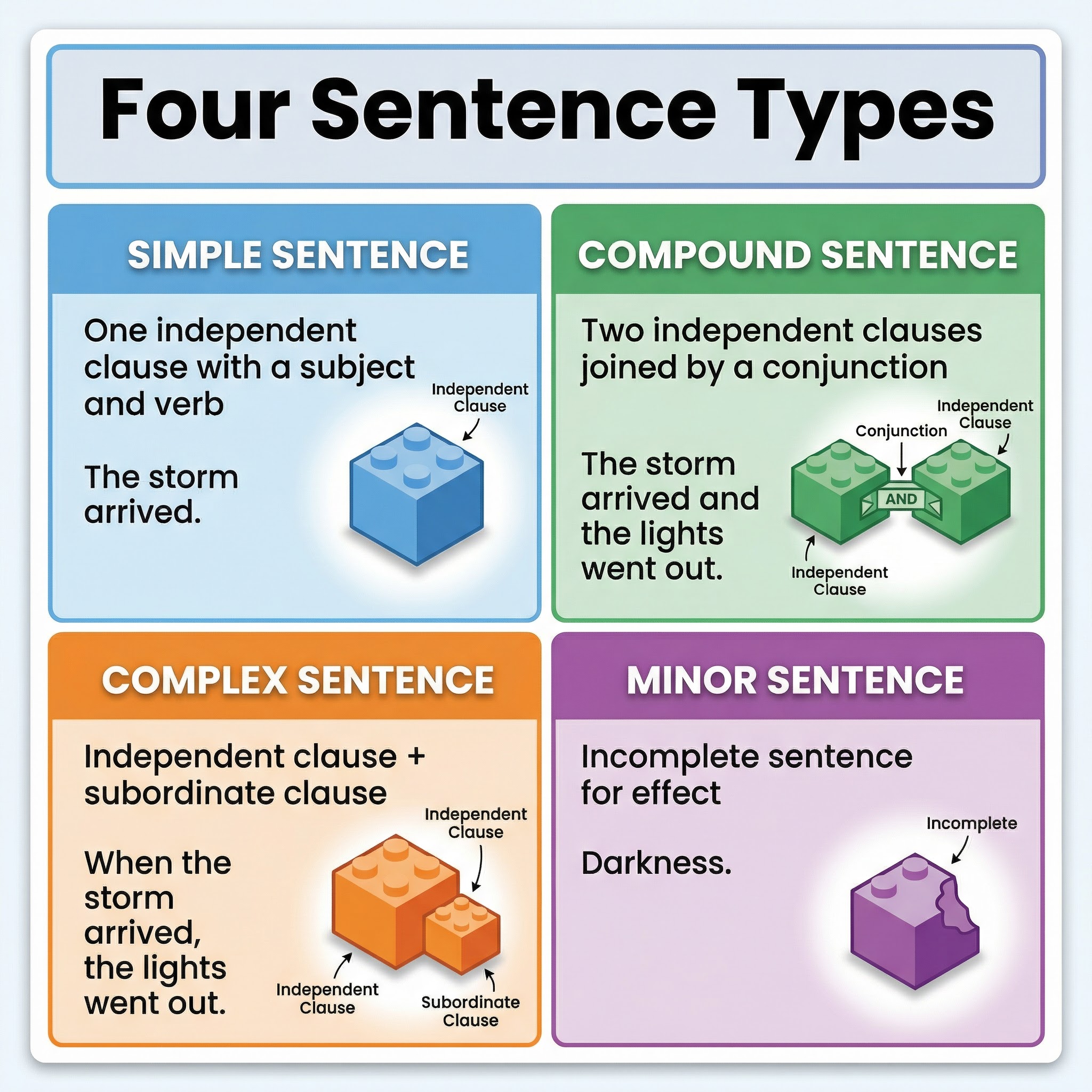
- Varied Sentence Structures: Use a mix of simple, compound, complex, and minor sentences to control the pace and rhythm of your writing.
- Engaging Openings: Start with action, dialogue, or a puzzling statement to hook the reader immediately.
- Satisfying Endings: A good ending provides a sense of closure, perhaps by linking back to the opening (a cyclical structure).
Transactional/Non-Fiction Writing
For letters, articles, speeches, and leaflets, you must consider Purpose, Audience, and Form (PAF). Your tone, vocabulary, and structure must be appropriate for the task. A formal letter to a headteacher will be very different from an informal article for your peers. Use persuasive techniques to make your point convincingly.
Technical Accuracy (SPaG)
Spelling, Punctuation, and Grammar (SPaG) account for a significant portion of the marks in writing tasks. Secure sentence demarcation is the absolute minimum. To access the higher levels, you must use ambitious punctuation correctly.
- Semi-colons (;): Used to link two closely related independent clauses. Think of it as a 'super-comma'.
- Colons (:): Used to introduce a list, an explanation, or a quotation.
- Dashes (-): Can be used to add extra information or create a dramatic pause.
- Parenthetical Commas: A pair of commas used to separate extra information from the main clause.
Always proofread your work. Reading your writing backwards, sentence by sentence, can help you spot errors you might otherwise miss.
"
Worked Examples
3 worked examples — open one to explore the question and available guidance.
Practice Questions
Test your understanding — click to reveal model answers
Identify the sentence type used in the following example: 'After the longest winter, spring finally arrived.'
Hint: Does the sentence have more than one clause? Is one of them dependent on the other?
Rewrite the following sentence to make it more engaging by front-loading the subordinate clause: 'The city felt magical as the snow began to fall.'
Hint: Move the clause beginning with 'as' to the start of the sentence. Don't forget the comma!
Analyse how the writer uses language in the phrase 'an ocean of grief' to describe the character's feelings.
Hint: What technique is being used? What are the connotations of an 'ocean'?
Write a single sentence to describe a busy market, trying to include at least two different types of punctuation (e.g., commas for a list, a semi-colon, a dash).
Hint: Try to link two related ideas with a semi-colon, or add a dramatic piece of extra information with a dash.
Evaluate how effectively the writer uses a structural shift to change the mood in the final paragraph.
Hint: Look for a change in sentence length, focus, or tone at the end of the text. How does this change affect you as a reader? Make a judgement.
Test your understanding of Using Vocabulary and Sentence Structures
Active recall beats re-reading. Take an instant quiz now to test what you’ve learned and lock it into long-term memory.
7 days Premium · Then free forever · No card, no charge