OCR · GCSE · English Language
Writing for Audience, Purpose and Form
Writing for Audience, Purpose and Form is a core skill assessed in OCR GCSE English Language Component 02, Section B (Transactional Writing). Candidates must demonstrate sophisticated control of tone, register, and style (AO5) tailored precisely to the specified recipient, whether formal or informal, while maintaining technical accuracy (AO6). Mastering this skill is essential for earning top marks in the writing section.
- 11 min read
- 3 worked examples
- 5 practice questions
- 11 key terms
Study Notes
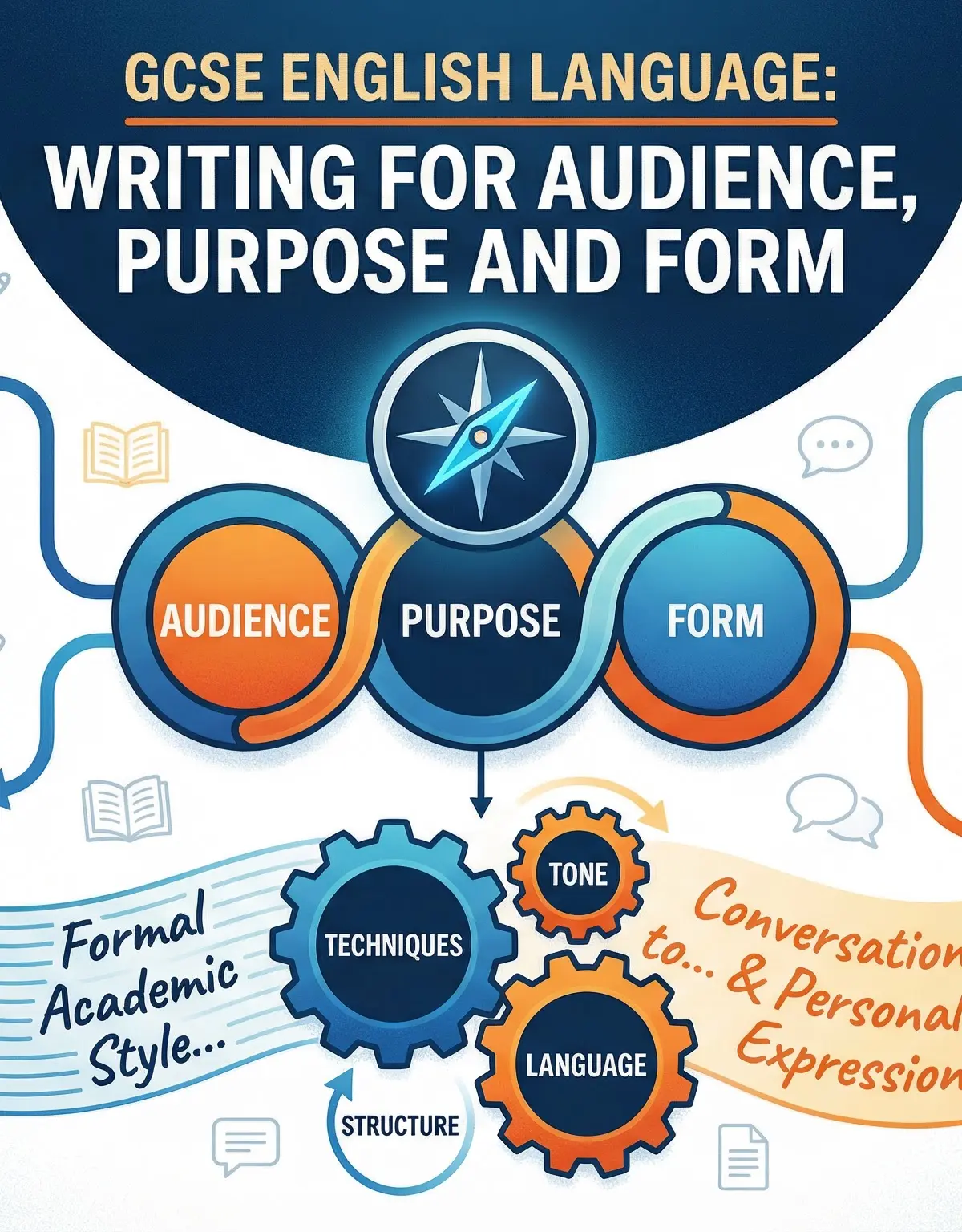
Overview
In OCR GCSE English Language (J351), the ability to write for a specific audience, purpose, and form is assessed primarily in Component 02, Section B. This is where candidates demonstrate their capacity to adapt their writing voice, structure, and vocabulary to suit the demands of the task. Unlike creative writing, which focuses on narrative and descriptive techniques, transactional writing requires candidates to write in specific real-world formats such as letters, articles, speeches, and leaflets. The examiner is looking for evidence that the candidate has consciously shaped their writing to meet the needs of the intended reader and achieve a specific communicative goal.
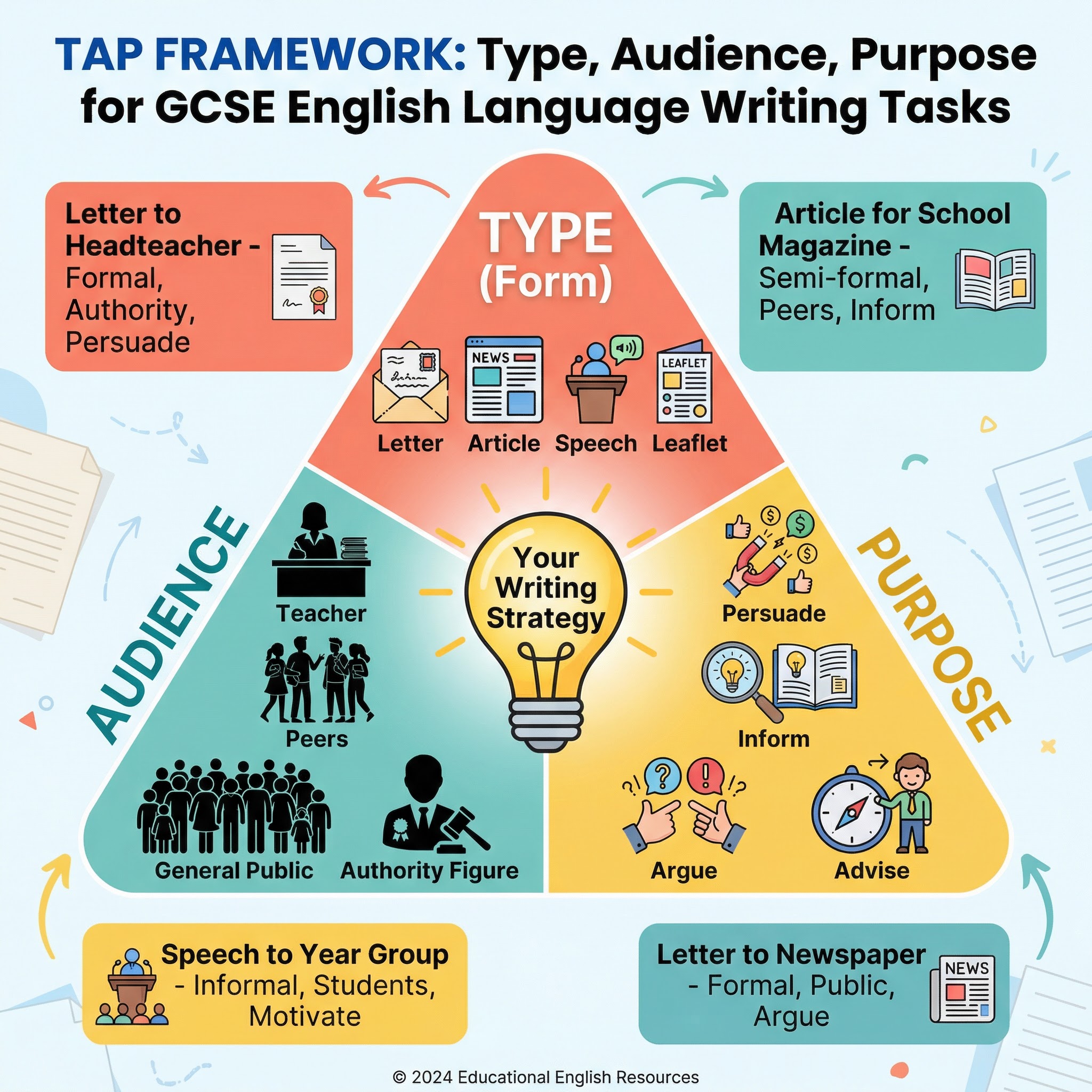
The key to success lies in understanding the TAP framework: Type (Form), Audience, and Purpose. Before writing a single word, candidates must identify these three elements and use them to guide every decision they make about vocabulary, sentence structure, tone, and register. This is not about writing what you think; it is about writing in a way that will have the desired effect on your specific reader.
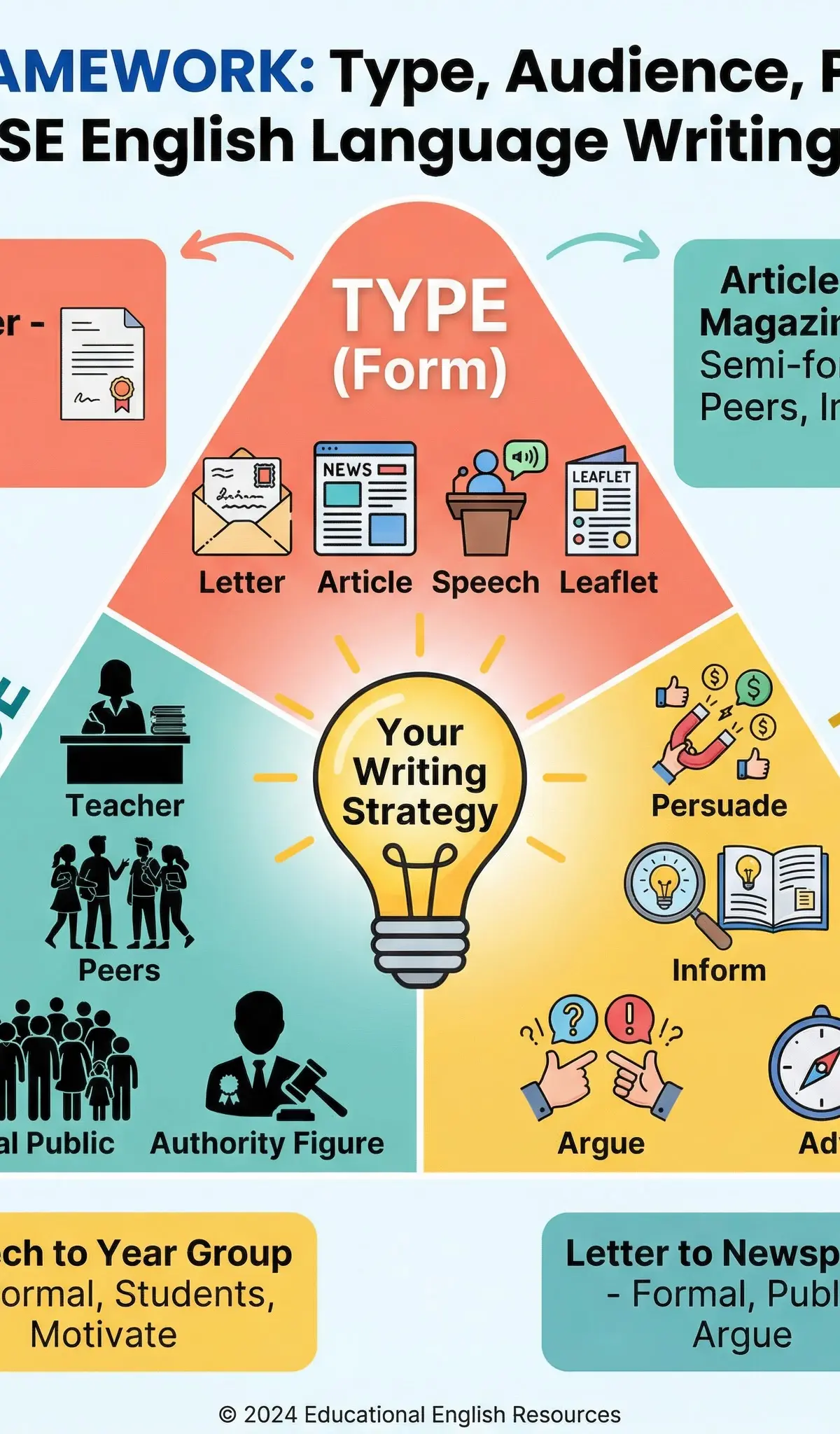
The TAP Framework: Type, Audience, Purpose
Type (Form)
The Type or Form refers to the genre of writing required by the task. Each form has its own set of conventions that candidates must follow to demonstrate their understanding of how real-world texts are structured. Examiners will award marks for correctly applying these conventions.
Common forms include:
| Form | Key Conventions | Example Context |
|---|---|---|
| Formal Letter | Sender's address (top right), date, recipient's name and address (left), formal salutation (Dear Sir/Madam, Dear Mr/Ms Surname), clear paragraphs, formal sign-off (Yours sincerely/faithfully), signature | Writing to a headteacher to request a change in school policy |
| Article | Engaging headline, subheadings, byline (author name), introduction that hooks the reader, paragraphs with clear topic sentences, conclusion or call to action | Writing for a school magazine or local newspaper |
| Speech | Direct address to the audience, rhetorical devices (questions, repetition, rule of three), inclusive pronouns ('we', 'us'), clear structure (introduction, main points, conclusion), conversational tone where appropriate | Addressing your year group or a formal assembly |
| Leaflet | Eye-catching title, bullet points or numbered lists, subheadings, persuasive language, contact information or next steps | Promoting a charity event or providing information about a local issue |
Candidates who omit or misapply these conventions will lose marks under AO5, as they demonstrate a lack of awareness of the form's requirements.
Audience
The Audience is the specific person or group of people the candidate is writing for. This is the single most important factor in determining tone and register. A common mistake is to adopt a generic 'exam essay' voice rather than tailoring the writing to the specified reader.
Key audience types and their requirements:
| Audience | Register | Tone | Vocabulary Choices | Example Techniques |
|---|---|---|---|---|
| Authority figure (headteacher, local councillor, editor of a broadsheet newspaper) | Formal | Respectful, serious, assertive | Sophisticated, subject-specific, Standard English | Complex sentences, passive voice where appropriate, formal discourse markers ('Furthermore', 'Consequently') |
| Peers (classmates, teenagers) | Informal to semi-formal | Friendly, relatable, energetic | Conversational, some colloquialisms acceptable | Inclusive pronouns ('we', 'us'), rhetorical questions, direct address ('you') |
| General public (readers of a local newspaper, community members) | Semi-formal | Informative, balanced, engaging | Clear, accessible, avoiding jargon | Anecdotes, statistics, balanced arguments |
Candidates must sustain their chosen register throughout the entire piece. A formal letter that begins with 'Dear Sir or Madam' and ends with 'Cheers' demonstrates a lack of control and will be penalised.
Purpose
The Purpose is what the candidate is trying to achieve through their writing. The purpose dictates the choice of language techniques and the overall structure of the piece.
Common purposes include:
- Persuade: Convince the reader to agree with a particular viewpoint or take a specific action. Use emotive language, rhetorical questions, and personal anecdotes.
- Argue: Present a balanced case for and against a proposition, then reach a reasoned conclusion. Use logical connectives, evidence, and counterarguments.
- Inform: Provide the reader with factual information in a clear and accessible way. Use subheadings, statistics, and explanations.
- Advise: Offer guidance or recommendations to the reader. Use modal verbs ('should', 'could'), imperative sentences, and a supportive tone.
The AFOREST acronym is a useful tool for remembering persuasive techniques:
- Alliteration: Repeating initial consonant sounds for emphasis (e.g., 'Save our students, save our school').
- Facts: Verifiable information that adds credibility.
- Opinions: Personal viewpoints that show conviction.
- Rhetorical Questions: Questions that do not require an answer but engage the reader (e.g., 'Can we really afford to ignore this crisis?').
- Emotive Language: Words chosen to provoke an emotional response (e.g., 'devastating', 'heartbreaking').
- Statistics: Numerical data that supports the argument.
- Three (Rule of): Grouping ideas in threes for impact (e.g., 'It is unfair, unjust, and unacceptable').
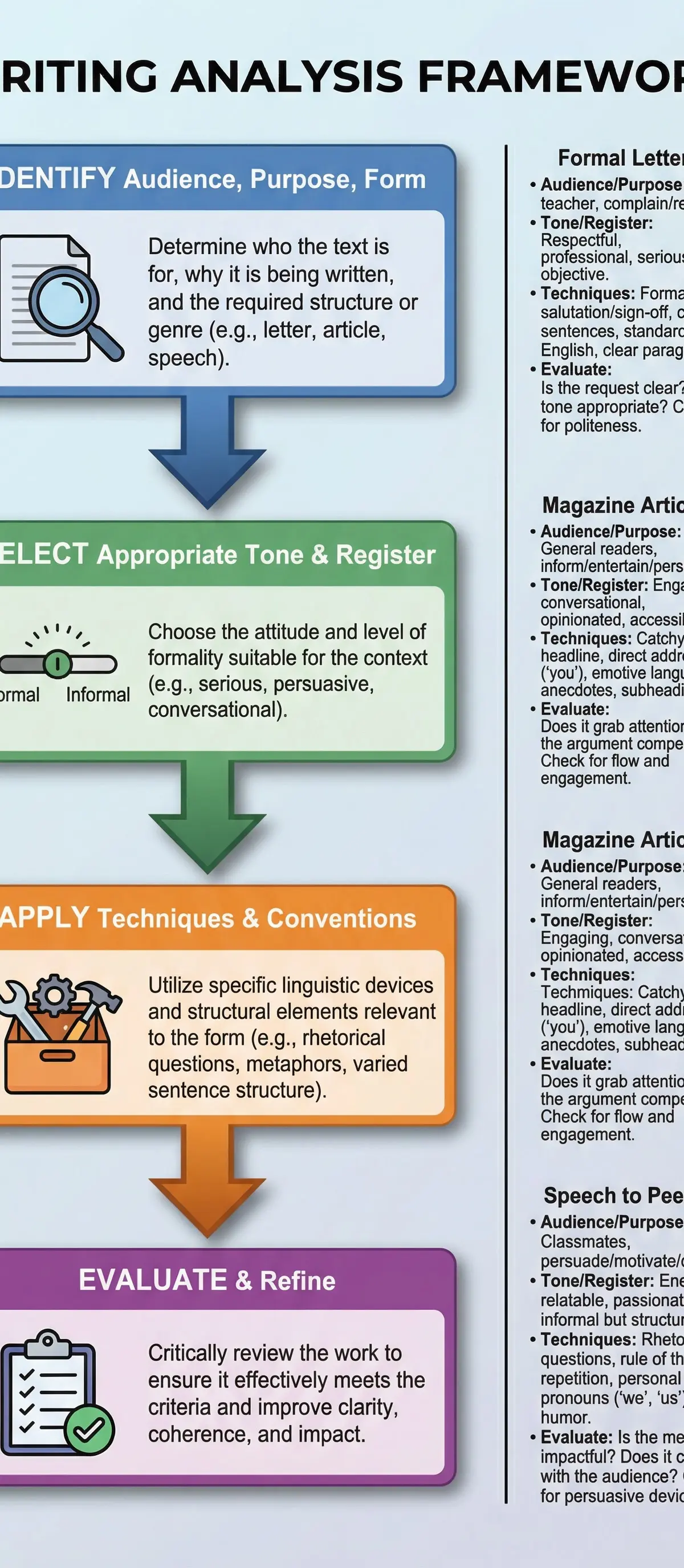
Tone and Register: The Heart of Audience Awareness
Register refers to the level of formality in the language used. It exists on a spectrum from highly formal (academic writing, legal documents) to highly informal (text messages, personal blogs). In GCSE transactional writing, candidates will typically be working within the formal to semi-formal range.
Tone refers to the attitude or emotion conveyed by the writing. It is shaped by word choice, sentence structure, and punctuation. A formal letter of complaint might have a serious, assertive tone, while a speech to peers might have an enthusiastic, motivational tone.
Examples of tone and register in action:
- Formal register, serious tone: 'I am writing to express my profound concern regarding the proposed closure of the local library. This decision, if implemented, will have a detrimental impact on the educational opportunities available to young people in our community.'
- Semi-formal register, persuasive tone: 'We all know how important our local library is. It's not just a building full of books—it's a lifeline for students, a safe space for families, and a hub for our community. Surely we can find a way to keep it open?'
- Informal register, friendly tone: 'Hey everyone! So, you've probably heard the news about the library closing. Honestly, it's such a shame. We need to do something about it—who's with me?'
Candidates who can shift seamlessly between these registers and sustain them throughout their writing will be rewarded with marks in the higher levels of AO5.
Structural Techniques for Transactional Writing
While transactional writing is less concerned with narrative structure than creative writing, candidates must still demonstrate a clear and logical progression of ideas. Examiners look for:
- Engaging openings: A strong first sentence or paragraph that establishes the tone and purpose. For a speech, this might be a rhetorical question or a bold statement. For a letter, it might be a clear statement of intent.
- Paragraph cohesion: Each paragraph should have a clear focus, introduced by a topic sentence. Use discourse markers ('Firstly', 'In addition', 'However', 'In conclusion') to guide the reader through the argument.
- Varied sentence structures: A mix of simple, compound, and complex sentences keeps the reader engaged and demonstrates technical skill. Short sentences can be used for emphasis; longer sentences can develop complex ideas.
- Effective conclusions: A conclusion should summarise the main points and, where appropriate, include a call to action or a final persuasive appeal.
Technical Accuracy (AO6): The Foundation of High Marks
Technical accuracy—spelling, punctuation, and grammar (SPaG)—is assessed under AO6 and accounts for 20% of the marks in Component 02. Candidates who consistently make errors in basic punctuation or spelling will struggle to achieve higher grades, regardless of the quality of their ideas.
Ambitious punctuation is particularly valued by examiners. This includes:
- Semicolons: Used to link two closely related independent clauses (e.g., 'The library is essential; it serves the entire community').
- Colons: Used to introduce a list or an explanation (e.g., 'We must act now: our children's futures depend on it').
- Dashes and parenthetical commas: Used to add extra information or create emphasis (e.g., 'The decision—made without consultation—is deeply flawed').
Candidates should also aim for varied sentence openings to avoid monotony. Instead of starting every sentence with 'I think' or 'It is', try using adverbials ('Undoubtedly', 'In my view'), subordinate clauses ('Although some may argue...'), or participial phrases ('Having considered the evidence...').
Exam Technique: Maximising Marks in Component 02, Section B
The transactional writing task in Component 02 is worth 40 marks (24 marks for AO5, 16 marks for AO6) and candidates are advised to spend approximately 45 minutes on it, including planning and proofreading time.
Step-by-step approach:
- Read the question carefully and annotate it. Circle or underline the Type, Audience, and Purpose. This is your TAP.
- Plan your response (5 minutes). Jot down 3-4 main points you want to make, and note which persuasive techniques you will use. Decide on your opening and closing sentences.
- Write your response (35 minutes). Keep referring back to your TAP. Ensure every paragraph is working towards your purpose and is appropriate for your audience.
- Proofread (5 minutes). Check for consistency in tone and register. Look for spelling errors, missing punctuation, and sentence fragments. This is where you can pick up easy marks.
Common pitfalls to avoid:
- Drifting into a generic voice: Starting with a strong, audience-appropriate tone but then reverting to a neutral, essay-like style.
- Inconsistent register: Mixing formal and informal language inappropriately (e.g., 'Dear Sir, I reckon you should sort this out').
- Ignoring the form: Forgetting to include the conventions of the specified form (e.g., no headline in an article, no address in a letter).
- Feature-spotting without purpose: Using persuasive techniques just to tick a box, rather than because they genuinely enhance the argument.
- Neglecting proofreading: Submitting work with easily avoidable errors in spelling and punctuation.
Podcast: Writing for Audience, Purpose and Form
Listen to this 10-minute podcast episode for a comprehensive overview of the topic, including exam tips, common mistakes, and a quick-fire recall quiz. The podcast is designed to reinforce the key concepts and help you internalise the TAP framework.
Summary
Writing for a specific audience, purpose, and form is a skill that requires conscious control and sustained awareness. Candidates must identify the TAP elements of the task, choose an appropriate register and tone, apply the conventions of the specified form, and use persuasive techniques to achieve their purpose. Technical accuracy is the foundation upon which all other skills are built, and proofreading is essential. By following the guidance in this study guide and practising regularly, candidates can develop the sophisticated control of style that examiners reward with top marks.
Visual Resources
2 diagrams and illustrations
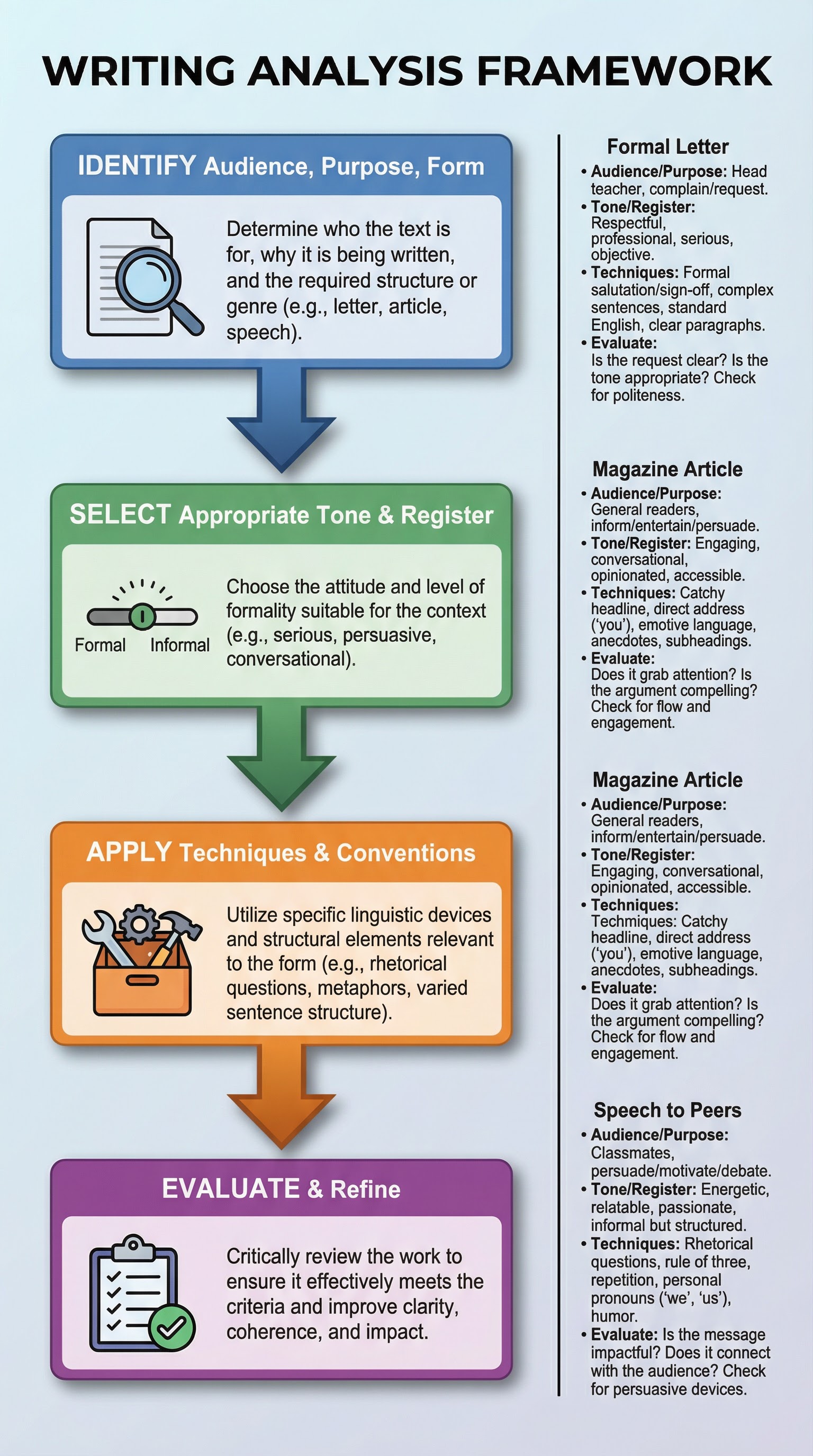
Interactive Diagrams
2 interactive diagrams to visualise key concepts
Conceptual Flow Outline
Flowchart for approaching a transactional writing task in Component 02, Section B
Conceptual Flow Outline
Register spectrum: formal vs informal language choices
Worked Examples
3 worked examples — open one to explore the question and available guidance.
Practice Questions
Test your understanding — click to reveal model answers
Write a letter to your local MP arguing that more funding should be allocated to youth services in your area. (40 marks)
Hint: Remember to use a formal register and a serious, assertive tone. Include the conventions of a formal letter (address, date, salutation, sign-off). Use persuasive techniques from AFOREST, and structure your argument logically with discourse markers.
Write an article for a teenage magazine persuading readers to reduce their use of single-use plastics. (40 marks)
Hint: Use an engaging headline and subheadings. Write in a semi-formal register with a persuasive, energetic tone. Use AFOREST techniques and direct address ('you', 'we'). Include facts and statistics to support your argument.
Write a speech to be delivered to your school assembly informing students about the importance of good attendance. (40 marks)
Hint: Use direct address and rhetorical devices. Structure your speech clearly: introduction, main points, conclusion. Use a semi-formal register and a serious but supportive tone. Include facts and examples to support your points.
Write a leaflet advising parents on how to support their children's mental health. (40 marks)
Hint: Use an eye-catching title, bullet points, and subheadings. Write in a semi-formal register with a supportive, informative tone. Use modal verbs ('should', 'could') and imperative sentences. Include practical advice and examples.
Write a letter to a friend who has moved away, persuading them to visit you during the summer holidays. (40 marks)
Hint: Use an informal register and a friendly, enthusiastic tone. Include the conventions of an informal letter (address, date, greeting, sign-off). Use persuasive techniques and personal anecdotes to make your case.
Test your understanding of Writing for Audience, Purpose and Form
Active recall beats re-reading. Take an instant quiz now to test what you’ve learned and lock it into long-term memory.
7 days Premium · Then free forever · No card, no charge