OCR · GCSE · English Language
Writing for audience, impact and purpose
This topic focuses on developing the essential skills required to adapt your writing style, tone, and register for specific audiences and purposes. Examiners heavily reward candidates who demonstrate conscious control over their language choices and structural techniques to create a deliberate impact on the reader.
- 6 min read
- 3 worked examples
- 5 practice questions
- 8 key terms
Study Notes
Overview
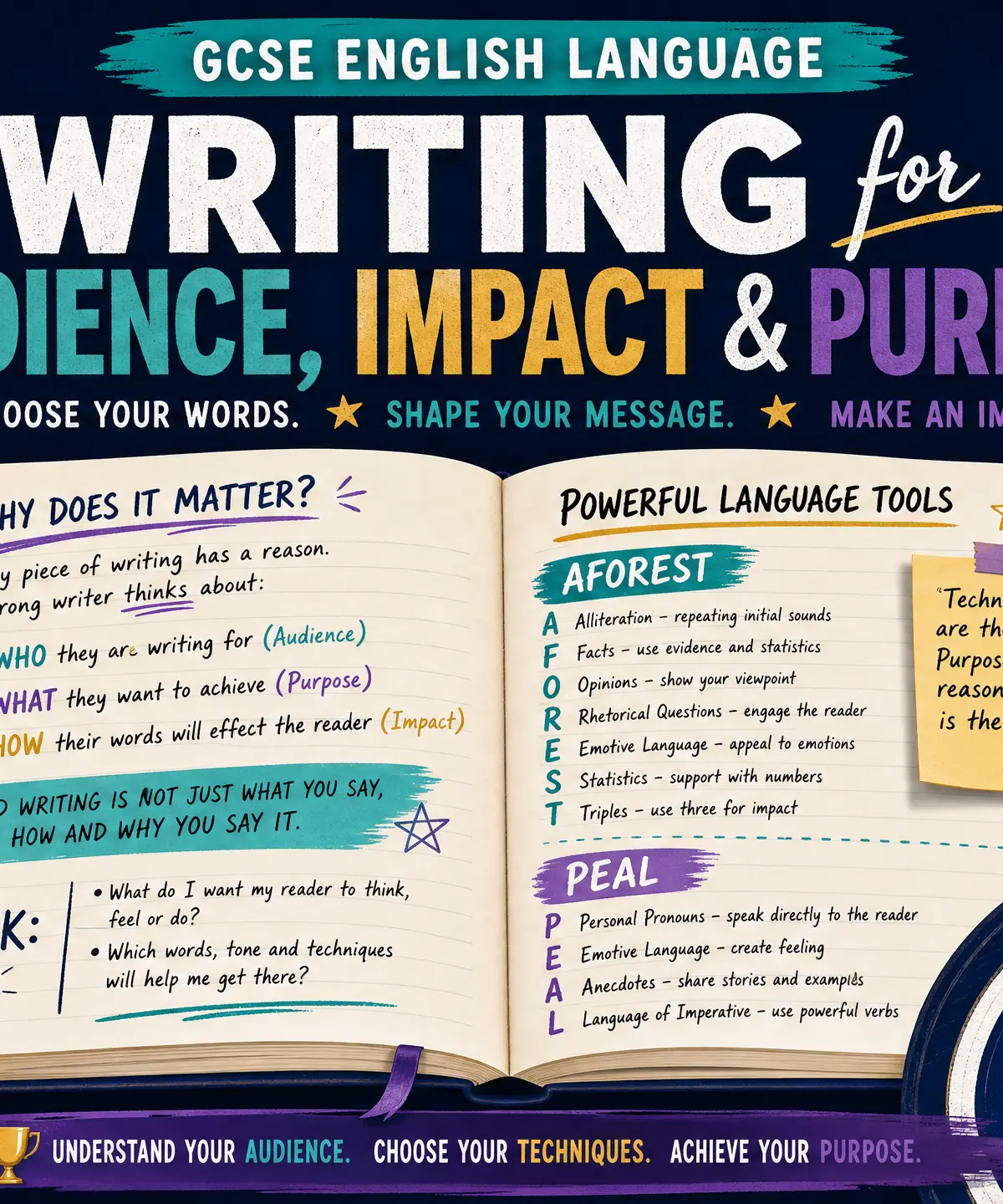
Writing for audience, impact, and purpose is the cornerstone of the GCSE English Language writing assessment. Examiners are looking for candidates who do not just write, but who craft their writing with a specific reader and goal in mind. Whether you are arguing a point in a broadsheet article, persuading a headteacher in a formal letter, or crafting a compelling narrative opening, every word choice must be deliberate.
Listen to our 10-minute revision podcast to consolidate your understanding:
Reading Skills
Identifying Information & Ideas
The foundation of reading comprehension is the ability to locate both explicit and implicit information in unseen texts. Explicit information is clearly stated on the page, while implicit information requires you to read between the lines and infer meaning. Examiners expect candidates to synthesise information from across the text rather than simply copying out large chunks.
Analysing Language
When analysing language, candidates must move beyond simple feature-spotting. The examiner awards marks for exploring the effect of the language on the reader.
Key Language Features to Identify
| Feature | Definition | Effect on Reader | Example |
|---|---|---|---|
| Metaphor | Describing something as if it is something else. | Creates vivid imagery and strong emotional associations. | "The classroom was a zoo." |
| Simile | Comparing two things using 'like' or 'as'. | Helps the reader visualise an unfamiliar concept by linking it to a familiar one. | "The wind howled like a wounded animal." |
| Personification | Giving human qualities to non-human things. | Brings inanimate objects to life, often reflecting the mood of the scene. | "The shadows danced on the wall." |
| Pathetic Fallacy | When the weather or environment reflects human emotions. | Establishes atmosphere and foreshadows events. | "A heavy, oppressive rain began to fall as she received the news." |
| Alliteration | Repetition of the same consonant sound at the start of words. | Creates rhythm, draws attention to key phrases, and can sound harsh or soothing depending on the letter. | "Cruel, cold, and calculating." |
| Sibilance | Repetition of 's' or 'sh' sounds. | Can create a sinister, hissing effect or a soft, soothing tone. | "The snake slithered silently." |
| Juxtaposition | Placing two contrasting ideas close together. | Highlights differences and creates tension or surprise. | "The bright, innocent child stood in the dark, decaying room." |
Analysing Structure
Structure is how the writer builds the text. Examiners want to see that you understand how the text is put together to guide the reader's experience.
Focus on these structural features:
- Openings: How does the writer hook the reader? (e.g., in medias res, establishing setting, introducing character).
- Shifts in Focus: Does the text move from the general to the specific, from inside to outside, or from one character to another?
- Narrative Perspective: Is it first-person (intimate, biased) or third-person (omniscient, detached)?
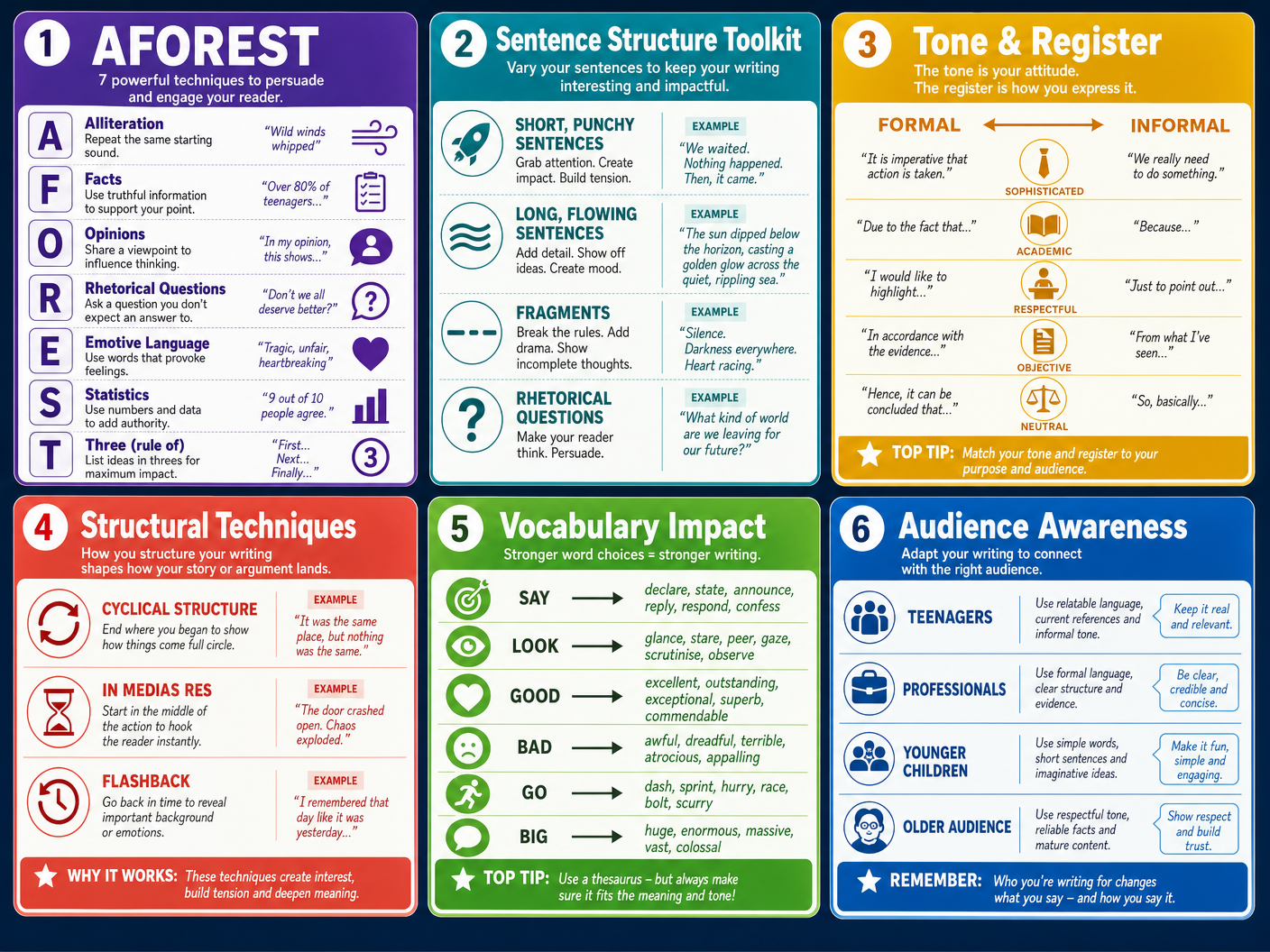
- Sentence Length Variation: Short sentences build tension or create impact; long sentences build description or flow.
- Cyclical Structure: Does the ending return to the beginning, suggesting a lack of escape or a sense of completion?
Evaluating Critically
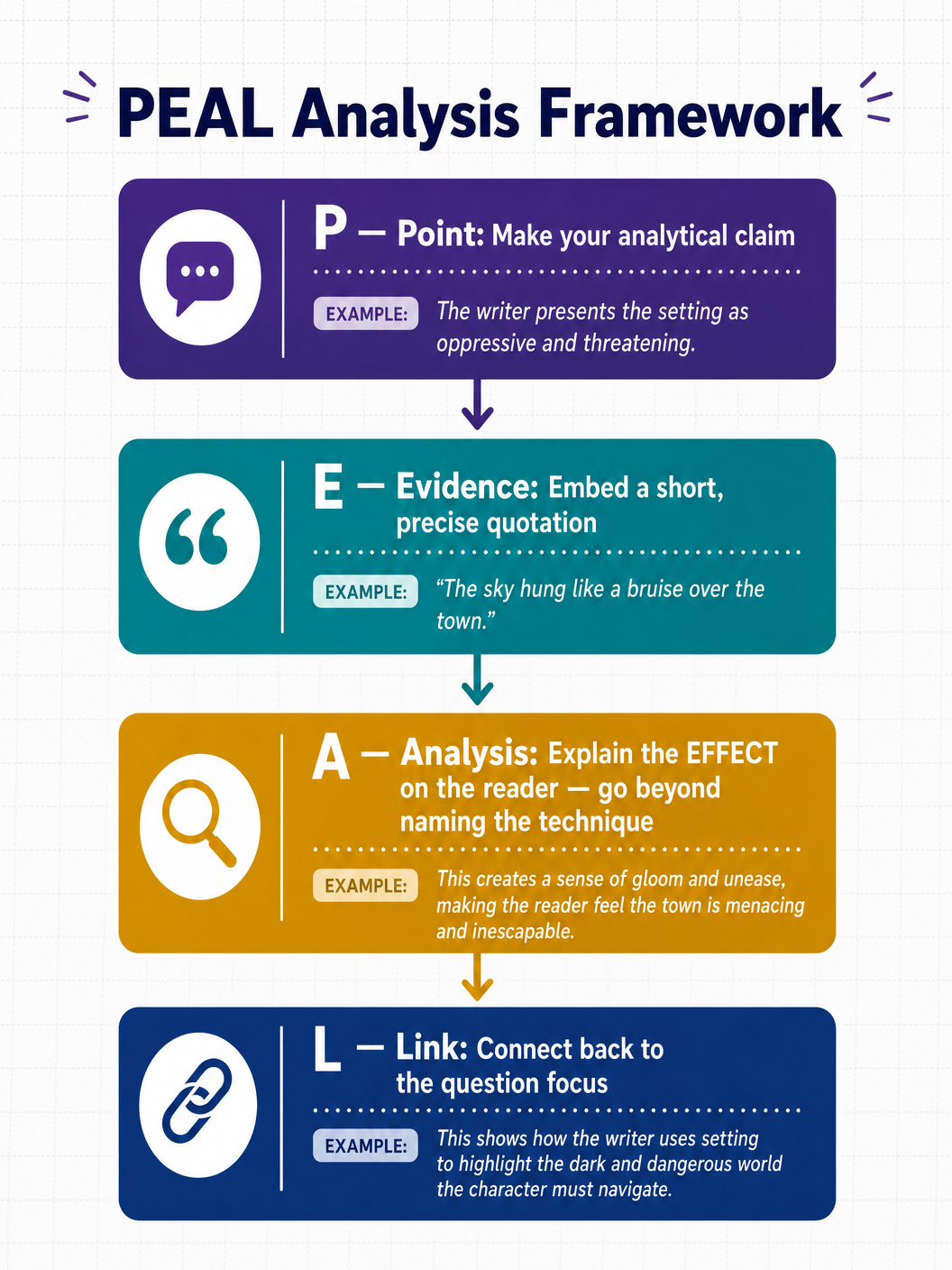
Evaluation requires you to form a judgement about how successful a writer has been. You must provide an opinion supported by evidence. Use the statement-evidence-analysis-link framework to structure your response.
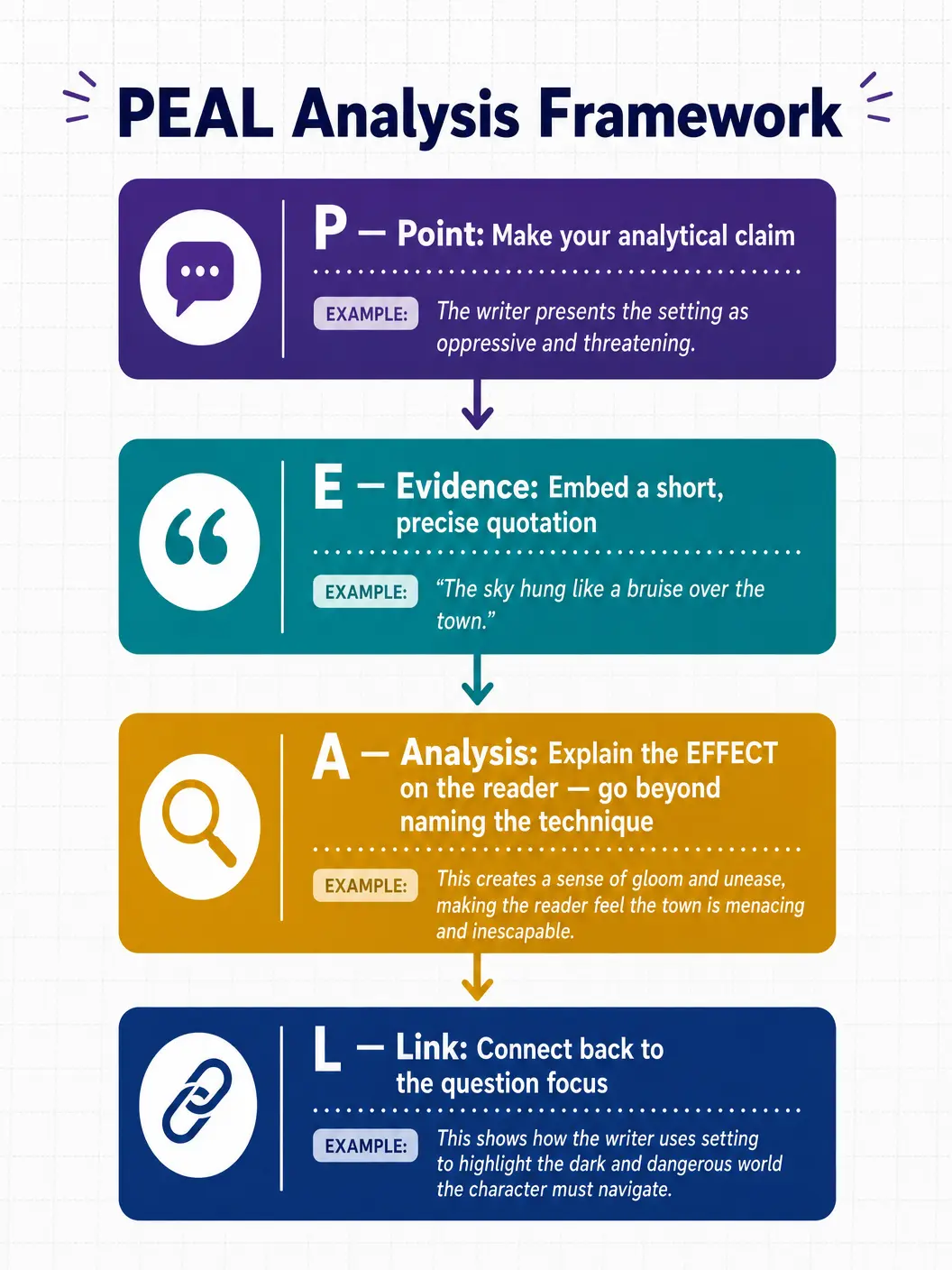
Comparing Writers' Viewpoints
When comparing texts, you must identify the differing viewpoints and then compare the methods the writers use to convey them. Always use comparative discourse markers (e.g., "Similarly", "In contrast", "On the other hand").
Writing Skills
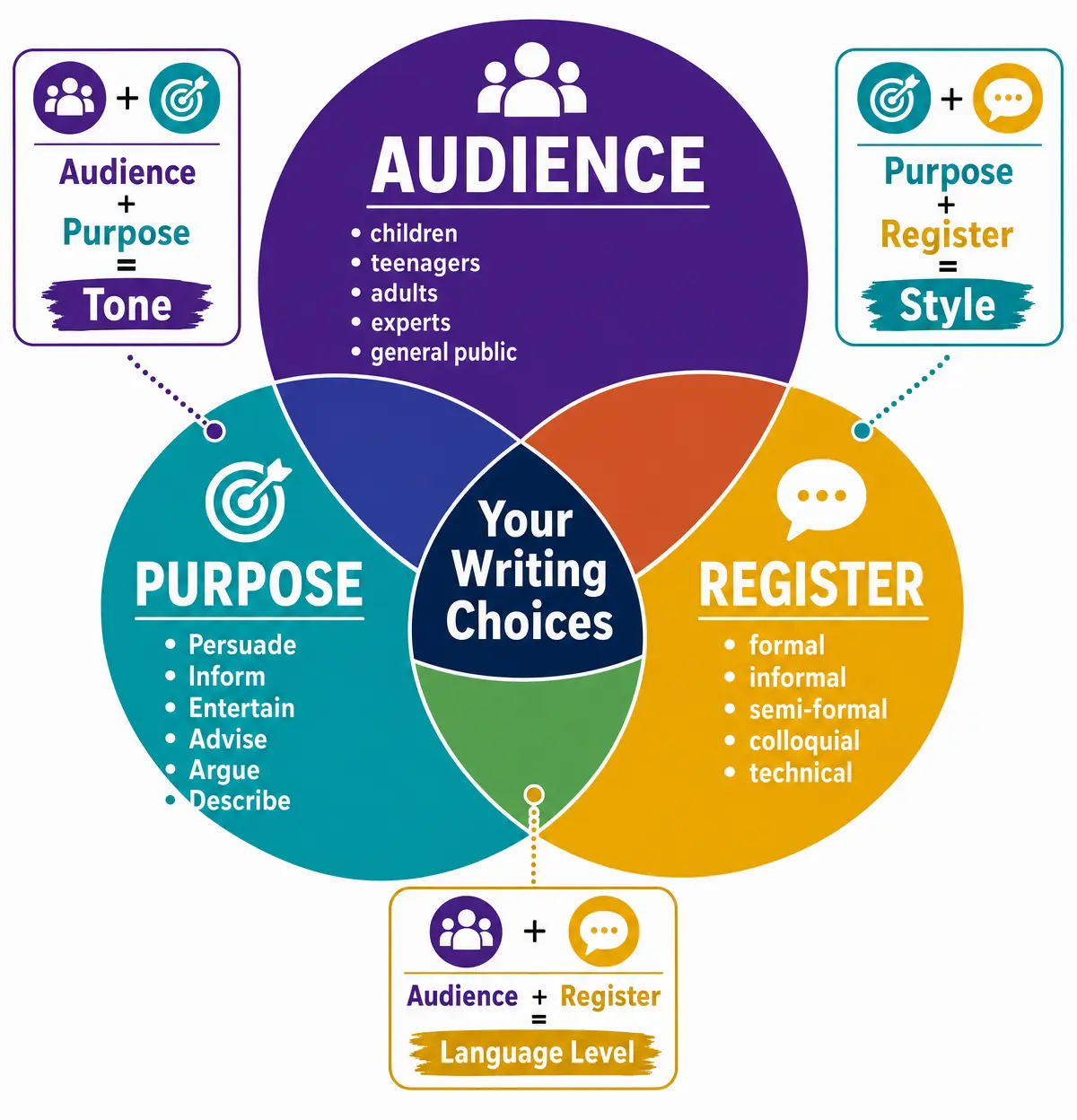
Creative Writing
Creative writing tasks demand a focus on description and narrative. Examiners reward candidates who use the "show, don't tell" technique. Instead of stating a character is angry, describe their clenched fists and gritted teeth.
Key techniques include:
- Sensory Description: Engage sight, sound, smell, touch, and taste.
- Varied Sentence Structures: Use simple sentences for dramatic impact and complex sentences for detailed description.
- Engaging Openings: Start in medias res (in the middle of the action) to hook the reader immediately.
- The One-Scene Rule: In exam conditions, it is often safer and more effective to describe one scene in detail rather than attempting a sprawling, multi-location narrative.
Transactional/Non-Fiction Writing
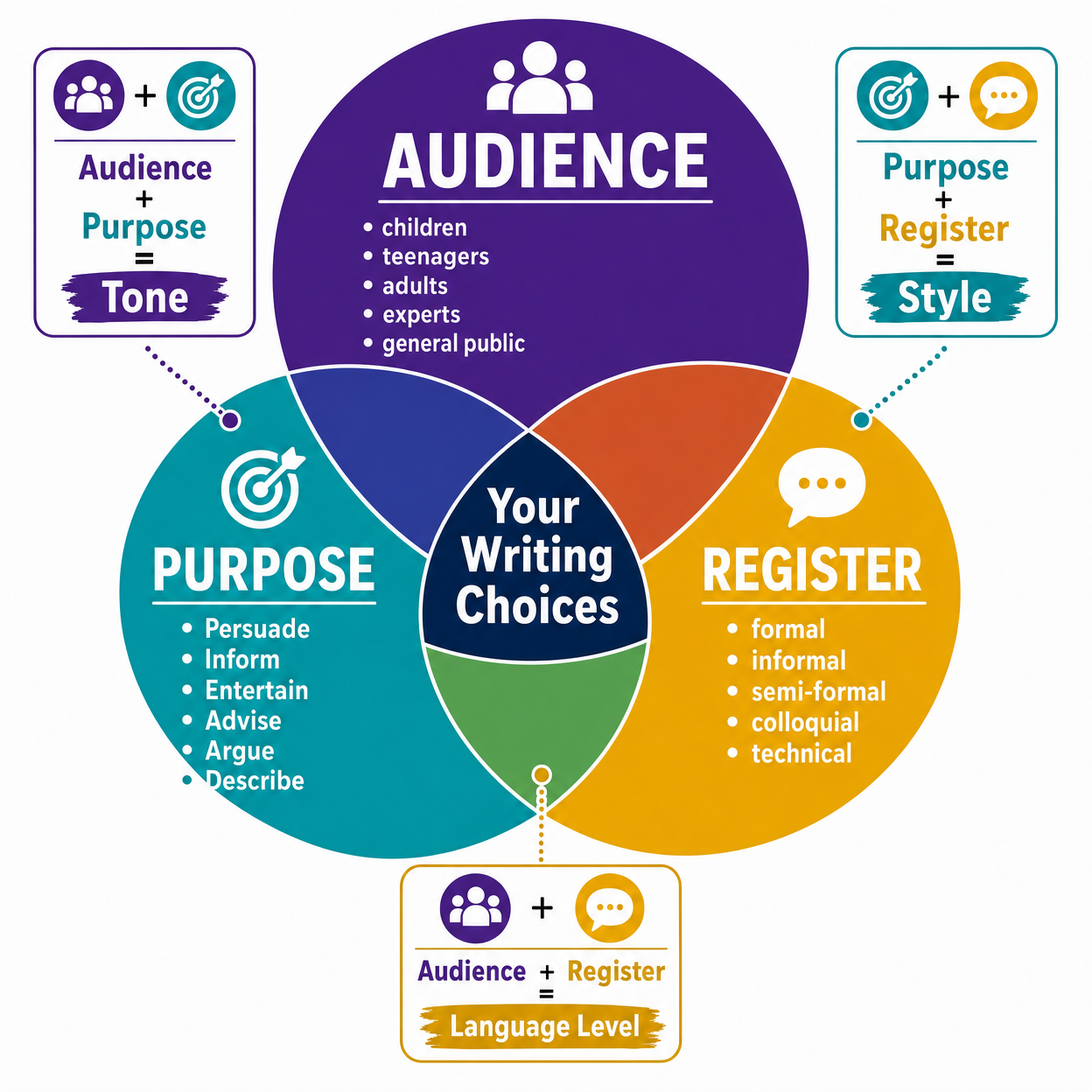
Transactional writing requires you to adopt a specific form (e.g., letter, article, speech, leaflet) for a specific purpose (e.g., argue, persuade, advise).
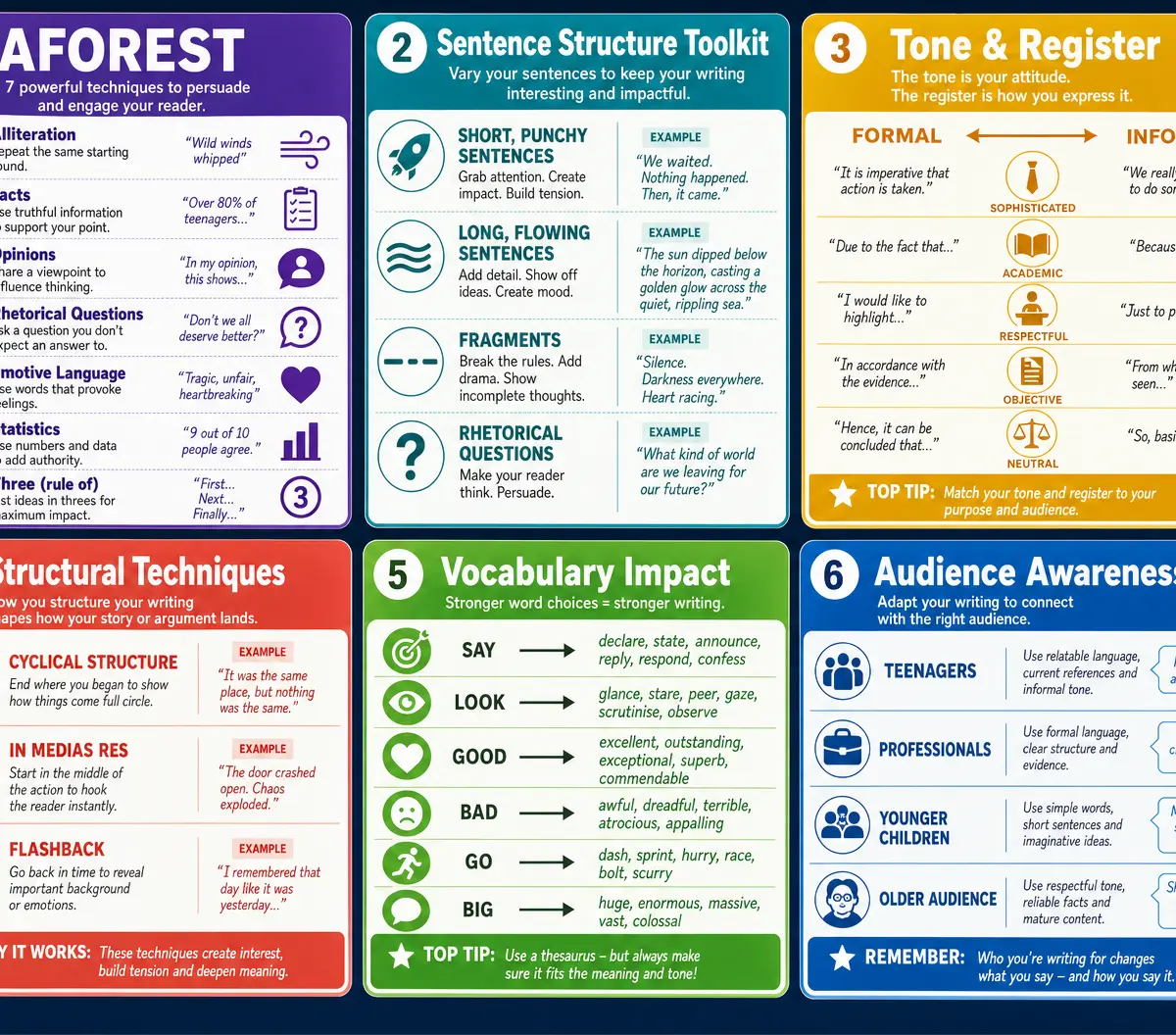
For persuasive writing, employ the AFOREST techniques to influence your reader. Always ensure your register matches the intended audience—a speech to your peers will sound very different from a formal letter to a local MP.
Technical Accuracy (SPaG)
Spelling, punctuation, and grammar (SPaG) constitute a significant portion of the marks in the writing section. Examiners look for ambitious vocabulary and a range of punctuation used accurately.
To access the highest bands, demonstrate control over:
- Semicolons (;): To link two closely related independent clauses.
- Colons (:): To introduce a list or an explanation.
- Dashes (—): To create a dramatic pause or add emphasis.
- Parenthetical Commas: To embed extra information within a sentence.
Ensure paragraph cohesion by using appropriate discourse markers to guide the reader through your argument or narrative.
Visual Resources
3 diagrams and illustrations
Interactive Diagrams
2 interactive diagrams to visualise key concepts
Conceptual Flow Outline
English Language exam approach flowchart
Conceptual Flow Outline
Writing Purpose and Audience Framework
Worked Examples
3 worked examples — open one to explore the question and available guidance.
Practice Questions
Test your understanding — click to reveal model answers
List four things you learn about the character's house from the first paragraph.
Hint: Look only at the first paragraph. Find explicit facts. You do not need to write in full sentences or analyse the language.
Read lines 10-15. Analyse how the writer uses language to create a sense of panic.
Hint: Focus on specific word choices (verbs, adjectives) and any figurative language (similes, metaphors). Explain *why* these choices make the reader feel panicked.
Write a letter to your local council arguing that funding for youth centres should be increased.
Hint: Plan your response. Form: Formal letter. Audience: Local council officials. Purpose: Argue/Persuade. Use AFOREST techniques and maintain a formal, respectful but firm register.
Evaluate the statement: 'The writer effectively makes the reader sympathise with the main character.' To what extent do you agree?
Hint: You need to form an opinion. It's usually best to agree 'to a large extent'. Find evidence where the writer creates sympathy, analyse the methods used, and explain how it impacts your feelings as a reader.
Write the opening of a story suggested by the image of a deserted train station at night.
Hint: Focus on 'Show, Don't Tell'. Use sensory description to build atmosphere. Do not try to write a whole story; focus on a detailed, atmospheric opening scene.