Pearson Edexcel · GCSE · English Language
Course version: 1EN0 · Version from Mar 2026
AO5: Communicate clearly, effectively and imaginatively, selecting and…
Full specification wording
Assessment Objectives: AO5: Communicate clearly, effectively and imaginatively, selecting and adapting tone, style and register for different forms, purposes and audiences; Organise information and ideas, using structural and grammatical features to support coherence and cohesion of texts
AO5 rewards writing that fits its brief.
Checked against the Pearson Edexcel 1EN0 specification (opens in a new tab) on .
- Point 5 of 9
- 4 key terms
Study notes
From the checked teaching notes for this specification point.
The idea
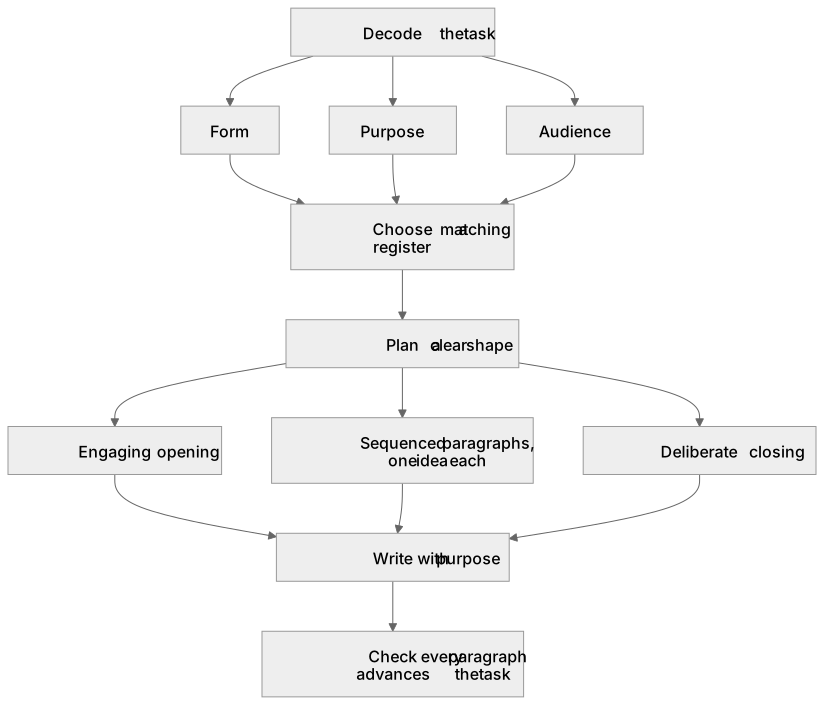
AO5 rewards writing that fits its brief. Before drafting, decode the task: form (letter, article, speech, review), purpose (persuade, inform, describe, argue) and audience (headteacher, newspaper readers, peers). Choose a register to match — formal for a council letter, conversational for a blog — and hold it consistently. Plan a clear shape: an engaging opening, sequenced paragraphs each developing one idea, discourse markers such as 'however' and 'consequently', and a deliberate closing. Vary sentence lengths and structures so key points land, and use cohesive devices (pronouns, repetition, connectives) to bind ideas. In an exam, spend a few minutes planning, then write with purpose, checking that every paragraph advances the task.
What earns the marks
- Selects and sustains a tone, style and register appropriate to the stated form, purpose and audience.
- Shapes whole-text structure with an effective opening, developed and sequenced paragraphs, and a purposeful ending.
- Uses structural and grammatical features — varied sentence forms, discourse markers, pronoun reference — to create coherence and cohesion.
- Communicates ideas clearly and imaginatively, with content matched to the task rather than drifting into unrelated material.
- Adapts vocabulary and address (for example direct address in a speech) to the intended reader or listener.
Common mistakes and how to put them right
Writing a story when the task asks for an article or letter.
Put it right by identifying the form first and using its conventions, such as a headline or salutation.
Mixing registers within one text, for example slipping into slang in a formal letter to a headteacher.
Put it right by deciding the audience first and matching vocabulary and tone consistently throughout.
Listing points without linking them.
Put it right by adding discourse markers and pronoun reference so each paragraph connects to the last.
Exam tips
- Annotate the question to extract form, purpose and audience before you plan.
- Sketch a five-part plan — opening, three developed points, closing — so structure is visible to the examiner.
- Leave two minutes to reread for register slips and unclear links between paragraphs.
Try the lesson
The start of the Assessment Objectives: AO5: Communicate clearly, effectively and imaginatively, selecting and adapting tone, style and register for different forms, purposes and audiences; Organise information and ideas, using structural and grammatical features to support coherence and cohesion of texts lesson, made from checked teaching notes for this specification point.
Have a go first
A student is writing a letter to a local council to argue for a new youth centre. Which opening best matches the required register?
Listen
AO5 rewards writing that fits its brief. Before drafting, decode the task: form (letter, article, speech, review), purpose (persuade, inform, describe, argue) and audience (headteacher, newspaper readers, peers). Choose a register to match — formal for a council letter, conversational for a blog — and hold it consistently. Plan a clear shape: an engaging opening, sequenced paragraphs each developing one idea, discourse markers such as 'however' and 'consequently', and a deliberate closing. Vary sentence lengths and structures so key points land, and use cohesive devices (pronouns, repetition, connectives) to bind ideas. In an exam, spend a few minutes planning, then write with purpose, checking that every paragraph advances the task. A strong answer earns marks for these points. Selects and sustains a tone, style and register appropriate to the stated form, purpose and audience. Shapes whole-text structure with an effective opening, developed and sequenced paragraphs, and a purposeful ending. Uses structural and grammatical features — varied sentence forms, discourse markers, pronoun reference — to create coherence and cohesion. Communicates ideas clearly and imaginatively, with content matched to the task rather than drifting into unrelated material. A common slip: Writing a story when the task asks for an article or letter. Instead, identifying the form first and using its conventions, such as a headline or salutation. Exam tip: Annotate the question to extract form, purpose and audience before you plan.
See it
Key words
Say what each word means before you turn the card.
Audience and purpose
Try answering aloud or in your head before turning the card.
Tone, style and register
Try answering aloud or in your head before turning the card.
Text structure and cohesion
Try answering aloud or in your head before turning the card.
Imaginative and clear communication
Try answering aloud or in your head before turning the card.
See every definition
- Audience and purpose
- The reader or listener the writing is for, and the aim of the writing, such as to persuade, inform, describe or argue.
- Tone, style and register
- The manner and level of language chosen to match the stated form, purpose and audience, held consistently throughout the text.
- Text structure and cohesion
- Shaping a whole text with an effective opening, developed and sequenced paragraphs and a purposeful ending, bound together by cohesive devices.
- Imaginative and clear communication
- Communicating ideas clearly and imaginatively, with content matched to the task rather than drifting into unrelated material.
Label the diagram
Some boxes have lost their names. Pick the right name for each number.
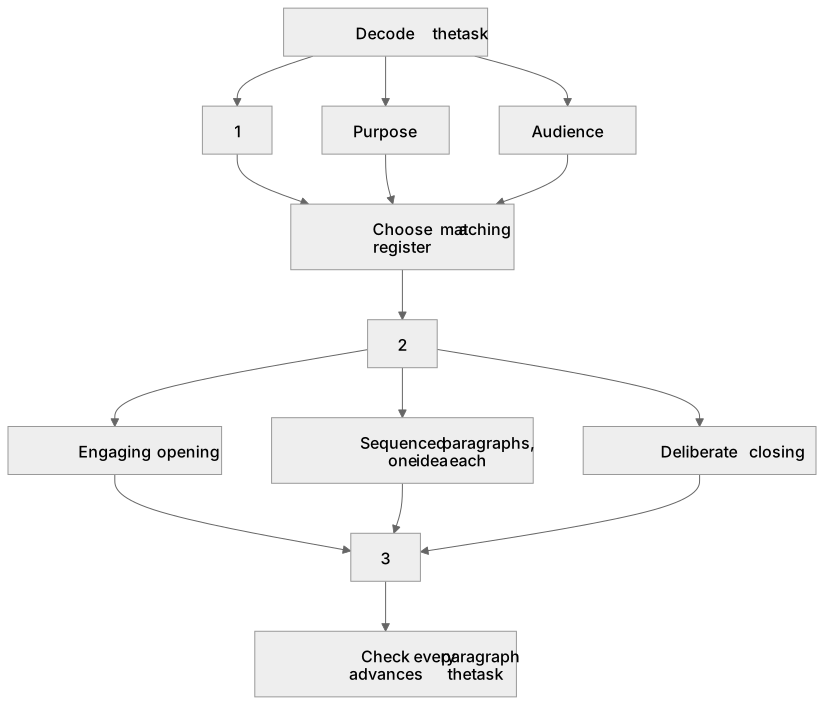
1Box 1
2Box 2
3Box 3
There is more to this lesson
The full lesson goes on to check your understanding and help you earn the marks. Create a free account to carry on, with your progress saved.
A week of Premium from your first lesson · Then the free plan continues · No card, no charge
Test your understanding of Assessment Objectives: AO5: Communicate clearly, effectively and imaginatively, selecting and adapting tone, style and register for different forms, purposes and audiences; Organise information and ideas, using structural and grammatical features to support coherence and cohesion of texts
Active recall beats re-reading. Take an instant quiz now to test what you’ve learned and lock it into long-term memory.
A week of Premium from your first lesson · Then the free plan continues · No card, no charge